India’s tiger #tourism model needs urgent rethinking.
A major multi-reserve study has found safari pressure and human activity are causing chronic stress in tigers and altering behaviour patterns.
Conservation cannot become crowd management around tiger sightings. Transparent, scientific and efficient park management is essential if #India wants healthy tiger populations.
#Tiger #TigerConservation #ProjectTiger #Wildlife #Conservation #India #Biodiversity #Corbett #Tadoba #Periyar #Kahna #Bandhavgarh #Ranthambore
https://t.co/fYOJSJjLET
🚨BREAKING: For the first time, the original Pakistani cypher — cable I-0678, the document that triggered the removal of former Pakistani Prime Minister Imran Khan — is being released in full by Drop Site.
India’s position on the Indus Waters Treaty after the #Pahalgam massacre is grounded in treaty law, state responsibility, and the UN Charter, not “water weaponization.”
#India#Pakistan#Indus#IWT
Read more as I write for the Jerusalem Post (Link)- https://t.co/Ym73az1F6A
#INSAridaman marks the moment India’s nuclear deterrence becomes undeniable.
In my latest for @CNNnews18, I write how INS Aridaman marks the point at which India’s nuclear deterrence becomes undeniable with fully sovereign capability at sea.
Read: https://t.co/YRraGaM938
West Asia is now in open conflict. #Pakistan is pitching itself as a mediator.
The arrests traced back to Rawalpindi keep coming. A pattern is repeating.
Pakistan may use Iran as a smokescreen to spread terror in India.
Read more in my latest for @srlankaguardian
#Pakistan called it a military target. International humanitarian law calls it a protected facility. The evidence supports one of those positions.
In my latest for @srlankaguardian. I examine Pakistan’s strike on #Kabul’s rehab hospital under international law.
#Afghanistan
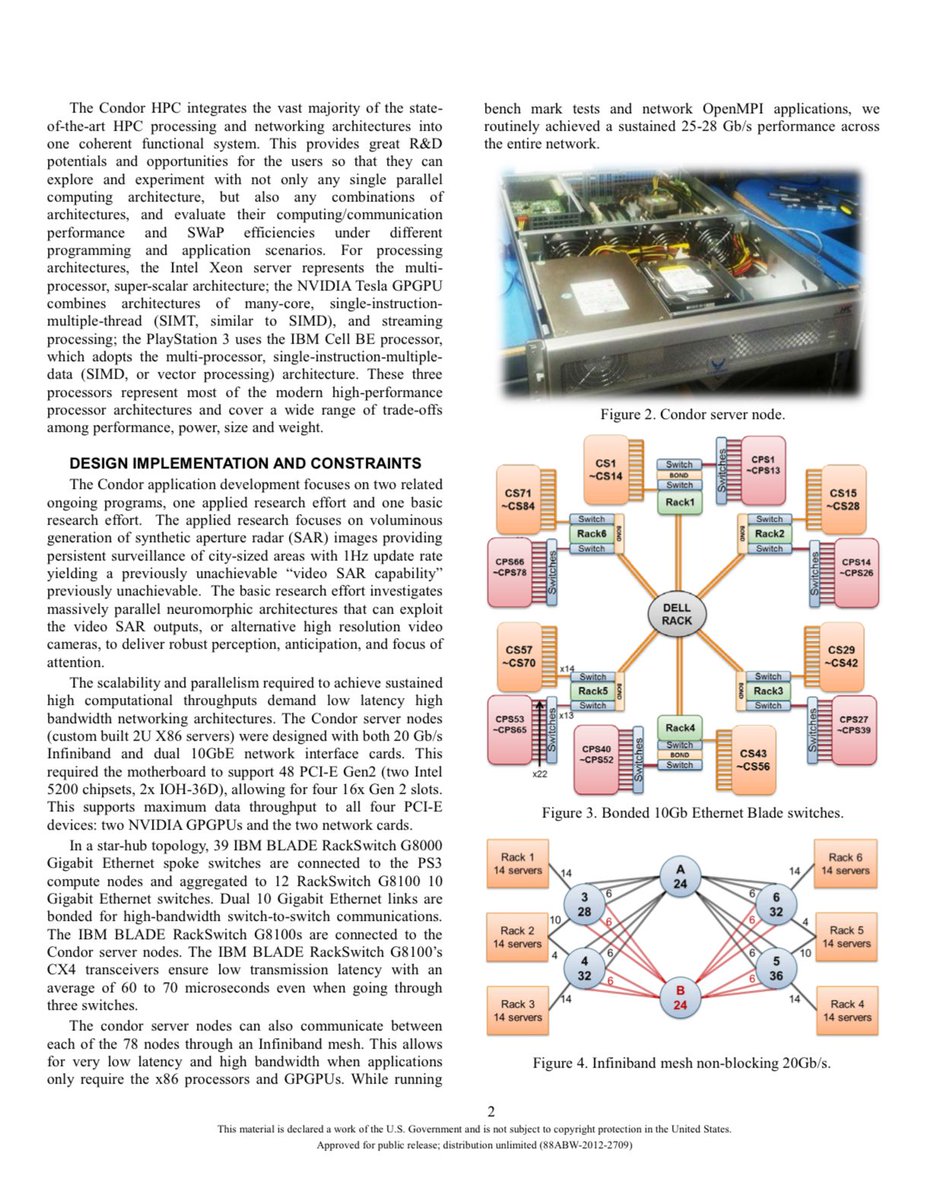
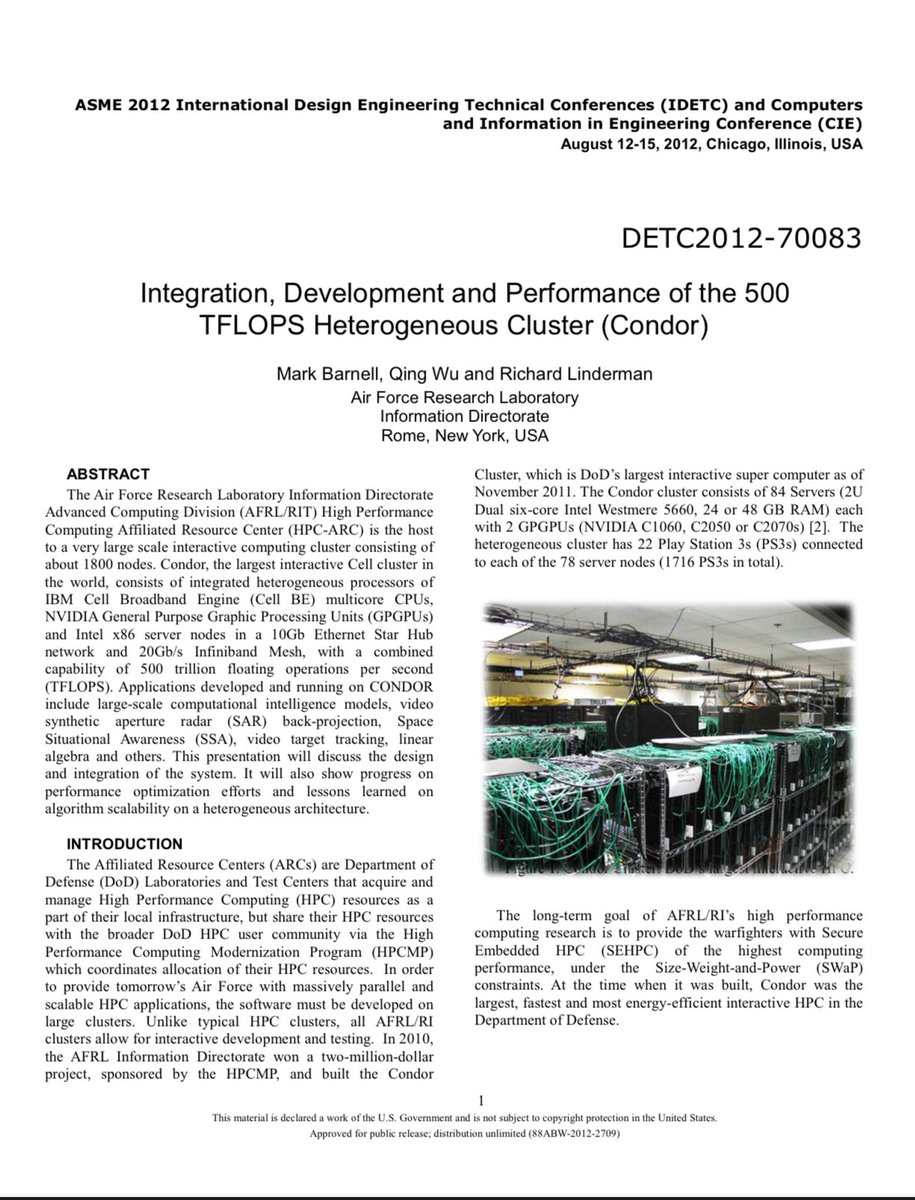
How the U.S. Air Force Turned PlayStations into a Supercomputer
In the late 2000s, deep inside the Air Force Research Laboratory (AFRL) in Rome, New York, a small team of engineers stared at a familiar problem: the Department of Defense desperately needed massive computing power for real-world defense work: processing high-definition satellite imagery, enhancing radar signals, spotting patterns in intelligence data, and experimenting with early artificial intelligence.
Traditional supercomputers could do the job, but they came with a brutal price tag: tens of millions of dollars, sky-high energy bills, and months of procurement red tape. Budgets were tight. Time was shorter.
Then Mark Barnell, director of high-performance computing at AFRL, had a spark of genius that sounded almost like a joke around the water cooler: What if we used Sony PlayStation 3s?
The idea wasn’t as crazy as it sounded. The PS3, released in 2006, hid a technological marvel inside its sleek black case: the Cell Broadband Engine processor, co-designed by Sony, Toshiba, and IBM.
This wasn’t just a gaming chip; it packed seven high-speed “synergistic processing elements” (SPEs) that excelled at the exact kind of parallel, vectorized calculations needed for scientific workloads.
Even better, Sony had built in an “Other OS” feature that let users install Linux. The consoles were cheap (around $400 each on the military’s bulk-buy discount), power-efficient, and already mass-produced by the millions thanks to the gaming market. Comparable specialized hardware would have cost $10,000 per unit.
Barnell and his team started small around 2006–2008, buying a handful of PS3s, ripping out the game discs, installing Linux, and clustering them together. The results were astonishing.
Early experiments proved the consoles could handle heavy scientific computing far better than anyone outside the lab expected. They published the first glimpse of their breakthrough in a technical paper on algorithm optimizations for PS3 clusters.
Emboldened, they scaled up. By November 2010, they had assembled the Condor Cluster: 1,760 PlayStation 3 consoles (some counts cite 1,716 as the exact core), networked with 168 GPUs and 84 coordinating servers running dual quad-core Intel Xeons.
The final machine delivered a blistering 500 teraflops (500 trillion floating-point operations per second). It ranked as the 33rd fastest supercomputer on the planet and the fastest *interactive* computer in the entire Department of Defense.
Total cost? Roughly $2 million: about one-tenth of what a traditional system would have demanded. Power consumption? A mere fraction of the energy a conventional supercomputer would gulp down.
The creativity was off the charts. This wasn’t just thriftiness; it was pure hacker ingenuity applied at the highest levels of national security. Instead of waiting for billion-dollar custom hardware, the team looked at the consumer electronics aisle and saw a supercomputer in disguise.
They turned gaming consoles: devices meant for Call of Duty marathons into a classified workhorse for analyzing spy-plane imagery, optimizing synthetic aperture radar, and exploring neuromorphic “computational intelligence.”
It was MacGyver meets Manhattan Project: resourceful, playful, and brilliantly subversive. Engineers joked that the PlayStations were “the only supercomputer you could buy at Best Buy.”
The Condor Cluster ran for years, delivering mission-critical insights until it was decommissioned around 2015.
Sony later patched out the “Other OS” feature in a firmware update, but the Air Force already had its fleet safely locked away. The project proved that sometimes the most powerful weapons aren’t built in secret labs: they’re bought off the shelf and reimagined.
(1/11) Kashmir has produced the likes of Pandit Shreya Bhat and Lalitaditya Muktapida, whose Tyaag (sacrifice) and Shaurya (valour) is comparable to Heroes of India like Maharana Pratap (16th C) & Chatrapati Shivaji Maharaj (17th C)
#NavrehMahotsav2026#ShriyaBhatTyaagDivas
India’s Defence Forces Vision 2047 signals something rarer than modernisation. It signals a shift in how India thinks about war.
In my latest for @CNNnews18, I examine why Vision 2047 matters and how it reframes India’s military future.
Read here:
https://t.co/soxaHz9K8N
#India
#Opinion | India's Defence Forces Vision 2047 signals something rarer than modernisation, a change in how the military thinks about war itself
Written by: @imrahulpawa
https://t.co/oKPLauErrL
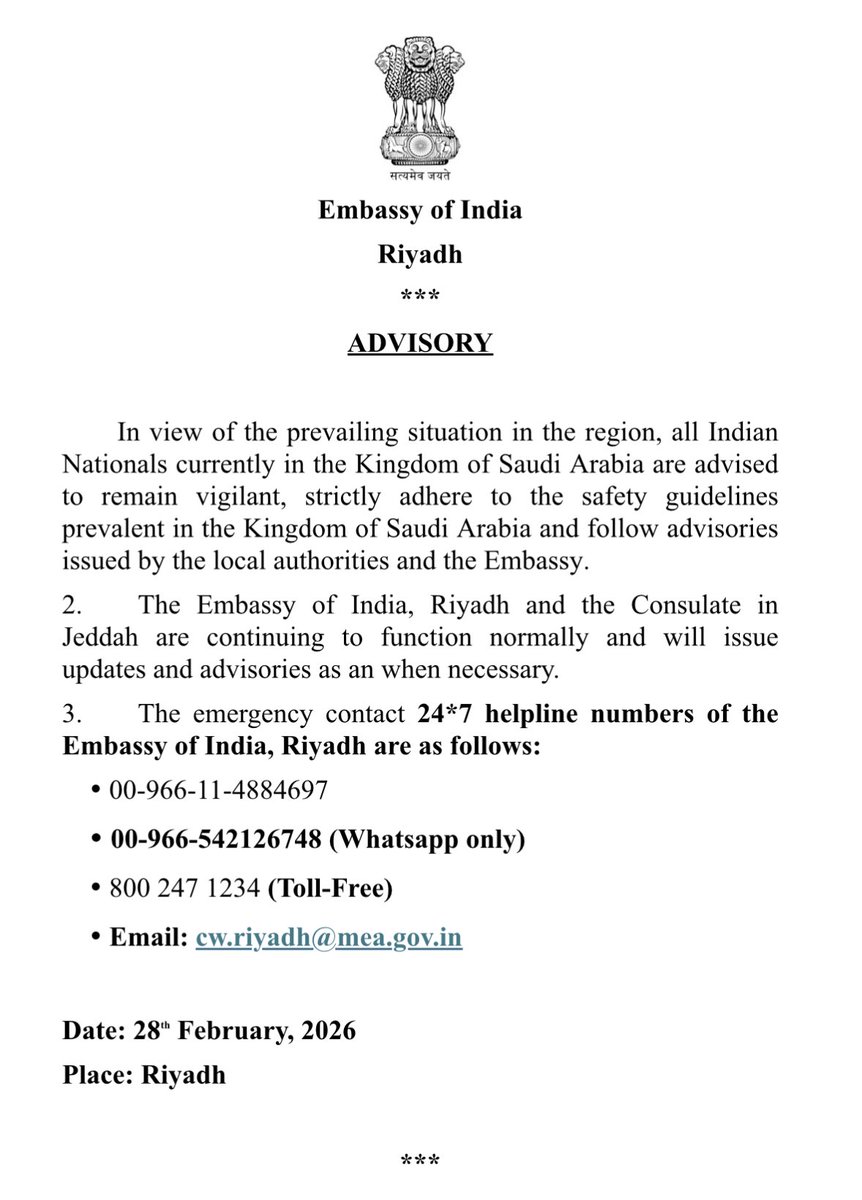
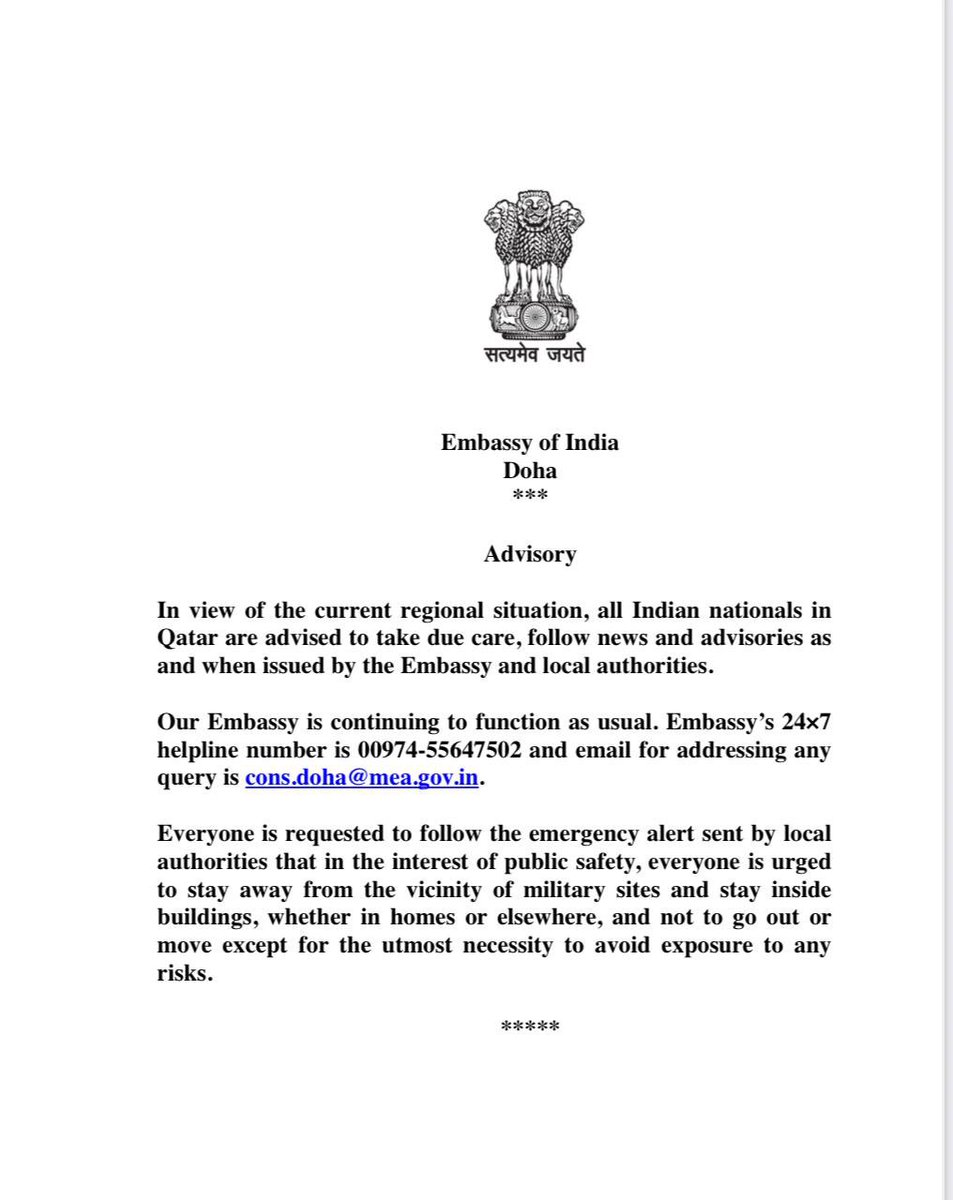
Advisory:
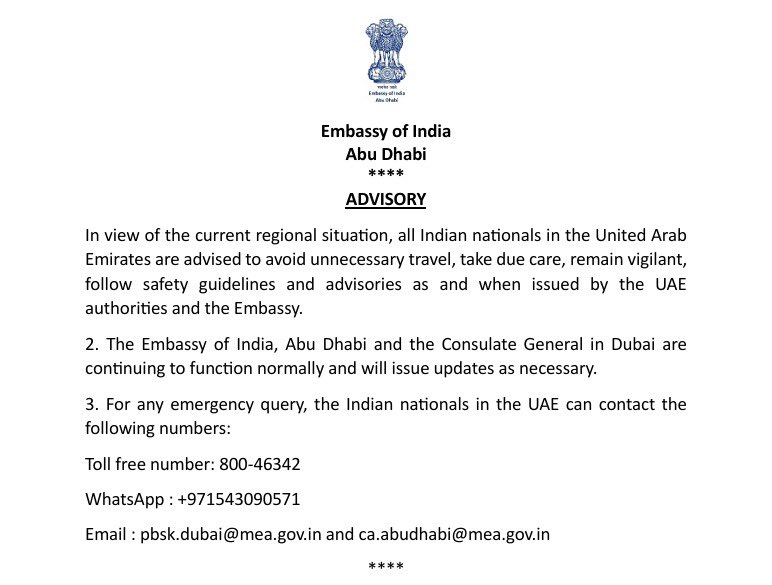
In view of the current regional situation, all Indian nationals in Bahrain are advised to take due care, & follow news and advisories as & when issued by the Embassy & local authorities.
ADVISORY
In view of the prevailing security situation in the region, all Indian nationals in Israel are advised to exercise utmost caution and remain vigilant at all times.
2. Indian nationals are strongly advised to strictly adhere to the safety guidelines and instructions issued by the Israeli authorities and the Home Front Command.
3. Updated instructions may be accessed at: https://t.co/SUU7UxJD1D .
4. All Indian nationals should remain in close proximity to designated shelters and familiarize themselves with the nearest protected spaces in their area of residence or work.
5. Indian nationals are advised to avoid all non-essential and unnecessary travel within Israel until further notice.
6. Citizens are encouraged to monitor local news, official announcements, and emergency alerts regularly.
7. In case of any emergency, Indian nationals may contact the Embassy of India, Tel Aviv, through the 24x7 helpline:
Telephone: +972-54-7520711; +972-54-2428378
E-mail: [email protected]
8. The Embassy remains closely engaged with the relevant authorities and will continue to issue updates as necessary.
28 February 2026
Tel Aviv
This is not a sudden crisis. It is a long-burning war, rooted in a colonial line drawn in 1893, Pakistan’s dismissal of #Pashtun identity, its romance with terrorism & decades of miscalculations. #Pakistan is ultimately its own worst enemy. My latest for @CNNnews18#Afghanistan
#Opinion | How a colonial boundary drawn in 1893 planted the seeds of war that now threatens to engulf the entire region and why Pakistan is its own worst enemy
@imrahulpawa
https://t.co/Iw0TCHVmNy