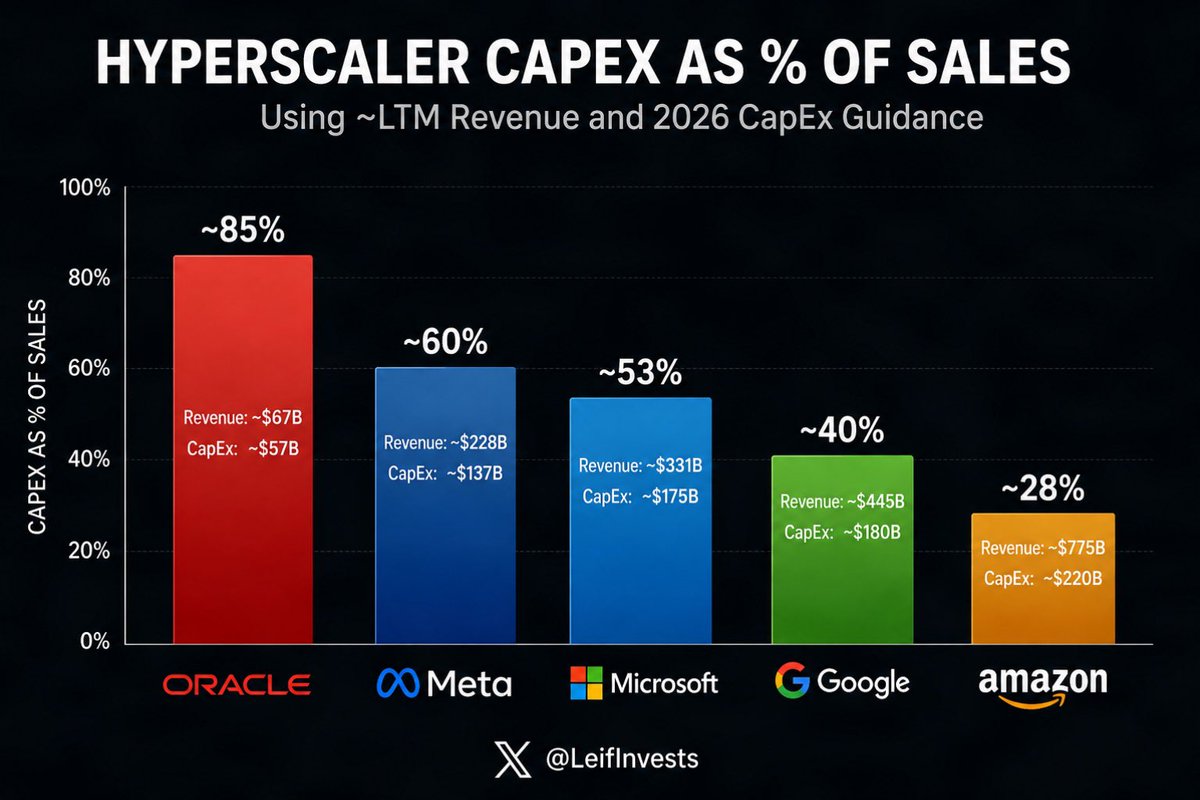
Take a look at these WILD CapEx as % of sales numbers. 🤯
• $ORCL: ~$67B revenue | ~$57B CapEx → ~85%
• $META: ~$228B revenue | ~$137B CapEx → ~60%
• $MSFT: ~$331B revenue | ~$175B CapEx → ~53%
• $GOOG: ~$445B revenue | ~$180B CapEx → ~40%
• $AMZN: ~$775B revenue | ~$220B CapEx → ~28%
• Using ~LTM revenue and 2026 CapEx guidance.
Do you view the CapEx as bullish or bearish for these companies?
The AI infrastructure buildout is unlike anything we’ve seen before. 🚀
🔴THIS IS ONE OF THE MOST FURIOUS BUBBLE BURSTS IN MARKET HISTORY:
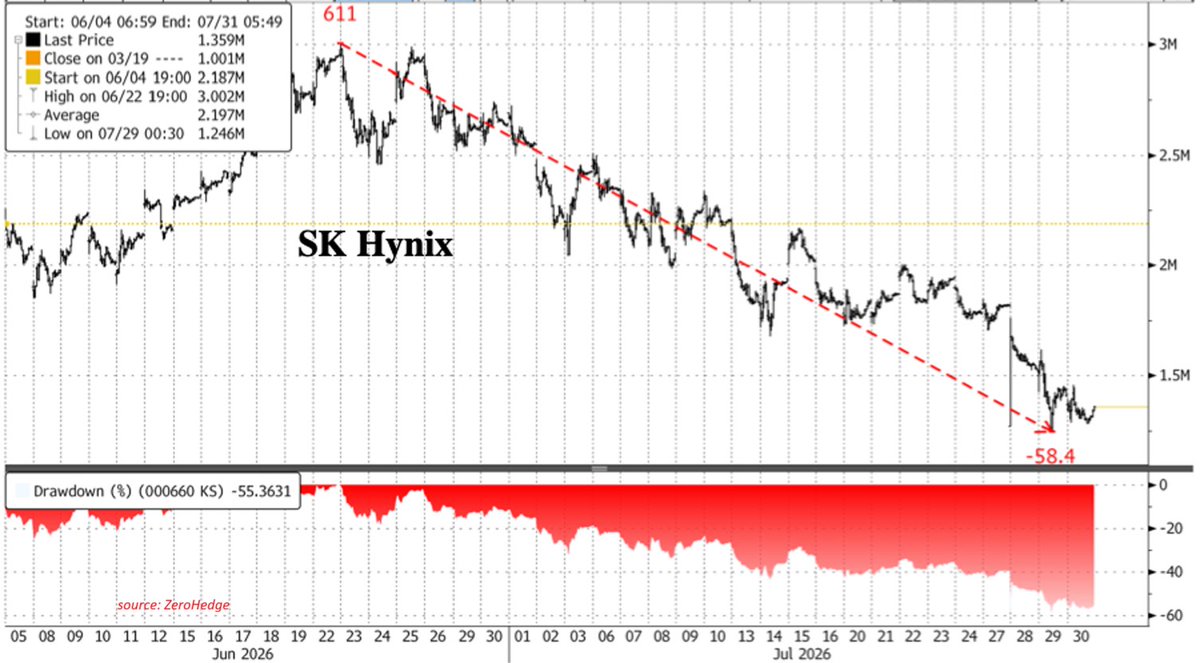
SK Hynix, the world's 2nd-largest memory chipmaker, has CRASHED -58% in just 6 weeks.
Samsung Electronics, the world's largest memory chipmaker, has dropped -45% over the same period.
Together, these 2 companies accounted for over 60% of the KOSPI index, a figure that has now fallen to around 50%.
As a result, the KOSPI index has declined -40% since its June peak, and -34% in July alone, putting it on track for the biggest monthly drop EVER.
This is what happens when leverage, speculation, and extreme market concentration unwind all at once.
🔴Oracle’s credit risk HAS NEVER BEEN HIGHER:
Oracle’s 5-year credit default swap (CDS) spread has surged to a record ~215 basis points, up from 144 bps at the start of the year.
This means investors now pay ~$215,000 annually to insure $10 million of Oracle debt against default.
The spike comes after Oracle announced plans to invest ~$70 billion in data center expansion on June 10, raising concerns that AI infrastructure spending is moving faster than near-term cash flow generation.
S&P Global Ratings also downgraded Oracle’s credit rating to BBB-, just one notch above junk status, citing uncertainty over the path to profitability amid massive AI-related investments.
Investors are increasingly questioning whether Big Tech’s AI spending boom can generate enough returns to justify the massive borrowing required to fund it.
Oracle's credit risk is BEYOND crisis levels.
$TSM | TSMC Q2’26 Detailed Earnings Highlights
🔹 Revenue: $40.2B; +33.7% YoY
🔹 Net Profit: $22.36B (Est. $19.74B) 🟢; +77.4% YoY
🔹 Gross Margin: 67.7% (Est. 67.1%) 🟢
🔸 CapEx raised to $60B-$64B from $52B-$56B.
Q3’26 Guide:
🔹 Rev: $44.6B-$45.8B (Est. $43.11B) 🟢; +37% YoY
🔹 Gross Margin: 65%-67% (Est. 65.9%) 🟡
🔹 Operating Margin: 56%-58% (Est. 57.7%) 🟡
🔹 FX assumption: US$1 = NT$32.0
🔸 CapEx over the next 3 years will be “even more significantly higher” than during the prior 3 years.
Revenue by Platform:
🔹 HPC: 66%; +20% QoQ
🔹 Smartphone: 22%; -4% QoQ
🔹 IoT: 5%; +4% QoQ
🔹 Automotive: 4%; +15% QoQ
🔹 DCE: 1%; +5% QoQ
🔹 Others: 2%; +5% QoQ
Technology Mix (Wafer Revenue):
🔹 2nm: 3%
🔹 3nm: 30%
🔹 5nm: 33%
🔹 7nm: 11%
🔹 7nm and below: 77%
Other Metrics:
🔹 EPS: $4.31 per ADR (Est. $3.83) 🟢
🔹 Operating Margin: 60.3% (Est. 58.6%) 🟢
🔹 Net Profit Margin: 55.6%
🔹 Wafer Shipments: +16.6% YoY; +3.9% QoQ
🔹 North America: 78% of revenue
🔹 ROE: 45.9%
🔹 OpEx: 7.8% of revenue
🔹 Inventory Days: 87; +7 days QoQ
🔹 VIS Share Gain: $2.00B
2026 Outlook:
🔸 N2 ramp expected to dilute gross margin by 3-4 pts in 2H26.
🔸 Overseas fabs expected to dilute gross margin by 2-3 pts initially and 3-4 pts in later stages.
🔸 Long-term revenue CAGR remains around 25%, while AI accelerator revenue CAGR remains in the high-50s%.
US Expansion:
🔸 TSMC announced an additional $100B investment in Arizona. The additional commitment lifts TSMC’s total US investment plan to $265B.
🔸 The eventual US footprint could reach 10 fabs and 2 advanced-packaging facilities.
🔸 The four new facilities are expected to focus on 2nm logic, although the final mix could shift to three logic fabs and one packaging plant.
🔸 Construction timing remains undisclosed and will depend on market conditions.
🚨 DMart vs Quick Commerce: Is the retail king losing its crown? 🛒
Intense competition from Quick commerce has caused a slowdown in growth for DMart,
Is the deep-discount model permanently disrupted by 10-minute convenience?
A thread🧵on the business of DMart and how it plans to combat quick commerce?👇
Sammaan Capital Ltd.
📞 Q4 FY26 Concall Summary
#SAMMAANCAPITAL
🟡 Management Guidance :
Management is targeting ₹30,000 crores in disbursements for this year with a Profit After Tax (PAT) of ₹1,400 crores and a steady dividend payout of 40%. Long-term guidance through FY30 is highly aggressive: targeting an 18% ROE, an ROA expansion to 4.4%, and driving the cost-to-income ratio down from 50% to a highly efficient 26%. Net Interest Margins (NIM) are projected to scale from 3.5% to 8% (with leverage), fueled by a 150+ basis point reduction in the cost of funds. The portfolio mix will be strictly controlled at 80% retail, comprising 60% secured and 20% unsecured/semi-secured lending.
🔴 Red Alert :
The company had to absorb massive historical write-offs and credit costs to clean the slate and create a "stainless" book (though they expect to eventually recover ~₹7,000 crores from these provided-for accounts). Currently, operational efficiency is a drag; employee productivity is remarkably low at just 0.6 loans per person per month. Management must rapidly scale this to their target of 2+ loans per person to successfully amortize centralized costs and justify their massive planned workforce expansion to 20,000 people.
🟢 Green Alert :
A completely fortified, pristine balance sheet! The opening AUM of ₹53,160 crores boasts absolutely zero gross and zero net NPAs, requiring no future incremental net provisions. Following the IHC investment, the company secured immediate, multi-notch rating upgrades from all three domestic agencies (CRISIL, CARE, and ICRA) to a consensus AA+. The bond markets have rewarded this forcefully, with domestic bonds tightening by 100 bps and international bonds by an impressive 250 bps.
🔵 Blue Alert :
IHC (one of the world's largest investment firms) has officially injected the first ~₹5,652 crores ($592 million) of its committed $1 billion strategic promoter stake. This partnership is triggering a massive technological overhaul, deploying AI across 37 distinct use cases to slash mortgage turnaround times from 5-7 days to 2-3 days. Sammaan is now actively diversifying beyond core mortgages into high-yield segments like gold loans and loans against securities (LAS), while simultaneously executing an asset-light strategy to sell down 30% of all new disbursements to partner banks.
🧠 Deep Insight :
Sammaan Capital is executing a flawless balance sheet reboot funded by deep-pocketed Middle Eastern capital. By willingly taking the historical pain to completely wipe out legacy NPAs, they have presented a pristine ₹53,000 crore portfolio to the rating agencies. This is not just an AUM growth story; it is a pure liability repricing masterclass. Because 90% of their borrowing is onshore, the rapid rating upgrades to AA+ (with a clear line of sight to AAA) will drive a structural 150-270 bps collapse in their cost of funds. This massive interest expense saving will flow directly to the bottom line, mathematically doubling their ROA before their new AI-driven operational efficiencies even fully kick in.
🚨Preventive medical check-ups are important to avoid any last-minute surprises
Prevention is better than a cure!
Tests that you need to do for regular monitoring of ur health:-
🏦Complete Blood Count(CBC)
🏦Lipid profile
🏦Kidney Function Test(KFT)
🏦Liver Function test(LFT)
🏦Thyroid panel
🏦HbA1c
🏦Fasting insulin
🏦CRP
🏦Vitamin B12,
🏦Iron studies
🏦Vitamin D3
I advise all my patients to do these tests at least,
Once a year, just for preventive checks
RBI dividends and bond purchases have quietly shaped India’s fiscal and liquidity conditions over the past two years.
In this post, @ananthng explains how money is actually created in the economy and why RBI transfers and OMOs are more consequential than they appear.
In FY25, the RBI transferred ₹2.69 trillion to the government, following ₹2.11 trillion the year before. Alongside record open market bond purchases, this helped keep borrowing costs contained in a low-inflation environment.
But these flows are not neutral.
Money expands when banks lend, when the banking system funds government spending, when foreign currency inflows are converted, and when the RBI distributes dividends. Unlike non-bank financing, these channels create fresh money.
With broad money (M3) growing ~12% YoY and OMOs reaching ₹6.4 trillion in FY26 (till January), monetary conditions have eased materially, with implications for yields, liquidity, and the rupee.
The piece examines the mechanics behind RBI income, FX gains, and dividend transfers, and asks what changes when inflation or external pressures rise.
Read the full post in the comments below👇
My dad never drank one drop of alcohol but one hospital admission changed our life forever.
Never do this in your life. Ayurveda.
One Sunday afternoon dad complained of zero urine output for 24 hours and a fever.
We quickly rushed to GMC casualty.
After a thorough history and examination they decided to do a CT scan and he was detected with BHP (enlargement of prostrate) which is manageable and is treatable.
But one question from the doctor, who is also my teacher, was: "Does he drink?"
I was like, "No, it's not even related. Why are you asking me this?"
"Are you aware he has liver cirrhosis?" I was shocked. "What!"
He has not touched a drop of alcohol!
He has no symptoms of liver disease.
This could be NASH (Non Alcoholic steatohepatitis)
He is not diabetic either.
But then, I suddenly realised: When COVID hit, the Ayurvedic supplement industry was booming and not very aware about these drugs dad had been consuming OTC drugs to improve immunity and probably continued with it for 2-3 years.
He has a weird obsession with Ayurvedic supplements.
Our house was almost an Ayurvedic store where you could find anything and everything.
After explaining him several times he has finally stopped ordering it.
Now he has finally stopped consuming it because of my constant nudging.
But if it hadn't been for the BHP he would have continued taking it and never stopped and would have ended up with decompensated liver disease and also may be Cancer.
Ayurvedic drugs are not only useless but have have a high risk of liver injury and other dangerous effects.
Do not consume it.
Now people in comment section will be like " my dad underwent ayurveda treatment and now his bronchial asthma is gone"
Understand there is something called as natural history of disease and anecdotal results at play.
I have seen several such cases in Goa Medical College where people with Ayurvedic drug consumption end up with complete liver failure ultimately losing their life.
@Ajay_Bagga Sir, your 2025 outlook analysis helped us greatly in shaping our macro and market perspective looking forward to a similar deep, insight-driven outlook for 2026 as well.
Attempting my first real macro analysis. @Ajay_Bagga Sir I have been following your tweets to learn macro analysis. Based on the Nov '25 data (NFP +64k, Core CPI 2.6%), I’ve attempted to decode the Fed’s next move, did I read the signals right? Would love your feedback.
I’ve broken down the key indicators from the latest reports (Q2 & Nov 2025) to show how the Fed views the current landscape.
Here is the dashboard the Fed is looking at right now:
Crucially, the December data released in January will be the deciding factor. If the current momentum persists, the case for a HOLD remains strong; however, any significant deviation could force a rapid reassessment of the policy outlook.