Optimist. Nobody. Future Arwah.
I tweet about tech, data/AI, business, economics, education and innovative ideas.
Follow if you're a lifelong learner 🚀
Alang2 cakap pasal lexicon, Ogos haritu saya kumpul ribuan perkataan dalam loghat Kelantan, dan bagi kepada Malaysia AI.
Ada 95 pages dalam google doc ni: https://t.co/uX1UyhXoAm
Dari tunggu DBP, baik kita scan sendiri setiap page dlm kamus dewan haha
If @officialmosti@changlihkang are serious about developing high-quality local AI, the first thing y'all should do (which requires almost zero effort) is
Open-source the entire DBP @DBPMalaysia lexicon.
Put it on https://t.co/3zhd2p1sG8 as a dataset for free reuse.
We have to take the LLMs to school.
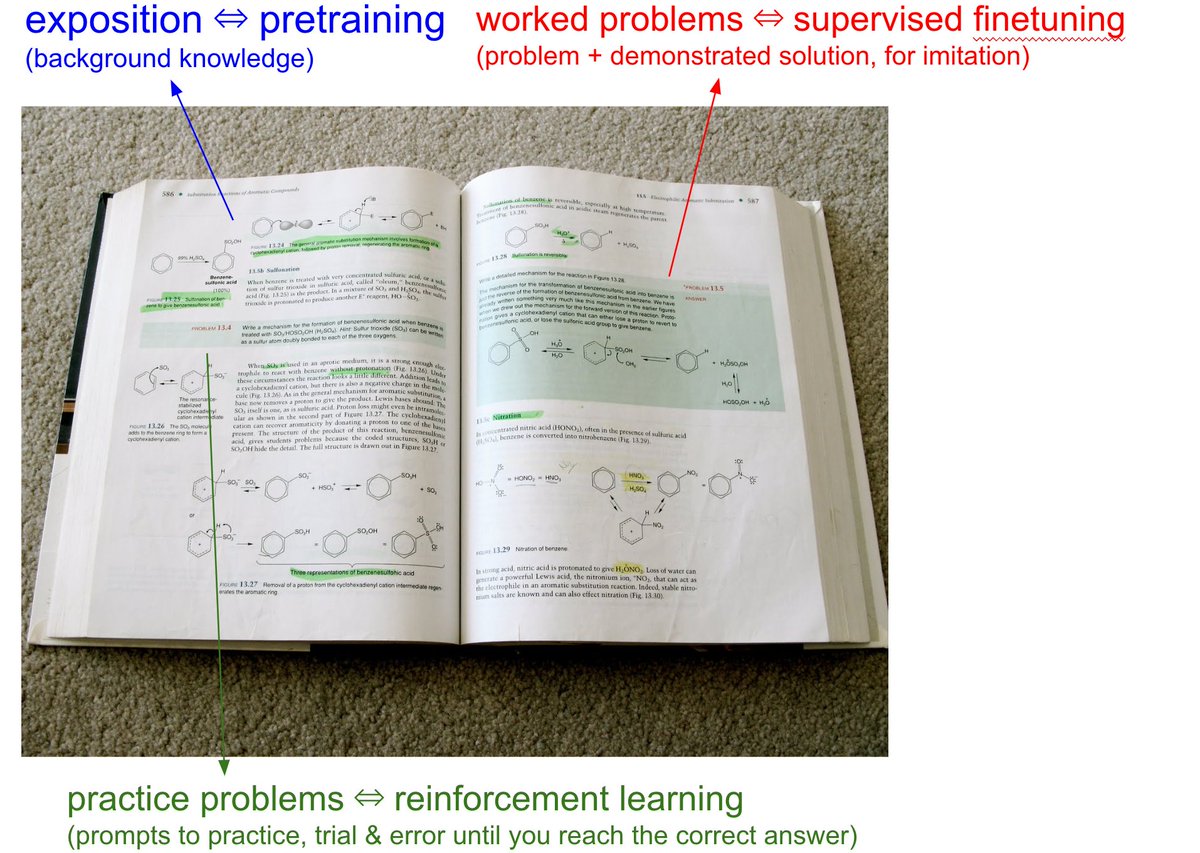
When you open any textbook, you'll see three major types of information:
1. Background information / exposition. The meat of the textbook that explains concepts. As you attend over it, your brain is training on that data. This is equivalent to pretraining, where the model is reading the internet and accumulating background knowledge.
2. Worked problems with solutions. These are concrete examples of how an expert solves problems. They are demonstrations to be imitated. This is equivalent to supervised finetuning, where the model is finetuning on "ideal responses" for an Assistant, written by humans.
3. Practice problems. These are prompts to the student, usually without the solution, but always with the final answer. There are usually many, many of these at the end of each chapter. They are prompting the student to learn by trial & error - they have to try a bunch of stuff to get to the right answer. This is equivalent to reinforcement learning.
We've subjected LLMs to a ton of 1 and 2, but 3 is a nascent, emerging frontier. When we're creating datasets for LLMs, it's no different from writing textbooks for them, with these 3 types of data. They have to read, and they have to practice.
True.
It’s because the majority of people only use the free-tier ChatGPT so far.
This is the first top reasoning model that is made available for free to the masses. Great strategy.
DeepSeek is a really good model, but it is not generally a better model than o1 or Claude.
But since it is both free & getting a ton of attention, I think a lot of people who were using free “mini” models are being exposed to what a early 2025 reasoner AI can do & are surprised
@Bannedforself @okaythenme Simply because some of the areas of growth are zero-sum.
Right now Singapore position itself as the financial and tech hub for the 700M Southeast Asia population.
When western/china companies move its SEA HQ to KL, Bangkok or Jakarta, it will be a loss for SG.
Prediction: ATS-friendly resume will no longer be important in the age of Generative AI/LLM.
Because many HR / recruiters are now using LLM to check at the first stage, whether the applicant’s resume match the job ad.
LLM has no problem to understand PDF like this ✅:
@leoplusx@karpathy@aifilmmaker > When ppl say “Let’s ask AI”, they expect “AI” to synthesize a balanced answer.
Maybe instead of just asking “What color is a Gropy?”, we can change the prompt a bit to get an answer that presents all sides, interpolate and summarize?
@leoplusx@karpathy > 3. Some "dumb" filtering to get the top n most diverse "ideas" or "snippets"
can you explain more on this? is it like a clustering algorithm of the entire internet, that the human labeler can then see the 10 biggest clusters (e.g. top 10 most recommended places in Amsterdam) ?
@osufever@karpathy interesting idea about user context.
maybe future chatbot interface would ask the user to login first, and then
insert their personal data (age, gender, religion, politics, hobbies, work experience, education) and take some personality tests (Big 5, MBTI, Enneagram, etc)
@osufever@karpathy interesting idea about user context.
maybe future chatbot interface would ask the user to login first, and then
insert their personal data (age, gender, religion, politics, hobbies, work experience, education) and take some personality tests (Big 5, MBTI, Enneagram, etc)
The timeline mindset matters:
In democracies, 4-year cycles often lead to short-term thinking—dividing the pie is the quickest way to satisfy voters before the next election.
But leaders who think in decades focus on building the pie. Eg: Lee Kuan Yew and Park Chung-Hee
After much thought and reading, I have come to the conclusion that this is the most important distinction in the world.
Socialism = arguing about how to divide the pie.
Capitalism = baking as much pie as possible.
Elements of both are necessary for balance but when you get to a situation where the socialist mindset is dominant (Europe), all the pie-bakers start leaving or stop baking.
Kesian pula tengok @huseinzol05@khalilhimura dah 2 hari firefighting kat twitter, kena fitnah macam2.
Puncanya FashionValet haritu. Sekarang orang kita dah skeptikal dengan local startup.
Harapnya hasil kerjasama dengan gov nanti worth it la untuk @mesolitica hadap semua ni 🙏