So many people here who've made childhood trauma the entire basis and justification for them being unpleasant and antisocial as grown adults will still refuse to see children as human or acknowledge how adults emotionally and physically abuse children.
I'm watching NATO push Russia toward a response that terrifies me.
Let me walk through what's actually happening.
The Kursk incursion wasn't a Ukrainian operation. It was NATO. Real-time satellite data. AI intelligence collecting digital and mobile network information showing exactly where Russian troops were positioned. Special NATO operatives and Ukrainian forces got guided deep into Russian territory by technology and planning they don't have on their own.
That's a red line people who lived through the 60s and 70s would never have considered crossing. Direct NATO operations inside Russia. Not weapons. Not training. Active intelligence coordination for a ground invasion.
Then Ukrainian forces following that incursion killed civilians. Another line crossed.
Then drones deployed from makeshift trucks attacked Russian nuclear bomber bases. Targeting the strategic deterrence force. The weapons designed to prevent exactly this kind of escalation.
Every step calculated. Every line deliberately crossed.
Here's what makes this dangerous: the West knows Russia doesn't want nuclear war. Russia never planned for global conflict. They responded to Ukraine's NATO membership trajectory because their security demanded it. Not because they wanted World War III.
But NATO is facing irrelevance. The alliance needs a purpose. It needs an enemy. It needs escalation to justify its existence and its budgets.
So watch the contradiction in Western media: Russia is too weak to advance on the battlefield. Russia is also an existential threat that could invade Europe any day.
Both statements can't be true. But both serve the same goal.
They want to make Russia look weak enough that pushing them further seems safe. While simultaneously making Russia look threatening enough that massive military spending stays justified.
The strategy is clear: push Russia into retaliating. Cross enough red lines that Moscow has to respond with something NATO can call escalation. Then use that response to flip Western economies onto war footing.
Because those economies are beyond saving through normal means. The debt is too high. The infrastructure is too broken. The political systems are too captured.
A war with a big payout at the end solves everything. Wipes debt. Rebuilds industry. Unites divided populations. Access to Russian resources makes it all worth it.
That's the gamble. Push a nuclear power until they snap. Then use their response to justify what you wanted to do anyway.
That bet scares me more than anything I've seen in 25 years.
The Ottomans spent centuries terrifying Europe, which makes admitting they were impressive slightly uncomfortable.
As a European, there is no point romanticising the Ottoman Empire. Its armies conquered European lands, Constantinople fell in 1453, Christian populations lived under Muslim rule, and generations of Europeans regarded Ottoman expansion as an existential threat.
My ancestors certainly weren't sitting around saying, “What fascinating cultural exchange.”
They were considerably more interested in keeping the Ottomans on the other side of Vienna.
But history becomes useless when admiration is confused with approval. As a Dutchman, I know this all too well. Our Golden Age was magnificent, just not for everyone.
The same honesty should apply when looking at the Ottomans.
Because the Ottoman achievement was extraordinary.
From relatively modest beginnings in Anatolia, they built an empire stretching across southeastern Europe, the Middle East and North Africa. Constantinople became Istanbul, one of the great commercial crossroads of the world. Their armies mastered gunpowder warfare, their administrators governed an enormously diverse population, and Ottoman power remained relevant for centuries.
You don't survive that long by merely having impressive hats.
And the hats were extremely impressive.
But my admiration goes beyond the size of their empire. Ottoman rule helped shape the geography, borders, cities and cultures of the Balkans, Anatolia and the eastern Mediterranean in ways still visible today.
It also changed the world around the Netherlands.
As Ottoman power reshaped older trade networks between Europe and Asia, maritime commerce became increasingly valuable. Dutch merchants later entered Mediterranean and Ottoman markets themselves, and in 1612 the Dutch Republic established formal diplomatic relations with the Ottoman Empire. Dutch ships traded in Ottoman ports, carrying products such as textiles and other European goods while returning with commodities from the eastern Mediterranean.
And four centuries later, traces of that connection remain in wonderfully ordinary places.
The tulip travelled from the Ottoman world into Western Europe and became almost absurdly Dutch. Coffee reached Dutch tables through wider Ottoman and Mediterranean connections before we enthusiastically turned it into another global business. Even words such as yoghurt remind us how cultural influence can survive empires themselves.
Meanwhile Dutch paintings, maps, merchants and diplomatic records preserve our side of that encounter.
That's ultimately why I admire Ottoman history.
Not because they were always our friends. They certainly weren't.
But because you cannot properly tell the story of Europe, its borders, its trade or even parts of Dutch history without eventually encountering the Ottomans.
Great civilizations don't disappear when their empires end.
They leave fingerprints on everyone around them.
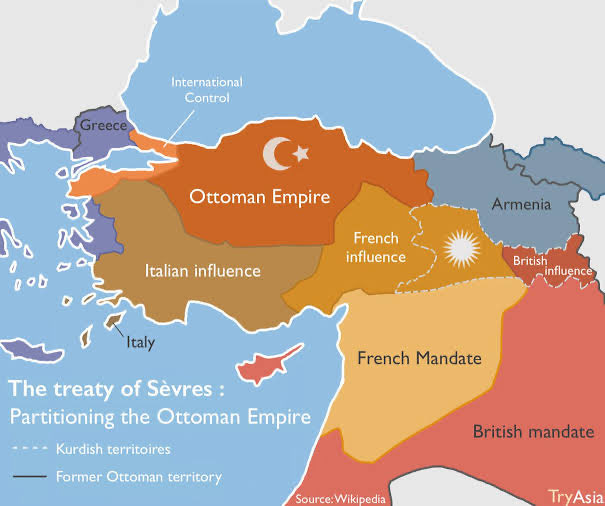
British archives reveal the UK greenlit the Greek landing in Smyrna primarily to block Italian expansion in Western Anatolia. When the Italians saw the Greek advance, they returned the occupied territories to the Turks and withdrew.Italians learned of this betrayal, a deep-seated hatred for Greeks exploded—leading them to aid the Turks, hand over their zones, and later invade Greece in WWII. 🇬🇷🇮🇹🇹🇷🇬🇧
Do you see how the elites are introducing the use of tactical nuclear weapons and the possibility of a limited nuclear exchange into the narrative? Last week, Marjorie Taylor Greene said that the Trump administration was talking about using them in Iran. This week, it’s Russia potentially using them in Ukraine.
You’re supposed to get used to the idea so that, when they use them, it will seem normal...
This was all leaked in 2010...
This passage from Dostoevsky’s "The Brothers Karamazov" aptly describes the situation in which the U.S. system of governance & foreign policy regarding Iran and the region finds itself due to its extreme reliance on 'lies':
"The man who lies to himself and listens to his own lie comes to such a pass that he cannot distinguish the truth within him, or around him, and so loses all respect for himself and for others."
The Brothers Karamazov,
Fyodor Dostoevsky
It is said that Allah allows just state to remain even if it is led by unbelievers, but Allah will nt allow the oppressive state to remain even if it is led by Muslims. & it is said that the world will endure with justice & unbelief, but it will not endure with oppression & Islam
Hijrah bros are annoying but you're proving their point. “I'll take my children being more likely to lose their faith as the price for material comfort”
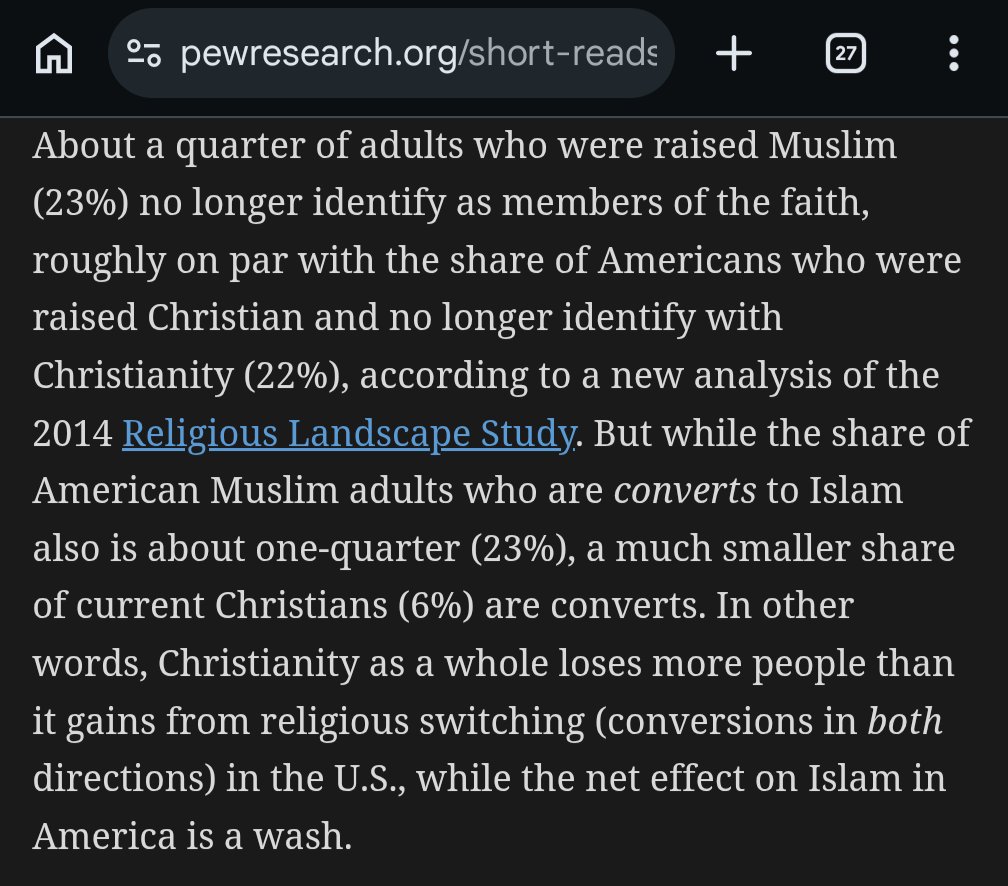
A ~quarter of those born Muslim in America apostasize. There isn't net loss due to converts, but not good odds for *your* kids
Hijrah bros are annoying but you're proving their point. “I'll take my children being more likely to lose their faith as the price for material comfort”
A ~quarter of those born Muslim in America apostasize. There isn't net loss due to converts, but not good odds for *your* kids
If preserving faith is the criterion, one could argue that a stable, religiously observant family in the West may provide a better Islamic environment for children than a nominally Muslim society with weak institutions, corruption, insecurity, or limited educational opportunities
Hijrah bros are annoying but you're proving their point. “I'll take my children being more likely to lose their faith as the price for material comfort”
A ~quarter of those born Muslim in America apostasize. There isn't net loss due to converts, but not good odds for *your* kids
Even if emigration contributes to brain drain, it doesn't follow that an individual Muslim has a religious duty to remain in a poorer country to improve its human capital stock. Thats a collective development argument, not automatically a religious ruling
Hijrah bros are annoying but you're proving their point. “I'll take my children being more likely to lose their faith as the price for material comfort”
A ~quarter of those born Muslim in America apostasize. There isn't net loss due to converts, but not good odds for *your* kids
Egypt air force procurement strategy ,collect every fighter on the planet, then [forget ] to buy the missiles that make them dangerousFerrari without engine.
F-16s without serious BVR weapons,Rafales without Meteor… bro is building an air force showroom,not an air force. 😭✈️
The relevant question isn't "Do Muslim children in the West have apostasy risk?" but "Is that risk higher than the risk of religious alienation, authoritarianism, poverty, or other harms in the alternative country?"
Hijrah bros are annoying but you're proving their point. “I'll take my children being more likely to lose their faith as the price for material comfort”
A ~quarter of those born Muslim in America apostasize. There isn't net loss due to converts, but not good odds for *your* kids
Joseph Henrich. In his book The WEIRDest People in the World, he argues that the medieval Western Church's restrictions on cousin marriage and other kin marriages gradually weakened extended kinship networks.