«I believe that scientific knowledge has fractal properties, that no matter how much we learn, whatever is left, however small it may seem, is just as infinitely complex as the whole was to start with»
— Isaac Asimov (I Asimov, 1995)
@sama So basically non-American customers are paying exactly the same amount (if not more considering the exchange rate) for technology that is sub-par to what the American consumers are getting. Not cool imo
@lyssasphere Yes - but only in a very philosophical way. Space without time could exist like a frozen stage: everything may have position, but nothing can move, change, or tell a story. So technically yes, but time is what makes space come alive.
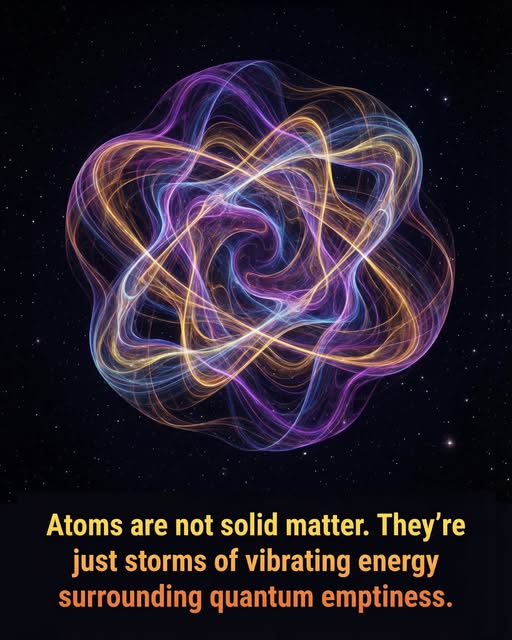
Quantum physics shows that what we perceive as solid matter is, at its core, mostly empty space, vibrating energy, and probability waves — far from the dense, static stuff our senses suggest.
Let's unpack this step by step.
Everyday objects — your hand, a chair, the floor beneath you — feel perfectly solid. But magnify them to the atomic level, and the picture changes dramatically.
Atoms consist of a tiny, dense nucleus surrounded by electrons. The nucleus occupies an incredibly small fraction of the atom's volume — the atom is over 99.9999999% empty space (or more precisely, space not occupied by point-like particles). Electrons don't behave like miniature planets orbiting a sun; instead, they exist as diffuse probability clouds — regions where the electron is likely to be found, spread out across the entire atomic volume.
So when your hand "touches" a table, no actual particles collide. The sensation of contact arises from the powerful electromagnetic repulsion between the electron clouds of your skin atoms and those of the table. Solidity is an illusion crafted by these forces.
Dive even deeper into quantum field theory (our most accurate framework for fundamental physics), and the story becomes stranger still. Particles like electrons aren't fundamental bits of stuff — they're localized excitations, or ripples, in invisible quantum fields that fill all of space. There's an electron field, a quark field, an electromagnetic field, and so on. What we call an electron is simply a vibration or "quantum" in the electron field. The same applies to photons (ripples in the electromagnetic field) and other particles. Matter, then, is essentially energy patterned into these dynamic field excitations.
Even the property of mass — what gives things weight and inertia — isn't intrinsic to particles. It emerges from their interactions with the Higgs field, another pervasive quantum field. Particles "drag" through this field, acquiring mass through these relationships rather than possessing it inherently.
This perspective, backed by countless experiments (from particle accelerators to precision spectroscopy), upends our intuitive view of reality.
So, what are you, really?
You're not a collection of tiny, solid building blocks. You're a symphony of quantum fields in constant vibration, vast clouds of probability, electromagnetic forces holding patterns together — and overwhelmingly... Emptiness. You're energy temporarily organized into the intricate, living form you experience as "you."
Millions have watched "Captain Steeve" conveniently pin blame on the pilots. But Captain don't oversimplify. Our pilots aren't fools, they are the best. Gear and flap controls are far apart.
Friends, never forget we're living in the time of info wars. Verify then believe.
When I was in business school, the idea of India overtaking Japan in GDP felt like a distant, almost audacious dream. Today, that milestone is no longer theoretical — we’ve become the world’s fourth largest economy.
It’s no small achievement. Japan has long been an economic colossus, with legendary productivity and resilience. That we’ve caught up is a testament to the ambition and ingenuity of millions of Indians — across sectors, generations, and geographies.
But as we celebrate, we must stay dissatisfied.
Because India’s next leap must be in per capita GDP, not just overtaking Germany…
For us to keep Rising, India needs sustained economic reforms — in governance, infrastructure, manufacturing, education, and capital access.
Fascinating how President Trump defies political labels—not left, right, or even center. He operates on a new axis entirely: relentless self-congratulation. Ideology? Optional. Credit? Non-negotiable. Frankly, it’s less strategy, more existential improv. And yes, that’s as dangerous as it sounds.