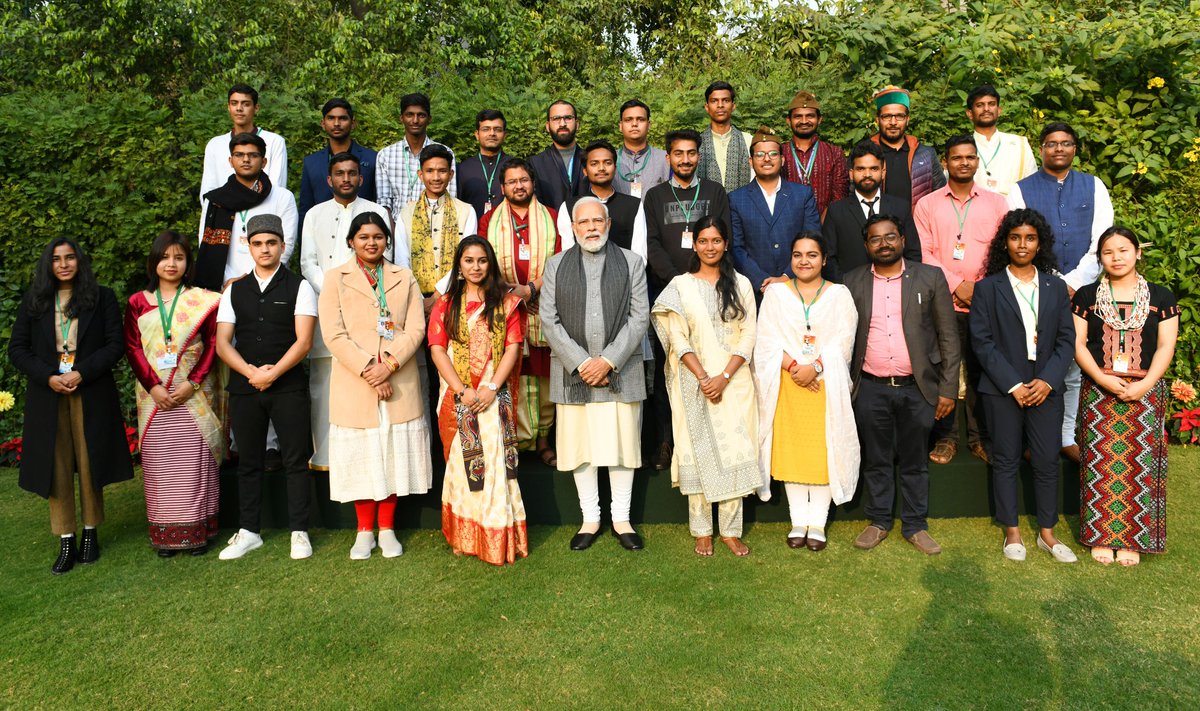
Thank you so much @narendramodi Ji for today's Interaction. We all really enjoyed our conversations with you and learned a lot from you .
Thanks again for your time 🙏
On #ParakramDiwas , PM @narendramodi interacts with youngsters selected to participate in the ceremony to honour Netaji Subhas Chandra Bose in Parliament under ‘Know Your Leader’ programme at 7, Lok Kalyan Marg
Read here: https://t.co/n5Xfu7o2g8
My salute to the Indian pilot Captain Smit Machchhar for his extraordinary bravery.
Despite being stabbed and seriously injured, he fought back, resisted, opened the cockpit door, and enabled passengers and crew to overpower the attacker — preventing a catastrophic mid-air disaster.
He saved the lives of 174 people, including Israeli citizens and other nationals.
I wish Captain Machchhar a speedy and full recovery.
He is a true hero.
The ‘Samrat’ Expectations
For years, the word “Bihari” itself became a slur in parts of the country. Long years of Lalu Prasad Yadav’s rule played a significant role in shaping that perception. Changing it required more than a change of Government; it required Bihar to rebuild its image from the ground up. @NitishKumar, popularly called Sushasan Babu, spent years trying to change that narrative. The transformation was not complete but the image of Bihar had begun to change. And in 2026, the burden of Bihar's Vikas passed to @samrat4bjp. For him, the challenges is not merely to preserve what has been built, but to confront what remains broken. He has big shoes to fill and even bigger problems to address
I write~
https://t.co/MLYKVZxdrP
Namaste, Ma'am...Aapko 1 story sunata hoon....
In the summer of 1980, a distraught 7th grade boy stood in the courtyard of a modest house in Mylapore, watching his father toss his cricket bat down a deep well. A fast bouncer had shattered the boy's spectacles during a local match & his father, a renowned Sanskrit logician, was terrified for his son's sight.
"Your cricket days are done," his father declared, handing him a violin. "If you want to master precision, master this."
The boy did not throw a tantrum. He directed his focus toward the strings, training until he was performing alongside musical legends, even taking direct corrections from Bharat Ratna M.S. Subbulakshmi.
5 yrs later, he suffered another blow: he failed to clear the IIT-JEE examination.
He did not give up. He enrolled in a regional engineering college, quietly mastering computer science logic gates. He eventually worked his way into IIT Madras as a postgrad researcher, earned a PhD, joined as a prof & eventually became the Director of the very institute that had once turned him away.
By 2011, while the world was building consumer mobile apps, this prof was looking at a hidden national vulnerability: every radar, fighter jet, banking server & defense system in India was running on foreign-designed microprocessors.
He had a single question in his mind: "We can test that a foreign chip does what we WANT it to do. But can we guarantee it does not do something we DO NOT want it to do when a war starts?"
He proposed building a completely indigenous, industrial-grade microprocessor from scratch. Global tech giants insisted it could not be done w/o billions of dollars in infrastructure & massive foreign patents.
He did not care. Working out of cramped labs on long shifts, he & his team adopted the open source RISC-V instruction set. They hand-coded logic gates, mapped silicon layouts & verified billions of instruction cycles.
In July 2018, a tiny 16mm² piece of silicon codenamed Risecreek arrived back at the lab. The team wired it up, flipped the switch & watched a flickering monitor as the Linux operating system booted on 100% Indian-designed silicon for the 1st time in history.
Today, his SHAKTI processor architecture powers everything from defense communications to space grade controllers built in collaboration with ISRO.
That young boy whose father threw his cricket bat down a well...
The student who missed the JEE list in 1985...
The violinist who turned down the official IIT Director's mansion to stay in his family home & protect his late father's Sanskrit library...
His name is Prof. Veezhinathan Kamakoti.
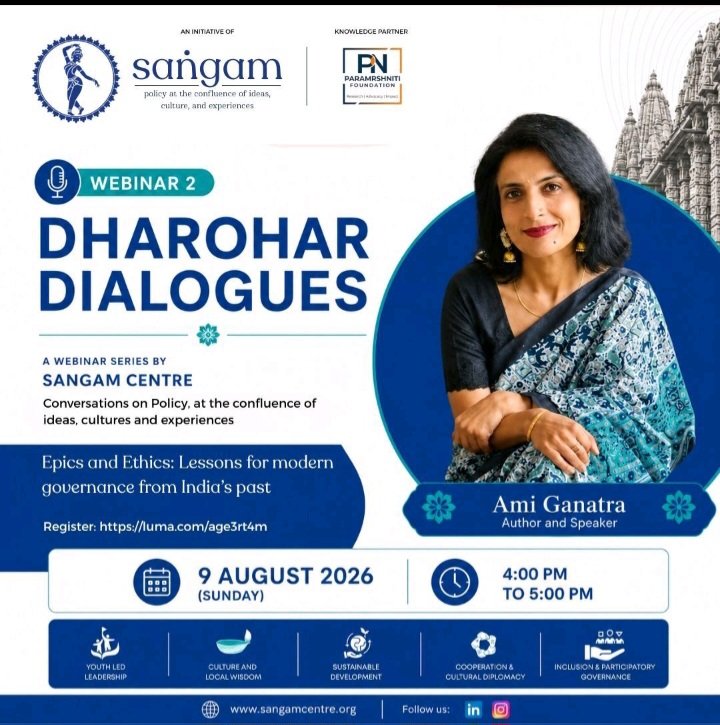
We invite you to be part of this conversation with Ami Ganatra as we examine the relevance of India's civilisational traditions to contemporary questions of governance.
Date: 9 August 2026
Time: 4:00PM - 5:00 PM IST
Registration Link :https://t.co/5b2VTAiqHt
Something most people don't know:
India holds the largest written record of any civilisation.
1 crore manuscripts. 3 lakh inscriptions in stone.
We gave the world zero. Wrote down surgery and calculus centuries before the West did.
Today, less than 1% can be read or searched. The rest is quietly turning to dust.
In the age of AI, knowledge a machine can't read is knowledge the world will never use.
MIDF is working to change that.
Help us keep India's memory alive. Donate below
He Came Back to Bihar After Traveling Across 20+ Countries with an Idea the World Had Never Seen Before.
Inspired by the resilience of communities, he founded the Centre of Resilience, turning waste into public art, livelihoods, and climate solutions.
Today, he built India’s first climate-resilient floating house on the Ganga, and his team creates sculptures from discarded materials and runs skill-development programs.
Building change at home.
Prashant Kumar from Bihar. #BiharStories
“The term ‘tribe’ as used by Western scholars was a colonial imposition grounded in an evolutionary framework that deemed tribal societies ‘primitive’.”
Authors Dr. Sachchidanand Joshi, Raghvendra Singh, and Prof. K. Anil Kumar call for a transformative shift in studying India’s forest and hill communities. This book seeks to dismantle the colonial "divide and rule" narratives and restore the profound civilisational and cultural links that unite all Indians.
#IndianAnthropology #Decolonisation #CivilisationalUnity #TribalIdentity #NationalPride
https://t.co/vLSrykKMZJ
You rarely hear the term 'Strategic Geography' because security and conflict are generally viewed by people outside the strategic community, as something linked to weapons and violence to settle disputes. That is a failure of comprehension. With terrain, economic growth, international boundaries, effects of climate change and disasters, existence or deficit of infrastructure and demographic dynamics, all go into making strategic geography. I never realized how live potent Bihar is for such research work. Hence this article by me in South Asian Defence Studies and Review.
https://t.co/JrAOJ9v0PB
चर्च का पादरी आदिवासी नहीं हो सकता, तो फिर आदिवासियों का पाहन ईसाई कैसे हो सकता है?
निशा उरांव जी को सुनिए और समझिए कि किस तरह धर्मांतरण कर ईसाई बन चुके लोग अब भी आदिवासियों के अधिकारों का अतिक्रमण कर रहे हैं।
@OraonNesha
Only 2 days left to register for the 15th edition of @indfoundation Young Thinkers’ Meet 2026 (YTM), to be held on 18–19 July 2026 in Uttarakhand.
🔗 Apply now: https://t.co/Wot69H0Di6
#YoungThinkersMeet#YTM2026
One year after #OperationSindoor, India must counter the Pakistani-backed social media handles promoting inflammatory content to radicalise youth in India and recruit them into terrorist activities.
(Authored by Dr. Siddhartha, Director, RLA)
https://t.co/4rNkAbzMsw
“Khanki magi [bloody whore]… Jaisi tumhari Hindu devi Maa Kaali nangi hai... waise hi tumko nanga karenge…” Those words still echo in my mind sometimes.
It was May 2021. After covering the Bengal Assembly elections, I returned to Bihar. Once the results were declared, reports began to surface of targeted killings of BJP workers and attacks on Hindus who were perceived to have supported or voted for the party. These incidents were not confined to a single locality. Disturbing videos began circulating widely, often shared through private messages on social media.
Around the same time, I started receiving calls from sources I had connected with during my reporting. Many of them were desperate for help. I still remember one call vividly. One of my sources was hiding in a field and said, “Sir, kuch kijiye… bacha lijiye… yeh log maar denge.” I felt completely helpless. I reached out to friends in Bengal, including some associated with the BJP, but they too were unable to offer any immediate assistance.
Eventually, I decided to return to Bengal to document what was happening on the ground. There, I met several women who alleged they had been subjected to brutal sexual violence. The TMC government denied every incident. Though there were around 100 such incidents, I managed to speak to six victims during my visit. At the time, only a handful of media outlets were reporting on these incidents, and many journalists had already left the state due to alleged threats from TMC goons.
What stood out most during my reporting was the alleged pattern of targeted violence, including sexual assault against women from families of BJP supporters. In several cases, families claimed that married women had been abducted and that money was demanded for their release. One particularly harrowing account involved an elderly woman who was assaulted in front of her family and later poisoned, though she survived. When I met her at a safe house where she was receiving medical treatment, she had been raped so brutally that she was unable to digest even a banana. She vomited twice in front of me after eating one.
After spending three to four days reporting from the ground, I returned and filed a cover story for the magazine @eOrganiser. The report received significant attention, as only a few journalists had remained in the field to document these accounts. #Organiser was the only media house that chose to bring the victims’ pain and grief to the forefront, featuring their stories on its cover [attached below. Faces were blurred for safety reasons].
Yesterday marked a historic moment, with @BJP4Bengal securing a massive mandate. While I was in Kolkata reporting updates on Twitter, I noticed that I still had that story pinned. It reminded me how difficult it was to write about such deep suffering. But if these stories are not told, the world may never know what people went through.
Most importantly, when you have a mentor like @prafullaketkar who places unwavering trust in you, it gives you the confidence to bring out the voice of ‘samaj ki antim pankti mein khade vyakti,’ no matter the circumstances.
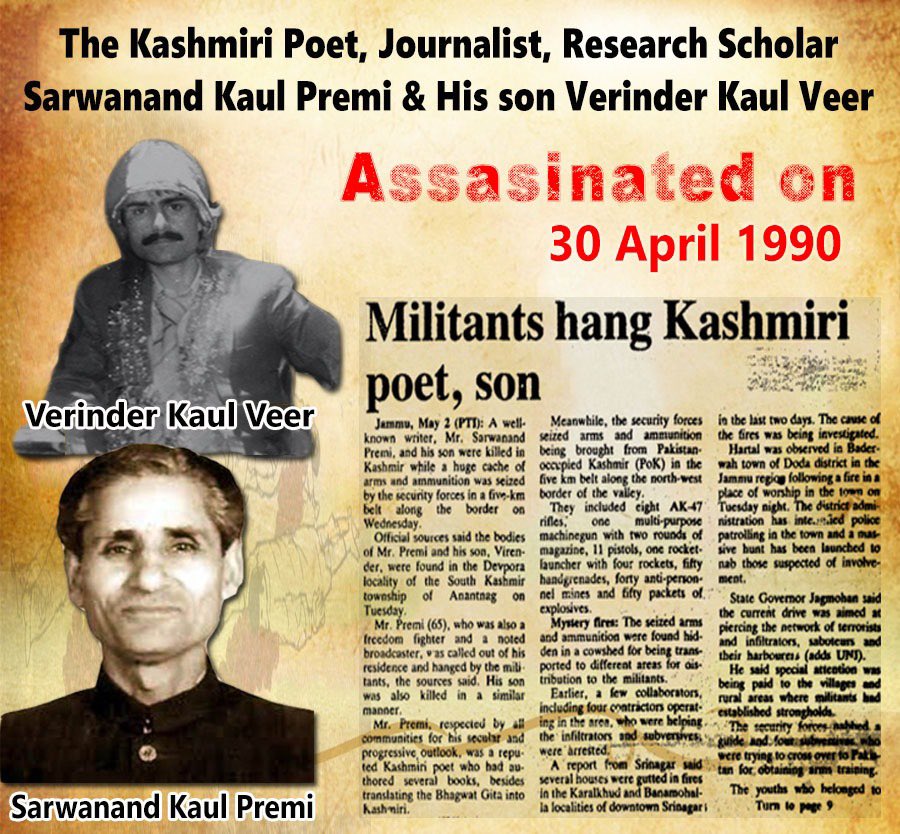
On the night of 28 April 1990, terrorists arrived at the home of Kashmiri Poet Sh Sarwanand Kaul.
Terrorists gathered all the members of the family together and offered a pretext: they claimed to be looking for someone called Ghulam Rasool. Then they looted the house systematically. They took gold, jewellery, Pashmina shawls, and clothes bought for an upcoming family wedding.
They entered Sh Sarwanand’s library and took literary manuscripts and works in progress.
Then came the demand: Sarwanand Kaul Premi must come with them to meet their commander.
His younger son, Virender Kaul, refused to let his father go alone. He insisted on going with him. The extremists agreed. Father and son walked out into the darkness of 28 April 1990 and did not come back.
#OnThisDay in 1990, their bodies were found hanging from a tree. Their arms & legs had been broken. Their eyes had been gouged and what not ..
Verinder Kaul left behind a young widow and an infant son, 18 months old.
This forced the Kaul family to leave Kashmir, never to return and people in Kashmir today blame Sh Jagmohan Malhotra for the exodus of the Kashmiri Hindus.
There was no protest in #Kashmir then and all this happened in the thought process of "Raliv, Galiv ya Chaliv"..