News must toe a populist line. Or, be simply, unread. This one about the Parsi woman, married to a Muslim man, whose body was disposed only by Hindu rites, qualifies but ... will not be read. Not yet!
Read my analysis: https://t.co/ozc26YlqfY
#ParsiWomenRights#VHP
A 55yo #Parsi woman, married to a Muslim, spent her life crossing social boundaries, which returned with a vengeance as both communities refused her last rites. It were the #Hindus, often accused of #intolerance, that did it.
READ: https://t.co/UBOzW3YcNQ
#ParsiWomenRights#VHP
Twenty-Two Million Followers. A Few Hundred at Jantar Mantar. India Has Seen This Before.
Reports say the Cockroach Janta Party gathered at Jantar Mantar in New Delhi on June 6, 2026, the day The Daily Telegraph published a piece framing the movement as Narendra Modi's 'biggest challenge' in twelve years of rule. Hundreds of mostly young people, many in cockroach masks and carrying dog-eared exam guides, assembled at India's most famous protest strip, attempting to turn an online joke into a real-world force. The foreign press filed its dispatches. Instagram metrics were cited with the reverence normally reserved for election results. The movement's founder announced that it had arrived.
What actually arrived at Jantar Mantar, as anyone who has covered Indian political mobilisation for longer than three weeks could have told the Telegraph's correspondent, was the latest iteration of a pattern that repeats with metronomic regularity in Indian public life: a social media surge, foreign media amplification, street turnout that bears no relationship to digital numbers, and a government that continues governing while the cycle exhausts itself.
The CJP was founded on May 16, 2026, by Abhijeet Dipke, a political communications strategist and Boston University graduate who formerly worked with the Aam Aadmi Party. It emerged in response to remarks by Chief Justice of India Surya Kant during a Supreme Court hearing on May 15, in which he compared unemployed youth who criticise the government to 'cockroaches' and 'parasites of society.' Within 78 hours, the Instagram account crossed 3 million followers. It subsequently surpassed 22 million, overtaking the official Instagram accounts of both the BJP and the Indian National Congress. Several notable personalities and politicians, including Samajwadi Party supremo Akhilesh Yadav and Trinamool Congress members Mahua Moitra and Kirti Azad, endorsed the parody account.
Twenty-two million Instagram followers, delivered in days, by a political communications professional with reported AAP connections, operating from Boston. The Telegraph described this as Modi's biggest challenge in twelve years. That description requires the reader to believe that Instagram follower counts are a reliable predictor of political consequence, that a satirical movement founded by an opposition-linked strategist living abroad represents authentic grassroots discontent, and that hundreds at Jantar Mantar constitute a political reckoning for a Prime Minister whose party won 206 seats in the West Bengal assembly election three weeks earlier. None of these propositions survives contact with India's actual political geography.
The Telegraph's framing is not an aberration within Western media's coverage of India. It is the house style. The New York Times has run a guest essay titled 'Modi's India is Where Global Democracy Dies' - a headline whose apocalyptic certainty was not supported by the electoral arithmetic of the country it described. An examination of the essay's author's portfolio, as ThePrint documented, revealed articles that consistently carried paeans to China alongside a string of negative assessments of India, prompting Shashi Shekhar Vempati, former CEO of Prasar Bharati, to observe that certain Western publications appeared to have become 'unwitting carriers of anti-India narratives as part of what appears to be pro-China propaganda to undermine Indian democracy.' The New York Times has not updated its democratic death certificate for India in the years since the essay was published. India has continued holding elections. Voters have continued voting, with turnout figures that the established democracies of the West cannot consistently match.
The Washington Post, whose editorial policy the BJP's foreign affairs department formally described as 'biased and agenda-driven,' has maintained a coverage pattern on India that applies critical frameworks to the BJP government with a consistency it does not extend to comparable governments in comparable geopolitical contexts. The Post's India bureau has covered exam controversies, farmer protests, anti-CAA agitations, and unemployment statistics as components of a singular narrative about democratic erosion, without applying the same analytical rigour to the democratic erosion documented in countries whose governments the Post's editorial orientation treats more sympathetically. Jeff Bezos visited India and described the twenty-first century as the Indian century. His newspaper's India coverage has not noticeably reflected that assessment.
The Economist, which in the weeks preceding the 2024 Indian general election suggested that the Indian opposition should question the legitimacy of the results if Modi won by a large margin, has treated the democracy watchdog rankings - V-Dem's 'electoral autocracy' classification, Freedom House's 'Partly Free' downgrade - as settled institutional verdicts rather than contested methodological positions. The Journal of Democracy published a rebuttal titled 'The Exaggerated Death of Indian Democracy' in July 2023, which observed that under the BJP, India's political system had produced increased voter turnout alongside more centralised party control, and that citizens surveyed expressed satisfaction with democracy, a data point that the democracy-downgrade narrative has consistently struggled to accommodate. The rebuttal generated a fraction of the global circulation that the downgrade narrative produced, because correction is less commercially valuable than crisis.
The CJP is not a new phenomenon. It is a new brand applied to an old model, and the model's track record is unambiguous. The farmer protests that began in November 2020 attracted sustained international media coverage, multiple foreign government statements, celebrity social media campaigns from Rihanna, Greta Thunberg, and Mia Khalifa, a toolkit controversy, and constant framing in the Western press as an existential threat to Modi's political standing. The three farm laws were eventually repealed. The BJP won Uttar Pradesh in the 2022 assembly elections with 255 of 403 seats, in a state with a substantial farming population. The farmer protests were real. The political reckoning the foreign press predicted from them was not.
The Maratha reservation protests produced massive street mobilisations in Maharashtra across 2018 and sustained coverage framing them as a threat to BJP governance. The BJP won Maharashtra in 2019. The agitation's primary demand was struck down by the Supreme Court on constitutional grounds, a judicial outcome that no amount of street pressure could alter. The Aadhaar protests filled foreign media columns across 2017 and 2018 with predictions of a surveillance state and constitutional devastation. The Supreme Court upheld Aadhaar's constitutional validity and left the system intact. The database today holds over 1.3 billion records and is the backbone of India's direct benefit transfer architecture, through which over Rs 38 lakh crore has been transferred to citizen accounts since 2014. The anti-CAA protests produced Shaheen Bagh, covered by international media as the most significant civil resistance movement in India in a generation. The Citizenship Amendment Act remains on the statute book, its rules notified in March 2024. The BJP won a third consecutive national mandate in the 2024 general election.
Critics have insinuated that the CJP may have been orchestrated by opposition parties, given Dipke's past links to the AAP. Whether it is orchestrated or organic is, in the immediate term, less analytically important than the question of what it can deliver. The AAP itself, whose creative political communications machinery produced some of the most technically sophisticated opposition messaging of the past decade, lost Delhi in the February 2025 assembly elections to the BJP after a decade of city government. Arvind Kejriwal, who built AAP on precisely the kind of anti-establishment, social media-amplified, ordinary-citizen energy that the CJP is attempting to replicate, is no longer Delhi's Chief Minister. The model the CJP is operationalising has been tested by its own creator in its own state and found insufficient to survive contact with an electorate that votes in booths rather than on Instagram.
The Bloomberg gold report sits in the same analytical category as the CJP's 22 million followers, a number that produced significant anxiety, significant media coverage, and ultimately no consequence that the institutional record supports. Bloomberg Economics estimated that the RBI had sold $12 billion worth of gold in two weeks. The RBI issued a formal clarification stating that these reports were not correct, that the physical stock of gold remained unchanged at 880.52 tonnes, and that members of the public were advised to rely on official information published by the RBI. Gold's share of India's foreign exchange reserves had in fact risen from 13.92 per cent at end-September 2025 to 16.85 per cent as of May 22, 2026...the precise endpoint of Bloomberg's alleged sale window. The Congress party had already distributed the Bloomberg estimate as evidence of Modi selling India's gold before the RBI's data had been consulted. The clarification reached a fraction of the audience the estimate had reached. The damage was done, the correction was filed, and the narrative moved to the next cycle.
This is the operational structure that The Telegraph's piece reflects without examining. The challenge is assembled from components that individually appear significant: 22 million Instagram followers, hundreds at Jantar Mantar, a Bloomberg estimate about gold, fuel prices rising, the rupee under pressure, exam paper leaks generating student anger. Each component is real. The fuel prices are real. The exam scandals are real. Youth unemployment among Indians aged 15 to 29 stands at approximately 9.9 per cent, and surveys confirm widespread anxiety about jobs and economic opportunity. These are legitimate grievances that deserve serious policy engagement. The question is whether a satirical movement founded three weeks ago by an opposition-linked strategist based in Boston, whose street demonstration produced hundreds at Jantar Mantar against a claimed Instagram following of 22 million, is the vehicle through which those grievances will translate into political consequence.
The ratio of followers to physical participants is not a sign of a movement building toward critical mass. It is a sign of a movement that has reached its ceiling, which is, as every comparable Indian social media phenomenon of the past decade has discovered, the ceiling of the smartphone screen itself.
Police in riot gear and steel barricades were deployed at Jantar Mantar for the CJP protest. Dipke told supporters that 'cockroaches don't ever fear.' The theatrical competence of the moment should not be mistaken for political competence. Mask-wearing protesters at Jantar Mantar with dog-eared exam guides, led by a Boston University graduate flying in for the day, photographed by Al Jazeera and cited by the Telegraph as evidence of Modi's greatest challenge, constitute a media event rather than a political movement. The distinction is the difference between what trends on Instagram and what moves votes in Azamgarh, Patna Sahib, Coimbatore, and the 543 constituencies whose aggregate verdict determines who governs India.
The Telegraph's piece, like Bloomberg's gold estimate, like the Rihanna tweet, like the Greta Thunberg toolkit, like the New York Times' democracy obituary, like the Washington Post's agenda-driven coverage, like the Economist's pre-election suggestion that the opposition should pre-emptively contest a result it had not yet lost, like the international media's annual discovery that India is on the cusp of a political convulsion that does not arrive, is a document of a particular kind of foreign media engagement with India: one that consistently mistakes the intensity of English-language social media discourse for the condition of Indian political opinion, and consistently discovers, after the election results are counted, that the two are not the same thing.
The pattern extends from Time magazine's 2021 cover story on Modi asking 'India's Divider in Chief?,' published by the same publication that had described him as 'India's Reformer in Chief' in 2015, under an article written by then-US President Barack Obama, to the BBC documentary on the 2002 Gujarat riots broadcast in 2023, timed to coincide with India's G20 presidency and described by India's External Affairs Minister S. Jaishankar as a 'propaganda piece designed to push a particular narrative.' Time's editorial position on Modi correlates precisely with the temperature of US-India relations in any given year, shifting from admiration to alarm as the geopolitical weather changes without the magazine acknowledging that its journalism has tracked the weather rather than the facts.
India's electorate has voted in four consecutive national elections, three of which have delivered the BJP to government, and twelve years of state elections in which the party has won large states and lost others with the regularity of a functioning democracy. The farmer protests did not remove the government. The anti-CAA movement did not repeal the Act. The Shaheen Bagh occupation did not alter the electoral arithmetic of 2024. The Maratha agitation did not produce the constitutional outcome its participants demanded. The Aadhaar opposition did not dismantle the system. The Bloomberg gold estimate did not move India's reserves by a single tonne. The New York Times' democracy death certificate has not been executed. The Economist's suggestion that election results be pre-emptively contested was not followed by the opposition that received it.
The haters will continue to hate. That is their constitutional right, available equally to Indian citizens and foreign publications that choose to exercise it from offices in London, New York, and Washington. The consistency of that hatred's failure to produce the political consequences it predicts is, at this point, the most extensively documented pattern in Indian political journalism since 2014, and the one that its practitioners show the least interest in examining, because examining it would require acknowledging that the story they have been telling about India and the story India has been living are, by the electoral record, the institutional record, and the economic record, two substantially different stories.
Twenty-two million followers. A few hundred at Jantar Mantar. The government is still there. The gold is still there. The election is still three years away. The foreign desk, presumably, is already preparing its next dispatch about the challenge India has never quite managed to mount against a Prime Minister it has now elected three consecutive times.
#CJP #cjp_पार्टी #Dipke #Cockroaches #DharmendraPradhan #CockroachJantaParty #JantarMantar #DelhiPolice #CJPProtest #JaiBhim #StudentProtest #SonamWangchuk #EducationMinister
#DelhiFire | India’s Unregulated B&B, Homestay Racket Continues To Kill!
Early morning on June 3, 2026, a fire broke out at Flourish Stay, a bed‑and‑breakfast in the Hauz Rani locality of Malviya Nagar, South Delhi. At least 21 people died, and more than 40 were rescued and taken to nearby hospitals. Among the dead were 17-18 foreign nationals, reportedly from Nigeria, Mozambique, Liberia and Bangladesh.
Officials said many of the guests had travelled to Delhi not for tourism but as medical tourists or attendants of patients receiving treatment at Max Super Specialty Hospital, located minutes from the building.
Licenced For Six Yet Ran 25 Rooms
According to Delhi Police and media reports, Flourish Stay had been granted a licence by the Delhi government under the Bed and Breakfast scheme permitting it to operate only six rooms. Instead, the property was running around 25 operational rooms, including accommodation in the basement. The building had no Fire Safety No Objection Certificate (NOC), a mandatory requirement for commercial hospitality establishments under the National Building Code. It had only one entry-exit point and no alternative escape routes.
These lapses turned the building into a death trap when the fire spread rapidly through the narrow five‑storey structure. Some trapped occupants jumped from upper floors; a woman carrying a child landed on a mattress improvised by residents who had run to a nearby bedding shop. Eight fire tenders were dispatched, and the blaze was fully extinguished after a massive rescue operation. The exact cause of the fire remains under investigation, though preliminary reports suggested it may have originated from a restaurant operating on the ground floor.
The Delhi Police have registered an FIR under charges of culpable homicide. Sources indicate that the B&B licence was valid until 2027, and a day’s stay cost between ₹2,500 and ₹3,000.
Seven Years Later, An Arpit Palace Repeat
This is not India’s first fatal hotel fire linked to basic safety violations. On February 2019, a fire at Hotel Arpit Palace in Karol Bagh killed 17 people. The FIR and subsequent chargesheet listed glaring lapses: No panic alarm on any floor, only one emergency exit that was locked, no proper signage guiding guests to the exit, use of highly inflammable materials for decoration, and an unauthorised kitchen in the basement. The hotel was run “like a death trap,” with the emergency exit intentionally closed and stairs blocked with laundry and bar items. The owners had submitted forged documents to obtain licences and operated a banquet hall from the basement without any licence.
Delhi Police subsequently reviewed certificates issued to hotels across Delhi’s tourist hubs. The review produced recommendations and circulars, but no functioning mechanism emerged to prevent a property licensed for six rooms from operating 25 rooms without a fire NOC in the same city where the same failure had already killed 17 people. Seven years later, Flourish Stay burned with the same core violations, under the same regulatory framework, through the same enforcement gap.
In Mumbai, Just The Geography Differed
If Delhi's Flourish Stay exposed the dangers of a bed-and-breakfast operating far beyond its licensed capacity, Mumbai's Kamala Mills fire had already demonstrated nearly a decade earlier how blocked escape routes, compromised fire-safety systems and regulatory complacency can transform commercial premises into death traps. The geography differed but the pattern didn’t.
In December 2017, fourteen people lost their lives when a fire tore through rooftop restaurants at Mumbai's Kamala Mills compound in Lower Parel, one of the city's most visible commercial and entertainment hubs. The subsequent investigations revealed a familiar catalogue of violations…unauthorised constructions, encroachments into mandatory safety spaces, obstructed evacuation routes and glaring discrepancies between approved plans and actual operations. Questions emerged not merely about how the fire started, but how establishments carrying obvious risks were allowed to continue functioning in plain sight of municipal authorities, licensing departments and enforcement agencies.
The parallels with Flourish Stay are difficult to ignore. In both cases, the immediate cause of the fire became secondary to the institutional failures that preceded it. Buildings were permitted to evolve beyond the limits of their approvals. Safety requirements existed but remained unenforced. Inspections either failed to detect violations or failed to act upon them. Commercial activity flourished while compliance became a paperwork exercise rather than a physical reality. The result was predictable; when fire finally arrived, it encountered conditions that ensured a routine emergency would become a mass-casualty event.
Kamala Mills should have served as a warning that India's urban hospitality sector faced a deeper structural problem than individual negligence. It revealed a regulatory culture in which approvals are granted, violations accumulate, notices are issued and forgotten, and enforcement often awakens only after fatalities compel public scrutiny. The Flourish Stay tragedy suggests that the lesson was noted, discussed and archived, but never institutionalised. What burned in Delhi in June 2026 was not merely a guesthouse. It was the credibility of a regulatory system that had already been shown, years earlier in Mumbai, exactly how such disasters unfold.
Fire Data That Activates After The Blaze
The broader pattern is visible in Delhi Fire Services data, though some earlier media figures have been corrected. In the first two and a half months of 2025, Delhi Fire Services reported 6 deaths in January, 2 in February, and 4 by March 11, totalling 12 fatalities compared with the same period in 2024, a 67.57% decline year‑on‑year. The department received 938 calls in January, 1,076 in February, and 455 by March 11, totalling 2,469 calls. These numbers, while showing a decline from 2024, still reflect a system whose enforcement is largely complaints‑based and often activates only after a fire has already broken out.
The problem is not confined to Delhi. It is a national condition whose geometry is consistent across every tourist destination in India. Its most documented expression outside Delhi is the coastal hospitality economy of Goa.
Goa-Style Deception Built Into The Platform Model
In January 2025, Goa Police arrested four persons, namely Saurabh Duseja of Gwalior and Sayed Ali Mukhtar, Mohammad Firoz, and Mohammed Azharuddin Saif of Hyderabad, for operating a multi crore villa rental scam. The gang had been duping tourists since 2022, listing non-existent properties on https://t.co/ZiRKn5xJaP, collecting advance payments through multiple bank accounts, and using female telephone operators to build trust with victims. Over 500 tourists were cheated and the scam came to light after a Chandigarh resident, Pankaj Dhiman, complained that he had paid ₹20,000 for ‘Ruby Villa, Goa’ only to find that the villa did not exist.
The infrastructure of deception required was not elaborate. It required listings on a platform that charges a commission for every completed booking and, in its standard operating procedure, does not physically verify the existence, accuracy, or legal compliance of the properties it lists before making them available for reservation. The platform’s incentive structure aligns with the fraud’s operating logic…more listings, more bookings, more commission. The accuracy of those listings, the safety compliance of those properties, and the experience of the guest who arrives to find that the villa does not exist or the B&B is a fire trap are externalities that the commission model does not account for.
Goa’s B&B and Homestay Business Is Paper Perfect
Goa’s B&B and homestay economy in North Goa, across Anjuna, Vagator, Morjim, Arambol, and the increasingly congested belt extending to Ponda, operates within a regulatory framework that exists with considerably more clarity on paper than in practice. Under the Goa Registration of Tourist Trade Act, 1982, and the Goa Registration of Tourist Trade Rules, 1985 (amended in 2021 and 2022), all homestay and B&B establishments fall under Category D and must register with the Department of Tourism. The Homestay and Bed and Breakfast Scheme 2025 outlines the registration process, requiring submission of Form XXIII, proof of ownership, safety compliance documentation, and compliance with basic hygiene and safety standards set by the Department.
The registration requirement is clear, its enforcement is not. Properties that have not registered, properties that have registered with inaccurate room counts, properties that registered with compliant facilities but operate something structurally different, and properties that describe themselves on global booking platforms with photographs and amenity lists that bear no verifiable relationship to physical reality, all of these categories exist in North Goa’s hospitality ecosystem. No tourism department official has been able to quantify their numbers with precision because the verification system that would produce a precise count does not function.
Complaints are distributed across consumer forums, TripAdvisor and Google Reviews pages, police complaint registers, consumer court filings, the inbox of the Goa Tourism Development Corporation’s grievance cell, and social media posts of tourists who discovered on arrival that the sea‑facing villa of the photographs was a windowless room in a concrete building kilometres from the water. The pattern is consistent … properties listed as having amenities they do not possess, room sizes described with measurements disproved by the guest’s suitcase, and safety infrastructure such as smoke alarms, fire extinguishers, and clearly marked emergency exits photographed in common areas that the guest never sees from their room.
The review system offered by every major booking platform as the primary consumer protection mechanism is manipulable in ways that platforms acknowledge in their own terms of service while declining to remedy in operational practice. Platforms permit property operators to respond to negative reviews, flag reviews for removal on policy grounds, solicit positive reviews before guests fully experience the property, and build review averages over time by offering discounts or upgrades to guests who leave five‑star ratings. A guest who leaves an honest negative review about a safety violation, misrepresented room size, or absence of advertised amenities has no mechanism to escalate that review to a regulatory authority. The review lives on the platform. The platform’s interest in the review’s content is commercial, not regulatory.
Airbnb’s Verification Prompt Globally, Absent In India
In 2023, Airbnb removed 59,000 fake listings globally and prevented another 1,57,000 from joining. The company announced it would implement thorough AI‑based verification processes for all listings in its top five markets, namely the United States, the United Kingdom, Canada, France, and Australia.
India, which has among the highest Airbnb listing densities in Asia and whose hospitality economy generates a significant proportion of the platform’s South Asian revenue, is not in that top‑five verification programme.
The guest who books in California’s Fresno has a platform‑backed verification system standing between them and a fraudulent listing. The guest who books in Goa’s Anjuna has a review average and a photograph of a swimming pool.
Delhi B&B Scheme Gaps Need To Be Filled
The Delhi B&B scheme under which Flourish Stay was licensed deserves examination as a regulatory instrument, because its design contains the gap through which the June 3 disaster walked. The scheme was introduced to formalise Delhi’s informal hospitality economy, to bring paying‑guest accommodations and small guesthouses within a regulatory framework that would, in theory, ensure basic safety compliance in exchange for the legitimacy of a government licence.
The licence permits a specific number of rooms. The licence fee is paid on that number. The property is then effectively free to operate as many rooms as its walls and its contempt for enforcement will allow, because the inspection mechanism that should translate the licence’s room limit into a physical constraint does not function with the frequency or rigour the licence implies.
Flourish Stay operated around 25 rooms on a 6‑room licence for long enough to become a listed property on a global travel platform with a review history suggesting ongoing guest satisfaction. The Fire NOC that would have required a physical safety inspection of those 25 rooms was never obtained. No inspection triggered by the absence of that NOC was ever conducted. The property remained on the platform and the commission kept flowing but 21 people died!
Overregulation Yet Underenforcement
The argument invariably produced at this point, that overzealous regulation will damage tourism, that India’s hospitality sector cannot absorb the compliance costs of rigorous safety enforcement, that the informal economy is the only viable model for the small operator who cannot afford the legal and administrative infrastructure of full compliance, deserves to be stated and then dismissed with precision.
Overregulation did not kill 21 people in Malviya Nagar. Under-enforcement of the regulation that already existed did. The licence existed, so did the room limit, the Fire NOC requirement, and the National Building Code’s emergency exit provisions. Yet, none of them were enforced.
The argument against tighter regulation, in this context, is an argument that the existing regulation’s non-enforcement should be extended rather than corrected. That is not a tourism policy position but a statement of institutional failure dressed as economic pragmatism.
The Reform Necessary To Save Lives
The specific reform this disaster makes necessary is not complex in design, though it is demanding in implementation. Every B&B, homestay, guesthouse, and paid accommodation registered under any state tourism scheme and listed on any commercial booking platform must be subject to an annual physical compliance inspection conducted by a joint team from the relevant state tourism department and the local fire authority. The findings must be uploaded to a publicly accessible database within 30 days of the inspection and linked directly to the property’s listing on every platform through which it accepts bookings.
The inspection must verify:
* Room count against the licence,
* Fire NOC,
* Emergency exit availability and accessibility,
* Smoke alarm and fire extinguisher installation, and
* Structural compliance with the applicable building code’s occupancy provisions
A property that fails the inspection must be unlisted from all booking platforms within 48 hours of the failure finding, with relisting contingent on verified remediation. The platform that continues to list a property after a failure notice has been served must bear joint civil liability for any harm to guests that results from the continued listing.
The platforms will resist this and their resistance will be framed as a defence of the small operator, of economic inclusion, of digital access to the tourism economy for properties that cannot afford compliance. This framing should be treated with the same scepticism appropriate for any argument in which the party resisting accountability presents itself as the defender of the party it is actually exploiting.
Airbnb, https://t.co/ZiRKn5xJaP, Expedia, and their domestic equivalents are not small operators. They are global technology companies whose combined market capitalisation runs into hundreds of billions of dollars. The cost of building a compliance verification API that checks a property’s current regulatory status against a government database before displaying it as bookable is not a burden that threatens their business model. It is a feature they have chosen not to build in markets where the regulatory pressure to build it does not exist.
India’s tourism authorities have the leverage to create that pressure. They have statutory authority, under existing tourism trade registration legislation in most states, to require that platform‑listed properties carry a valid, current registration number, and to require platforms operating in India to verify that registration number against a live government database before processing a booking.
This is not a novel regulatory concept. The European Union’s Digital Services Act, which came into full effect in February 2024, requires large platforms to implement risk‑based content moderation and compliance verification systems precisely because the EU determined that self‑regulation by commercially interested platforms was structurally inadequate to protect consumers.
India does not yet have an equivalent legislative instrument applied to the hospitality booking sector, and the absence of that instrument is the gap that the Ministry of Tourism, the Ministry of Consumer Affairs, and every state tourism department with a registration scheme must now urgently fill.
The Medical Tourist Who Followed The System’s Logic
The medical tourist from Nigeria who booked Flourish Stay was not a careless consumer. He was a person in a foreign country, seeking accommodation near a hospital where he would receive treatment, using the tool that every travel system in the world now operates through, applying the verification logic that the platform’s interface encourages: Check the star rating, read the reviews, look at the photographs, confirm the distance from the hospital.
None of those steps would have revealed that the building had no Fire NOC. None of them would have shown that 25 rooms were being operated on a 6‑room licence. None of them would have indicated that the single entrance that served as the building’s only exit was also the point through which the fire would cut off escape.
The platform knew none of this because it had not checked. The government knew none of this because it had not inspected. The licence existed, the commission was collected, and the booking confirmed.
At least 21 people died in a building that the system had certified as legitimate and the market had certified as acceptable. Both certifications were wrong, and both the system and the market knew the mechanisms through which they could have been right and chose not to use them.
The Cycle That Will Repeat Unless Broken
The inquiry that the Delhi Police have announced, the arrests that may follow, and the city‑wide fire safety audit that the tragedy has prompted will produce - with the consistency of a pattern that India has rehearsed many times - a set of findings, a set of recommendations, a circular to all B&B licence holders, and a renewed commitment to enforcement that will last approximately as long as the news cycle sustains public attention.
The Arpit Palace fire produced the same cycle in 2019. Its lessons were not institutionalised. Flourish Stay burned seven years later with the same violations, in the same city, under the same regulatory framework, through the same enforcement gap.
The only honest response to this pattern is the one that does not fit in a news cycle, which is a permanent, technology‑enabled, platform‑integrated, publicly accessible compliance verification system that makes the regulatory status of every listed accommodation visible to every prospective guest before the booking is confirmed and enforceable against every platform that profits from listings made in its absence.
At least 21 people, most of whom had come to India for medical care, deserve, at least, the acknowledgement that their deaths were not an accident of fate. They were an outcome of choices: A licence holder’s choice to operate beyond his licence, a fire authority’s choice not to enforce its NOC requirement, a platform’s choice not to verify the property’s compliance before listing it, and a regulatory system’s choice to treat tourism promotion as a priority that accommodation safety enforcement should not be allowed to complicate.
Those choices have names attached to them. The inquiry should find the names and the law should hold them.
#FireSafety #SafetyViolations #FireAccidents #Delhi #Goa #Mumbai
On #Savarkar’s 143th birth anniversary, a chapter of Gajanan Khergamker's (@indiarighter) '10/3: Exile, Empire And War In The Andamans' revisits the Cellular Jail through documented #history, not political mythology.
Report: https://t.co/jhEux4giSu
#VeerSavarkar#AndamanAnnals
Read my piece on how the surge of selective criticism against the Great Nicobar Project spearheaded by straetgic political posturing under the guise of environmental concern for the flora and fauna is an old trick. The Metro in Mumbai and the flurry of infrastructure projects needed to meet the demands of a frustrated population were placed on the backburner for years. And, when cleared by the State and the courts, the exemplary costs triggered by the delay had to be borne by the people themselves. Thankfully, the Great Nicobar Project isn't going to wait ... and mustn't either.
https://t.co/s0yfBVmhMZ
#GreatNicobar #Development #Infrastructure #Environment #Ecology #AndamanNicobar
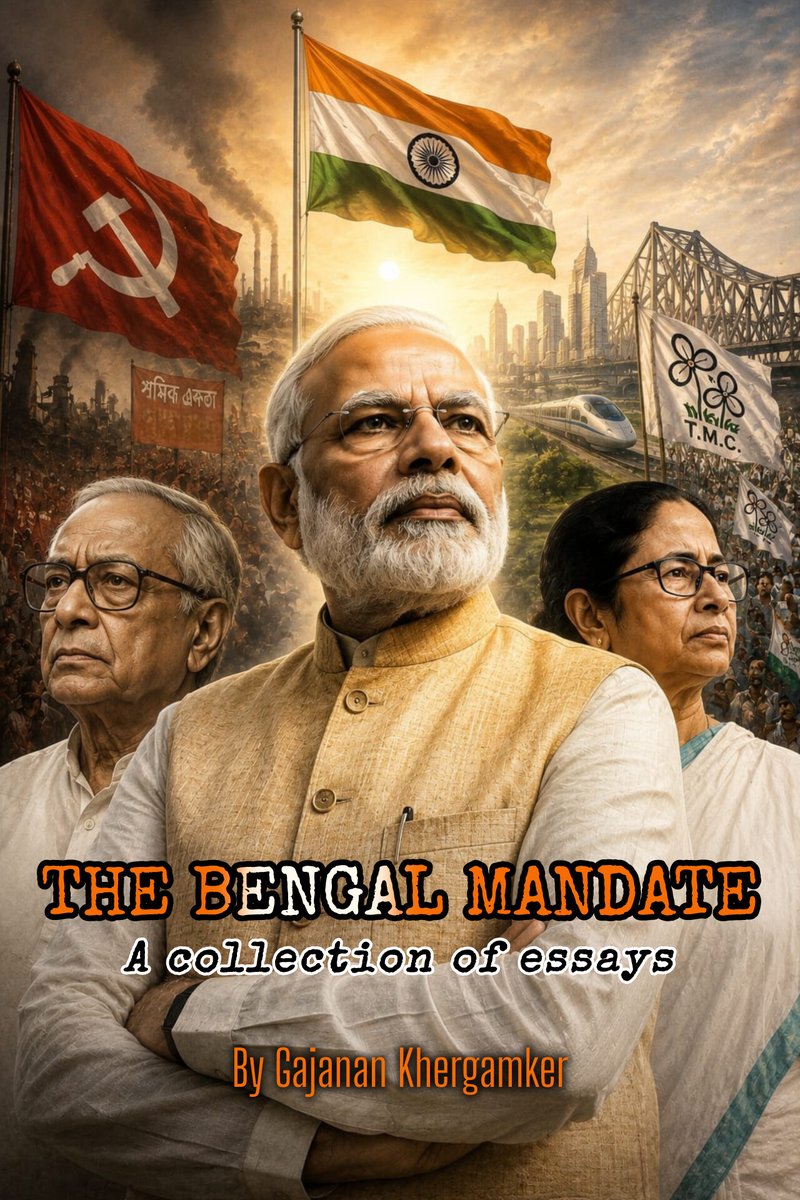
#KolkataDiaries | I did not travel to Kolkata expecting to write a series of essays. I travelled there to listen.
To walk through College Street’s fading intellectualism, to sit quietly at tea stalls where politics is discussed with the seriousness of scripture, to observe a state standing at the edge of what may become one of the most consequential political transitions in contemporary India.
What I encountered in West Bengal after the BJP’s phenomenal victory was not merely celebration or resistance. It was something far more layered. Fatigue. Curiosity. Anxiety. Assertion. Silence. Reinvention.
That journey eventually became this collection of essays.
Bengal as Blueprint is not a campaign chronicle, nor is it an exercise in partisan applause or ideological lamentation. It is an attempt to examine what happens when a state that long resisted the BJP’s political vocabulary suddenly begins speaking in a different electoral language. It asks uncomfortable questions about power, identity, federalism, bureaucracy, political violence, cultural negotiation, minority anxieties, the eclipse of the Left, and the future of opposition politics in India.
Over several essays, I explore whether Bengal is witnessing the end of an era, or merely the mutation of one.
Can a party built on command governance adapt to Bengal’s deeply localised political culture? Has Hindu consolidation genuinely reshaped the state’s political imagination, or is this only a temporary realignment? What becomes of Mamata Banerjee in opposition? Can the BJP govern Bengal without unsettling its cultural grammar? And perhaps most importantly, does this victory become a blueprint for eastern India, or a cautionary tale about the limits of political replication?
Bengal has never been politically ordinary. It absorbs ideology differently. It negotiates power differently. It remembers differently.
This was written in hotel rooms, cafés, taxis, railway compartments, and long walks through Kolkata’s restless streets immediately after the verdict. It attempts to capture not just the politics of a result, but the atmosphere of a state in transition.
For readers who follow Indian politics beyond headlines and television binaries, I hope these essays offer a more layered conversation.
Because West Bengal is rarely just about West Bengal.
Read my collection of essays 'The Bengal Mandate' here: https://t.co/fKKlXFKC07
#WestBengal #Kolkata #BengalPolitics #Politics #Essay #NewsEssay #Election #Elections2026 #DraftCraft
#KolkataDiaries | In a parliamentary democracy built on the foundational principle that electoral mandate is sovereign, that the people's verdict is not a suggestion but a directive, the Chief Minister of West Bengal has chosen to remain in office following a result that, by any honest accounting, constitutes a significant popular rejection. The refusal is not merely a political calculation, though it is certainly that. It is a direct challenge to the moral architecture of representative governance, a test of whether the structures designed to ensure accountability retain any operational force or whether they have become elaborate theatre - the costumes of democracy without the substance.
The numbers do not require creative interpretation. West Bengal delivered its verdict. The mandate was not ambiguous. In democratic tradition across every serious parliamentary system, from Westminster to the state capitals of India's own history, an electoral rebuke of this character carries a singular obligation: the acknowledgment that the public trust has been withdrawn, and the dignified transfer of moral authority that follows from that acknowledgment. Mamata Banerjee's Trinamool Congress has received that verdict. She has received it. And she has declined to act on it.
Read my report from Ground Zero: https://t.co/YGrUo5Pr8X
#WestBengal #GroundReport #GroundZero #BengalPolitics #MamataBanerjee
#GroundZero | West Bengal has come a long way. From a democratically-elected communist party to have a record run to being overthrown by Mamata Banerjee's TMC that gave a tough opposition to Narendra Modi's saffron sweep across the nation, to finally ... align with the force of the BJP ... development is here ... and to stay!
Read my latest ground report from Kolkata - https://t.co/tdYl658ISf
#bengalelections #WestBengal #BJPVictory #kolkatadiaries
BJP's Gujarat Sweep Is Not A Victory ... It's A Verdict
Gujarat's municipal corporation results are not a verdict on governance. They are a verdict on the complete structural collapse of opposition politics in one of India's most contested states.
The Bharatiya Janata Party's sweep across 15 of Gujarat's municipal corporations, including clean sweeps in Morbi and Porbandar, consolidates what political analysts have been reluctant to name plainly: The organised, near-total electoral erasure of credible opposition in a state that was once the testing ground for competitive democracy at the local governance level. Morbi, the town still carrying the weight of the October 2022 bridge collapse that killed over 135 people, returning a BJP clean sweep, is not a political footnote. It is a structural statement about how accountability is mediated through narrative in contemporary Indian electoral politics.
The numbers, wherever the Congress and Aam Aadmi Party fielded candidates in these municipal contests, tell the story more honestly than any press conference. The Congress, which held Gujarat local bodies through much of the 1990s and early 2000s, has progressively ceded not just seats but the organisational infrastructure to contest them. The AAP, which arrived in Gujarat ahead of the 2022 state assembly elections promising urban disruption and a middle-class revolt against incumbency, has demonstrated precisely what ambition without grassroots architecture produces; noise, candidacy and negligible returns.
The Porbandar sweep carries its own symbolism. The birthplace of Mahatma Gandhi, a city whose political identity was once shaped by the moral weight of that association, now returns its municipal representatives without contest in any meaningful sense. The irony is not lost, and it should not be softened.
What the BJP's Gujarat municipal dominance reveals is a campaign machinery operating at a level of local penetration that its opponents have neither matched nor, by available evidence, strategically attempted to match. Booth-level management, ward-by-ward candidate selection calibrated to caste arithmetic and a welfare delivery infrastructure that functions as both governance and campaign. These are not accidental advantages, but the compounded returns of three decades of organisational investment.
The Morbi result demands specific attention. A tragedy of the scale of the Morbi bridge collapse, with its charge sheet of negligence, its questions about the municipal corporation's oversight role, its pending accountability, would, in most political environments operating under normal opposition pressure, translate into localised electoral consequence. It did not. The explanation is not that voters are indifferent to accountability. It is that accountability requires a credible vehicle, and in Morbi, as in most of Gujarat's urban wards, that vehicle does not exist.
The AAP's Gujarat project, launched with considerable media amplification and some early traction in the 2022 assembly results where the party crossed double digits in seat share, has evidently not translated into the municipal-level organisation capable of sustaining a challenge. Vote share without ward presence is a headline, not a movement.
Congress, for its part, continues the managed decline it has performed across western India with a consistency that would be admirable if it were intentional strategy rather than structural disintegration. The party that once governed Gujarat, that gave the state chief ministers, shaped its bureaucratic culture, contested its every ward, is now operating as a protest placeholder, not a governing alternative.
What Gujarat's 15 municipal corporation results confirm is that the BJP's dominance here has moved beyond the electoral cycle into something more durable: institutional presence at the granular level of local governance where civic contracts are administered, licences issued, and daily political loyalty formed. Elections at this level are won or lost years before polling day, in the ward offices, in the welfare queues, in the candidate selections that precede every vote.
Gujarat is not a bellwether. It is a terminus, the furthest point the BJP's organisational model has reached in any Indian state. The question for national politics is not whether the opposition can win Gujarat. It is whether the opposition has studied, with sufficient seriousness, exactly how it lost it.
#Gujarat #BJPAAP #BJP #MunicipalElections #Elections
It's the same story everywhere and the drama, much the same, in everyone's backyard. The law provides for free access, free speech and free movement but, come the social media frenzy, there must be some prerequisites and conditions to be met, in place. Or there's a guaranteed crisis waiting to happen.
#Goa #Tourism #Privacy #PublicSpace
#LegallySpeaking | The ‘No Photography’ signs across #Fontainhas reflect local fatigue with constant intrusion, but raise a key question: can locals restrict freedoms that the #law permits in public spaces?
Legal Analysis by Gajanan Khergamker.
#Nuisance#Privacy#PublicSpace
Panjim’s #Fontainhas residents have been hollering hoarse for #tourists to stop ‘invading’ their spaces, even put up posters banning #photography and more but have failed in keeping the tourists away. Can they do it legally?
https://t.co/L9hSIUZeNI
#Goa#Tourism#Nuisance#Law
A month ago, on 10 March 2026, I released my e-book '10/3: Exile, Empire And War In The Andamans' in a limited offline digital format, symbolically at Flag Point overseeing Ross Island, in Port Blair. It was never meant to be a finished product. It was, instead, the beginning of a conversation, one burgeoning with patriotic nostalgia.
Today, after a month of sustained engagement across lecture halls, seminar rooms, and discussion forums with academia, students, professionals, and policy observers, I have made the work publicly accessible online.
This journey began in the Andaman & Nicobar Islands, where I spent time alongside a remarkable cohort of journalists, environmentalists, researchers, and legal minds. What emerged from that experience was not a travelogue, nor a static documentary narrative, but a layered exploration of a geography that resists simplification.
The Andamans compel you to confront uncomfortable questions.
...Development here is not an abstract policy ambition; it is a lived disruption. Every road, every structure, every intervention redraws equations that have existed for centuries...
The deeper I went, the clearer it became that documentation itself is not a neutral act.
...To document the Andamans is to confront a paradox. The more one observes, the clearer it becomes that visibility itself alters the subject...
And beyond the visible lies memory, often unarticulated, frequently ignored.
...Memory in these islands does not rest in monuments alone. It lingers in landscapes, in silences, and in narratives that remain deliberately unrecorded...
Over the past month, the responses, critiques, and conversations around 10/3 have reshaped my own understanding of the work. What I had initially conceived as a publication has now evolved into something far more dynamic.
Project 10/3 is no longer just a book. It is a live, evolving framework. And, with this, I am opening that framework to you.
I invite researchers, institutions, practitioners, and engaged citizens to read, question, critique, and contribute. The intent is not passive readership, it's participation.
This is only the beginning. The road ahead will involve deeper field studies, interdisciplinary collaboration, and continued documentation of vulnerable geographies that demand nuanced attention.
If 10/3 does anything, I hope it unsettles certainty and provokes inquiry. The work is now out there. What it becomes next will depend on how we choose to engage with it.
Do have a read...
Click to View/Download PDF: https://t.co/rSqC7ak4GW
#EBook #Publication #Research #History #Andaman #FreedomStruggle #Chatham #ChathamIsland #FreedomFighters #Opportunity #Internship #IndiaRighter
The ceremonial choreography of Ambedkar Jayanti in 2026, with its blue pennants, choreographed reverence, and ritual invocations, risks presenting B. R. Ambedkar as a figure safely embalmed in national memory. That instinct, though politically convenient, is intellectually dishonest. Ambedkar was never meant to be commemorated in stillness. He was meant to be argued with, returned to, and, where necessary, confronted. His 135th birth anniversary does not mark closure. It sharpens the discomfort of an unfinished constitutional conversation that India continues to defer.
The reference to the Constitution of India as a moral contract is not rhetorical indulgence. It is a precise legal characterisation. Ambedkar’s constitutionalism was not limited to institutional design. It was an attempt to recalibrate the moral grammar of Indian society. The recent judicial reaffirmation of the “absolute religion bar” in Scheduled Caste status by the Supreme Court of India underscores the persistence of the very dilemmas he grappled with. The ruling, while doctrinally anchored in precedent, exposes the uneasy intersection of religion, caste, and state recognition. It raises a question that Ambedkar himself wrestled with in his critique of caste as a system sustained by religious sanction. Can a constitutional democracy afford to freeze social categories in theological amber while claiming to dismantle hierarchy?
At Chaityabhoomi, the site of Ambedkar’s cremation, the annual convergence of citizens is often read as an act of collective gratitude. In 2026, it also reads as a site of quiet dissent. The gathering is no longer merely commemorative, it is interpretative. Citizens arrive not just to remember Ambedkar, but to renegotiate his meaning in a republic where the distance between formal equality and substantive justice remains stubbornly intact. The symbolism of that space is inseparable from the anxieties of the present.
The recently-held 'National Conference on Judicial Process Re-Engineering and Digital Transformation' in New Delhi presents itself as a technocratic exercise. It is, in fact, an Ambedkarite moment disguised as administrative reform. Ambedkar’s insistence that law must be accessible to the last citizen finds a contemporary echo in the digitisation of courts. The project promises efficiency and transparency. It also risks reproducing exclusion in a new form. Digital justice, if not accompanied by digital literacy and infrastructural parity, may well become an instrument of procedural alienation. The question is not whether justice can be digitised. It is whether it can be democratised in the process.
The expansion of the gig economy and the visibility of platforms such as the e-Shram portal reveal another layer of Ambedkar’s continuing relevance. As India’s first Labour Minister, he approached labour not as a mere economic category but as a site of dignity. The registration of millions of unorganised workers on e-Shram is administratively significant. It is also a quiet indictment. It reflects a workforce that remains structurally vulnerable despite decades of constitutional governance. The language of flexibility and entrepreneurship that defines the gig economy often obscures the absence of social security, collective bargaining, and legal protection. Ambedkar would have recognised this paradox immediately. He would have asked whether economic modernity without social safeguards merely repackages old inequities in new vocabulary.
The interventions of the National Human Rights Commission of India in cases of bonded labour, including its recent virtual hearings, must be read within this continuum. The emphasis on rehabilitation and skill development signals an attempt to move beyond rescue into reintegration. It also highlights the persistence of conditions that the Constitution sought to abolish. Bonded labour is not an aberration but a structural residue. Its continued existence challenges the celebratory narrative of India as a knowledge economy. Ambedkar’s faith in education as emancipation was never naive. It was contingent on systemic support. Without that, education risks becoming aspirational rhetoric rather than transformative practice.
The contemporary judicial engagement with the 'merit versus reservation' debate further illustrates the enduring tension between formal equality and substantive justice. Ambedkar’s articulation of constitutional morality was a warning against majoritarian impatience. It demanded that institutions act not merely within the confines of legality but within the discipline of justice. The courts, in revisiting these questions, are not merely interpreting policy. They are navigating the ethical architecture of the Constitution itself. The invocation of merit, detached from historical disadvantage, risks reinstating privilege under the guise of neutrality. Ambedkar anticipated this critique with disarming clarity.
Culturally, the reclamation of Ambedkar across digital platforms, corporate inclusion frameworks, and community-led initiatives reflects a decentralisation of his legacy. He is no longer confined to academic discourse or political rhetoric. He inhabits everyday conversations about dignity, representation, and belonging. This diffusion is significant as it signals that Ambedkar’s ideas have escaped the custodianship of the state and entered the vocabulary of the citizen. That transition, however, carries its own risks. Simplification can dilute complexity. Symbolism can eclipse substance.
The impending hearings before the National Human Rights Commission of India on labour exploitation serve as a sobering counterpoint to the day’s commemorative fervour. They remind us that constitutional promises are not self-executing. They require continuous institutional vigilance and civic engagement. Ambedkar’s caution against the “grammar of anarchy” acquires renewed relevance in an era defined by instantaneous mobilisation and digital outrage. The temptation to bypass constitutional processes in pursuit of immediate justice is strong. Ambedkar’s warning was not conservative, it was pragmatic. He understood that the erosion of constitutional method ultimately weakens the very groups it seeks to empower.
To engage with Ambedkar in 2026 is to resist the comfort of selective remembrance. It requires a willingness to interrogate the republic’s performance against its foundational commitments. The processions will disperse, the slogans will fade, and the iconography will return to its frames. What must endure is the discipline Ambedkar demanded. Justice, as he conceived it, was not an event to be celebrated annually. It was a practice to be sustained daily, through institutions that are accountable, policies that are inclusive, and a citizenry that is vigilant.
In that demanding, often uncomfortable, discipline lies the true measure of Ambedkar’s relevance. He does not belong to the past. He persists as a constitutional conscience, interrogating the India of 2026 with the same rigour with which he once imagined it.
#AmbedkarJayanti #Ambedkar #Constitution #India #Law #Reservation #ConstitutionOfIndia