As part of the Su-30MKK's weapon package, R-77/AA-12/RVV-AE active radar homing AAM was provided to PLAAF for the first time.
China later developed its PL-12 (SD-10) active radar-homing air-to-air missile heavily using technology, design concepts, and seeker components derived from the Russian R-77 (Vympel NPO R-77) family.
Now they advanced it to PL-15 , PL-16 and PL-17 series on their own.
There is a probability that murica may begin ground invaSION on PerShia next month. May use fighter ships masquerading as cargo vessels on the SoH.
I hope I am proven wrong.
I remember few days back, India ran a nationwide Emergency Alert test. Loud siren, flashing text — most phones got it.
But some Indians got nothing. Later many mutuals and indians found out that? Emergency Alerts were switched OFF in their phone settings all along.
That's a real gap ,in an actual disaster, that's the alert that could save your life.
Check now:
Settings → Notifications → Wireless Emergency Alerts → turn ON everything.
Don't just fix yours. Forward this to your family group. RT this. Someone you know might have it switched off and not even know it.
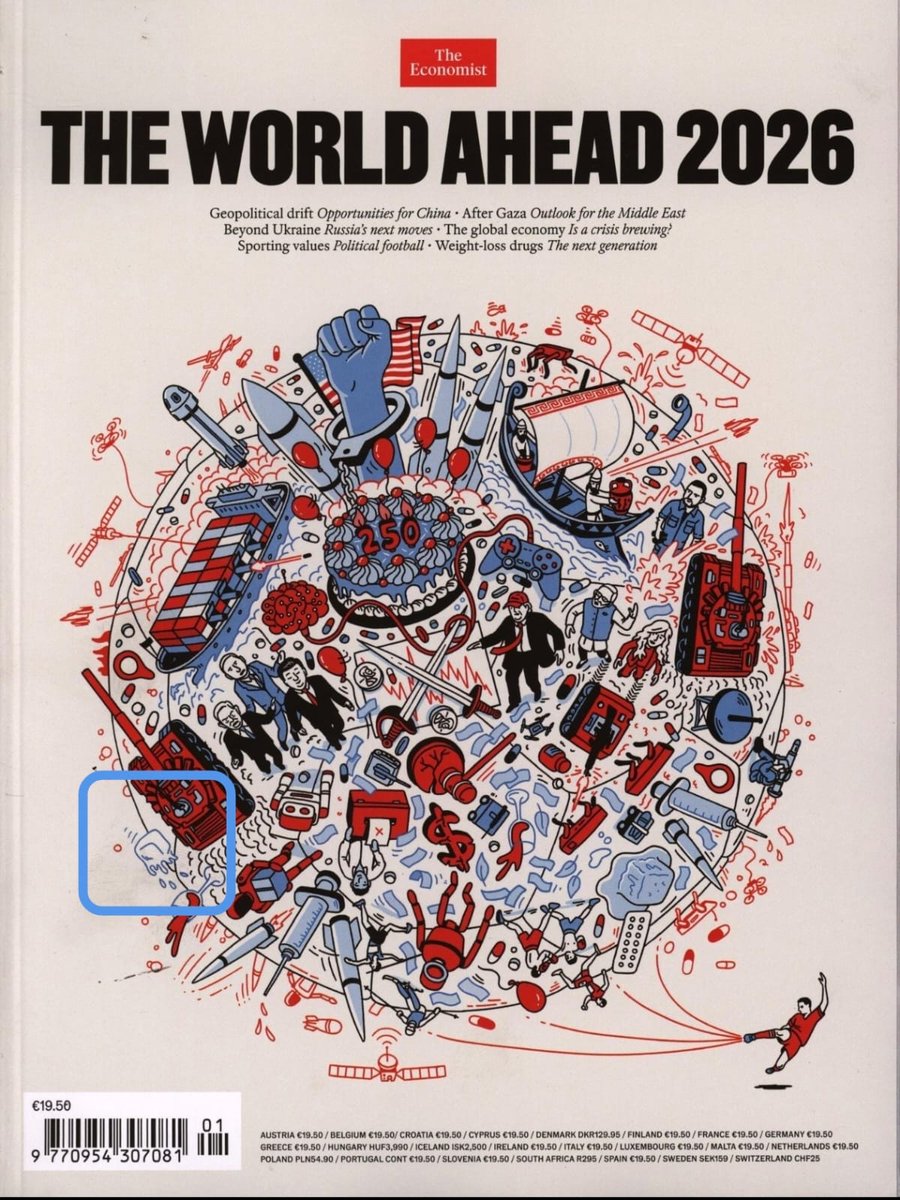
Rothschild family owned magazine The Economist published this cover image in its January 2026 edition
If you look carefully at first image, they have shown a melting glacier at bottom left
If you place this image on a clock, melting glacier aligns exactly with the end of August
When Iltutmish razed Nagda and thought Mewar was finished, Jaitra Simha Rawal smashed his army so completely that the Sultan never looked south again.
One undefeated king. 43 years. Half a century of safety for South India.
A name every Hindu should know.
https://t.co/03pA4EOC3i
The 13th Century CE, Indian poet and saint Gyandev created a children's game called Moksha Patam. The British later named it as Snakes and Ladders instead of retaining the original Moksha Patam....
Originally, the game was used as a part of moral instruction to children. The squares in which ladders start were each supposed to stand for a virtue, and those housing the head of a snake were supposed to stand for an evil. The snakes outnumbered the ladders in the original Hindu game. The game was transported to England by the colonial rulers in the latter part of the 19th Century CE, with some modifications.
In the original one, a ‘hundred squares game board’, the 12th square was faith, the 51st square was reliability, the 57th square was generosity, the 76th square was knowledge, and the 78th square was asceticism. These were the squares where the ladders were found and one could move ahead faster.
The 41st square was for disobedience, the 44th square for arrogance, the 49th square for vulgarity, the 52nd square for theft, the 58th square for lying, the 62nd square for drunkenness, the 69th square for debt, the 84th square for anger, the 92nd square for greed, the 95th square for pride, the 73rd square for murder and the 99th square for lust. These were the squares where the snake waited with their mouth open.
The 100th square represented Nirvana or Moksha.The tops of each ladder depicted a God, or one of the various heavens (Kailash, Vaikunth , Brahmalok) and so on. As the game progressed various actions were supposed to take you up and down the board as in life..The game had been interpreted and used as a tool for teaching the effects of good deeds versus bad ones.
The game was popular in ancient India. It was also associated with traditional Sanatan philosophy contrasting karma and kama, or destiny and desire. It emphasized destiny, as opposed to games such as pachisi, which focused on life as a mixture of skill and luck. The underlying ideals of the game inspired a version introduced in Victorian England in 1892.
The modified game was named Snakes and Ladders and stripped of its moral and religious aspects and the number of ladders and snakes were equalized. In 1943, the game was introduced in the US under the name Chutes and Ladders.
#archaeohistories
Invented in 1910 by Bengali polymath Dr. Indumadhab Mallick, the Icmic cooker was India's original portable steam cooker, designed to be "hygienic" and "economic" (IC-MIC).
In 1968, Hamid Dalwai published a short book arguing that Hindu communalism was a reaction to Muslim communalism, and that it would not go away until Muslim communalism did.
Dalwai was a Muslim, a socialist, and a man who had spent his working life on reform inside his own community.
The book made him unwelcome across most of the Indian intelligentsia. It is still the sharpest criticism of Muslim society in India written by an Indian Muslim.
He knew the first objection would be that he was doing the Hindu right's work for it. So before making his case he put his record on the table. He had opposed the ban on cow slaughter, and not on Islamic grounds as Shah Waliullah had, but on economic ones.
Congress had always drawn a line between the communal Muslim and the nationalist Muslim. It condemned the first and honoured the second.
Dalwai said the line did not exist, and he argued it using what nationalist Muslims had said themselves.
Syed Mahmud, a former Congress leader routinely described as a nationalist Muslim, told him:
- that Hindus were incapable of ruling a country,
- that the nation was going down the drain because Muslims had no share in power, and
- that only Muslims could save it.
The difference Dalwai found was not in what such men wanted but in how they meant to get it. Jinnah had settled for an Islamic state in one part of the subcontinent. The nationalist Muslim, on Dalwai's reading, opposed partition because a smaller India was a smaller field to Islamise.
He did not put the blame on Muslim leadership alone.
He blamed the secular parties, which found the arrangement convenient, and Congress in particular for building up the ulema as leaders of the community instead of the small number of Muslims who wanted to reform it.
What he wanted in their place was a liberal Muslim class committed to modern values, and he was clear that Muslim society had not yet produced one.
However, Dalwai did get some of it wrong, and his reading of Savarkar is where it shows.
The liberal Muslim class he wanted has produced some voices since but almost all of their energy goes on Hindutva and almost none on the communalism inside their own community.
Read the full piece for the quotations Dalwai collected from the men everyone called nationalist, and for the one reform proposal of his that would trouble most of his admirers.
https://t.co/6J24oQSZkP
𝗕𝗲𝗻𝗴𝗮𝗹’𝘀 𝗼𝗶𝗹 𝗽𝗿𝗼𝗱𝘂𝗰𝘁𝗶𝗼𝗻 𝗯𝗲𝗴𝗶𝗻𝘀 𝗮𝘁 𝗔𝘀𝗵𝗼𝗸𝗻𝗮𝗴𝗮𝗿.
Commercial crude oil extraction has begun in Ashoknagar, North 24 Parganas, from a depth of around 2,396 metres. ONGC is initially targeting nearly 20,000 litres of crude per day, with specialised tankers transporting the oil to a refinery. Exploratory extraction in 2020 had produced around 375 barrels. The Ashoknagar block now has 6 wells—4 for oil and 2 for natural gas.
Around ₹1,000 crore has already been invested in the project. Crude from Baigachi has an API gravity of 40–41, reportedly comparable to Bombay High crude. ONGC plans 5–6 more drilling locations and further exploration across Bhurkunda, Daulatpur and other areas. Road upgrades and local development support are also planned, while technical and land-related hurdles are being resolved to expand production.
Let me explain this chart (also check my sources in snip of excel) which also appears in my book.
The chart is presenting Timur and Genghis Khan as descendants of the same ancestor, but through different sons of Tumanay: Qachuli and Khabul.
That genealogy is found in the Timurid genealogical tradition, while the Khabul–Bartan–Yesügei–Genghis portion is independently and very strongly attested in the much earlier Secret History of the Mongols.
Rashid al-Din’s Jamiʿ al-Tawarikh (14th-century universal history written by the Persian physician and statesman Rashid al-Din Hamadani in the Mongol Ilkhanate) preserves the relationship of the Barlas to the same ancestral stock as the Kiyad/Borjigin, and identifies Qachuli as the ancestor of the Barlas.
The right source for every connection are as below:
1. Tumanay > Khabul
The Secret History of the Mongols, §48, calls Tumbinai Sechen the father of Qabul Qahan.
So, Tumbinai/Tumanay > Qabul/Khabul
is directly attested by the early Mongol source.
2. Khabul > Bartan
Again, Secret History, §48. It lists Bartan Ba’atur among the seven sons of Qabul Khan.
3. Bartan > Yesügei
Secret History, §50. It gives Bartan’s sons and names Yesügei Ba’atur among them.
4. Yesügei > Genghis Khan
Secret History, §§59–60.
The text records the birth of Temüjin to Yesügei Ba’atur and Hö’elün, and then explicitly identifies Temüjin among Yesügei’s sons.
Now the left-hand branch
5. Tumanay > Qachuli
The Timurid genealogical tradition identifies Qachuli/Qāchulī as the son of Tumanay and the twin brother of Qabul. Sharaf al-Din ʿAli Yazdi’s Zafarnama develops this genealogy, as do other Timurid genealogical works. Modern scholarship has specifically noted that these early Timurid nasab-namas constructed the parallel Chinggisid–Timurid genealogy.
6. Qachuli > Erdemchu Barlas
This is part of the same Timurid genealogy.
Yazdi’s genealogical account makes Erdemchu Barlas the son of Qachuli.
7. Erdemchu > Suqu Sechen
Yazdi identifies Suqu Sechen as one of Erdemchu Barlas’s sons and the most prominent among them.
8. Suqu Sechen > Qarachar
This one is particularly interesting because they have an early source too.
The Secret History of the Mongols, in its account of the 1190 tribal assembly, names:
Suqu Sechen with his son Qarachar
among the Barlas delegation.
However, later Yazdi material gives Suqu a biography that conflicts with the Secret History. Yazdi has Suqu dying around the time of Yesügei’s death, whereas the Secret History places Suqu alive at the 1190 assembly. So the existence of Suqu and Qarachar, and their father-son relationship, are early; the elaborate biography surrounding them is not equally secure.
9. Qarachar > Ichil
Here we have something much better than a late genealogy.
The Bibi Khanum mosque inscription, made during Timur’s own reign and dated 806 AH / 1403–04, gives Timur’s genealogy as:
Amir Timur Gurgan b. Taraghay b. Burgul b. Aylangir b. Ichil b. al-Amir Karachar Noyan
The inscription therefore explicitly establishes:
Qarachar > Ichil > Aylangir > Burgul > Taraghay > Timur.
10. Ichil > Aylangir
Same inscription.
11. Aylangir > Burgul
Again it also appears in the Bibi Khanum inscription.
12. Burgul > Taraghai
Again in the same inscription.
13. Taraghai > Timur
And finally too is stated there as well.
The inscription calls him:
Amir Timur Gurgan b. Taraghay b. Burgul b. Aylangir b. Ichil b. al-Amir Karachar Noyan
and dates the completion of the mosque to 806 AH.
The descent of Qabul–Bartan–Yesügei–Temüjin is recorded in the Secret History of the Mongols. The Barlas genealogy through Qachuli, Erdemchu and Suqu is preserved in the Timurid genealogical tradition, while Suqu��s son Qarachar is independently mentioned in the Secret History. The descent from Qarachar to Timur—through Ichil, Aylangir, Burgul and Taraghai—is also recorded in the inscription of the Bibi Khanum mosque at Samarqand, dated 806 AH (1403–04).
India’s external debt is among the lowest in the G20, at just 19.4% of GDP.
While several major economies carry external debt exceeding 100% of their GDP, India remains at the lower end of the table.
Here’s how India compares with the world’s major economies.
The film was a biographical documentary on Subhas Chandra Bose and drew on footage that had been smuggled from Southeast Asia into India. One account says the reels reached Sardar Patel through B. C. Mehta after being brought from Yangon.
March 1947 :: Sardar Patel Becomes Film Producer
Sardar Patel Produces Documentary Film On Netaji Subhas Chandra Bose
Pre View Screening After Obtaining Necessary Approvals
India is at the forefront of the global digital payments revolution, accounting for 49% of global real-time transactions. As UPI completes 10 years, it now handles 85% of India’s digital transactions and is operational in 11 countries, taking digital payments innovation global.
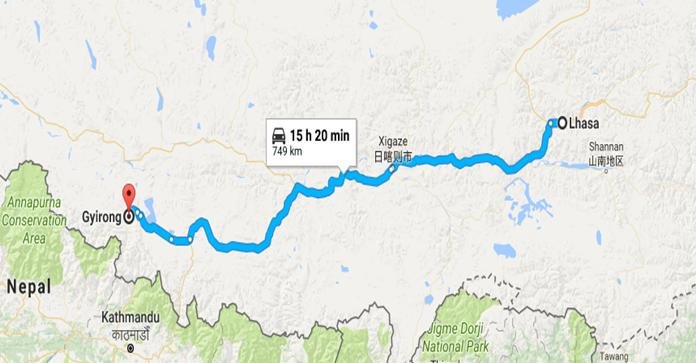
THE PROOF: CHINA IS CUTTING DOWN, BORING THROUGH THE HIMALAYAS IN ECO-SENSITIVE TIBET.
The Padang Mountain Tunnel (Padangshan Tunnel) is one of China's biggest highway tunnel projects in Tibet. It is part of the Lhasa–Shigatse Expressway, the expressway. This snakes through the Himalayas and it forms the backbone of China's road corridor towards the Gyirong (Kerung) Port on the Nepal border. The tunnel is located in Rinbung County, Shigatse, roughly 200–250 km from the Nepal border at Gyirong/Rasuwagadhi.
Very often as the pictures show the debris is left in open landfills. This creates perfect conditions for mud slides and river bed encroachment.
The USA & China are 2 of the largest contributors to the UN. If we develop the Great Nicobar project, located near the strategic Strait of Malacca it'll likely concern both countries because of its proximity to that maritime choke point. Now we must definitely go for dis project.
The GOI should study the Nepal disaster & urgntly prepare for future disaster like situations in NE India. With China’s Medog Hydropower Station on the Yarlung Tsangpo River in Tibet the risks for downstream regions like Arunachal & Assam could be huge. Prevention must start now.
"নন্দলাল বসু-কৃত যাদবপুরের লোগো ভ্যান্ডালিজমের বিরুদ্ধে যারা কেঁদে ভাসাচ্ছেন , আর্ট স্কুল বিশ্ববিদ্যালয়ের আঙিনা থেকে নন্দলাল এবং অবনীন্দ্রনাথের ভাবধারা কে সম্পূর্ণ নির্বাসন দেওয়ার পিছনে সবচেয়ে বড় হাত এই এদেরই ! যে সব উঠতি ক্ষুদে শিল্পীরা আর্ট কলেজ ভারতীয় পুরাণ দেবী দেবী আঁকে তাদেরকে সরাসরি " ক্যালেন্ডার এঁকে কি হবে ? " অথবা " সেই বস্তাপচা ঠাকুর দেবতা আঁকলে কি আর্ট হয় " .... বলে হতোদ্যম করার মূল কান্ডারী সেই তারাই । এরা একটা বিশেষ বৈদেশিক মতের অনুপ্রেরণায় ভারতের ধর্মকে যখন নির্বাসিত করেছিল তখনই ধর্মের সাথে সাথে বেঙ্গল স্কুলকেও নির্বাসিত করেছে ।
তাই আজকে এদের কুম্ভীরাশ্রু আমার মনে বিন্দুমাত্র রেখাপাত করছে না ! আগে নন্দলালের ভারত বোধ কি আপন করুন , তারপর এই নাটক করতে আসবেন ।" - Halley Goswami
🚨 Noida-based EndureAir Systems has combined its UAV tech with Addverb Technologies’ quadruped robot to demonstrate autonomous reconnaissance capabilities.
This integrated system can enter confined and hazardous zones first, giving forces safer reach in high-risk environments.