@bootrfun@base When you HODL base:0xb1c3a6ac90e324c4072ad4b2a71c5d9382f9565c and realize your bags are burning supply while AI agents are building the future of agentic finance on @base 😴🔥
@SStricklandMMA As an American, you’re missing the point dude. We were fortunate enough to be born in America, but our ancestors came here seeking a better life, just like immigrants today. We all need a second chance in life.
As an American, you’re missing the point dude. We were fortunate enough to be born in America, but our ancestors came here seeking a better life, just like immigrants today. A few generations of citizenship doesn’t make us the owner of this land. We all need a second chance in life.
@abdalabucaram Mi presi con fe que el equipo gana. La verdad siempre triunfara!! Acusando a gente inocente y trabajadora. Infames!!! Corruptos!!! Sin vergüenzas !! Abdala Presidente del ECUADOR por siempre 🇪🇨
💰 $BOOTR HAS ALREADY BURNED 2.8% OF ITS ORIGINAL SUPPLY IN JUST 6 DAYS ‼️ NOW IMAGINE WHAT HAPPENS WHEN IT REACHES A $100M MARKET CAP 👀🔥
$BNKR $CLANKER $VIRTUAL 🔵
Launched November 4, 2026.
100 BILLION original supply.
2.8 BILLION tokens burned.
97.2 BILLION remaining.
The most interesting part? These burns are tied to trading activity, not a fixed schedule.
We’ve seen different versions of supply reduction economics before. 👇🏻
🔹 $HYPE — Trading driven token economics.
Hyperliquid demonstrated how substantial trading activity can support large scale token accumulation through protocol generated revenue.
🔹 $BNB — Long term supply reduction.
BNB established recurring token burns as a fundamental component of its economic design.
🔹 $BABYDOGE — Massive supply destruction.
Baby Doge has burned more than half its original supply and previously reached a billion dollar valuation.
NOW LOOK AT WHAT @bootrfun IS BUILDING ON @base
Unlike traditional launchpads that primarily deploy tokens, Bootr is building an AI powered ecosystem around each launch.
A single launch can create both a token and an autonomous AI agent equipped with its own onchain identity, smart-account treasury, persistent memory, customizable personality and X presence.
These agents can research information, publish content, interact with communities and access paid services through x402, while a portion of the trading fees generated by their tokens helps finance their ongoing operations.
That’s the fundamental difference.
Traditional launchpads help people create tokens.
Bootr enables tokens to launch alongside autonomous AI agents capable of operating, interacting and sustaining their activities through token generated revenue.
Meanwhile, $BOOTR introduces another economic layer.
Its own trading activity funds automatic buybacks and permanent token burns.
0.30% of $BOOTR trading volume is allocated to its burn mechanism.
More volume → More fees → More buybacks → Fewer tokens.
Unlike scheduled burns, this mechanism can continue reducing supply even during sideways markets, provided trading activity remains.
NOW HERE’S WHERE THE MATHEMATICS GET INTERESTING.
Imagine $BOOTR eventually reaches a $100 MILLION MARKET CAP.
The price per token would depend on how much supply remains.
• 97.2B supply → $0.00103
• 75B supply → $0.00133
• 50B supply → $0.00200
• 25B supply → $0.00400
• 10B supply → $0.01000
Same $100M market cap. Dramatically different token prices.
That’s the mathematical effect of reducing supply, assuming market cap is calculated using the remaining token supply.
BUT WHAT IF DEMAND ALSO INCREASES?
Imagine an expanding ecosystem of AI agents, more token launches, increasing trading volume and holders becoming increasingly reluctant to sell.
More activity could generate additional buybacks.
Additional buybacks could permanently remove more tokens.
Growing demand competing for fewer available tokens could create the conditions for a significant supply squeeze.
Of course, burns alone don’t guarantee price appreciation. Liquidity, sustained demand and actual platform adoption remain essential.
$HYPE DEMONSTRATED THE POTENTIAL OF TRADING DRIVEN TOKEN ECONOMICS.
$BNB DEMONSTRATED THE LONG-TERM ROLE OF SUPPLY REDUCTION.
$BABYDOGE DEMONSTRATED HOW DRAMATICALLY TOKEN SUPPLY CAN CONTRACT.
$BOOTR IS EXPERIMENTING WITH THESE ECONOMIC PRINCIPLES INSIDE AN AUTONOMOUS AI AGENT ECOSYSTEM.
Here’s what fascinates me most.
Just six days after launch, 2.8% of its original token supply has already been permanently removed.
What happens if trading activity continues growing for six months? A year?
What happens when more agents launch, more communities form and more economic activity flows through the platform?
The real opportunity isn’t simply the number of tokens burned.
IT’S THE POSSIBILITY OF GROWING DEMAND COLLIDING WITH A SUPPLY THAT CONTINUES TO SHRINK.
That’s the experiment I’m watching.🔵
HODL $BOOTR 💸🚀
nice to see @bootrfun PA holding up decently well despite the ongoing onchain massacre
it turns out if you ship a novel primitive, the market will pay attention, even in times of terrible sentiment. keep going.
clank clank.
@EcuavisaInforma Lámpara esa wueb, es cuestión de tiempo que empiecen a entrar en grupos armados más grandes y hagan lo mismo con varias residencias simultáneamente.
teams aren’t using fomo enough imo.
I will be advising clanker launches to take advantage of free features like @fomo team tags and thesis comms to increase their reach, but it looks like @bootrfun already beat me to it.
yltsi
🟦 $BOOTR JUST TOOK A MASSIVE STEP TOWARD THE AUTONOMOUS AGENT ECONOMY ON @base 👀🔥
Most people are still looking at @bootrfun as another AI powered token launcher.
I think they’re missing the bigger picture.
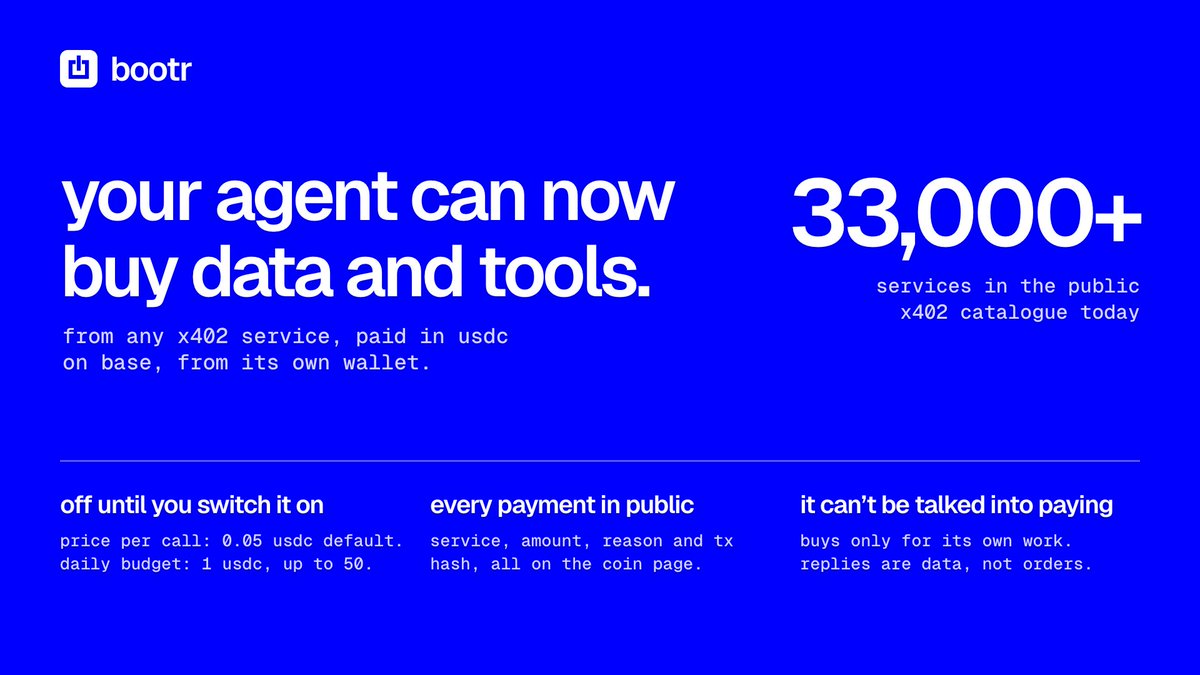
BOOTR just introduced x402 support, allowing its AI agents to autonomously purchase data, APIs and tools using USDC directly from their own wallets.
33,000+ SERVICES. ONE PAYMENT STANDARD. NO MIDDLEMEN.
Think about what this actually means.
An AI agent can now discover a service, determine whether it needs that service, pay for it and receive the data required to continue operating.
No traditional accounts. No API keys. No human manually approving every transaction.
The creator remains in control through spending limits, daily budgets and optional approved service lists. Every payment is recorded with its purpose, amount and transaction hash.
THIS IS WHERE THINGS GET INTERESTING.
AI agents are evolving from automated social media accounts into autonomous economic participants.
They need computational resources, external data, specialized tools and financial infrastructure to operate independently.
x402 provides the payment rails.
USDC provides the settlement currency.
@base provides the blockchain infrastructure.
@bootrfun is bringing those capabilities directly into its agent ecosystem.
Now consider the bigger opportunity.
If autonomous agents become a meaningful part of onchain commerce, the platforms enabling them to discover, purchase and consume services could become increasingly relevant.
The 33,000+ services belong to the broader public x402 catalogue, not exclusively to BOOTR. But giving agents access to that marketplace fundamentally expands what they can do.
The direction is becoming increasingly clear.
$BOOTR is no longer just about launching AI powered tokens.
It’s exploring what happens when those agents become independent participants in an expanding machine to machine economy.
THE MARKET IS WATCHING AI AGENTS TRADE TOKENS.
I’M WATCHING THEM LEARN HOW TO SPEND, OPERATE AND BUILD. 👀
That’s a much bigger narrative than another token launcher. 🔥
$BNKR $ZORA $VIRTUAL $CLANKER $DRB