A single FibroScan reading has a 35.6% day-to-day coefficient of variance.
A reading of 10 kPa = true range of 6.5–13.5 kPa.
Prof. Arun Sanyal on what non-invasive liver fibrosis tests actually tell you — and what they don't.
For resource-limited settings:
If FibroScan isn't practically accessible, FIB-4 alone is sufficient to stratify risk and initiate treatment.
Don't let lack of elastography delay care for a patient with FIB-4 >1.3.
"There is no point being obsessed about the liver if the patient is going to die from a heart attack next year. And no point fixing the heart if liver cancer is coming in twelve months."
— Prof. Arun Sanyal
This is what integrated metabolic care actually means.
The bidirectionality matters too.
More metabolic syndrome features = higher liver outcome hazard ratio:
2 features → HR ~1.5 6 features → HR ~4.0
The liver drives CRM outcomes. CRM drives liver outcomes. Same biology. Same patient.
Temporal sequence (CDC data):
Obesity surge → fatty liver → diabetes
The liver gets hit first. T2DM comes later, once beta-cell reserve is lost.
If you're screening for diabetes and not for liver disease, you're detecting the downstream event and missing the upstream driver.
The mechanism isn't theoretical.
MASLD upregulates hepatic HMG-CoA reductase + SREBP-2 → excess VLDL → LDL → coronary plaque.
Most of the body's cholesterol is made in the liver. Fat in the liver = atherogenic factory running in overdrive.
We've been treating HTN, T2DM, CKD, HFpEF, and fatty liver as separate problems in the same patient.
Prof. Arun Sanyal says they're one disease with multiple organ manifestations.
The data are hard to argue with.
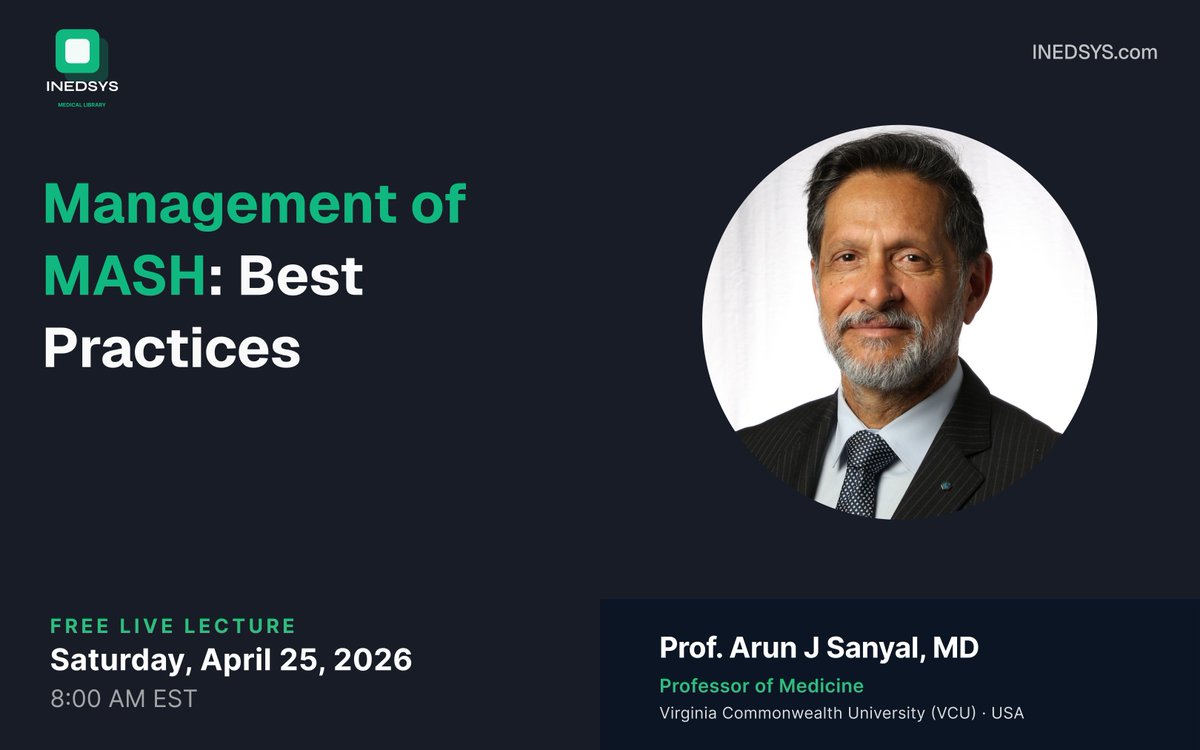
Free live lecture: Management of MASH — Best Practices
Speaker: Prof. Arun J. Sanyal, MD (VCU) Past President, AASLD · Chair, NIH NASH CRN 500+ publications · H-index 150+
Sat, April 25 · 8:00 AM EST Register → https://t.co/uSaHuVjIP4
#MASH#MASLD#Hepatology#LiverTwitter