We are pleased to announce the first edition of Inference Magazine — a new publication on AI progress.
In the first edition, we cover:
How much economic growth we should expect from AI, how soon? Previous general-purpose technologies provided very gradual boosts to growth over decades, should we expect this time to be different?
Next, ‘AGI is an engineering problem’ argues that all the necessary components for building human-level AI systems are in place, and all that remains is scaling the engineering.
Finally, ‘on o1’ is a technical primer on the new reasoning paradigm.
Links are in the thread below...
Inference is hosting some of the world’s leading experts for a debate on the possibility and potential consequences of automated AI research.
The debate will be hosted in London on July 1st. There are limited spaces available. Register your interest below
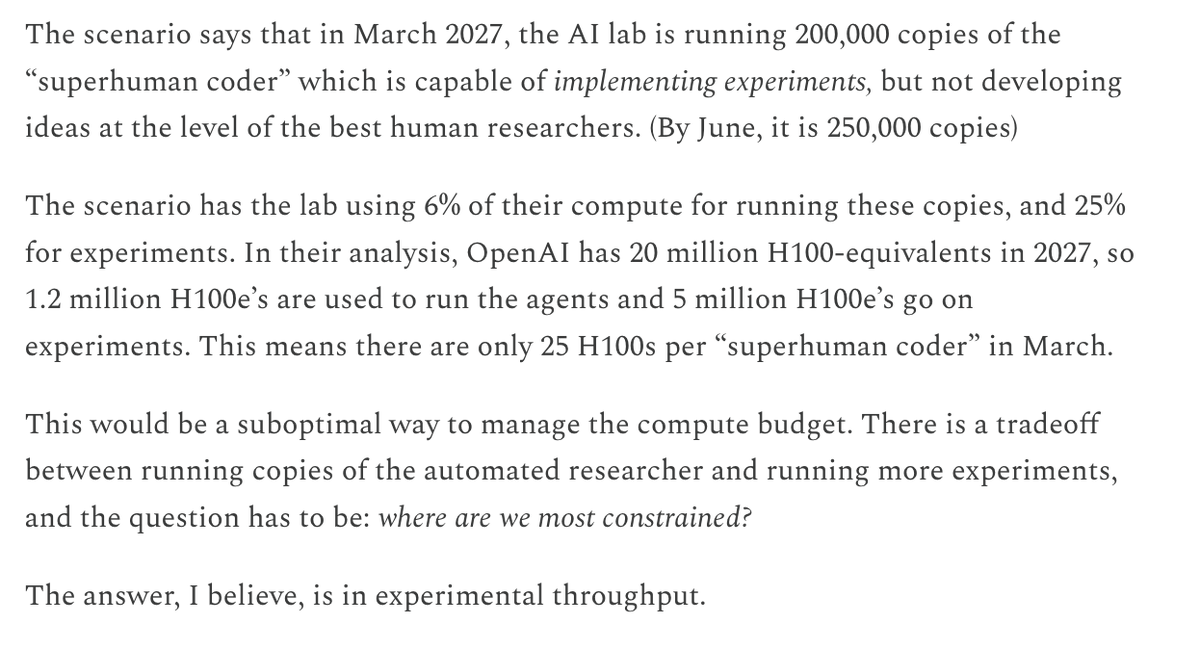
AI 2027 forecasts that 200k automated superhuman coders will be accelerating AI research in March 2027, but what are they all going to do?
Based on their forecast, each coder only has 20 GPUs to work with.
My latest piece on why I think AI 2027 is an unrealistic scenario:
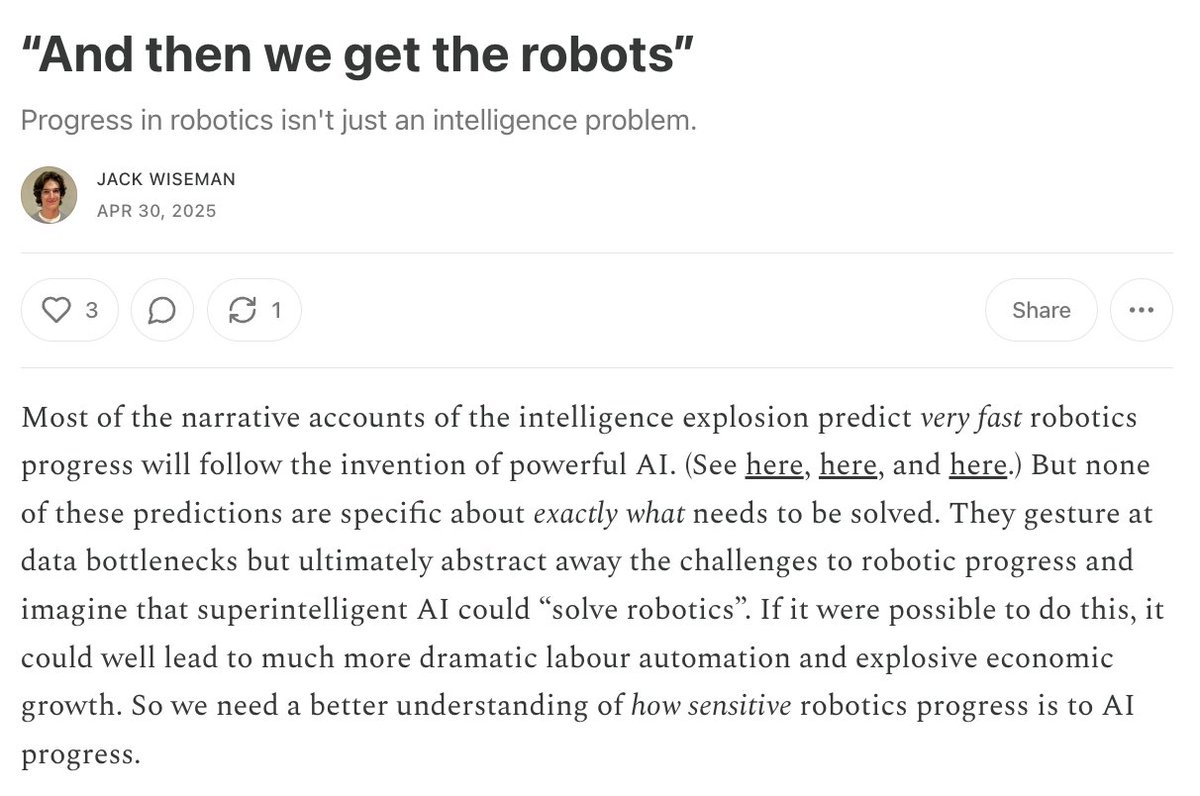
Narratives of the singularity (sit awareness, AI 2027 etc) assume it will be straightforward to "solve robotics" with powerful AI.
But they don't address the challenges in robotic R&D.
To get robots that could automate 100% of human tasks, we'll need to improve the hardware.
Inference latest: The Parrot Is Dead
We've had indications for a while that AI models aren't just "stochastic parrots". Anthropic's new research has proved it: large models are learning circuits to solve general classes of problems.
But what separates this from human reasoning?
Latest from Inference
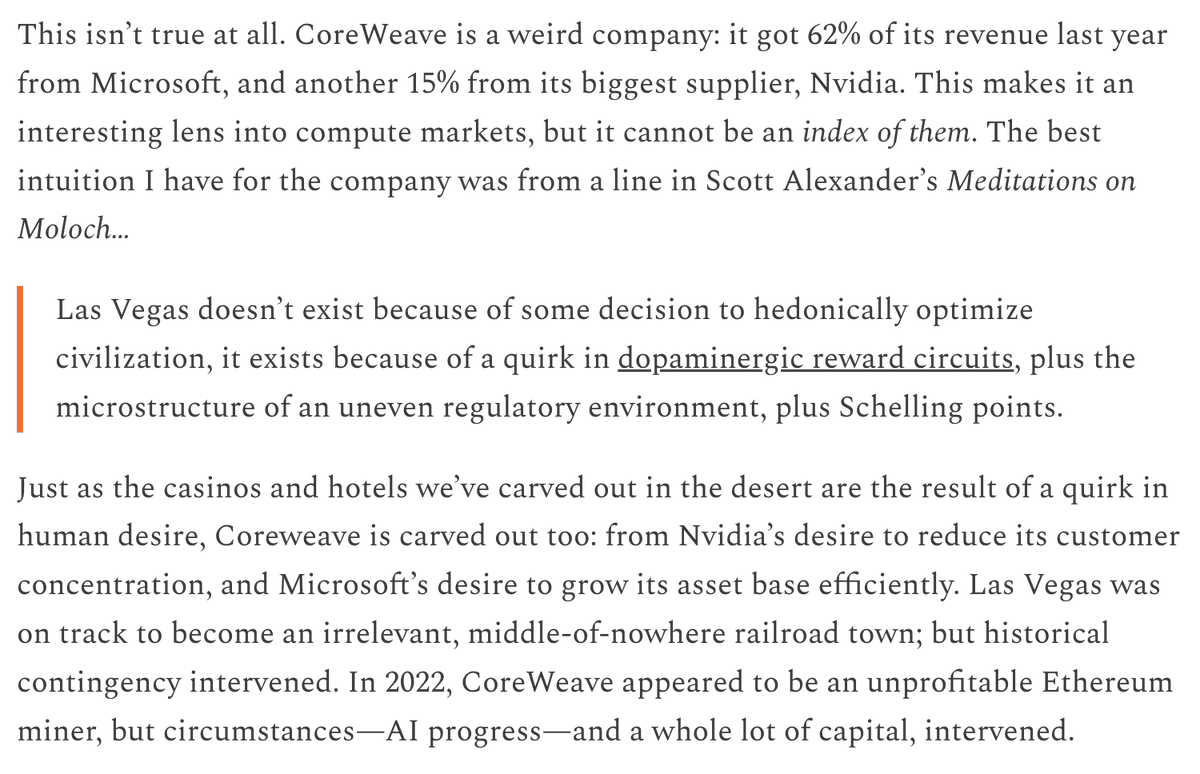
CoreWeave is the largest AI neocloud, which rents compute to Microsoft, OpenAI, and Nvidia.
Some commentators have suggested that "demand for CoreWeave = demand for AI" and that CoreWeave struggling would vindicate suggestions that AI revenues do not live up to the hype.
But CoreWeave is nearer to a financial tool for these Great Powers to manage the AI infrastructure buildout.
Link to the article in the thread below.
When will AI systems be able to carry out long projects independently?
In new research, we find a kind of “Moore’s Law for AI agents”: the length of tasks that AIs can do is doubling about every 7 months.
New from me & @jackwisem4n in @inferencemag: Peak Brussels
Right now, it looks like EU institutions run European AI policy. This piece tells the story of how that could rapidly unravel in the face of economic and geopolitical pressure.
🧵
New from me & @jackwisem4n in @inferencemag: Peak Brussels
Right now, it looks like EU institutions run European AI policy. This piece tells the story of how that could rapidly unravel in the face of economic and geopolitical pressure.
🧵
--
(NB: We do not endorse the OP's comments; especially on 'socialist logic' or 'suicidal energy policy', this was a narrow point about compute)
[1] https://t.co/v9TqGz3mru
[2]https://t.co/bz6O5nKIQu
[3]https://t.co/0qodqONUBG
[4]https://t.co/2CDVdGmdAs
[5] https://t.co/2CDVdGmdAs
This response makes a fundamental error about compute, which signals poorly to potential investors and hyperscalers about the UK's capacity to deliver on AI datacentres.
Stark says, "I am sceptical about some of the future projections for the increasing power demand [of AI], because they are based ultimately on the idea that we won't see efficiencies in the way AI takes place."
This misunderstands how computation works! Whenever we have improved the efficiency of computation; there is induced demand! (i.e. New things to do with cheaper computing power!)
Behold the socialist logic that drives our suicidal energy policies.
Chris Stark, put in charge of decarbonising the Grid by Ed Miliband, says data centres vital for AI must be located not where it suits business, or where tech workers are, but where it suits the Grid (1/6).