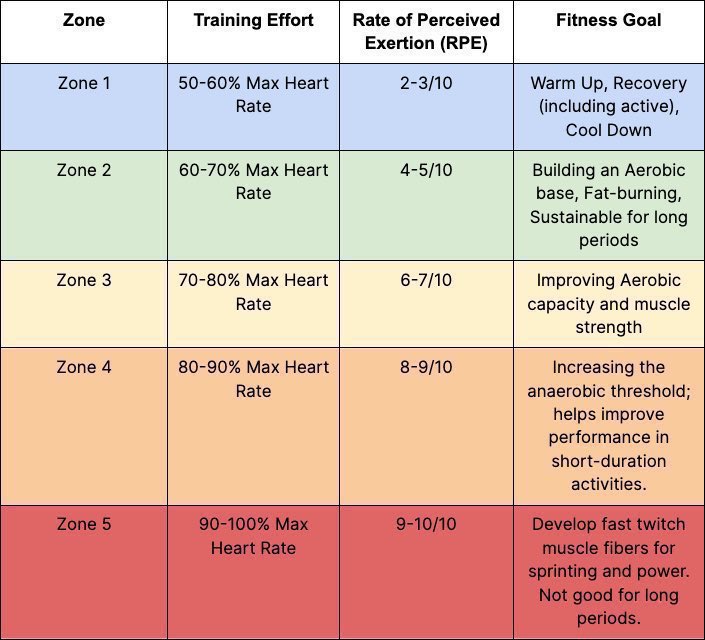
Ideal Cardio Timing:
Zone 2 is basically fine whenever
That said, if you do enough of it before your workout…it can definitely negatively impact performance to some extent
Thus…
The MOST ideal time to do Zone 2 = totally separate from lifts
The secone most ideal time to do Zone 2 = after your lift
The LEAST ideal time to do Zone 2 = prior to your lift
Worth nothing that I’m talking about extended duration Zone 2 (30+ minutes)
A 5-10 minute bout prior to resistance training could actually AID your training performance as it’ll serve as a great general warm up by elevating core temperature
When it comes to Zone 3 - Zone 5 Cardio…you most definitely want to keep those sessions secluded from your workouts but sometimes doing a bout after lifting is FINE
It’s very context dependent
One thing is for certain though:
If you are doing Zone 3 - Zone 5 Cardio just prior to resistance training…you are a FOOL
To improve your writing, read more.
To improve your thinking, write more.
To improve your storytelling, present more.
To improve your energy, rest more.
To improve your understanding, teach more.
To improve your network, give more.
To improve your happiness, appreciate more.
@TheDunkCentral@BrandonRahbar one of the west conference finals games proved this issue with challenging them. SAS challenged them twice in the first half and sure they got them overturned, but now they have no challenges the rest of the game.
🚨 ANOTHER MASTERCLASS FROM @3BLUE1BROWN
The compressibility of language isn’t just a math curiosity, it’s the hidden engine behind every LLM you use.
Grant’s new video reframes Shannon’s entropy through one elegant lens:
Prediction IS compression.
→ The better you predict the next word, the fewer bits you need to store it
→ Shannon measured English at ~1 bit per character: astonishingly compressible
→ This is exactly what GPT-style models optimize
→ Intelligence, in this framing, is compression
FUN FACT: Von Neumann told Shannon to name it “entropy” because nobody truly understands it anyway 😄
Decades later, that same concept became the bedrock of modern AI.
Deep-dive resources in the 🧵 ↓
Your body only has a limited number of ways it can move.
Flexion & Extension. Abduction & Adduction. Internal & External Rotation. Pronation & Supination.
Thousands of exercises. Same fundamental movement patterns.
Understanding them can instantly improve how you learn anatomy and analyze exercise form.
🚨Smoking Behind the Supermarket with You currently holds a perfect 5.0 rating on Crunchyroll from roughly over 10000 reviews.
It becomes one of the only anime to ever achieve this feat.
KNOW THE DIFFERENCE ✨
Deep core = inner muscles that support your body, improve posture, and build real strength
Six pack = outer muscles that create that defined, aesthetic look
Train both for the best results 💯
Gym fit & gear from
Use my code: ...
I have been experimenting with homemade tortillas. I have found that store bought tortillas have many added ingredients that I’d rather not eat. I have found a very simple recipe that works well for me, and thought you might enjoy trying it 😋
Two math olympiad champions wrote a training manual in 1993 on two old Macintosh computers, and every American kid who has won a major math competition in the last decade learned to think from it.
Their names are Sandor Lehoczky and Richard Rusczyk. The book is called The Art of Problem Solving. Most people in math know it as AoPS.
Since 2015, every single member of the US International Math Olympiad team has been an AoPS student. Not most of them. Every one.
That statistic sounds impossible until you understand what the book actually does.
Lehoczky and Rusczyk were not professors. They were competitors. Lehoczky earned the sole perfect AIME score in 1990 and led the national first place team. Rusczyk was a USA Mathematical Olympiad winner and a perfect AIME scorer in 1989. They had both survived the same brutal selection process the book was designed to train students for.
And the first thing they decided was that almost every existing math textbook was teaching the wrong thing.
School math gives you formulas. You memorize them. You apply them. You pass the test. Then you sit down in front of a real competition problem and the formula does not apply, and you have nothing underneath it.
That is the gap. The gap is not knowledge. It is thinking.
The entire premise of AoPS is that problem-solving is a transferable skill, not a bag of memorized tricks. A student who genuinely understands why a technique works can adapt it, combine it with something else, and deploy it in a context they have never seen before. A student who only memorized the technique freezes the moment the problem looks different.
The book teaches the difference between a formula and a method.
A formula tells you what to compute. A method tells you how to see. The students who win olympiads are not the ones who know more formulas. They are the ones who have trained themselves to look at an unfamiliar problem and recognize its structure. To see that this problem is secretly asking the same question as a problem they solved three weeks ago, just dressed differently.
Rusczyk calls this "learning to read the problem." Not reading the words. Reading what the problem is actually asking underneath the words.
The second thing they built into the book is tolerance for being stuck.
Most students treat confusion as a signal to stop. The book treats confusion as the starting point. Every chapter pushes students past the point where the obvious approach runs out. That moment of running out is not failure. That is where the actual thinking begins.
Lehoczky once described it this way. If you can solve a problem quickly, you are not learning. You are performing. Learning only happens when you are past the edge of what you already know.
The book was written on old Macintosh computers in 1993. Rusczyk launched the AoPS website in 2003. Today the community has over one million users. Thousands of students enroll in AoPS online courses every year. Most winners of every major American math competition are AoPS alumni.
A platform built by two kids who were good at math competitions has become the infrastructure that produces the next generation of mathematicians, engineers, and scientists who are good at thinking.
The formulas you memorized in school will eventually be obsolete.
The thinking you trained will not.
What is one problem in your life right now that you have been avoiding because you do not yet know the right formula to solve it?