🚨Kate officially diagnosed with endometriosis
> done without surgery
> across three modalities: imaging, blood, and AI
> all non-invasive
> in 42 days
For context, average time to diagnosis is 6.6 years.
And, we found 2 other diagnoses at the same time.
Over the past 6 weeks, we’ve sprinted to confirm or deny Kate’s suspected endometriosis. Endo is notoriously challenging to diagnose.
It’s one of the most gnarly diseases and affects 15% of women.
Men, to get you on the same page, having endo is akin to an alien growing in your guts and balls, self replicating, and glueing everything together. Causing you constant pain and discomfort.
We got to work.
> got an MRI
> got a transvaginal ultrasound
> both results came back negative
At this point, Kate’s patient journey had followed the archetype precisely. Most women don’t get diagnosed for 7-10 years. For Kate, it’s been 7 years. And, like most women, her imaging came back clear even though now we know that she has endo.
This is why diagnosis has traditionally happened via surgery. There has been no other way than to open her up and look inside.
We wanted to avoid surgery so we went back to the drawing board. We searched the world over.
On our second go, we did:
> endo-specific ultrasound
> an endo blood test
> AI MRI
> saliva test
This was successful.
We were able to confirm her endo via ultrasound, blood test, and MRI. Confirmed simultaneously by three unique modalities, as far as we know, a world-first approach.
The extensive measurement allowed us to find additional things.
Her ultrasound showed:
> endometriosis
> PMOS (formerly PCOS) (needs confirmation)
> adenomyosis
30-40% of women have at least one of these conditions. That’s intimidating especially when the path to diagnosis is fraught with so many challenges.
Phase I was getting a diagnosis.
Phase II is curing endometriosis. We’ve already started working.
If you’re a female with suspected endo, here’s what you can do to accelerate your diagnosis.
—
1. Endo-Specific Ultrasound
You want an endo-specific ultrasound. As we saw with Kate, a standard pelvic/transvaginal ultrasound failed to identify her endo.
You want the ultrasound to be performed by a physician or sonographer specifically trained. They follow a special protocol to hunt for endometriosis by mapping the ovaries and uterus, and testing whether organs can slide freely, or are tethered by endometriosis lesions.
It’s best timed just after ovulation, when a small amount of peritoneal fluid aids visualization.
It can detect superficial endometriosis, lesions, and adenomyosis that general imaging misses.
We went to Dr. Kacey Hamilton at Cedar Sinai.
2. AI MRI / MatricesAI
Radiologists miss lesions in up to 60% of cases. We worked with @MatricesAI which leverages AI and a unique dataset to detect endometriosis lesions on pelvic MRI. This model is still new, its first pilot study with 200 participants began in April this year.
Here is how you can work with them:
They’re opening their diagnosis program at the Geneviève Institute to give early access to their AI model in a clinical trial.
They will take you through a state-of-the-art clinical intake questionnaire. Help you advocate for your symptoms with your gynecologist, based on your intake or connect you to a new center where their AI is being piloted and the clinical trial conducted.
3. Blood test / HerResolve
Kate had two small tubes of blood drawn for a test built by @Heranovalifesci.
The test measures seven biological markers (three microRNAs, three proteins, and one hormone) and uses an AI model to help detect endo.
It was highly accurate in its validation study at confirming endo and caught most cases that ultrasound and MRI had missed.
Their technology has been validated in a peer reviewed study (298 women, 11 sites across US/Europe/Hong Kong, published in the Journal of Minimally Invasive Gynecology): specificity 97.5%, sensitivity 80%, with strong diagnostic performance (94.4%), demonstrating it was highly effective at distinguishing women with endometriosis from those without the disease.
A positive result is a strong signal, since only 2.5% of women without endometriosis test positive, though final confirmation is still clinical. A negative is less conclusive, because the test misses about 20% of true cases.
The test identified 61.5% of histologically confirmed cases that transvaginal ultrasound and/or MRI missed.
#
We did one more saliva based test and will report back on that when results are returned.
@henrythe9ths@claudeai Intuit is pretty awful company please don’t make them the defacto tax pipeline for the AI future 🙏
Work with @FreeTaxUSA please!
I want to address what happened to Neeraj and me last week. Of course, it was quite shocking to us as well and honestly very disheartening. But today, we want to talk about what actually happened and more importantly, what we’re going to do about it.
On March 21, we were taken into police custody in connection with a fraud complaint. Three days later, on March 24, a Thane court granted us bail, finding that prima facie, no case was made out against us. The fraud at the centre of this complaint was carried out through a fake website - "https://t.co/mn7Ou56fXE" by impersonators who have absolutely no connection to our platform, our systems, or CoinDCX. No money moved through CoinDCX. No transaction occurred on our exchange. The complainant himself confirmed in court that he did not know us and had never met us.
I'll be honest: our experience was deeply unsettling. Not because we doubted the facts -- we knew from the first moment that this had nothing to do with us. But because it made something painfully clear: the ecosystem we operate in doesn't yet have the tools to tell the difference between the people building this industry responsibly and the people exploiting it.
Think about what this precedent means: if a scammer uses your brand, your name, your face in a fake website and defrauds someone, you can be arrested. Not the scammer. You. This Could Happen to Any founder, Any Business.
That has to change.
And we've decided that CoinDCX will lead that change - not with words, but with actions. Today, we are announcing Digital Suraksha Network (D.S.N.) - a ₹100 crore commitment from CoinDCX to build the cyber safety infrastructure that India's digital finance ecosystem needs but does not yet have. This is not a crypto problem. This is a problem across any company which has a digital footprint.
Here's what we're building:
→ 24x7 WhatsApp helpline: free for everyone, not just CoinDCX users, to verify links, platforms, and offers before you transact.
→ Open Fraud Intelligence API: We have already documented 1,200+ fraudulent websites impersonating CoinDCX. That data sat inside our systems. Not anymore. We're building an open API to share this intelligence in real time and inviting every exchange, fintech, bank, and digital lender to contribute. A shared immune system for India's digital finance ecosystem.
→ Cyber Safety Infrastructure for Law Enforcement: The Digital Suraksha Network will fund training programmes for state cybercrime cells on blockchain forensics and digital asset tracing.
→ "Caution Before Transaction": a nationwide initiative to give every Indian the tools to participate in digital finance safely.
We know that no single company can solve this. Fraud networks are sophisticated, cross-border, and evolving daily. Nowadays, they make use of AI that makes them exponentially harder to catch. But someone has to start to fix this problem from the root.
We are putting ₹100 crore on the table because the ecosystem cannot afford to wait. I am asking every platform, every regulator, and every Indian who participates in digital finance to join us.
We want to ensure that anyone building startups in India like us can do so with confidence, and not with fear.
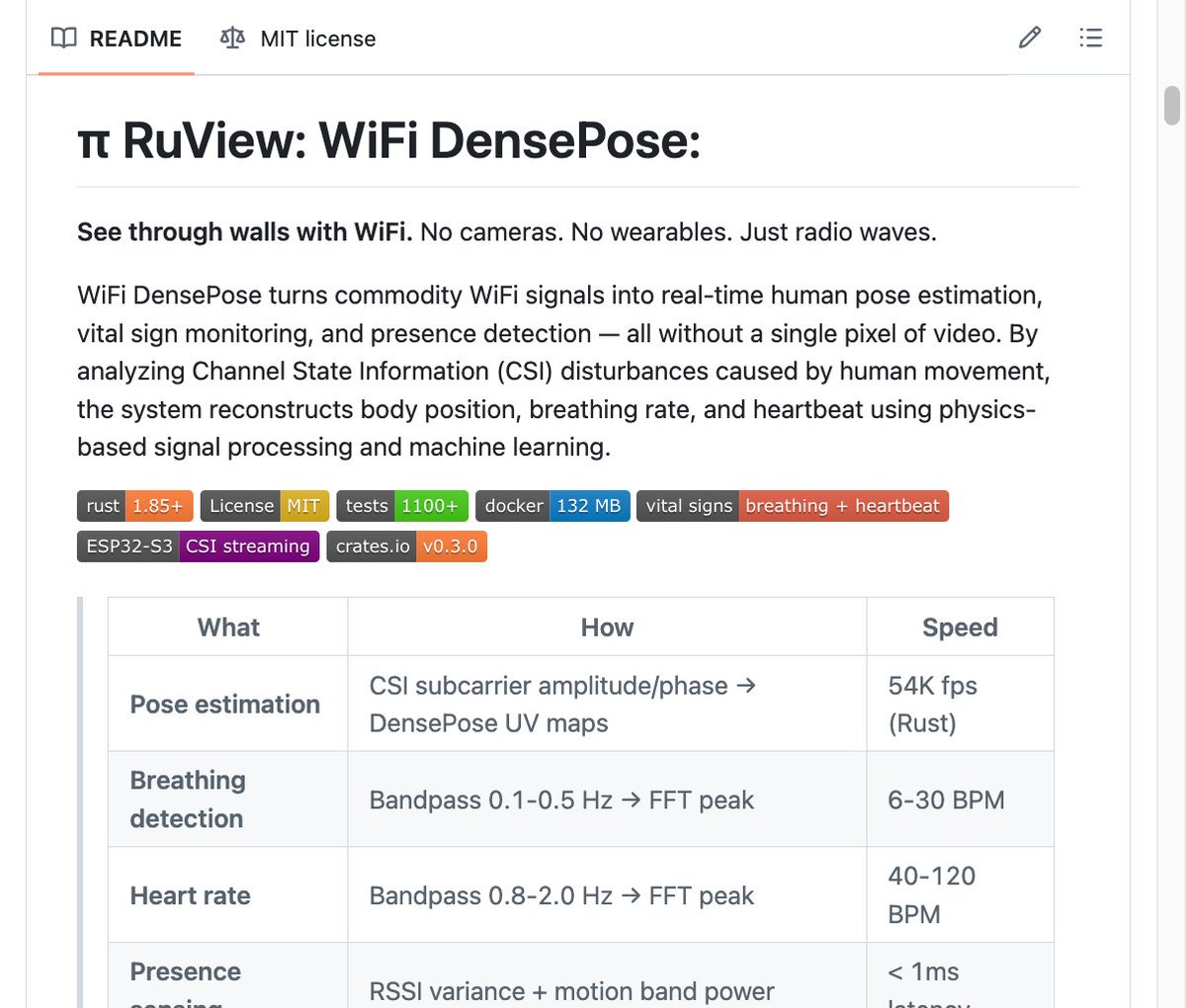
🚨 Someone just turned your WiFi router into a full-body surveillance system.
No cameras. No wearables. No video. Just radio waves.
It's called RuView. It uses the WiFi signals already in your room to detect human poses, track breathing, measure heart rate, and see through walls.
Not a concept. Not a research paper. Working code you can run right now.
Here's what this thing actually does:
→ Tracks full 17-point body pose using only WiFi signals
→ Detects breathing rate (6-30 BPM) without touching anyone
→ Measures heart rate (40-120 BPM) from across the room
→ Sees through walls, furniture, and debris up to 5 meters deep
→ Tracks multiple people simultaneously with zero identity swaps
→ Self-learns from raw WiFi data. No labeled datasets needed
Here's how it works:
WiFi signals pass through your room and hit the human body. The body scatters those signals differently based on position, breathing, even heartbeat. RuView reads that scattering pattern and reconstructs everything.
A mesh of 4 ESP32 nodes ($48 total) gives you 360-degree coverage with 12 measurement links, 20 Hz updates, and sub-30mm precision.
Here's the wildest part:
It has a disaster response mode called WiFi-Mat. It detects survivors trapped under rubble through concrete walls, classifies injury severity using START triage protocol, and estimates 3D position. The kind of tool that saves lives after earthquakes.
The Rust implementation processes 54,000 frames per second. That's 810x faster than the Python version. The entire Docker image is 132 MB.
The AI model fits in 55 KB of memory. Runs on an $8 ESP32 chip.
Train once, deploy in any room. No retraining. No recalibration.
1,100+ tests. SHA-256 verified capability audit.
22.4K GitHub stars. 2.7K forks. MIT License.
100% Open Source.
Picture this: you compromise the account of a NPM developer whose packages are downloaded more than 2 billion times per week. You could have unfettered access to millions of developer workstations. Untold riches await you. The world is your oyster.
You profit less than 50 USD.
This Bitcoin Pizza Day, we’re celebrating how far crypto has come since 2010 in helping to create a cheaper, faster system.
Welcome to the Coinbase Pizza Truck.
$1 USDC slices.
Payment easy as pie.
Washington Square Park, NYC
12-5PM EST
Stop by if you’re in town.
When I worked in an office, I had to commute every day for 2 hours.
1 hour to the office, 1 hour to come back home. That’s 40 hours per month wasted on commute.
Now tell me again why would I go back to the office and waste 40 hours per month on commuting? I can use those hours to do… literally anything that I enjoy instead.
The Costco hot dog combo is a legendary meme.
But how does it still only cost $1.50? Introduced in 1985, the price of that combo should be ~$4.20 if adjusted for inflation.
Thankfully, the $216B warehouse retailer has done everything in its power to keep the price down.
And Costco sells A LOT of them: 130m+ hot dogs a year (more than all MLB teams combined).
Many believe the $1.50 combo is a “loss-leader” for Costco, but this is incorrect.
In a 2009 interview, Costco co-founder and former CEO Jim Sinegal told the Seattle Times that Costco doesn’t “engage in loss leaders” and “the only time we sell below cost is when we’ve made a mistake and have to mark it down”.
However, the retailer does cap its margin at 14% and drives many products to near break-even.
Here’s how Costco has managed to keep the cost of the inconic hot dog combo at $1.50:
1️⃣It dropped leading hot dog suppliers like Hebrew National and Nathan’s because they wouldn’t lower prices
2️⃣In 2009, Costco built its own hot dog manufacturing plant in LA (and has a second one in Chicago)
3️⃣ It got better pricing on buns, ketchup and mustard
4️⃣ It removed onions and sauerkrauts as free condiments
5️⃣ It dropped Polish sausages
6️⃣ The pop that came with the combo was swapped from a can to refillable fountain soda
Costco’s effort to keep hot dog prices low is also the source material for the greatest quote in business history.
In 2018, the current Costco CEO Craig Jelinek was recounting a conversation he had with Sinegal, who he just replaced as CEO.
Jelinek told Sinegal he wanted to raise the price of the $1.50 hot dog and pop combo.
Sinegal shot back, “If you raise the [price of the] f**ing hot dog, I will kill you. Figure it out.”
Costco has figured it out and, in September 2022, the company’s CFO Richard Galanti confirmed that the hot dog combo would remain at $1.50 despite rising inflation.
“There are some businesses that are doing well with margin like gas business on a smaller way -- in the travel business,” said Galanti. “Those things help us be more aggressive in other areas, or as you mentioned, hold the price on the hot dog and the soda a little longer, forever.”
Forever sounds about right.




![TrungTPhan's tweet photo. The Costco hot dog combo is a legendary meme.
But how does it still only cost $1.50? Introduced in 1985, the price of that combo should be ~$4.20 if adjusted for inflation.
Thankfully, the $216B warehouse retailer has done everything in its power to keep the price down.
And Costco sells A LOT of them: 130m+ hot dogs a year (more than all MLB teams combined).
Many believe the $1.50 combo is a “loss-leader” for Costco, but this is incorrect.
In a 2009 interview, Costco co-founder and former CEO Jim Sinegal told the Seattle Times that Costco doesn’t “engage in loss leaders” and “the only time we sell below cost is when we’ve made a mistake and have to mark it down”.
However, the retailer does cap its margin at 14% and drives many products to near break-even.
Here’s how Costco has managed to keep the cost of the inconic hot dog combo at $1.50:
1️⃣It dropped leading hot dog suppliers like Hebrew National and Nathan’s because they wouldn’t lower prices
2️⃣In 2009, Costco built its own hot dog manufacturing plant in LA (and has a second one in Chicago)
3️⃣ It got better pricing on buns, ketchup and mustard
4️⃣ It removed onions and sauerkrauts as free condiments
5️⃣ It dropped Polish sausages
6️⃣ The pop that came with the combo was swapped from a can to refillable fountain soda
Costco’s effort to keep hot dog prices low is also the source material for the greatest quote in business history.
In 2018, the current Costco CEO Craig Jelinek was recounting a conversation he had with Sinegal, who he just replaced as CEO.
Jelinek told Sinegal he wanted to raise the price of the $1.50 hot dog and pop combo.
Sinegal shot back, “If you raise the [price of the] f**ing hot dog, I will kill you. Figure it out.”
Costco has figured it out and, in September 2022, the company’s CFO Richard Galanti confirmed that the hot dog combo would remain at $1.50 despite rising inflation.
“There are some businesses that are doing well with margin like gas business on a smaller way -- in the travel business,” said Galanti. “Those things help us be more aggressive in other areas, or as you mentioned, hold the price on the hot dog and the soda a little longer, forever.”
Forever sounds about right.](https://pbs.twimg.com/media/FtC4rXNagAYBGUM.jpg)