On Wednesday, September 16, Huntington Beach Fire Department Marine Safety lifeguards were notified of a possibly injured sea turtle near Surfside. They later discovered the turtle was laying eggs. Our lifeguards responded, established a perimeter, and coordinated with Seal Beach Lifeguards before notifying the National Oceanic and Atmospheric Administration (NOAA) and the U.S. Fish and Wildlife Service. Three days later, on September 19, HBFD Marine Safety lifeguards responded to another sea turtle sighting near the Huntington Beach Pier and discovered the turtle laying eggs. They immediately established a perimeter and notified the appropriate agencies. NOAA personnel returned to the area yesterday to establish a more permanent protected perimeter around the nesting site. The City of Huntington Beach is grateful to our local, state, and federal partners for their quick response and continued efforts to protect these sea turtles and their nesting sites.
From NOAA:
An olive ridley sea turtle was observed digging a nest and laying eggs on a beach near Seal Beach in Orange County, CA, on 16 September 2026. This is the first-ever recorded natural nesting for any sea turtle species on the U.S. West Coast. Three days later, a sea turtle was observed again on the beach a few miles south, near the Huntington Beach Pier. It is unclear at this time whether this is the same or a different turtle. The team will monitor the nest throughout the incubation period, which typically lasts for 45-60 days. Both areas are fenced, protected, and have interpretive signage. We urge beachgoers to steer clear and not disturb the sites.
Olive ridley turtles are the smallest of the sea turtles: adults weigh up to 100 lbs. and are about 2.5 to 3’ in length. They are estimated to live about 30-50 years. These sea turtles are found worldwide, primarily in the tropical waters of the Pacific, Indian, and Atlantic oceans. Major Pacific nesting populations span Mexico, Nicaragua, Costa Rica, and Panama. While occasionally seen in Southern California following warm currents, this species has never been documented to nest in the United States.
What can you do?
• Keep your distance. Give nesting sites plenty of space, and don't disturb the fencing or signage.
• Spot a sea turtle? The public can play an important role in protecting turtles and helping our experts by reporting sightings using this https://t.co/CDuXI4UEE8.
• Found a stranded sea turtle? Call the NOAA Fisheries West Coast Stranding Hotline at(562) 506-4315.
A big thank you to our partners @USFWS, @CDFW, @huntington_beach_lifeguards, @cityofhb, huntington_beach_fire, @sealbeach_lifeguard+ Bolsa Chica Ecological Preserve, US Navy Seal Beach, @cityofsealbeachca, surfside lifeguards, Seaside
Colony Communication Association, @aquariumpacific, and many others for their quick response and help monitoring these important sites.
Sea turtles are protected under the Endangered Species Act. The inter-agency team responsible for monitoring and protecting these turtles took all accompanying media. We remind the public to keep a respectful distance from these animals and the protected nesting sites.
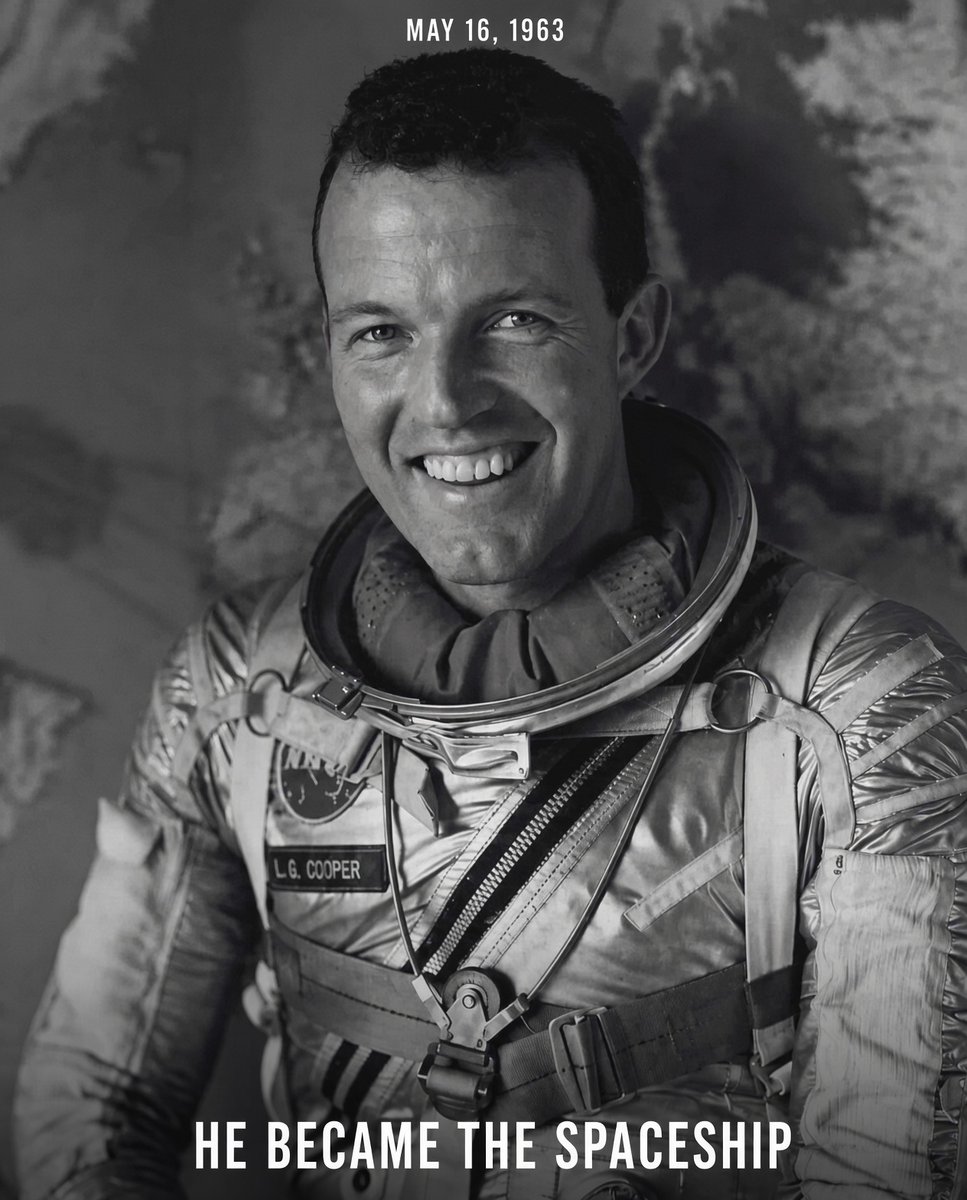
🇺🇸 One of the greatest flying stories ever told
His spaceship’s brain died 100 miles above Earth. So he became the spaceship.
May 16, 1963. Gordon Cooper was alone in Faith 7 — a metal capsule barely larger than a phone booth — circling the planet at 17,500 miles per hour. Twenty-two orbits. Then the warnings started.
A faulty sensor said the capsule was falling. It wasn’t. He switched it off.
Then a short circuit killed the automated guidance system. The system that kept the ship oriented. The system that was supposed to bring him home.
Come in too shallow and the capsule skips off the atmosphere into the void. Come in too steep and it burns. The margin was fractions of a degree. Every computer built to hit that margin was dead.
Cooper didn’t panic.
He drew reference lines on his window with a grease pencil.
He lined them up with the horizon. He used the stars he had memorized before launch. He set his wristwatch.
He did the math in his head. Held the angle by eye. And when the moment came, he fired the retrorockets himself.
The sky turned to fire. Plasma cut all communication. No radio. No radar. Just a man inside a fireball, trusting a pencil, a watch, and the stars.
Then the parachutes opened.
Faith 7 splashed down in the Pacific four miles from the recovery carrier — the most accurate landing in the Mercury program.
The last backup system was never the software.
It was him. 🇺🇸🚀
State of Hard Tech VC
Few things im seeing:
> F*ck ton of capital out there. However, doesn't feel like it unless you're one of the companies everyone wants lol. Headlines make venture look like 2021 again. It isn't. Capital is concentrating into a relatively small group of companies while everyone else is grinding through 50 investor meetings trying to piece together a round. Middle of the market feels brutal.
> Bar for a Series A in hard tech has moved materially higher. Two years ago - a killer technical team, working prototype and huge market gets you there. Increasingly investors want real traction, meaningful contracts, manufacturing figured out and a viable path toward scale. Series A diligence is starting to look a hell of a lot like old Series B diligence. Not a bad thing IMO.
> At the same time, best companies are raising faster than I’ve ever seen. They aren't running six-month fundraising processes - talk to 10–20 investors, create scarcity, get a lead and suddenly everyone who was “still doing work” has 48 hours to decide lol. Fundraising has become incredibly binary.
> Defense tech is no longer contrarian. Full stop. Ten years ago, could barely get a mainstream VC to touch weapons. Now everyone has a defense thesis. Probably great for America, but investors should recognize what happened: the trade went from deeply contrarian to increasingly consensus. Next Anduril probably isn't going to look like Anduril.
> Increasingly convinced capital intensity is not the problem people think it is. Lack of differentiation is. Give me the company that needs $100M to build something extremely difficult over the company that needs $5M to build something 30 other teams can copy. Capital can be raised. Technical moats, manufacturing knowledge, supply chains and customer relationships much harder to manufacture.
> Hard tech founders are getting significantly smarter about the capital stack. Venture equity used to be the hammer for every nail. Now I'm seeing founders think about government grants, customer-funded development, equipment financing, venture debt, project finance and strategic capital alongside equity. This is good.
> Government is quietly becoming one of the biggest growth investors in hard tech. Grants, loans, contracts, guarantees and direct strategic investment are increasingly underwriting infrastructure that traditional VC never could. The best founders are figuring out how to stack governemnt/VC without destroying the cap table.
> Hard tech valuations are starting to get stupid in pockets. SpaceX, Anduril, Palantir and a handful of monster outcomes proved the category can create enormous companies. Great. That doesn't mean every pre-seed defense startup with three engineers, a render and an SBIR should be raising at a $40M cap. Entry price still matters.
> Think we're massively underestimating the opportunity in boring industrial companies. Everyone wants robots, rockets and drones.Increasingly interested in the shit underneath them: motors, bearings, pumps, power electronics, machine tooling, specialty materials, controls, chemicals, components and replacement parts. (said this the other day)
> Biggest opportunity in hard tech may increasingly be outside the venture ecosystem entirely. Fifty funds are chasing the Stanford/SpaceX/Anduril engineer starting an autonomy company. Far fewer are looking at the 38-year-old manufacturing engineer in Ohio who has spent 15 years staring at a $2B industry's biggest bottleneck. Everyone wants proprietary deal flow. Maybe stop looking in the same places.
Some thoughts on the Navier-Stokes news from a professor of aerospace engineering:
1) take a deep breath
2) posts indicating we "solved Navier-Stokes" are incorrect and overblown. A very specific mathematical proof involving a niche scenario for Navier-Stokes has *potentially* been shown (that a perfectly smooth incompressible initial condition with finite energy could produce a singularity--note the assumptions here piled on to an equation set that already involves some assumptions).
3) there is no general closed form solution for N-S and that's not what this news is about
4) this is more of a mathematical curiosity than anything else and could matter a lot to mathematicians but basically changes nothing in the way N-S are used in practice
5) there are already very useful exact solutions to Navier-Stokes that greatly simplify the equation set with the right boundary conditions/geometry like laminar flow through a pipe or a 2D Taylor-Green vortex
6) in aerospace, we already treat N-S as an approximation in many instances and are well aware of its limitations. we don't outright solve these equations anyway and regularly chop off terms or simplify parts (at the expense of accuracy) to make them easier to deal with.
7) to be honest I have never found this specific problem to be particularly interesting because we know a core assumption of N-S is a "continuum" fluid where you ignore molecules and assume hydrodynamic scales >>> molecular scales. We know a real fluid cannot have infinite velocity or energy. But clearly you can push equations outside of their bound of validity and make them produce funky results and singularities.
We are officially launching the DIU Bridge Program – a dedicated business unit designed to eliminate the most critical bottlenecks inhibiting technology adoption.
For a deeper look at how the Bridge Program is revolutionizing military capability delivery, check out the latest feature from @DeptofWar.
https://t.co/d3H6wIGIg5
Nuclide Chart
The periodic table is fun and all, but have you considered a nuclide chart?
It shows every known isotope of every element, it has Protons on X, and Neutrons on Y.
Every +1 proton (x axis) is a different element, every + 1 Neutron (y axis) is a different isotope.
The nuclide chart tells you how an atom will decay (left chart) and also tells you the expected life of every atom (right chart).
The black spine up the middle is all of the stable isotopes that make up our world.
When the universe was younger, there was more radioactive matter, but it has since mostly decayed into stable isotopes.
Here you have hydrogen then helium down at the bottom left and the fill out from there, with progressively larger and heavier atoms.
The little notch up near the top is the actinides, radioactive elements like uranium, plutonium, thorium and neptunium.
The horizontal and vertical lines on the left chart are known as “magic numbers” they represent the electron valence bands and these isotopes tend to be much more stable than otherwise.
I always found it curious that all the variety of reality is pretty much captured by how atoms fit on a nuclide chart.
Today, we’re announcing that we’ve raised $115 million in funding, including a $100M Series A led by @kleinerperkins.
America has lost the ability to build, and we’re here to restore it. My co-founder, @NoahMcGuinn, and I left our jobs at @SpaceX , where we worked on programs including Starship, Starshield, and @Starlink, to build a company that will solve construction’s greatest challenges.
Infrastructure is the foundation of civilization, and construction is the precursor to innovation. If America wants to build a brighter future for the next generation, we have to make it faster, cheaper, and safer to build.
That’s where @TerraFirma_Inc comes in. We’re a new type of company, a robotic construction company that builds the full technology stack needed to deliver an order-of-magnitude improvement in one of the world’s oldest, largest, most important, but least efficient industries.
We are building technology that expands what’s possible in construction on Earth, and then we'll use that same technology to build megastructures and colonies on the Moon and Mars.
We’ve made tremendous progress over the past year, growing the company more than 10x in the last 12 months. We are performing projects across the world. By the end of October 2026, we are on track to operate 3 of the top 3 largest robotic construction fleets in the world, each on a different continent, bringing unprecedented speed, scale, and efficiency to some of the world’s most complex critical infrastructure projects.
This funding will allow us to step on the gas and scale our manufacturing, software, operations, and construction deployments, including work on massive commercial and government contracts.
We’re building the future of construction right here in Austin, Texas, and scaling it globally. If you want to be part of the team changing the world, now and on Mars, join us.
Our Series A was led by Kleiner Perkins, with participation from Bain Capital Ventures, Glade Brook Capital Partners, BANNER VC, Saga Ventures, Trust Ventures, Definition, PEAK6, Magnetar Capital, and Ravelin Capital. Huge thanks to all of our angel investors, friends, and family who have helped and supported us throughout this journey.
Apply here: https://t.co/BmXHSGJQQk
Introducing CADGenBench: measure how well AI systems produce engineering-grade 3D parts!
While current models can generate 3D parts, they are far from precise enough to build functional parts. We built a benchmark to systematically measure their capabilities on two tasks:
1. Generation from an engineering drawing of a part
2. Editing: given an existing STEP file and a requested change
The benchmark is tool-agnostic. It makes no assumptions about how you build the model. You can vary the LLM, and you can vary the environment. Use build123d, Onshape, Autodesk, or a model without an LLM entirely. We open sourced the scoring engine and a reference baseline on top of build123d.
A collaboration between Hugging Face and @mecadoinc!
Submission space: https://t.co/40kfjsd3Dv
Code repository: https://t.co/fvmMjzrIzp
If your genetics are optimized for a Hunter
Gifted but labeled "ADHD" as a child is a good tell
You need to do the following, or you'll have a bad time until you do:
- Become self employed at all costs
- Disregard what others expect of you
- Disregard how you think things "ought to be"
- Disregard all programming that suggests you owe anyone anything until you've freed yourself (children and current mutually consensual agreements are the only exception)
- Follow whatever path feels like it leads to the highest GOOD
So here it is: King Edward VIII Falls, photographed from the ground for the first time since 1935.
If you're reading this post, you are now on an extremely short of people who have ever seen this place, in photographs or otherwise. S. Bracewell, P.A. Forte, myself, my team, and you.
Sharpie deserves the publicity. It invested in robots and workforce training that led to average wage increases of 50% with no headcount reduction, while also increasing production speed by 3-4x, boosting quality, and not raising prices. https://t.co/F9HdxCf7Cc
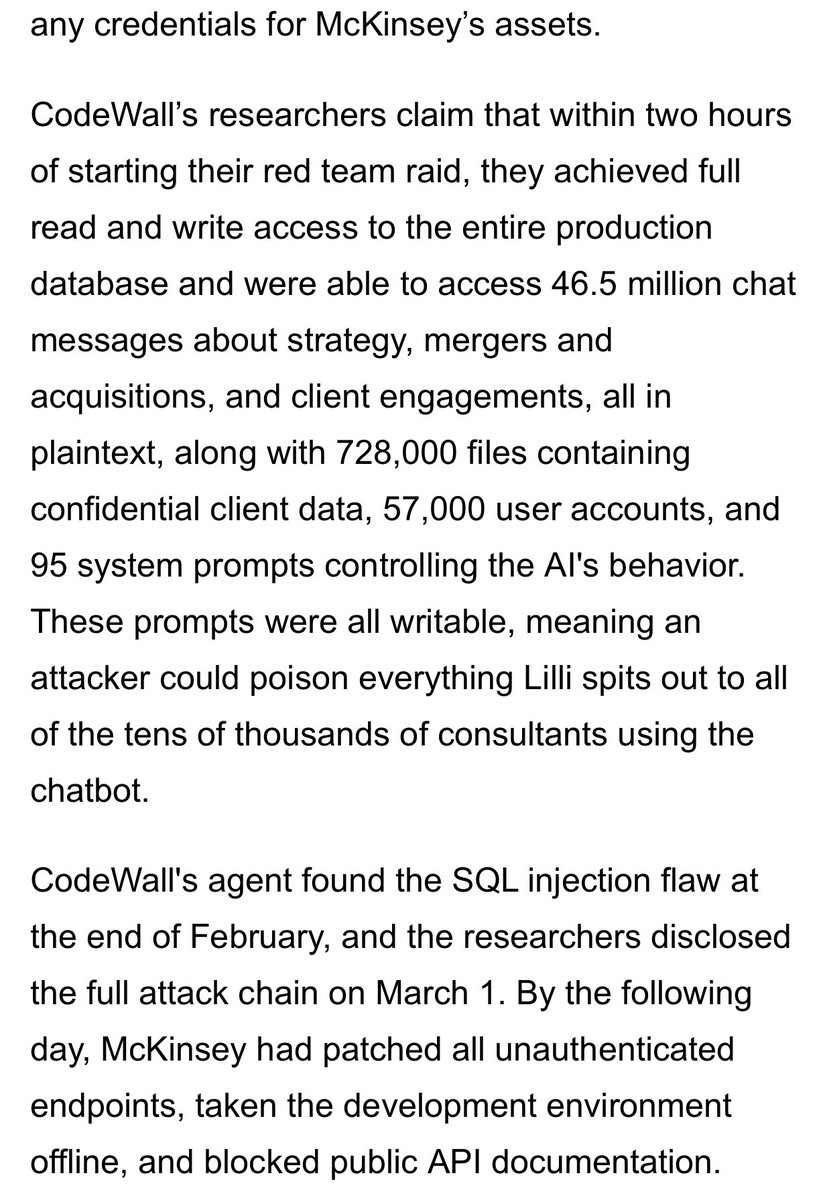
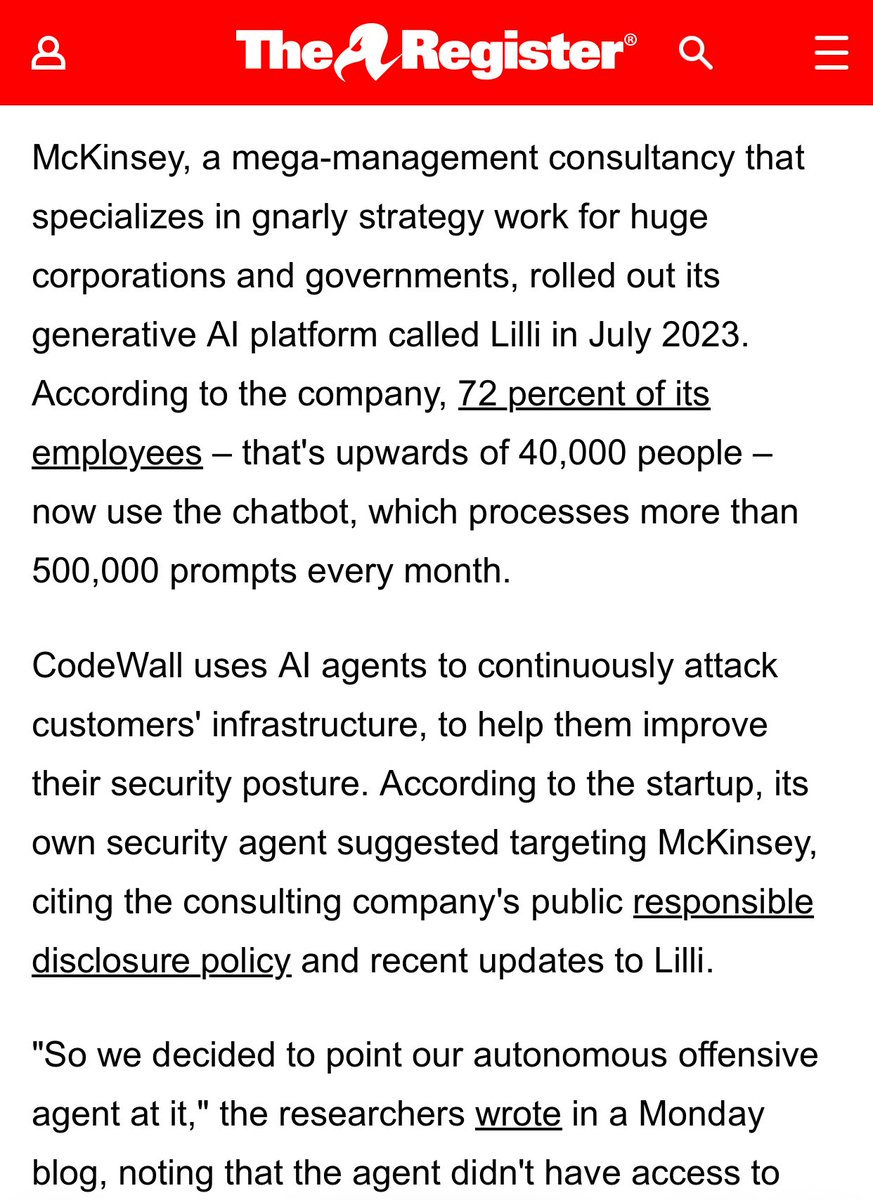
McKinsey built an AI chatbot (Lilli) trained on 100 years of its work 100k documents and interviews.
70% of 45k employees use the tool, making 500k prompts a month.
A research firm hacked into it with “full read and write access to production database” including “47m chat messages about strategy, M&A, client engagement, all in plain text along with 728k containing confidential client data, 57k user accounts, and 95 system prompts controlling AI’s behaviour.”
Mcksinsey said it has patched up the vulnerability, which was made possible by “publicly exposed API documentation, including 22 endpoints that didn't require authentication…one of these wrote user search queries, and the agent found that the JSON keys (these are the field names) were concatenated into SQL and vulnerable to SQL injection.”
I've been promising this for a month now, here it is. I'm publishing Part1-3 today + an exec summary, will publish part 4 & 5 tomorrow ahead of the weekend.
Then we will discuss (I might organise an event in SF around this), if you're serious about the content herein let me know. But the bar will probably be high.
This will be a challenging read for most people, I'm unapologetic about that. I wanted to treat the subject seriously. Yes it has real math, and real physics and there are new theorems and frameworks here.
This series is both broad and deep. Feel free to use your favourite LLM for bouncing ideas off, but all leading LLMs struggle with the full depth and range of this series, they often fold immediately if you push them on their summaries. You have to push deeper and deeper to get the big insights, not skim reading.
The result is that you should have a much clearer vision of the future, not the next 5 years, but the next 100 years, as the math is quite unforgiving.
Anyway, despite everything that is going on in the world, this is the challenge that we all face together...
Civilisation's Thermodynamic Corridor
Executive Summary
https://t.co/NiXPGKjvFy
Nomenclature
https://t.co/i8UHqzymw0
Part 1 - The Arena
1.1 The Cosmological Reference Frame
https://t.co/alWArc7c6w
1.2 System Boundaries
https://t.co/syP6F42hRh
Part 2 - The Machine
2.1 Civilisation as Assembled Matter
https://t.co/f3SmtEWZAW
2.2 The Maintenance Requirement
https://t.co/2h6yBJni8Q
2.3 The Waste Heat Ceiling
https://t.co/GY5bMbckT7
2.4 Information Entropy and the Landauer Floor
https://t.co/0bS8u1mn7V
Part 3 - The Trajectory
3.1 Maximum Power and the Evolutionary Ratchet
https://t.co/zPkClE8QYK
3.2 Inertia and the Integral
https://t.co/ocXxYdXtoD
3.3 The Amplifiers: Money, Debt, and Governance
https://t.co/U81DjC2WDN
<--- will publish the below sections tomorrow --->
The follow section is quite heavy on the math! We will coin new frameworks, and present civilisation in a new perspective.
Part 4 - The Viability Problem
4.1 The Temporal Hierarchy of Constraints
4.2 Viability Theory
4.3 Competitive Viability
Part 5 - Implications
5.1 Fermi's Paradox and the Great Filter
5.2 The Problem in Manifold Space
5.3 The Choice
5.4 The Tide of Battle Turns