Another* Bull Case for @MetaDAOProject
What’s the long-term bull case for META? Grants? Meh. DAOs? Interesting, but there are issues. "Everything is futarchy"? Sounds good, but not much substance right now. I am a futard at heart but feel the current narratives aren’t doing META justice. I spent time consolidating thoughts into another bull case for $meta (Ai UwU).
Meta is positioned to become an AI coordination layer helping us transition from the internet of information to the internet of intelligence.
Let's start with some context:
Why do CEOs make 1000 times their employees’ salary? They don’t work longer hours or have more skills. CEOs are paid for their ability to make high-stakes decisions that can make or break an entire organization.
Effective decision making is valuable.
In crypto we've replaced the “CEO” with vote-based DAO governance. There are a lot of theoretical benefits to decentralized governance but in reality, it’s a system so slow and ineffective that I don't even need to provide evidence to back up that claim. So, why did we eliminate leadership in favor of decentralization?
The illusion of governance.
Here's a hard truth: most of DAO governance is a façade, a legal shield for key stakeholders to exit. Decentralized governance primarily adds value by enhancing the robustness of mature protocols, and there are very, very few mature protocols. While launching tokens early may offer other advantages, "governance tokens" typically do not—and arguably should not—serve a governance function.
So... futarchy fixes this?
Sort of. First, what is Futarchy? Futarchy is market driven governance. Markets serve as synthetic knowledge aggregators, distilling all available information into a single metric. Futarchy uses competing decision markets to govern protocols. In theory, with highly liquid decision markets, futarchy should govern more effectively than voting or any one person because it aligns participants and synthesizes all information. Although futarchy doesn’t “fix” every aspect of decentralized governance it does improve an important part, decision making. Futarchy is in theory better.
More information here:
Now, you might be wondering, "If futarchy is so great, why do most DAOs vote?" Fair question. Let's break down the headwinds:
1. It's early: MetaDAO, the only project currently implementing futarchy for core governance.
2. Processes suck: Current DAO processes are a joke – empty forums, snail-paced decision-making, and "safe" proposals. Futarchy fixes governance not operations.
3. People want control: As mentioned earlier, decentralization is often just smoke and mirrors, with voting power concentrated among founders, VCs, and ecosystem participants. Implementing futarchy means these power players would have to relinquish control to the markets. People don’t want to give up control.
Ok, let’s backtrack. I said this was a bull case and just provided a bunch of short-term headwinds. Don’t worry this is still a bull case, let me explain.
All these headwinds are temporary: More protocols will adopt futarchy over time, DAO process will improve and people will begin to give up control.
Why will people give up control??
AI✨
Yeah yeah I know, just hear me out.
Yes, people don’t want to give up control, but ultimately if there were significant advantages to giving up control people would.
Current organizational structures tend to favor centralized leadership because the costs of coordinating people often outweigh the marginal benefits of decentralizing decision-making. Within the next decade AI and the commoditization of knowledge will make it so this is no longer true.
This statement is dependent on two key assumptions; that AI will be smarter* than us, and that improvements of ai-infrastructure will make it so that there is a near-zero cost of coordination between different agents/stakeholder.
If these assumptions hold true, we are moving towards a future where teams won’t have a choice, they will HAVE to give up control to stay competitive.
Agentic protocols force us to give up control.
This brings us to the concept of Agentic Protocols – decentralized, autonomous protocols that operate without human intervention. As the marginal cost of intelligence continues to plummet, the advantages will increasingly tilt towards AI-enabled protocols. Consumers don't care if their goods and services are produced by humans or machines – they care about results.
Relevant Blog: https://t.co/paFKzwAgS4
Agentic protocols are just one piece in the emerging internet of intelligence. As the space evolves the multitude of specialized solutions/agents will emerge and the endstate will likely be a web of interconnected solutions competing to most effectively service intents. Market dynamics will naturally encourage competition and diversification.
Evidence for diversity: https://t.co/scrL1JUfvG
More about the Internet of Intelligence: https://t.co/QFcnR2Fv0w
We are already in the internet of intelligence, just most of the participants are human. Over time activity will shift from mostly human to mostly agent.
Ok yeah AI is cool, where does futarchy fit in?
As we transition into the era of the internet of intelligence, effective AI coordination becomes critical. Agentic protocols won't exist in a vacuum; they will require a robust coordination layer to align with both human and non-human stakeholders and adapt dynamically to evolving market conditions. Since markets inherently synthesize information, market-driven governance models like futarchy emerge as a compelling short- to medium-term solution for coordination as the internet of intelligence and agentic protocols begin to take shape.
So what’s the bull case?
Futarchy as an AI coordination layer.
Situational Awareness (kek where are we now)
True* DAOs (Now) - The earliest iteration of agentic protocols will be true DAOs (we are here). True DAOs will lay the foundation for decentralized governance. True DAOs are organizations where governance has direct control over smart contracts, not where governance is a suggestion for a multisig to possibly follow. Over time true DAOs will begin to be made up of human and early agent contributors. By empowering governance these organizations will lay the groundwork for agentic protocols. Futarchy will work to improve decentralization and decision making of these DAOs.
Early Agentic Protocols (Soon) - Within the next 1-3 years it is likely that we will see significant improvements in AI model’s reasoning ability, 01 is just the start. This combined with continued infrastructure improvements should expand the scope of AI applications and agents, paving the way for them to be self improving/ self operating. At this stage futarchy will play the pivotal role of aligning these Agentic protocols with the evolving market and effectively governing them.
Intelligence layer – This is further out, but in this reality an evolved version of futarchy could act as an intelligence layer synthesizing intelligence and aligning fragmented agents and resources. "Everything is futarchy" coming to fruition.
In Summary…
Futarchy utilizes synthetic intelligence to make better decisions. AI is a major tailwind to the stagnant DAO space. As the DAO market grows, futarchy spreads.
What’s the price target? Doesn't matter chud.
Notes: This is just one of many possible bull cases. Even if every assumption holds true Meta DAO still needs to execute (luckily Proph3t and Kollan are giga cracked). Ink will do it’s small part to contribute in this area.
I kept stuff high level and linked evidence because we are early so specifics are pointless. There are a couple solid counterarguments/questions that we just can't answer yet.
Also, why does ai need crypto? That’s a separate piece, but as both AI and crypto spread eventual overlap makes sense...
ALSO Reach out to @airtightfish if you want to chat AI x Crypto or Futarchy. 😎
AI generated recommendations for Improvement based on @DriftProtocol forum post.
Diversify Milestone Metrics:
Include TVL growth, user retention, or liquidity provision to incentivize balanced protocol engagement.
Implement Anti-Manipulation Safeguards:
Introduce time-weighted volume checks, Sybil-resistant identity verification, or penalties for wash trading.
Clarify Governance and Transparency
Specify how volume will be audited and ensure the security council’s role is time-bound or community-monitored
Extend Vesting Periods
Stagger bonus unlocks over 3–6 months to align with long-term protocol growth
Link to post: https://t.co/WjGSkr3RCq
Raw Ai output of @deanslistDAO 's @MetaDAOProject proposal
_______________________________________________________
[Pass]
Pros:
Pro 1 – [Rating: 95]: Significant revenue growth projected, aligning with the DAO’s sustainability goals by increasing treasury inflows.
Pro 2 – [Rating: 90]: Immediate implementation feasibility ensures rapid benefits with minimal overhead or delays.
Pro 3 – [Rating: 85]: Tiered market structure enhances ecosystem participation and liquidity provisioning.
Cons:
Con 1 – [Rating: 70]: Potential trading volume decline, especially among smaller participants, poses a moderate risk to revenue projections.
Con 2 – [Rating: 65]: Perception of governance centralization could alienate smaller contributors and harm decentralization ethos.
Con 3 – [Rating: 60]: Over-reliance on treasury growth creates vulnerability to market fluctuations and volume stability.
Summary Paragraph:
The proposed liquidity fee adjustment offers clear benefits, including substantial treasury revenue growth, operational sustainability, and ecosystem alignment through a tiered market structure. While potential risks such as volume decline and governance perception challenges exist, they are mitigable through proactive communication and targeted incentives for smaller contributors. The balance of strong financial outcomes and efficient implementation strongly supports proceeding with this proposal.
Would love to discuss below.
------------------------------------------------------------
This is still def a wip***
Raw Ai analysis:
[PASS]
Reasoning:
The proposal should pass because it aligns with the DAO's long-term goals of increasing token utility, generating revenue, and reinforcing decentralized governance principles. While there are risks associated with adoption and integration, these can be mitigated through transparent execution and iterative improvements. The benefits of enhancing token utility and securing additional revenue streams outweigh the concerns of delayed benefits and potential risks.
Bull Case:
Adding the JTO Vault to TipRouter NCN enhances token utility, incentivizes participation, and generates new revenue streams for the DAO. These improvements strengthen the DAO’s financial sustainability and promote tokenholder engagement, aligning with its strategic growth objectives. Adherence to governance processes further legitimizes the decision.
Bear Case:
The proposal lacks immediate, measurable benefits and introduces operational risks, including security vulnerabilities. Success is heavily dependent on uncertain market reception, and failure could waste resources and erode community confidence. These risks could outweigh potential long-term benefits if execution falters.
Note: WIP but it's something.
more musings
millions of DeFi agents of self sustaining competing for alpha to fund their own compute
only the best live, natural selection
no one DeFi agent will outcompete
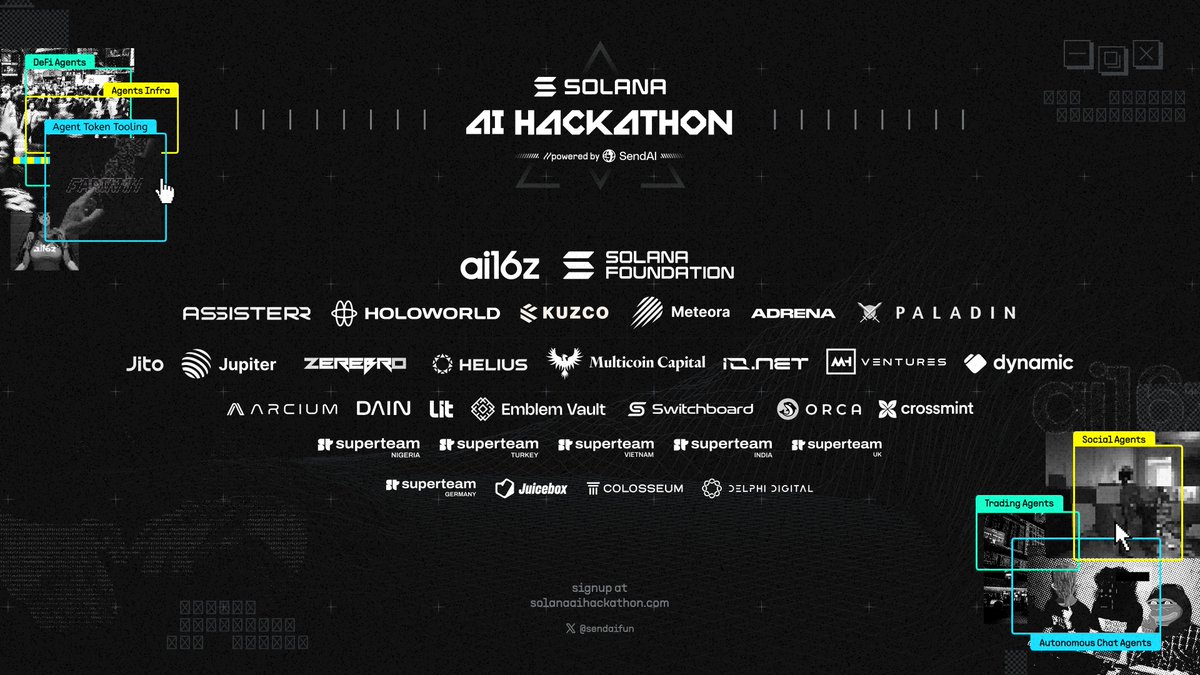
The first-ever Solana AI Hackathon is now live!
–– $185k+ in cash prizes
–– Global and Online
–– 6 Tracks on AI Agents
–– 10th to 23rd December
Here are all the details and tracks — powered by @sendaifun 🧵
Been thinking about what to do
like building futarchy related stuff is cool
but in reality a well done futarchic meme coin is probably the most +ev thing for @MetaDAOProject
thoughts?
how would you do it?