Eng lead of @firebase app hosting, functions, hosting, & storage. Prev @googlecloud, @facebook @parseit, & @microsoft windows. Scuba instructor on the wkends.
🎉 So @firebase launches 🚀
💻 Firebase Studio - a GenAI powered web based IDE powered by Gemini
🌏 Firebase App Hosting General Availability
🤝 Firebase Data Connect General Availability
🤖Genkit Beta for Golang and Alpha for Python 🐍and a prod monitoring dashboard
👇🧵 1/12
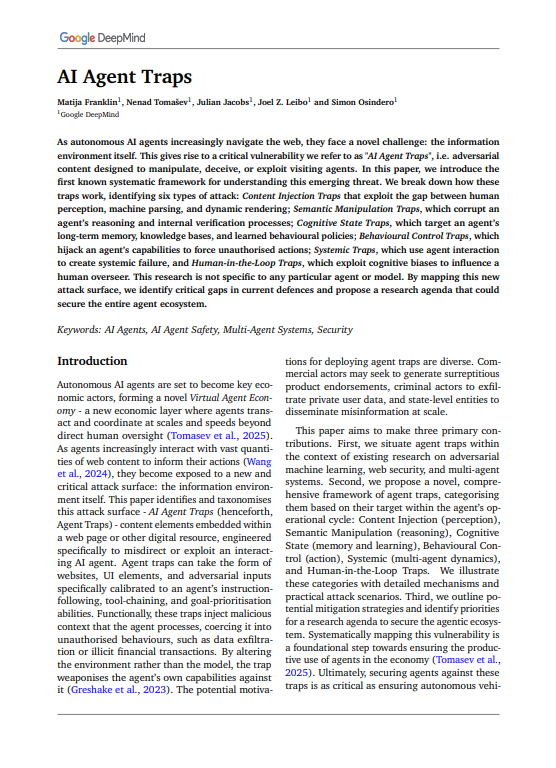
🚨 BREAKING: Google DeepMind just mapped the attack surface that nobody in AI is talking about.
Websites can already detect when an AI agent visits and serve it completely different content than humans see.
> Hidden instructions in HTML.
> Malicious commands in image pixels.
> Jailbreaks embedded in PDFs.
Your AI agent is being manipulated right now and you can't see it happening.
The study is the largest empirical measurement of AI manipulation ever conducted. 502 real participants across 8 countries.
23 different attack types. Frontier models including GPT-4o, Claude, and Gemini.
The core finding is not that manipulation is theoretically possible it is that manipulation is already happening at scale and the defenses that exist today fail in ways that are both predictable and invisible to the humans who deployed the agents.
Google DeepMind built a taxonomy of every known attack vector, tested them systematically, and measured exactly how often they work.
The results should alarm everyone building agentic systems.
The attack surface is larger than anyone has publicly acknowledged. Prompt injection where malicious instructions hidden in web content hijack an agent's behavior works through at least a dozen distinct channels.
Text hidden in HTML comments that humans never see but agents read and follow. Instructions embedded in image metadata.
Commands encoded in the pixels of images using steganography, invisible to human eyes but readable by vision-capable models.
Malicious content in PDFs that appears as normal document text to the agent but contains override instructions.
QR codes that redirect agents to attacker-controlled content.
Indirect injection through search results, calendar invites, email bodies, and API responses any data source the agent consumes becomes a potential attack vector.
The detection asymmetry is the finding that closes the escape hatch. Websites can already fingerprint AI agents with high reliability using timing analysis, behavioral patterns, and user-agent strings.
This means the attack can be conditional: serve normal content to humans, serve manipulated content to agents.
A user who asks their AI agent to book a flight, research a product, or summarize a document has no way to verify that the content the agent received matches what a human would see.
The agent cannot tell the user it was served different content.
It does not know. It processes whatever it receives and acts accordingly.
The attack categories and what they enable:
→ Direct prompt injection: malicious instructions in any text the agent reads overrides goals, exfiltrates data, triggers unintended actions
→ Indirect injection via web content: hidden HTML, CSS visibility tricks, white text on white backgrounds invisible to humans, consumed by agents
→ Multimodal injection: commands in image pixels via steganography, instructions in image alt-text and metadata
→ Document injection: PDF content, spreadsheet cells, presentation speaker notes every file format is a potential vector
→ Environment manipulation: fake UI elements rendered only for agent vision models, misleading CAPTCHA-style challenges
→ Jailbreak embedding: safety bypass instructions hidden inside otherwise legitimate-looking content
→ Memory poisoning: injecting false information into agent memory systems that persists across sessions
→ Goal hijacking: gradual instruction drift across multiple interactions that redirects agent objectives without triggering safety filters
→ Exfiltration attacks: agents tricked into sending user data to attacker-controlled endpoints via legitimate-looking API calls
→ Cross-agent injection: compromised agents injecting malicious instructions into other agents in multi-agent pipelines
The defense landscape is the most sobering part of the report.
Input sanitization cleaning content before the agent processes it fails because the attack surface is too large and too varied.
You cannot sanitize image pixels. You cannot reliably detect steganographic content at inference time.
Prompt-level defenses that tell agents to ignore suspicious instructions fail because the injected content is designed to look legitimate.
Sandboxing reduces the blast radius but does not prevent the injection itself. Human oversight the most commonly cited mitigation fails at the scale and speed at which agentic systems operate.
A user who deploys an agent to browse 50 websites and summarize findings cannot review every page the agent visited for hidden instructions.
The multi-agent cascade risk is where this becomes a systemic problem.
In a pipeline where Agent A retrieves web content, Agent B processes it, and Agent C executes actions, a successful injection into Agent A's data feed propagates through the entire system.
Agent B has no reason to distrust content that came from Agent A. Agent C has no reason to distrust instructions that came from Agent B.
The injected command travels through the pipeline with the same trust level as legitimate instructions. Google DeepMind documents this explicitly: the attack does not need to compromise the model.
It needs to compromise the data the model consumes. Every agentic system that reads external content is one carefully crafted webpage away from executing attacker instructions.
The agents are already deployed. The attack infrastructure is already being built. The defenses are not ready.
@kimmonismus The more I think about it, the more sense this makes. Why is the transformed vector for "rabbit" different if I say "the white fluffy rabbit" vs "the rabbit that was white and fluffy"? Is there a white paper that justifies this architecture with qualitative analysis?
@kimmonismus The fact that models only see left to right is a specific implementation of the transformer to zero out the upper triangle of the K & Q matrices. Other AI (i.e. translation) DO get to see tokens out of order. I wonder if that should be a toggle to avoid inflating token count?
@mbleigh Have you tried doing this when you're in a _broken_ state to see if it can tease apart what works and what doesn't, giving you a minimal repro?
Figured out why the redactions are so bad in the Epstein releases.
They're using software to automatically redact specific strings of characters.
Gee.
Why would they be trying to redact every mention of the letters
don t
? 🤔
Suggestion to all agentive IDEs:
Update your implementation of Agent Skills to allow folders containing collections of skills (e.g. ~/.myIDE/skills/GROUP1/skill1). This wold allow developers to git clone repositories of skills and "subscribe" to a feed of multiple.
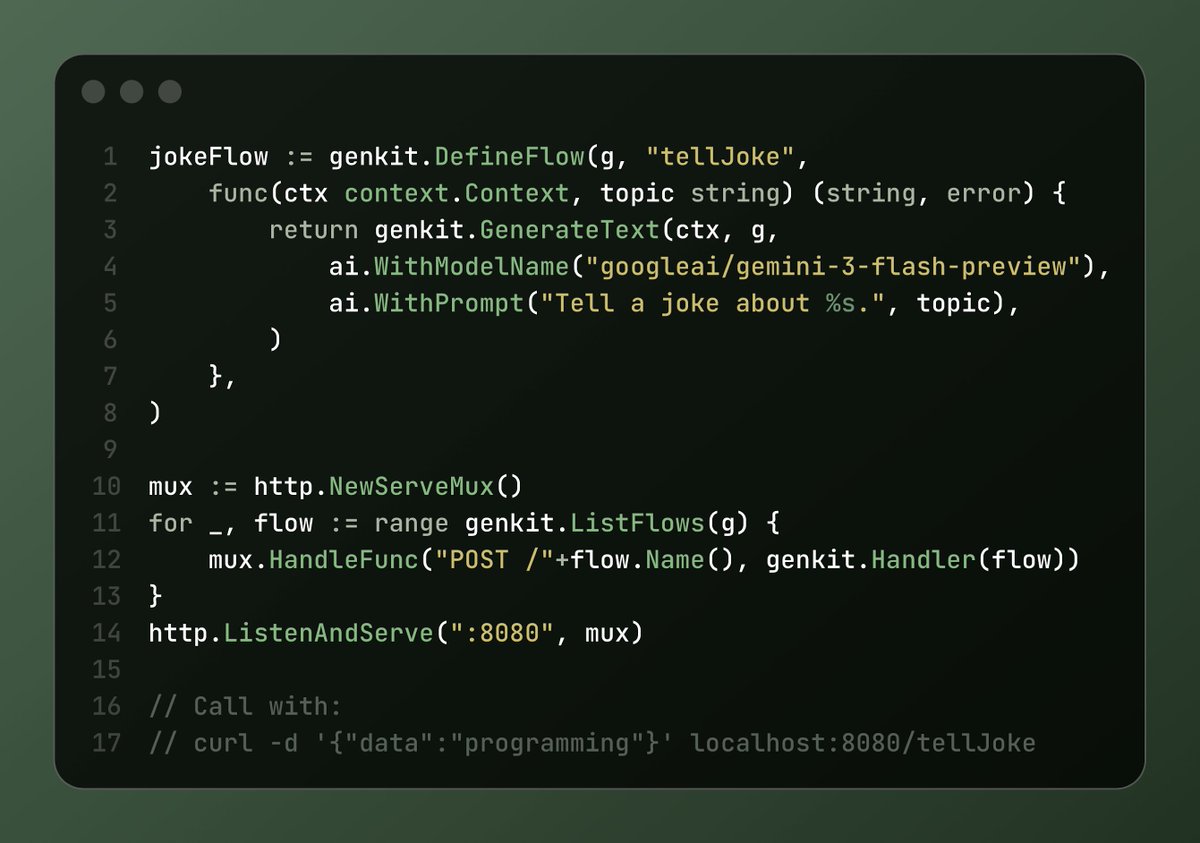
Once you've defined a flow, securely exposing it over HTTP is straightforward. Genkit handles JSON serialization, and streaming flows automatically use Server-Sent Events.
Check out Genkit Go 1.0, the open-source AI framework for @golang. Build scalable, production ready AI apps with the CLI and interactive developer UI.
https://t.co/Dz9vVaDKI9
Agents could use some more fine tuning with their YOLO/always allow modes. E.g. I'll never say "always allow" "git" or "npx", but I'd be quite comfortable always allowing "git diff" or "npx mocha".
📣 Genkit JS 1.17.0 is here! See the release notes → https://t.co/OU9pTAwg47
This release includes out-of-the-box support for Nano Banana and a new Genkit CLI command: genkit init:ai-tools. 🍌🪄
If you're using a coding agent like Firebase Studio, Gemini CLI, Claude Code, or Cursor, this command helps you configure the agent's rules and context. It can also install Genkit's MCP server to help the agent produce the best possible Genkit code. Learn more here → https://t.co/F6Rhb2ztLj
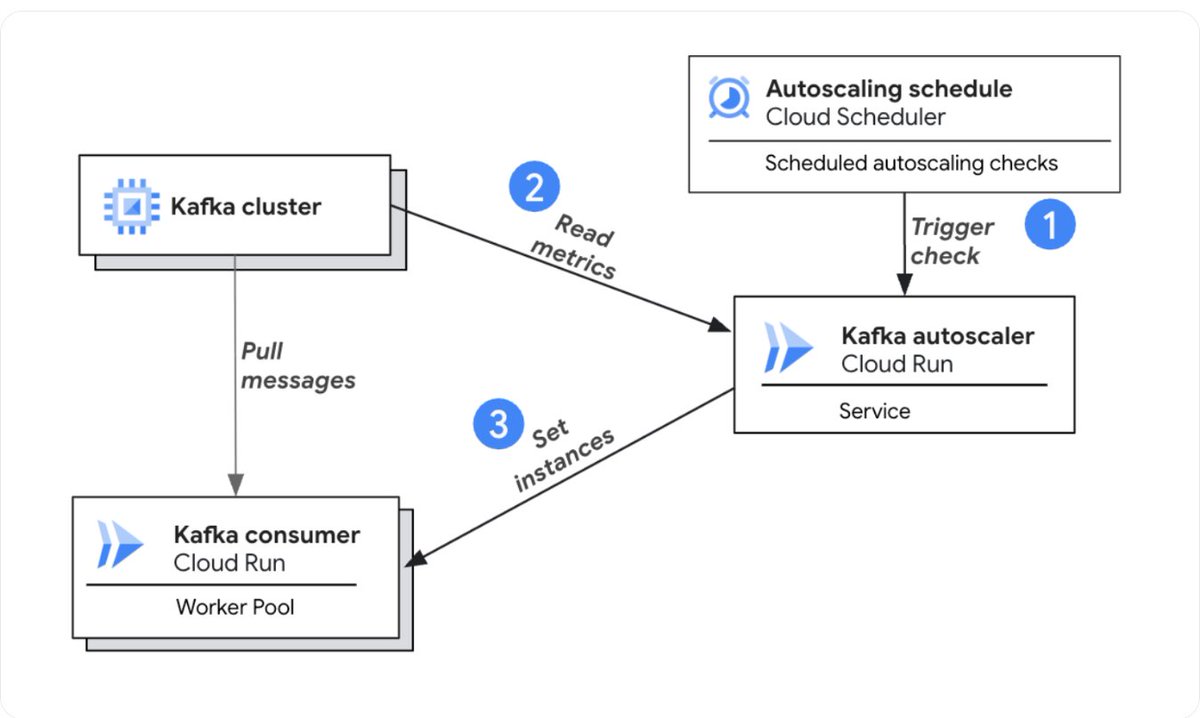
Yesterday, we introduced Cloud Run worker pools, designed for continuous background processing , ideal for pull-based workloads.
Today, we are introducing an open source autoscaler for Kafka consumers.
Hey @Hyundai, my GPS has been on the fritz for months since the last nav update. I finally got to a dealership (San Leandro, CA) and they said it can’t be fixed because your update was infected with malware and there is no timeline for a fix. Is this actually true? Big news if so!
Looks like @juliareid22 and my talk for I/O is live now! Learn more about #Firebase App Hosting, including an e2e demo e-commerce app built on Auth, Data Connect, Genkit, Gemini, Memorystore, and (of course) App Hosting 🔗👇
Fix for the “wealth tax is like shaving down a bar of gold” argument: every two years after acquiring a security, your cost basis adjusts 30% towards the current market price even if you hold. You can pay taxes or take losses on the change.