I have a report full of security issues of a software I'm working on.
Codex won't fix them because of Cyber guardrails
Fable won't fix them because of Cyber guardrails
Kimi K3 fixed them all. No restrictions, just gets the job done.
This will end badly for OpenAI & Anthropic.
IN 1998 A DEVELOPER GAVE A KEYNOTE USING ONLY SIMPLE ONE-SYLLABLE WORDS AND EVERY BIGGER WORD HE NEEDED, HE FIRST DEFINED ON STAGE BEFORE USING IT, IT SOUNDS LIKE A GIMMICK, UNTIL YOU REALIZE HE WAS LIVE-DEMONSTRATING THE ENTIRE FUTURE OF PROGRAMMING
52 minutes from Guy Steele -- co-designer of Scheme, Common Lisp, and the Java spec, one of the sharpest language minds alive.
-> His point: a language should not be finished. It should start small and let its users grow it, the same way English grew every word he was defining in real time.
A language carved in stone stays small and dies. A language people can extend themselves becomes limitless.
He was arguing against the whole industry, which kept shipping rigid, finished languages you were stuck inside.
And this is exactly what AI just became -- a language that grows to fit you. You add a new word in plain English, and the system understands and extends itself around it.
He was not describing a compiler feature. He was describing prompting, 25 years early.
You thought the language was fixed and you had to obey it. This is the talk that shows the language was always supposed to obey you.
Save this. Watch how he builds it live ↓
Can we release all the weights of an LLM but still provide differential access to privileged users?
Yes! We introduce: 𝗧𝗶𝗲𝗿𝗲𝗱 𝗟𝗮𝗻𝗴𝘂𝗮𝗴𝗲 𝗠𝗼𝗱𝗲𝗹𝘀 (𝗧𝗟𝗠𝘀). Define access tiers corresponding to different computation graphs over the same set of LLM parameters!
@kradleai The headline is misleading: alignment training is for human-AI alignment, not inter-AI cooperation. Because the game involved no humans, this experiment measures which AI is better able to grasp the dynamics of a novel environment and not much else.
A French engineer who lives quietly in Paris has spent 30 years writing software that the entire internet now runs on without knowing his name.
He wrote the code that streams every YouTube video, every Netflix show, every TikTok clip. He wrote the code that runs the virtual servers underneath AWS, Google Cloud, and Microsoft Azure. He calculated more digits of pi than anyone in history. He has no Twitter. He has no marketing. He just keeps shipping.
His name is Fabrice Bellard.
Here is the story, because almost nobody outside the systems programming world knows what one man has built.
Fabrice was born in 1972 in Grenoble, France. He studied at École Polytechnique, the top French engineering school. He never went to Silicon Valley. He never built a startup empire. He just wrote code.
In 2000 he started a project called FFmpeg, an open-source multimedia framework for encoding, decoding, and streaming video. He was 28. The project did one thing nobody else had done well. It handled every video and audio format that existed, in one library, on every operating system. He led it himself for years.
Today FFmpeg is the invisible engine of the internet. YouTube uses it. Netflix uses it. VLC uses it. Chrome and Firefox use parts of it. Every Android phone, every iPhone, every smart TV, every video editing tool you have ever touched runs FFmpeg somewhere underneath. If you have watched a video on a screen in the last 20 years, Fabrice's code processed it.
He was not done.
In 2003 he started QEMU, a machine emulator and virtualizer. He wrote it solo until version 0.7.1 in 2005. QEMU lets you run any operating system on any other operating system. It became the foundation of modern virtualization. KVM, the Linux kernel hypervisor, runs on top of QEMU. Every major cloud provider, AWS, Google Cloud, Microsoft Azure, IBM Cloud, runs virtual machines on infrastructure built around it. The Quick Emulator is the most cited piece of cloud infrastructure code on Earth.
He kept going.
In 2001 he won the International Obfuscated C Code Contest with a small C compiler that grew into TCC, the Tiny C Compiler. TCC can compile and boot a Linux kernel from source in under 15 seconds. In 2004 he calculated the most digits of pi ever computed at the time, using a personal desktop computer and an algorithm he derived himself called Bellard's formula. In 2011 he wrote a complete PC emulator in pure JavaScript that runs Linux in your browser, a project called JSLinux that engineers still cannot believe is real.
In 2019 he released QuickJS, a small but complete JavaScript engine that fits where V8 cannot. In 2021 he released NNCP, a neural network based lossless data compressor that immediately took the lead on the Large Text Compression Benchmark.
Then he turned his attention to large language models. He built TextSynth Server, a web server with a REST API for running LLMs locally. He released ts_zip and ts_sms, compression utilities that use language models to compress text and short messages at ratios traditional algorithms cannot reach. He released TSAC, a very low bitrate audio compression system. In December 2025 he released Micro QuickJS, a new JavaScript engine for microcontrollers, separate from QuickJS, designed for environments with almost no memory.
Fabrice co-founded a telecom company called Amarisoft in 2012, where he serves as CTO. Amarisoft builds 4G and 5G base station software used by carriers and labs around the world. He has been running it for over a decade while continuing to ship personal projects from his own home page at bellard dot org
He has no Twitter. He has no Instagram. He gives almost no interviews. His personal website is a flat list of projects with no styling, no fonts, no marketing copy. Just titles and links.
A quiet French engineer who never moved to Silicon Valley wrote the code that quietly runs the internet.
He is still shipping.
@_KarenHao Humans are cute, they erect monuments to their own gullibility. Perhaps it's a sign of future human endeavors (advertising their deficiencies) as AI increasingly takes care of the lower rungs of human needs in Maslow's pyramid.
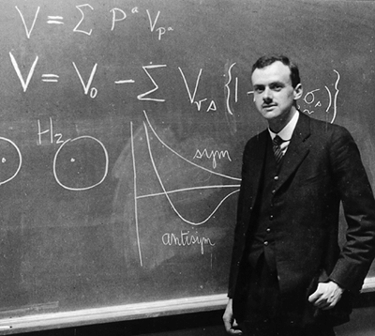
"If we are honest — and scientists have to be — we must admit that religion is a jumble of false assertions, with no basis in reality. The very idea of God is a product of the human imagination. It is quite understandable why primitive people, who were so much more exposed to the overpowering forces of nature than we are today, should have personified these forces in fear and trembling. But nowadays, when we understand so many natural processes, we have no need for such solutions. I can't for the life of me see how the postulate of an Almighty God helps us in any way."
— Paul Dirac, Remarks made during the Fifth Solvay International Conference
With curve-fitting, you are recording a lossy approximation of the output of some generative program. With symbolic learning, you are losslessly reverse-engineering the source code of the generative program.
Symbolic learning won't be the best fit for all problems, but for the ones where the latent program is reasonably simple, it will outperform by many orders of magnitude.
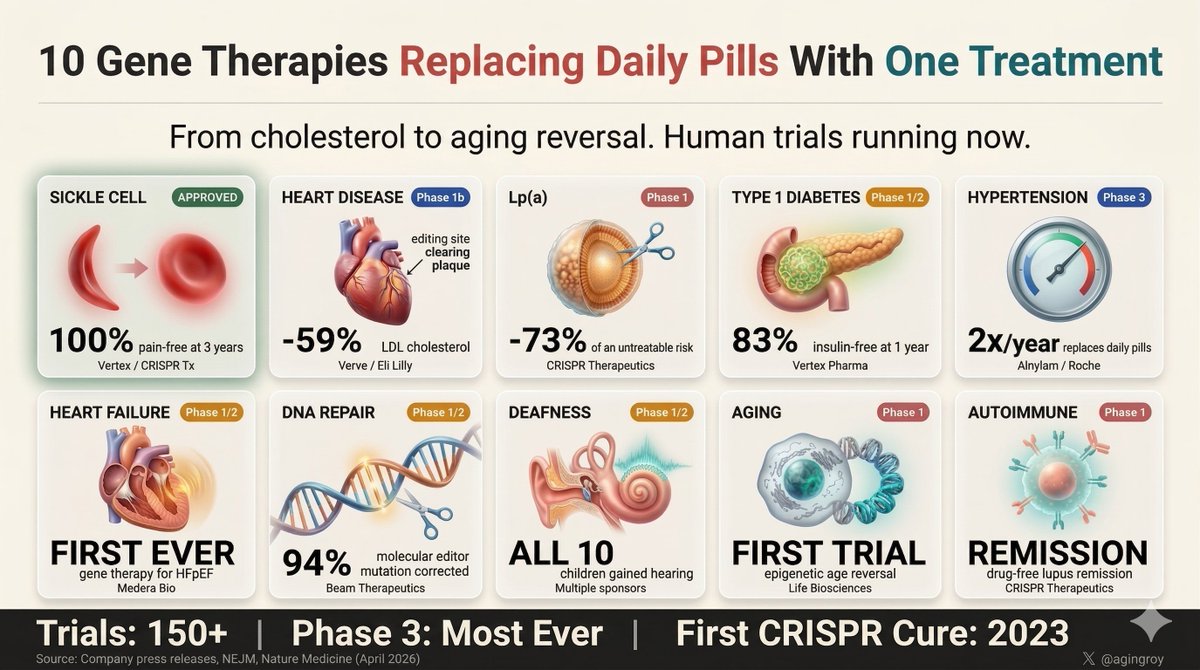
One injection to lower your cholesterol forever. One dose to cure sickle cell. One shot to restore a deaf child's hearing.
Not hypotheticals. All in human trials right now:
-> Heart disease: -59% LDL, one infusion, permanent (@VerveTx/Lilly, Phase 1b)
-> Lp(a): -73% of an untreatable risk 1 in 5 people carry (@CRISPRTx, Phase 1)
-> Sickle cell: 100% pain-free at 3 years (@VertexPharma/@CRISPRTx, APPROVED)
-> Type 1 diabetes: 83% insulin-free at 1 year (@VertexPharma, Phase 1/2)
-> Heart failure: First gene therapy for HFpEF, zero existing treatments (Medera, Phase 1/2)
-> Hypertension: Twice-yearly shot replaces daily pills (Phase 3, 11K patients)
-> DNA repair: First point mutation corrected in a living person, 94% fixed (@BeamTx, Phase 1/2)
-> Deafness: Single injection, hearing restored within months (Phase 1/2)
-> Aging: First human trial of cellular age reversal, targeting vision loss (Life Biosciences, Phase 1)
-> Autoimmune: CRISPR cells put lupus in drug-free remission (Phase 1)
150+ gene editing trials running. 2026 has more Phase 3 readouts than any year in history.
One-and-done genetic medicine isn't coming. For some diseases, it's already here.
Microsoft 365 connectors are now available on every Claude plan.
Connect Outlook, OneDrive, and SharePoint to bring your email, docs, and files into the conversation.
Get started here: https://t.co/EdoQeT8BBN
We're open-sourcing more of our stack: iron-proxy, a default-deny egress proxy for untrusted workloads.
It's been a bad month for supply chain security. Trivy, KICS, LiteLLM, and Axios all followed the same playbook: compromise a package, harvest env vars, exfiltrate secrets to a C2 server. Your CI runner, your agents, and your sandboxes all have real keys.
iron-proxy sits between your workload and the internet. Workloads get proxy tokens. iron-proxy swaps in real credentials at the network boundary. If a compromised dependency exfiltrates your API key, it gets a token that's worthless outside the proxy. It's how we secure our VMs at iron[.]sh.
The only way out is making sure there are no real secrets to steal.
GitHub: https://t.co/KElrG9hZy6
@TechCrunch Periodic clownish behavior by members of various parliamentary organs has been observed since perhaps the Roman Republic. This historical context is notable for its frequent omission from the contemporary media coverage of such episodes.