The cancer-Alzheimer's paradox, an inverse correlation, with an unexplained mechanism
"The risk of Alzheimer’s disease in patients with cancer is significantly reduced, and the risk of cancer in patients with Alzheimer’s disease is halved."
https://t.co/JOI0agYsWq
A must-read article by Corcos and colleagues for anyone caring for people with Parkinson's disease. The authors make a compelling case that exercise and lifestyle modification aren't just complementary therapies, they're essential parts of Parkinson's disease management. https://t.co/03WEK2Zlzu
We have conducted a 10 year longitudinal analysis of #Parkinsons trials (n=444), highlighting some interesting trends; Symptomatic trials registered each year has been trending down, while DMT trials have been shifting up; Only 9 Phase 3 DMTs in the last 10 years!
Very proud of this: It's the 5th edition of the #Parkinsons drug therapies in the clinical trial pipeline report (by @SueBCal1 @InnovationFixer@kenpitzer650 Brian fiske & the @CureParkinsonsT research team) & we have done something really special!
https://t.co/U7mvaeedKf
The Parkinson’s Hope List also has 455 projects listed as no longer active and 11 approved or submitted. All projects are classified by symptom relief or disease modifiers; and type (NCE, reformulation, repurposed, cell or gene therapy). #Parkinsons https://t.co/MXVxXMBq9W 2/2
The latest version of the Parkinson’s Hope List is now available at https://t.co/MXVxXMBq9W . It has 204 projects in Research stage, 86 in Discovery and 118 in Pre-clinical; and 174 in Clinical stage broken down by phase. #Parkinsons 1/2
The Parkinson’s Hope List also has 455 projects listed as no longer active and 11 approved or submitted. All projects are classified by symptom relief or disease modifiers; and type (NCE, reformulation, repurposed, cell or gene therapy). #Parkinsons https://t.co/MXVxXMBq9W 2/2
The latest version of the Parkinson’s Hope List is now available at https://t.co/MXVxXMBq9W . It has 204 projects in Research stage, 86 in Discovery and 118 in Pre-clinical; and 174 in Clinical stage broken down by phase. #Parkinsons 1/2
The Parkinson’s Hope List also has 455 projects listed as no longer active and 11 approved or submitted. All projects are classified by symptom relief or disease modifiers; and type (NCE, reformulation, repurposed, cell or gene therapy). #Parkinsons https://t.co/MXVxXMBq9W 2/2
The latest version of the Parkinson’s Hope List is now available at https://t.co/MXVxXMBq9W . It has 204 projects in Research stage, 86 in Discovery and 118 in Pre-clinical; and 174 in Clinical stage broken down by phase. #Parkinsons 1/2
The NOPARK phase 3 study on nicotinamide riboside in Parkinson's did not meet its primary endpoint. Disappointing, to say the least. #Parkinsons
https://t.co/V0rax9OBe5
Many people with Parkinson’s who could benefit from Deep Brain Stimulation (DBS) aren’t offered it due to cognitive concerns. However, evidence suggests DBS can be safe, improve long-term survival, and reduce institutional care needs, time to rethink: https://t.co/zy6faSe843
Alzheimer's disease drug development pipeline: 2026 published today! The 2026 AD drug development pipeline includes 158 unique therapies in 192 trials, marking continued growth in disease-modifying agents, with 35% being repurposed drugs. Thanks @DrJeffCummings@NIHAging@TheADDF
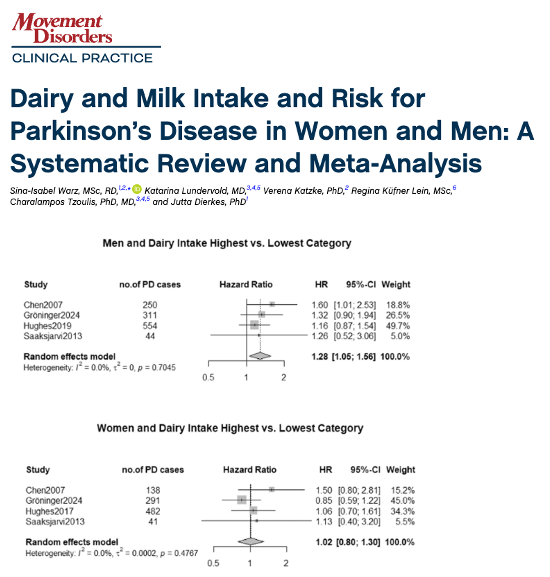
Does dairy increase Parkinson’s risk? A new meta-analysis takes a closer look. Dairy refers to foods produced from milk (milk, cheese, yogurt and butter). Warz and colleagues describe in a new paper that just dropped in Movement Disorders Clinical Practice how dairy and milk intake may relate to Parkinson’s disease risk in men and women.
Key Points:
- A systematic review and meta analysis including more than 578,000 participants examined whether higher dairy intake was linked to Parkinson’s disease risk.
- Higher total dairy intake was associated w/ a modestly increased Parkinson’s disease risk in men, but no meaningful association was observed in women.
- Milk intake alone showed a possible signal toward higher risk, however the evidence was inconsistent and the overall certainty of the data remained low.
My take: The dairy and Parkinson’s discussion has been around for decades and continues to evolve. This updated analysis suggests overall there may be a small association in men, however the signal remains weak and observational. Dairy remains an important nutritional source and the current evidence does not support sweeping dietary changes specifically to prevent Parkinson’s disease. We should remember the Honolulu Aging Study when discussing dairy and Parkinson’s disease. In that cohort, higher milk consumption was clearly associated w/ greater Parkinson’s disease risk. Investigators later uncovered an environmental clue tied to dairy production. Dairy cows had been fed pineapple plant tops contaminated w/ the pesticide heptachlor. The chemical entered the milk supply and likely exposed those who consumed the dairy. This story reminds us that the risk signal may not be the milk itself, but what may occasionally travel along w/ it. Here are 5 points that resonated w/ me about the recent paper:
1- Environmental factors likely contribute to Parkinson’s disease risk and diet may be one small piece of a much larger puzzle.
2- The association between dairy intake and Parkinson’s disease appeared stronger in men, highlighting possible biological or hormonal differences.
3- Several hypotheses exist including pesticide contaminants in dairy or metabolic effects such as lower uric acid levels.
4- Observational nutrition studies can show associations, however they do not prove cause and effect.
5- At this time health care providers should focus on balanced nutrition and overall health rather than eliminating dairy solely to reduce Parkinson’s disease risk.
https://t.co/cdAcshcvlQ @ParkinsonDotOrg@MDCP_Journal #parkinson
The Past, Present and Future of Clinical Trials in Parkinson's Disease as well as a Critique of How, Who and What We Measure...
https://t.co/4JjiF1xYXB
Why is Parkinson disease growing worldwide? The 'bathtub analogy' explains the surge. A bathtub analogy means imagining disease cases like water filling a tub where inflow, outflow and drainage determine how high the water rises. Dommershuijsen and colleagues describe in a new paper in Nature Reviews Neurology how simple epidemiological dynamics help explain the worldwide growth of Parkinson disease. They apply the bathtub metaphor.
Key Points:
- The bathtub water level represents the total number of folks living w/ Parkinson's disease, and this level has risen dramatically worldwide over the past decades.
- Inflow into the bathtub represents new cases and may rise due to population aging, environmental exposures and better detection of Parkinson's.
- Outflow represents deaths or cures, and longer survival w/ Parkinson's means less water draining from the bathtub and a steadily rising level.
My take: The bathtub analogy is a powerful way to understand the Parkinson pandemic. Even if the rate of new diagnoses stays stable, the total number of folks living w/ Parkinson disease can keep rising because more folks survive longer and populations are aging. This framing also reminds us that prevention, environmental protection and disease modifying therapies will be essential if we want to slow the rising water level.
Here are 5 points that resonated w/ me:
1- Parkinson disease is the fastest growing neurodegenerative disorder worldwide and the number of affected folks continues to climb.
2- Population aging expands the reservoir of individuals at risk and adds more water flowing into the bathtub.
3- Environmental exposures across a lifetime may contribute to rising disease risk in many regions of the world.
4- Better recognition and earlier diagnosis mean fewer cases are missed, which also raises the apparent number of folks living w/ Parkinson's.
5- Slowing the Parkinson's pandemic will require prevention strategies, disease modifying therapies and ultimately cures. These strategies will actively pump water out of the bathtub.
https://t.co/wfOZIhEN7q #parkinson @ParkinsonDotOrg
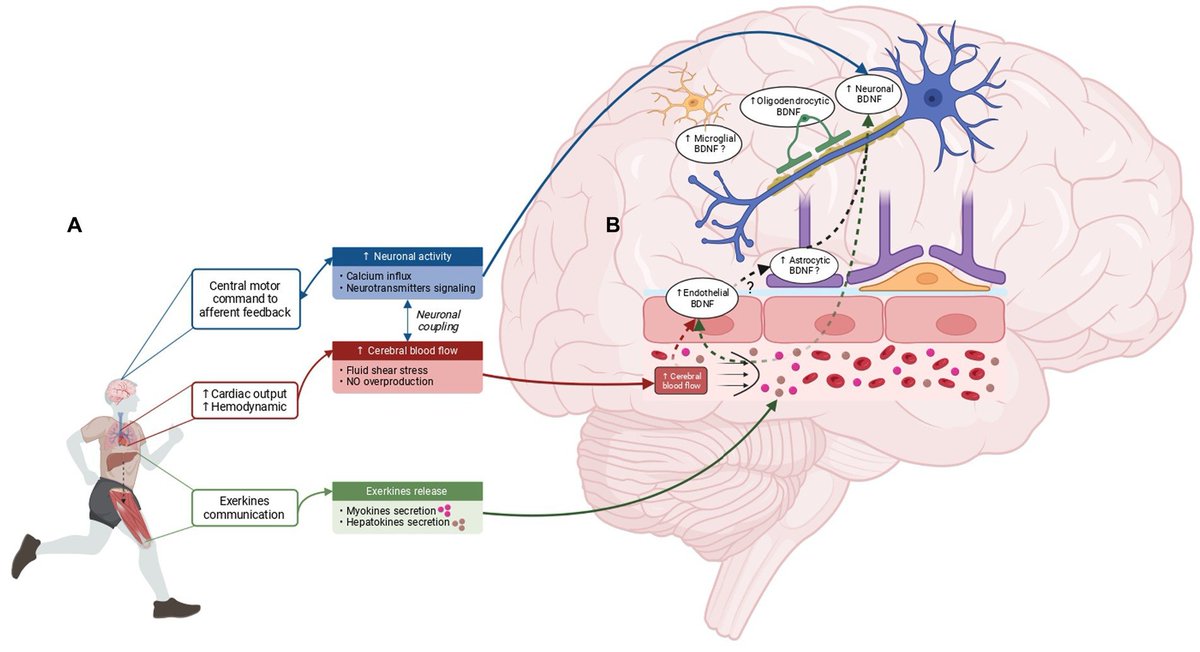
Exercise is a brain drug. Here’s the biology behind it
New review in Frontiers in Molecular Neuroscience breaks down how exercise boosts brain BDNF, the key molecule for learning and memory.
What matters most:
1. Exercise reliably increases brain BDNF, a driver of neuroplasticity and neurogenesis
2. BDNF supports memory, learning, mood, and stress resilience
3. Blocking BDNF signaling removes many cognitive benefits of exercise
How exercise raises BDNF:
4) Neuronal activity increases calcium signaling and gene expression
5) Increased cerebral blood flow activates endothelial BDNF production
6) Muscle and liver release exerkines like lactate, irisin, IGF-1, and ketones that signal the brain
7) Brain BDNF comes from neurons, blood vessels, and peripheral organs working together
Exercise isn’t just movement, it’s a whole body signal that rewires the brain from the inside out.