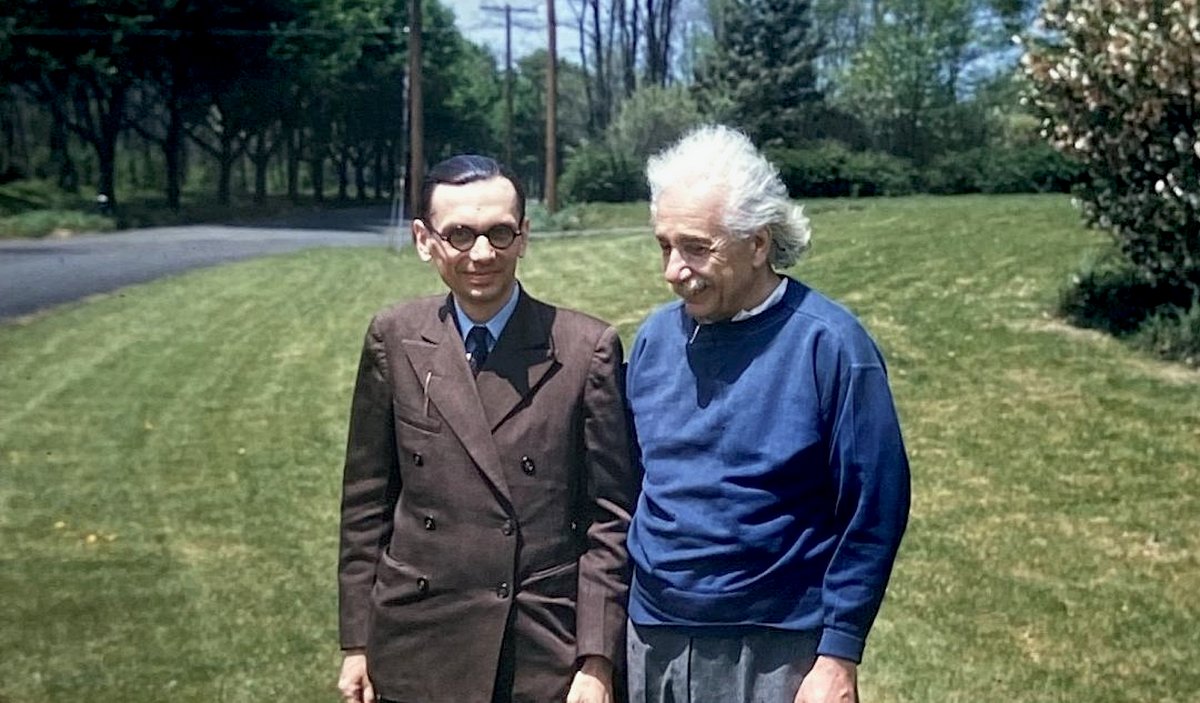
Albert Einstein and Kurt Gödel became close colleagues at Princeton, often walking home together from the Institute for Advanced Study. Gödel used Einstein’s general relativity to discover a bizarre rotating-universe solution in which the equations allowed paths through spacetime that could, in principle, return to your own past.
Einstein was fascinated by Gödel’s result, and reportedly joked that he came to work mainly so he could have the privilege of walking home with Gödel.
📷 IAS/Princeton
A four-way arch, 13 metres tall, still standing alone in a field in western Spain. It's the only one of its kind anywhere in the country.
Cáparra, on the Vía de la Plata: Rome's great north-south highway through Hispania, linking Mérida to Astorga.
Originally a Vettonian settlement. Granted Roman citizenship and municipal status in 74 AD, under Vespasian's edict of Latin rights.
A walled town of around 15 hectares. Forum, baths, a theatre, an amphitheatre.
Inscriptions show the road through it was repaired again and again: under Tiberius, Nero, Trajan, Hadrian. Emperors two centuries apart, all maintaining the same stretch of road.
At its centre: a tetrapylon, a four-sided monumental arch, standing over the road itself, where the city's two main streets crossed. Every traveller on the Vía de la Plata walked straight through it.
Then, as the empire fell, the town emptied out. Nothing is recorded of it through the Visigothic period. By the Arab conquest, there was nobody left to mention it.
Abandoned by the 9th century. Never resettled.
Almost nobody visits Cáparra today. For eight centuries, nobody could avoid it.🏛️
Aún seguimos maravillados por las vistas que nos dejó el eclipse solar total de esta semana. ✨
Pero este fenómeno no solo transforma el cielo: también es una gran oportunidad para la ciencia. Aprende más en este video: https://t.co/vo1T9OMAme
¿Preparados para el #eclipse? 🌘🌑🌒
La BNE se suma a @trioeclipses con una exposición digital de obras e imágenes que reflejan la riqueza cultural de estos fenómenos. En alta calidad y con información detallada de cada obra y su contexto histórico. 🔭
https://t.co/YoKbqBm9Ps
Hoy dentro un año tendremos al segundo eclipse total. Total por debajo del paralelo de Chipiona. Máximo en el Estrecho. Asómese ahora a ver dónde tiene el Sol porque será sobre las 10:50CEST.
¿Pero cómo es posible que hayamos normalizado la idea de que los menores, por principio, no deben ser devueltos a sus familias? Quienes así lo proponen, ¿se han aplicado el cuento a ellos mismos, que su hijo o hija de 15 años engrose un contingente a "repartir" en otro país?
Me hace mucha ilusión anunciar esta #exposición digital que Juan Pimentel y yo, en colaboración con un equipo fantástico de la @BNE_biblioteca, hemos preparado con motivo de los tres #eclipses solares:
“Eclipses. Cuando se alinean los astros”.
🌞: https://t.co/OIAgNir2tn
En el Complejo de Comunicaciones de Espacio Profundo de #Robledo asegurando el perímetro y realizando tareas de inspección y verificación para garantizar su operatividad con @intaespana y @EjercitoTierra
📸: Imágenes tomadas 26/07/2026 11:45h
Siguen con palabras vacías para un problema es que es muy simple: el abandono del medio rural.
No hay pastores ,el ganado cada vez va menos por el monte,la burocracia infinita para cualquier cosa,como coger leña y también la falta total de prevención en invierno. Ya está bien.
Before he unified electricity and magnetism, James Clerk Maxwell deeply studied the stability of Saturn’s rings. In 1859, he mathematically proved that the rings could not be solid or fluid but had to consist of numerous small particles — a result that was only observationally confirmed more than a century later by spacecraft!
📷 artistic impression
On 16 July 1969, the Apollo 11 spacecraft was launched from Kennedy Space Center in Florida, USA.
The crew consisted of three astronauts: Commander Neil Armstrong, Command Module Pilot Michael Collins, and Lunar Module Pilot Buzz Aldrin.
The launch vehicle used for Apollo 11 was the Saturn V rocket, one of the most powerful rockets ever built. It propelled the spacecraft into Earth orbit and then on a trajectory towards the Moon. The launch was a crucial step in the mission's objective to land humans on the lunar surface. After successfully reaching space, the Apollo 11 spacecraft orbited the Earth before executing a series of engine burns to set a course for the Moon. The journey to the Moon took approximately three days.
The Apollo 11 mission is best known for the historic moon landing that occurred a few days later. On July 20, 1969, Neil Armstrong became the first human to set foot on the lunar surface, famously declaring, "That's one small step for man, one giant leap for mankind." Buzz Aldrin joined him shortly afterward, and together they conducted experiments and collected samples during their time on the Moon.
[Image credit: NASA]
Three generation of Bohr's in one frame✍️
Niels Bohr (left) – along with his son Aage Bohr (center) – and his grandson Tomas Bohr (bottom) – currently Professor of Physics at the Technical University of Denmark (DTU).
@ClientesAdeslas Mi madre sufrió un ictus el 13 de abril. Llévanos desde el 23 de abril sin que Adeslas le dé un centro de rehabilitación.
Dan evasivas desde hacer 1,5 meses pese a q el contrato indica q deben proporcionar el centro en 5 días hábiles.
X favor, ayudadme con RT




![PhysInHistory's tweet photo. On 16 July 1969, the Apollo 11 spacecraft was launched from Kennedy Space Center in Florida, USA.
The crew consisted of three astronauts: Commander Neil Armstrong, Command Module Pilot Michael Collins, and Lunar Module Pilot Buzz Aldrin.
The launch vehicle used for Apollo 11 was the Saturn V rocket, one of the most powerful rockets ever built. It propelled the spacecraft into Earth orbit and then on a trajectory towards the Moon. The launch was a crucial step in the mission's objective to land humans on the lunar surface. After successfully reaching space, the Apollo 11 spacecraft orbited the Earth before executing a series of engine burns to set a course for the Moon. The journey to the Moon took approximately three days.
The Apollo 11 mission is best known for the historic moon landing that occurred a few days later. On July 20, 1969, Neil Armstrong became the first human to set foot on the lunar surface, famously declaring, "That's one small step for man, one giant leap for mankind." Buzz Aldrin joined him shortly afterward, and together they conducted experiments and collected samples during their time on the Moon.
[Image credit: NASA]](https://pbs.twimg.com/media/HNUxZT8aEAA2h2b.jpg)