In the beginning was the worm, and the worm was elegant. 📖
How does experience become inheritance? Opinions are based on my experience but some are inherited.
@small_LM I enjoyed this post and the one before it on the lysine codon. When I teach cell bio again next semester I'll mention your work to my students! Make sure to write these up as preprints for the wider community.
@MitoPsychoBio That kind of artifact would make a lot of sense. But in a way, I can't unsee it, and will be keeping an eye out for nuclear inclusions from now on!
Look at these gorgeous, dynamic, orange mitochondria surrounding the blue nucleus.
A view of life from beneath a cell monolayer in a parti dish. Whatever angle you look at it, life is always dynamic and pretty special.
Join us as a grad student! 🪱🔬
Using volume EM at Miami University's state-of-the-art imaging center (CAMI), we ask how embryos are shaped by their parents' and ancestors' experiences.
Apply via CMSB:
https://t.co/DhJEaChT99
@NEBiolabs I am aware of the technical note. However, I would like to see the data that enzyme performance does not decline after storage above 0°C for 24 hours. Why have you not published these results?
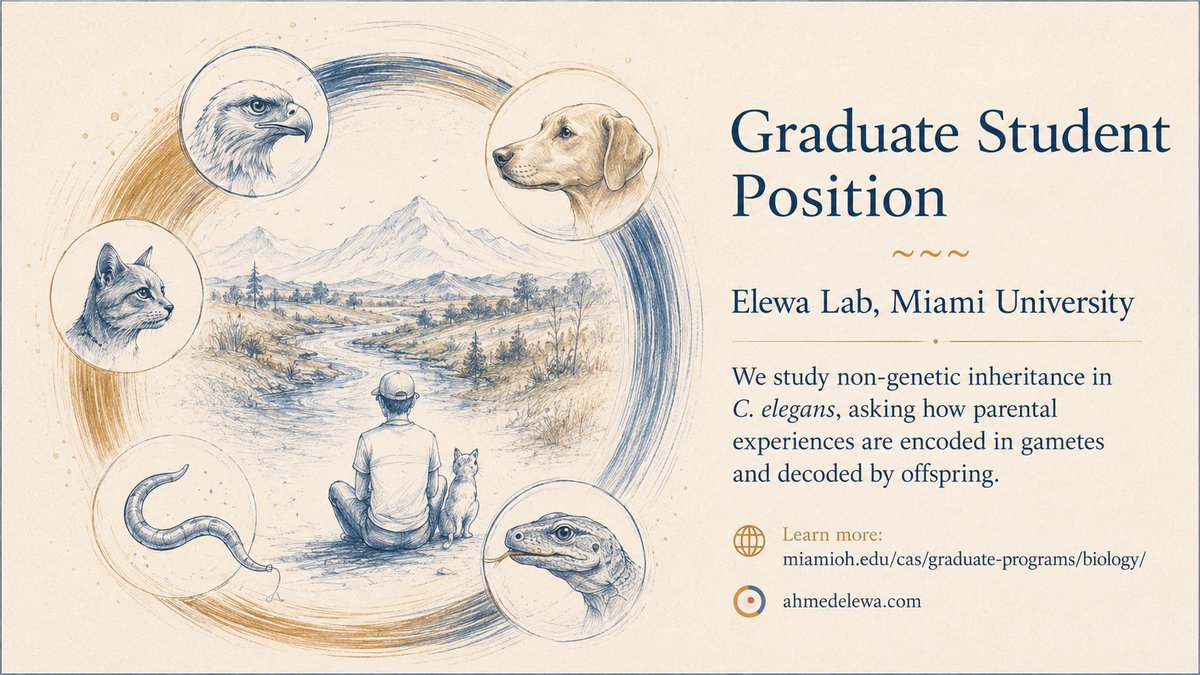
Welcoming graduate students who want to ask big questions with small worms. We study non-genetic inheritance in C. elegans, asking how parental experiences are encoded in gametes & decoded by offspring. Visit https://t.co/MJNa4yBuKC & https://t.co/m4jJxH5XSV for more information.
“Students weren’t just annotating - they were thinking critically about what they observed.”
In this course project, students used WEBKNOSSOS to explore real EM data, segment organelles, analyze cellular asymmetry, and develop biological hypotheses from their own observations. Read more: https://t.co/7Ur8YdXClH
Is Gemini inventing new terminology? It started off by suggestion "homozygizing" as a correct spelling, then doubled down when I searched if that word actually exists.
We spoke with Ahmed Elewa from Miami University about using WEBKNOSSOS in a cell biology course built around real C. elegans vEM data.
48 students annotated cells, generated AI training data, and even contributed to a biological discovery.
Read the interview: https://t.co/7Ur8YdXClH