Learn to sit back and observe; not everything requires a response. Sometimes the most powerful response is no response at all—just awareness.
Roy T. Bennett, The Light in the Heart
I've used Claude Code to build 20+ projects in the last 6 months. Thousands of new users across them. And I've never written a single line of code.
I just dropped a 24-min video with my top 10 tips for non-developers — the exact playbook I use every day to run multiple AI agents that handle work that used to take me a full week.
This is the best beginner guide to learning and building with Claude Code out right now. Every tutorial I found assumes you're a developer. This one doesn't.
I cover everything from first install to running multi-agent workflows — with live demos and real examples for every single tip. How I set up new projects, how I got Claude to match my writing style, how I automate repeatable workflows with one command, and how I run multiple agents working on different tasks at the same time.
I also built a full resource repo to go alongside the video — curated video tutorials, the best skill libraries, plugin directories, MCP server guides, written docs, community links, and a starter https://t.co/00cPLRz1gJ template you can copy-paste into your first project today.
Comment "GUIDE" and I'll send you the full guide with everything you need to learn Claude Code!
(make sure we're connected so I can DM you)
0% tax on crypto countries, where you can actually live with your family, from the more affordable to the least:
1. Portugal
2. Malta
3. UAE
4. Switzerland
5. Singapore
This is my selection based on safety, healthcare, schools, stability, and lifestyle, ordered from the more affordable to the least.
What's your favorite?
Master these 10 habits in 2026.
Feel amazing, reclaim agency + self-respect.
1. final food 4 hr before bed
2. screens off 30 min before bed
3. avoid blue light 2hr before bed, use red/amber
4. book in hand 10 min before sleep
5. go to bed same time every night
6. light in eyes when waking (sun or 10k lux)
7. walk for 10 min immediately following eating
8. daily exercise (even if for 20 min)
9. eat good stuff, ditch the junk
10. foster friends, family and love
They read as simple. I promise they'll change your life. Make them non-negotiate life habits. Do them every_single_day. Once you establish the habits, it is very easy to maintain. Stick with it for two weeks and start getting the dividends.
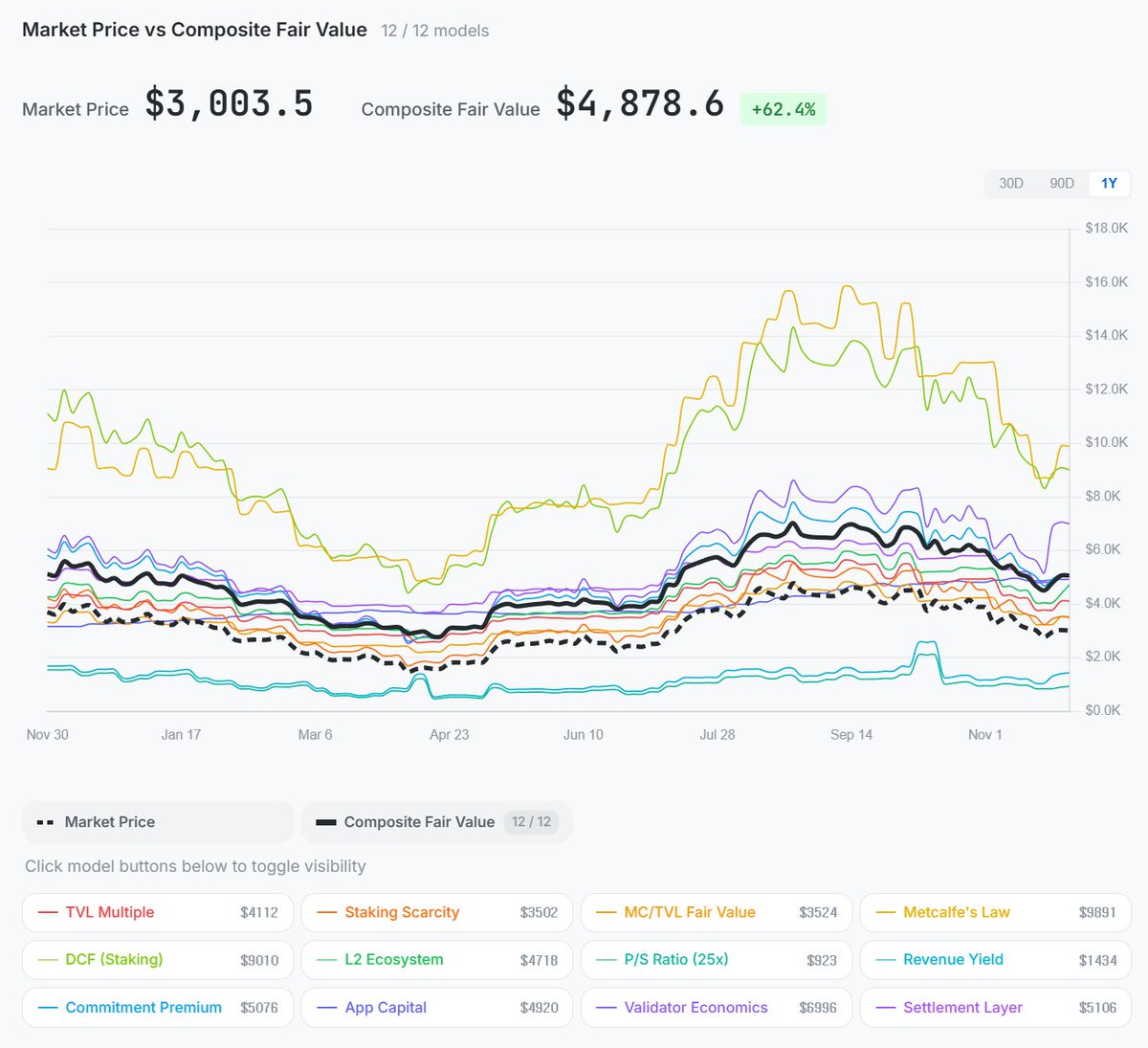
ETHval's biggest update in v0.3: Historical Charts for All 12 Models 📈
You can now compare how each valuation model has performed over the past year. See which models tracked the market closely, which ones called the tops and bottoms, and how your selected models stack up against actual price action.
https://t.co/CanopzxSz5
--
ETHval v0.3.1 Release Notes
📊 Historical Charts (NEW!)
* 1-Year Model Comparison: View all 12 valuation models against Market Price on a single interactive chart
* Model Mini Charts: Each Methodology card now has its own 30D/90D/1Y chart
* Interactive Legend: Click to toggle individual model visibility
* Custom Tooltip: Hover to see all values sorted from highest to lowest
🎨 UI/UX Polish
* Visual hierarchy with Market Price (dashed) vs Composite Fair Value (solid)
* Mobile-optimized layouts and responsive improvements
* Various typography and spacing refinements
🔧 Fixes
* Fixed some minor data & calculation bugs
Keep the feedback coming — let's keep building this together! 🙌
In Defense of Exponentials
I used to tell founders, the reaction you are going to get to your launch is not hate, it’s indifference. By default, nobody cares about your new chain.
I have to stop telling them that now. Monad just launched this week, and I’ve never seen so much hate about a blockchain that just launched. I’ve been investing into crypto professionally for 7+ years now. Before 2023, almost every chain I’ve ever seen that launched was mostly met with enthusiasm or indifference.
But now, new chains are born into a chorus of hate. The amount of haters I’ve seen for projects like Monad, Tempo, MegaETH—before they even hit mainnet—is a genuinely new phenomenon.
I’ve been trying to diagnose: why is this happening now, and what does it mean about the psychology of this market?
The Cure is Worse than the Disease
Forewarning: this is going to be the vaguest blockchain valuation post you ever read. I don’t have any fancy metrics or charts to sell you on. Instead, I’ll be arguing against the zeitgeist of Crypto Twitter, which for the last couple of years, I’ve been constantly on the opposite side of.
In 2024, I felt like what I was arguing against was financial nihilism. Financial nihilism is the belief that none of these assets matter, it’s all memes at the end of the day, and everything we’ve built is inherently worthless.
Thankfully, that’s no longer the vibe. We have broken out of that spell.
But the zeitgeist now is what I’d call financial cynicism: OK, maybe some of this stuff has value, maybe it’s not all memes, but it’s grossly overvalued and it’s only a matter of time before Wall Street finds that out. Not that all chains are worthless. But these things are all maybe worth 1/5th-1/10th of what they’re currently trading at (have you seen these PE ratios?), and so you’d better pray like hell Wall Street doesn’t call us on our bluff, because once they do it’s all getting wiped out.
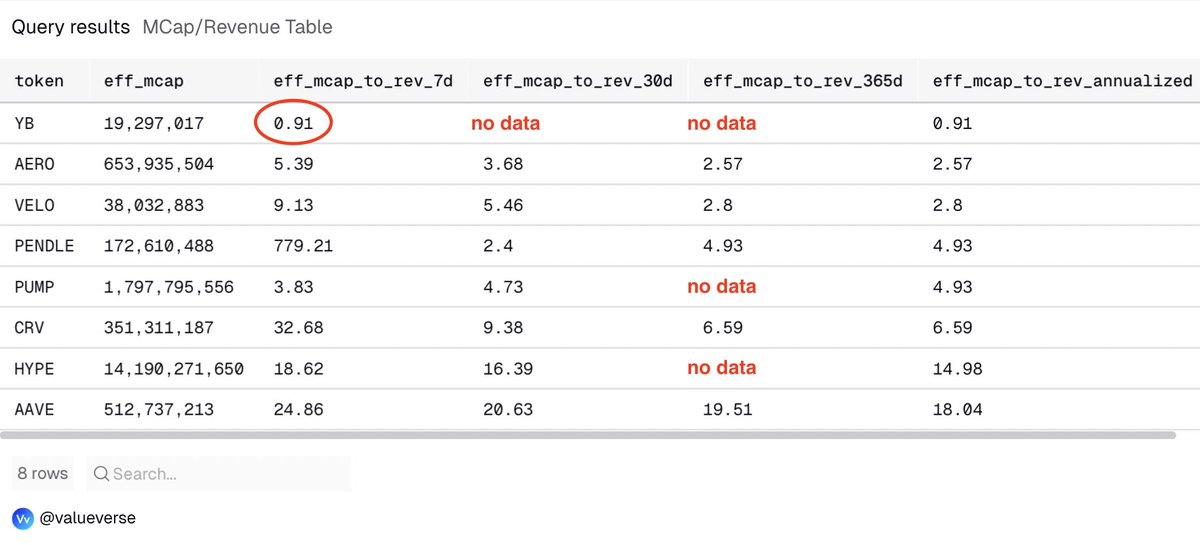
You’ve got many bullish analysts now trying to conjure up optimistic L1 valuation models, inflating PE ratios, gross margins, DCFs, trying to fight against this mood.
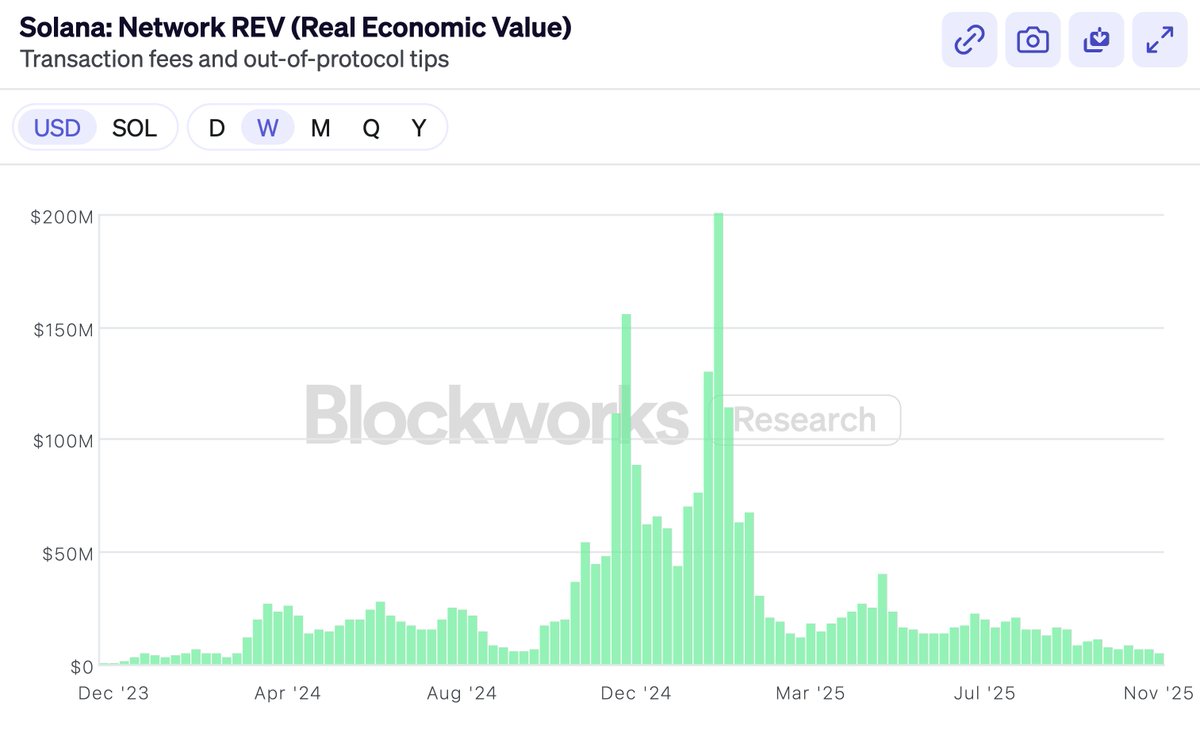
Late last year, Solana very proudly embraced REV as a metric that could finally justify their valuation. They proudly announced: we—and only we—are no longer bluffing to Wall Street!
And, of course, almost immediately after REV was embraced, it fell off a cliff (though $SOL, tellingly, did better than REV did).
Not that there’s anything wrong with REV. REV is a very clever metric. But the point of this post is not metric selection.
Then came the launch of Hyperliquid. A DEX that had real revenue and buybacks and PE multiples. And the chorus said—look, look I told you! Finally, for the first time ever, a token that has some real profits and a proper PE multiple. (Nevermind BNB, we don’t talk about that.) Hyperliquid will eat everything because obviously Ethereum and Solana don’t make any real money, we can stop pretending to value them now.
Hyperliquid, Pump, Sky, these buyback-heavy tokens are all great. But the market always had the ability to invest into exchanges. You could always buy Coinbase, or BNB, or whatever. We own $HYPE, and I agree that it’s a fantastic product.
But that’s not why people were investing in ETH and SOL. The fact that L1s don't have exchange-like profit margins is not why people were buying them—if they wanted that, they could’ve bought Coinbase stock.
So if I’m not critiquing blockchain financial metrics, maybe you think this post is going to be chiding the sinfulness of the token-industrial complex.
Obviously, everyone has lost money on tokens in the last year, VCs included. Alts are down bad this year. And so the other half of the zeitgeist on CT is arguing about who's to blame. Who’s become greedy? Are the VCs greedy? Is Wintermute greedy? Is Binance greedy? Are the farmers greedy? Are the founders greedy?
The answer, of course, is the same as it’s ever been.
Everyone is greedy. Everyone. The VCs, Wintermute, the farmers, Binance, the KOLs, they're all greedy, and you are greedy too. But it doesn't matter. Because no functioning market has ever required anyone to act against their self-interest. If we're right about crypto, we can all be greedy and the investments will still work out. Trying to analyze a market that has gone down by figuring out “who’s greedy” is going to be about as fruitful as commissioning witch trials. I guarantee you, nobody just started being greedy in 2025.
So this, too, is not what I’m going to be writing about.
Many people want me to write a post about why $MON should be valued at X or $MEGA at Y. I’m not interested in writing this post, or advocating that you buy anything in particular. In fact, you probably shouldn’t buy any of them if you don’t already believe in them.
Will any new challenger chain win? Who knows. But if it has a material chance of winning, it's going to be priced on that basis. If Ethereum is worth $300B or Solana is worth $80B, a project that has a 1-5% chance of becoming the next Ethereum or Solana will be priced according to those probabilities.
Somehow CT is scandalized by this, but it’s no different than Biotech. A drug that has less than a 10% chance of curing Alzheimer's is priced by the market as worth billions of dollars, even if 90% chance it won’t pass stage 3 trials and will go to 0. That's how the math works—and turns out, markets are pretty good at doing math. Binary outcomes are priced on probabilities, not on run rates or moral turpitude. It’s the “shut up and calculate” school of valuation.
I really don’t think that’s an interesting question to write about. “5% chance to win? No way, that’s clearly a 10% chance!” Markets, not articles, are the best way to assess that for any individual token.
So here’s what I am going to write about: CT doesn't seem to believe anymore that chains are valuable.
I don’t think this is because they don’t believe new chains can win market share. We just saw Solana dominate market share after emerging from the ashes less than 2 years ago. It’s not easy, but of course it’s possible.
It’s more that people have come to believe that even if a new chain wins, there’s no prize worth winning. If $ETH is just a meme, if it’ll never generate real revenue, then even if you win, you won’t be worth $300B. The contest is not worth winning, because these valuations are all bunk and it’ll all come crashing down before you go to claim your prize.
Being optimistic about chain valuations has become passé. Not that nobody is optimistic—obviously there must be optimists out there. For every seller there’s a buyer, and as much as CT cool kids love to drag L1s, people are comfortable buying SOL at $140, ETH at $3000.
But there’s a perception now that all the smartest people are over buying smart contract chains. Smart people know the jig is up. If not now, then soon. The only people buying here are suckers—Uber drivers, Tom Lee, and KOLs who say stuff like “trillions.” And maybe the US Treasury. But not the smart money.
This is bullshit. I don’t believe it, and you shouldn’t either.
So I felt like I had to write a smart person’s manifesto on why general purpose chains are valuable. This post is not about Monad or MegaETH. It’s really in defense of ETH and SOL. Because if you believe ETH and SOL are valuable, the rest is straight downstream.
Defending ETH and SOL valuations is generally not my job as a VC, but fuck it, if nobody else is willing to do it, then I’ll write it.
Feeling the Exponential
My partner Bo experienced the Chinese Internet boom first-hand as a VC. I’ve heard how “crypto is like the Internet” so many times now that it doesn’t even register for me anymore. But when I hear his stories, it always reminds me how costly it is to be wrong about these things.
A story he often tells is about when all the early e-commerce VCs (it was a small group back then) got together for coffee in the early 2000s. They debated: how big is the market for e-commerce going to be?
Is it going to be mostly electronics (maybe only techies will use PCs)? Could it ever work for women (perhaps they’re too tactile)? What about food (maybe impossible to manage perishables)? These were deeply important questions for early VCs to decide what to invest in and what prices to pay.
The answer, of course, was that literally every single one of them was devastatingly wrong. E-commerce would sell everything, and the target audience was the whole fucking world. But nobody at the time actually believed it. And even if they did, it would be too absurd to say out loud.
You just had to wait long enough for the exponential to show you. Even among the believers, very few thought e-commerce would become as big as it became. And those few who did, almost all of them became billionaires from just not selling. Every other VC—as Bo tells me, since he was one of them—sold too early.
It has become passé in crypto to believe in the exponential.
I believe in the crypto exponential. Because I’ve lived it.
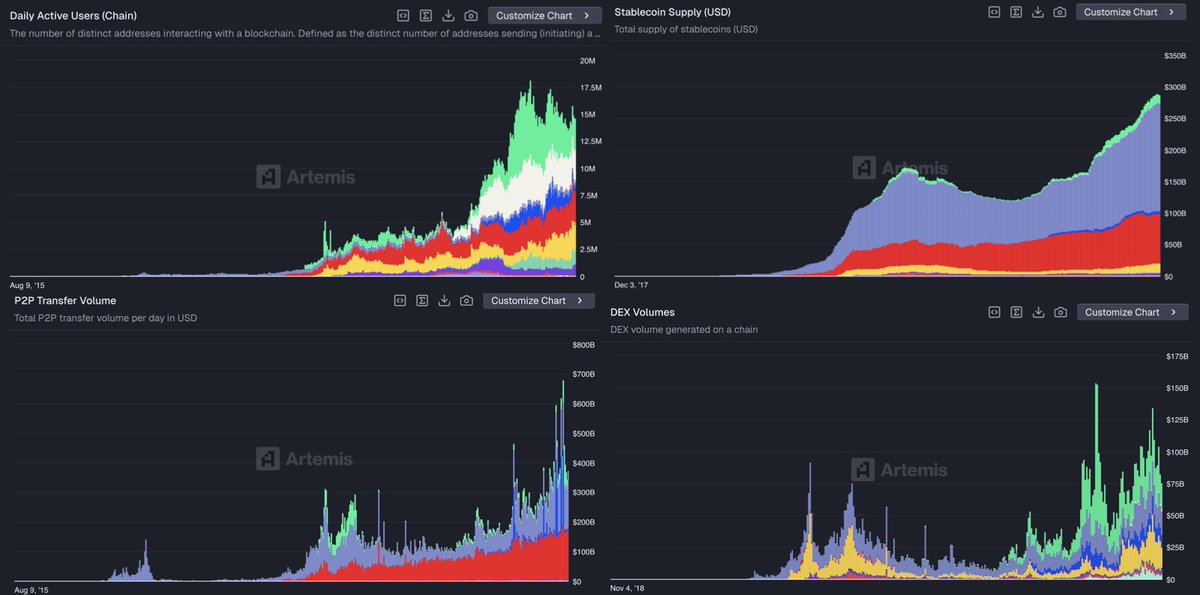
When I started in crypto, nobody used this stuff. It was tiny and broken and awful. TVL on-chain was in the millions. We invested into the first generation of DeFi, MakerDAO, Compound, 1inch, back when they were science projects. I remember playing around on EtherDelta back when DEXes traded single digit millions a day, and that was considered to be a huge success. It was complete dogshit. Now we routinely trade in the tens of billions on-chain every day. I remember believing it was crazy that Tether hit a billion dollars in issuance and was being written up in the NYT as a ponzi scheme on the brink of shutdown. Now stablecoins are over $300B and regulated by the Federal Reserve.
I believe in the exponential because I’ve lived it. I’ve seen it over and over again.
But you might respond—well, stablecoin growth might be exponential, maybe DeFi volumes are exponential, but they don’t accrue to ETH or SOL. The value doesn’t get captured by the chains.
To which I answer: you still don’t believe in the exponential.
Because the exponential’s answer is always the same: it doesn’t matter. This stuff is going to be so much bigger than it is today. And when it’s absolutely enormous, you’ll make it up on scale.
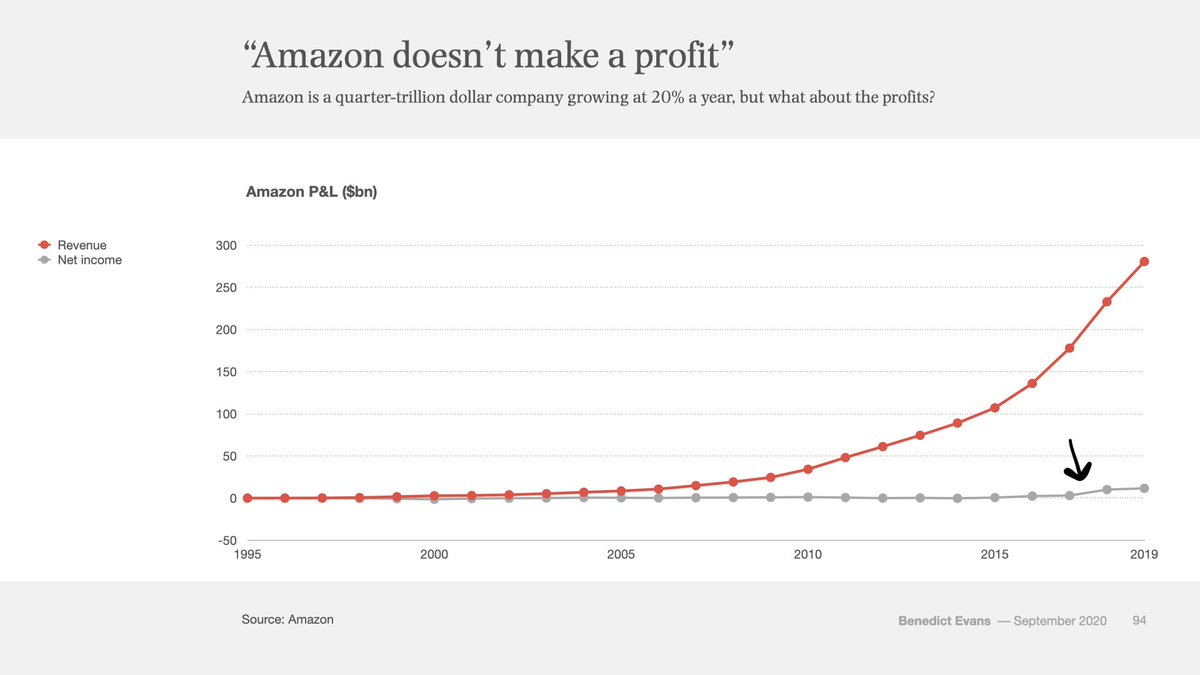
Study this chart.
This is Amazon’s P&L from 1995 to 2019. That’s 24 years. Red is revenue, gray is profit. You see that little blip on the end where the gray line goes up? That’s when, 22 years in, Amazon started actually making a profit.
Amazon was 22 years old when this little gray line of net income first peeled off of 0. Every single year before then, there were op eds and critics and short sellers claiming that Amazon was a ponzi scheme that would never make any money.
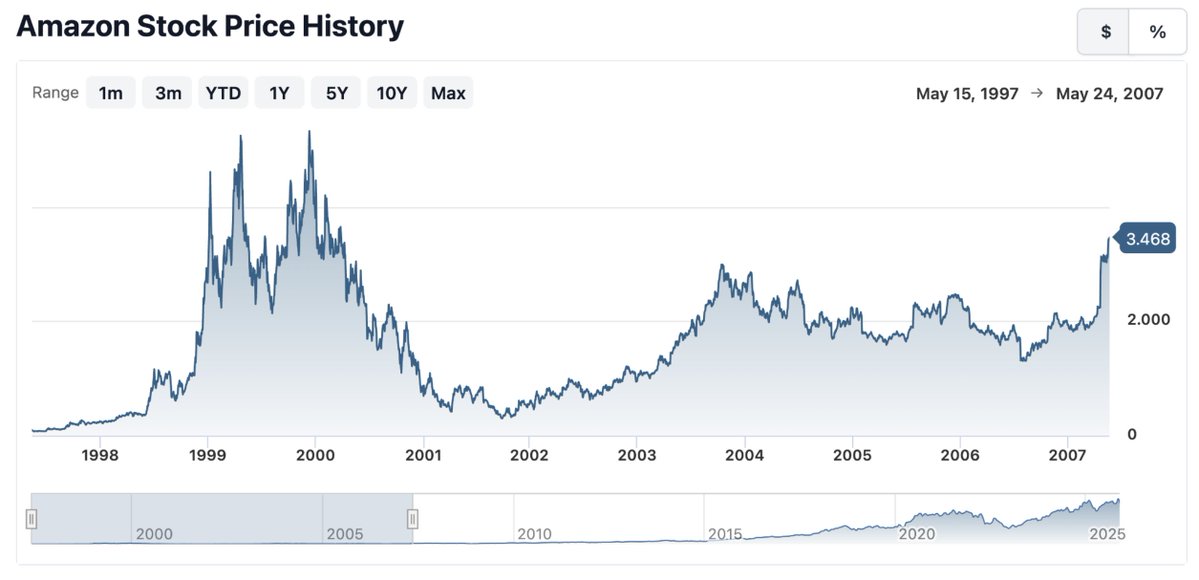
Ethereum just turned 10 years old. This is what the first 10 years of Amazon stock looked like:
10 years of chop. All along the way, Amazon was beset with doubters and non-believers. Is e-commerce a VC-subsidized charity? They’re selling underpriced cheap low-quality knick-knacks to bargain hunters, who cares? How are they ever going to make actual money, like Walmart or GE?
If you were arguing about Amazon’s P/E ratio, you were in the wrong regime. That’s the regime of linear growth. But e-commerce was not a linear trend, and so every single person for 22 years arguing about P/E ratios was devastatingly wrong. No matter what you paid, no matter when you bought, you were not bullish enough.
Because that’s what exponentials do. When it comes to truly exponential technologies, no matter how big you think it’s going to get, it just keeps getting even bigger.
This is the thing that Silicon Valley has always understood better than Wall Street. Silicon Valley was raised on exponentials, while Wall Street was raised on linearity. And over the last few years, crypto’s center of gravity has migrated from Silicon Valley to Wall Street. You can feel it.
Granted, crypto growth doesn’t look as smooth as e-commerce’s growth. It’s burstier, it goes in fits and starts. This is because crypto, being about money, is deeply tied to macro forces, and it also has more violent regulatory push and pull than e-commerce. Crypto strikes at the heart of the state—money—and so it’s more unnerving to governments than e-commerce ever was.
But the exponential is no less inevitable. It's a crude argument. But if crypto is exponential, then the crude argument is correct.
Zoom out.
Financial assets want to be free. They want to be open. They want to be interconnected. Crypto turns financial assets into file formats, makes it as easy to send a dollar or a stock as to send a PDF. Crypto makes it possible for everything to talk to everything. It makes it all 24/7, global, interconnected, and open.
That will win. Open always wins.
If there’s no other lesson I've learned from the Internet, it’s that. Incumbents will fight against it, governments will huff and puff, but eventually they will give up against the adoption, the generativeness, the sheer efficiency that this technology enables. It’s what the Internet did to every other industry. Blockchains are how that same trend will gobble up all of finance and money.
Yes—with enough time—all of it.
An old saying goes: people overestimate what can happen in two years, but they underestimate what can happen in ten.
If you believe in the exponential, if you zoom out enough, then it’s all still cheap. And it should humble you that every day, the holders outlast the sellers and naysayers. Big capital has a longer time horizon than CT swing traders might lead you to believe. Big capital has been trained through history not to fade big technologies. You know, the big gushy story that originally got you to buy $ETH or $SOL? Big capital believes that story and hasn't stopped.
So what exactly am I arguing?
I am arguing that applying P/E ratios to smart contract chains (the “revenue meta,” as it’s now called), is giving up on the exponential. It means you have consigned this industry to the regime of linear growth. It means you believe 30 million DAUs on-chain and <1% of M2 is it. Crypto is just one of the things in the world. A sideshow. It did not win. It was not inevitable.
More than anything, I’m arguing to be a believer. Not just a believer, but a long-term believer.
I’m arguing that this exponential will be bigger than anything else you’ve been a part of in your life. That this is your e-commerce. That you will look back when you’re old and tell your kids—I was there when it all happened. Not everyone believed it was possible, that whole societies could change, that all of money and finance would be transformed by programs running on decentralized computers that we collectively owned.
But it actually happened. It changed the world.
And you were a part of it.
Disclosure: These are my own views. Dragonfly is an investor in $MON, $MEGA, $ETH, $SOL, $HYPE, $SKY among many other tokens. Dragonfly believes in the exponential. This is not investment advice, but is advice of another kind.
Today I turn 55.
I’m the fittest, sharpest, and happiest I’ve ever been.
If I’m an outlier, it’s not because I’m built different or discovered a secret formula. The truth is far less glamorous:
It’s a million tiny choices, compounded over decades.
Here are 55 of them:
1. Walk 15+ miles a week, even if you do other exercise. Humans are uniquely made to move slowly over long distances—it’s critical to longevity.
2. Develop a writing practice. It’s the single best way to sharpen your mind. And remember, you don’t have to be a good writer to write. Start with 10 minutes a day.
3. Swap out your toothpaste, deodorant, lotions, soap, shampoo, and other personal care products for natural versions. Here’s a rule of thumb: Don’t put anything on your skin that you couldn’t safely eat.
4. If you have a positive thought about someone, don’t keep it to yourself—share it immediately. Encouragement defies the laws of physics: When you give energy, you also receive it.
5. Wear shoes with a wide forefoot (I like Topo Athletic) and wear toe spreaders around the house (search “yoga toes” on Amazon). Spine health begins with the feet.
6. Get sunlight regularly. Moderate sun exposure (without sunscreen) is hugely important for overall health.
7. Do a 3-minute deep (“ass to grass”) squat every morning. Deep squats are often called the anti-aging exercise. It’s been said that, “It’s not that you can’t do deep squats because you’re old, it’s that you’re old because you can’t do deep squats.”
8. Explore minimalism (it’s not what you think it is).
9. Set boundaries on toxic relationships. We tend to cling to relationships past their expiration date, and it takes a bigger toll on our health than we recognize.
10. Eat real food. Not too much. Don’t eat garbage. Binge occasionally. Fast occasionally. That’s the diet.
11. Learn about FIRE. It’s a great framework for financial success.
12. Don’t take antibiotics except in emergency situations. They’re massively over-prescribed and aren’t needed in most cases. Antibiotics have done untold damage to our guts, which is where health begins. Great natural alternatives are out there.
13. Get 8 hours of quality sleep each night. To optimize sleep:
—Don’t eat after 6pm
—Get blackout shades and cover LEDs with black tape
—No screens 2 hours before bed
—Try ashwagandha (an herb) to calm the nervous system
14. Stop drinking, even in moderation. People find all sorts of ways to justify drinking, but there’s no escaping the simple fact that alcohol is a toxin and it limits your potential.
15. Travel as much as possible. Nothing expands the mind like seeing the world. And travel doesn’t have to be expensive—the best experiences happen outside of fancy resorts, when you live like a local.
16. Let go of resentment. When you forgive someone, you release the prisoner, and the prisoner isn’t them… it’s you.
17. Show up on time, every time. Poor time management limits success more than most people realize. If you struggle with punctuality, stop everything else and fix that first.
18. Spend lots of time in nature and touch the earth. Humans evolved over 300k years to live in harmony with nature, and only recently have we retreated indoors. If you don’t spend time outside, you’re fighting biology (hint: You won’t win.)
19. Stop doing dumb things. As Leo Tolstoy said, “People try to do all sorts of clever and difficult things to improve life instead of doing the simplest, easiest thing—refusing to participate in activities that make life bad.”
20. Find your happy place and (eventually) move there. Most people live where they live because... that's where they live. We are products of our environment—choose yours carefully.
21. Find a hobby and pursue mastery. You can’t have a happy life without a passionate pursuit that isn’t your vocation. Your work—even if you enjoy it—isn’t enough.
22. Avoid mainstream medicine except as a last resort. The results are in—our healthcare (or more appropriately, sick care) system is badly broken and only makes people sicker.
23. Have a mindset of abundance. There is no advantage to being a pessimist—even if you’re right, it’s a miserable way to live. In a very real way… whatever you believe, you’re right!
24. Do hard things. Choose courage over comfort. Everything you want is on the other side of fear and hard work. As Jerzy Gregorik said, “Hard choices, easy life. Easy choices, hard life.”
25. Ignore haters. Hurt people hurt people. Negative/toxic people live in a prison of their own design. Don’t join them!
26. Say no. Protect your time and energy like it’s your most precious asset… because it is.
27. Become a water snob. As an alien said on Star Trek, humans are “ugly bags of mostly water.” You are what you drink—literally! We have Mountain Valley Spring water delivered in glass 5-gallon jugs and also have whole-house water filter (Aquasana Rhino).
28. Stop drinking sodas and sugary energy drinks. After a few weeks you won’t miss them, and a few months later they’ll seem disgusting. Refined sugar causes inflammation, which is the root of most disease.
29. If you’re over 35, find a good functional/longevity medicine doctor and start tracking your hormones. Modern life is hell on the endocrine system and restoring healthy hormone levels can change your life. As we get older, we either accept a slow decline in performance or we do something about it—choose the latter!
30. Develop a morning routine and follow it faithfully. Win the morning, win the day!
31. Invest in experiences, not things. People frequently regret buying things, but rarely regret investing in great experiences (especially when shared with loved ones). Remember, there’s nothing you can buy in a mall that you’ll remember in ten years.
32. Explore spirituality. It’s arrogant and small-minded to believe there’s nothing going on in our universe that is beyond our comprehension. We know less about our universe than an ant meandering on a sidewalk understands about this planet.
33. Have a strong bias toward action—doing rather than talking. If you ask a bunch of old people about their regrets, they’ll talk about the things they *didn't* do—the shots they didn’t take—more than the things they did do (even if it went wrong). As Wayne Gretzky famously said, “You miss 100% of the shots you don’t take.” Most people don’t take enough shots.
34. Stay lean. Men in particular are obsessed with muscle mass these days, but bulk doesn’t age well. The goal is to be strong but lean. The fittest guys in their 50s and beyond aren’t meatheads, they’re lean guys who are serious about a sport.
35. Curate your inner circle carefully. Surround yourself with people you admire and who challenge you to grow. Remember, we’re the average of our 5 closest relationships.
36. Be the fittest version of yourself. Your body is your only vessel for experiencing life—so treat it as such. Fitness isn’t working out a few times a week, it’s a lifestyle. The older you get, the more time you need to devote to your health.
37. Take the time to appreciate art and beauty in all its forms.
38. Think globally, but act locally. Too many people put their energy into far-away problems they don’t understand and can’t impact, while ignoring problems right under their nose. Want to change the world? Start at home.
39. Try psychedelics. It’s one of those things everyone should do at least once, and it might be the breakthrough you’ve been looking for.
40. Limit bad habits, including unhealthy thought patterns. We all have them—practice avoidance and find substitutes. Get professional help if needed.
41. Be a lifelong learner. Your brain is just like a muscle—if you don’t feed and flex it regularly, it will atrophy.
42. Find your purpose. People with a strong sense of purpose are happier and live longer. Lack of purpose sucks energy and magnifies depression.
43. Only take advice from people who embody the traits you want to have. Talk is cheap—emulate those who have DONE it.
44. The goal is not to retire and do nothing, it’s to build a great day-to-day life that you don’t need to escape. A life of leisure is a slow death. Happiness isn’t possible without a little struggle, uncertainty, and skin in the game.
45. Have fun! Do frivolous and silly things that make you smile. As George Bernard Shaw famously said, “We don't stop playing because we grow old; we grow old because we stop playing.”
46. Whatever you want to do or achieve in life, start NOW. Don’t fall victim to “someday thinking” because someday never comes.
47. Accumulate assets—things that grow in value over time. It’s the #1 habit of rich people, and it can be done in tiny chunks. Instead of spending $100 on an impulse purchase that has no lasting value, put that money into an index fund or Bitcoin. It becomes addictive (in a good way).
48. Don’t ignore the big 3 canaries in the coal mine for health:
—Low libido (and ED)
—Frequent sinus & respiratory issues
—Depression
These usually aren’t medical conditions in themselves, they’re symptoms of an underlying problem. Find a good doc (outside of the mainstream) and figure out the root cause.
49. Have a clear vision for your future. How can you decide which direction to go if you haven’t clearly defined the destination? It sounds obvious, but 95% of people haven’t defined their “Ideal End State” in detail and in writing. (Check out my thread on this topic.)
50. Make your own decisions. We live in an era where most of what society tells us is wrong. Don’t be afraid to break from societal norms—if people say you’re crazy, it’s a sign that you’re doing something right.
51. Get hardcore about mobility exercise. As you age, it’s usually the knees, hips, and lower back that limit physical performance. 30 min a couple times a week can spare you a lifetime of pain. YouTube is a great resource.
52. Go all in on family. Get married, stay married, have kids. Burn the boats. In the end, family is all that matters.
53. Be ruthless with your time. Money comes and goes. Time only goes. Audit your calendar ruthlessly—cut the trivial, double down on the meaningful, and spend your hours like your life depends on it. (Because it does.)
54. Have a strong bias toward action. Be curious, try things, meet people—it’s how you increase your surface area for serendipity, the most powerful unseen force in our lives.
55. Reinvent yourself every decade. Over time, we slowly drift off course from our priorities, values, and true identity. Take stock and don’t be afraid to hit the reset button. Bold, calculated moves made for the right reasons almost always pay off—usually even more than you can imagine.
🎁 P.S. If you enjoyed this post, would you give me a birthday gift? Repost or comment with the item number(s) you liked best?
This dip is just long-term holders rotating among themselves. Old Bitcoiners are selling to tradfi players, who will also hold for the long run.
The reason I predicted the top early this year is that OG whales were dumping hard. But the market structure has changed. ETFs, MSTR, and other new channels kept injecting fresh liquidity. Onchain inflows are still strong. This dip is basically OG whales dragging the market.
Now sovereign funds, pension funds, multi-asset funds, and corporate treasuries are building even bigger liquidity channels. The cycle theory is dead until these liquidity channels stop running.
I've lost millions to overthinking.
Not kidding. Maybe 10's of millions.
Last night: 2am, calculator in hand, building P&Ls for something I cant stop thinking about...
And it hit me.
Possibly the largest destroyer of wealth in human history is just overthinking.
The richest people I know aren't smarter than you. They're not more talented.
Many are much more stupid than you tbh.
They just make decisions FAST and act immediately.
Asked one of my best friends who runs multiple 8-figure businesses how tf he does it:
"I don't overthink. I decide quickly and adjust as I go."
While you're perfecting your business plan, someone else launched the same idea and is making money.
While you're optimizing your funnel, they're closing deals with an imperfect pitch.
Know what makes you money?
The sloppy, unfinished ides that you just launch.
We get ONE life. And it moves fast.
Your first version will suck anyway.
So launch at 70% ready.
Learn from real results, not theories.
Build momentum. Momentum beats perfection.
Your overthinking is costing you millions too.
Stop planning. Start building.