Once attackers get inside a network, they can reach other systems in under 30 minutes, and within 27 seconds. Most organizations won’t spot an intrusion in that window, let alone stop it.
Defenders need AI agents that are faster than the attackers. That takes ultrafast inference, so each agent reasons faster, and collaborative agent swarms, so many agents chase every lead at once.
We've built both. Our agent swarms have built inference engines that run DeepSeek v4.1 Flash at 1,700+ tokens/sec on 8×B200.
If you’re defending an enterprise network and need to outpace attackers, INT21 can help. Reach out at [email protected].
More about our approach: https://t.co/uQFDEIpeV3
Our CEO and founder, @bingxu_, spoke to @wccftech about how INT21 sped up Fish Audio's Drama 3 model. This was achieved by using our self-improving AI agents to design a customized inference engine in just one hour!
Bing discusses INT21's core methodology, how we built a runtime in an hour despite no early access to Drama 3 (and beat the SGLang-Omni framework), and why using compute to improve compute produces results that surpass existing benchmarks.
Read more: https://t.co/ySroGVOqCC
For years, CUDA engineers wrote kernels by hand and tested them one at a time. But now, AI now handles much of that work, and engineers increasingly direct it.
At INT21, we are taking this shift even further, moving from single kernels to complete inference engines. This week, we had 2 engineers direct AI to build 20 engines in just 2 weeks. We achieved faster text generation on all six language models tested (up to 2.4× faster than SGLang), while our audio generation performs up to 7.5× faster than vLLM.
Our founder and CEO spoke to @BusinessInsider Insider about how CUDA talent has always been scarce, and AI is now closing that gap. Read more: https://t.co/X4FIBWhy2h
Explanation of the #GPU differences in the benchmarks: All benchmarks follow SGLang/vLLM’s official guidelines for low-latency inference. For many models, vLLM/SGLang does not support 8-GPU config. For generated code, however, this is not an issue, as it can scale across all available GPUs.
In the agentic era, inference latency becomes business latency.
A coding agent implementing and testing a fix can make dozens of sequential model calls. Every wait compounds. That is why INT21 chose ultra-fast inference as its first target.
Two engineers directed the generation of 20 engines in 2 weeks, across 7 model categories: autoregressive language, diffusion language, speech recognition, speech generation, OCR, image generation, and video generation.
We benchmarked a 15-model subset against SGLang and vLLM. The results include:
✅ INT21 leads on decode rate for all 6 text models tested. MiMo reaches 1,308 tokens/s, versus 540 for tuned SGLang and 1,011 for vLLM.
✅ On complete audio generation with the same GPU allocation (Hunyuan AuK, one B200 per engine), INT21 is 1.73 to 2.30× faster than SGLang-Omni and 5.39 to 7.54× faster than vLLM-Omni.
Self-improving agent swarms are changing how we build the systems that run AI, and how quickly we can improve them.
Read the full results and the interactive benchmark explorer: https://t.co/nbwrTQqr2n
In the agentic era, inference latency becomes business latency.
A coding agent implementing and testing a fix can make dozens of sequential model calls. Every wait compounds. That is why INT21 chose ultra-fast inference as its first target.
Two engineers directed the generation of 20 engines in 2 weeks, across 7 model categories: autoregressive language, diffusion language, speech recognition, speech generation, OCR, image generation, and video generation.
We benchmarked a 15-model subset against SGLang and vLLM. The results include:
✅ INT21 leads on decode rate for all 6 text models tested. MiMo reaches 1,308 tokens/s, versus 540 for tuned SGLang and 1,011 for vLLM.
✅ On complete audio generation with the same GPU allocation (Hunyuan AuK, one B200 per engine), INT21 is 1.73 to 2.30× faster than SGLang-Omni and 5.39 to 7.54× faster than vLLM-Omni.
Self-improving agent swarms are changing how we build the systems that run AI, and how quickly we can improve them.
Read the full results and the interactive benchmark explorer: https://t.co/nbwrTQqr2n
Exciting news! We’re scaling up the our Inference Engine Factory, and now have 20 Rust inference engines covering 7 categories of models.
Check out how we've expanded from ultra-low-latency inference into high-throughput inference, with our output across language, images, video, and sound.
See and learn more: https://t.co/Kq1dhnMVQJ
We’re scaling up the factory. We now have 20 Rust inference engines covering 7 categories of models. We’re expanding from ultra-low-latency inference into high-throughput inference.
When LLMs can solve frontier math, why do we still need Autograd with tons of historical legacy? Just throw it away. We made another concrete step in system software generation.
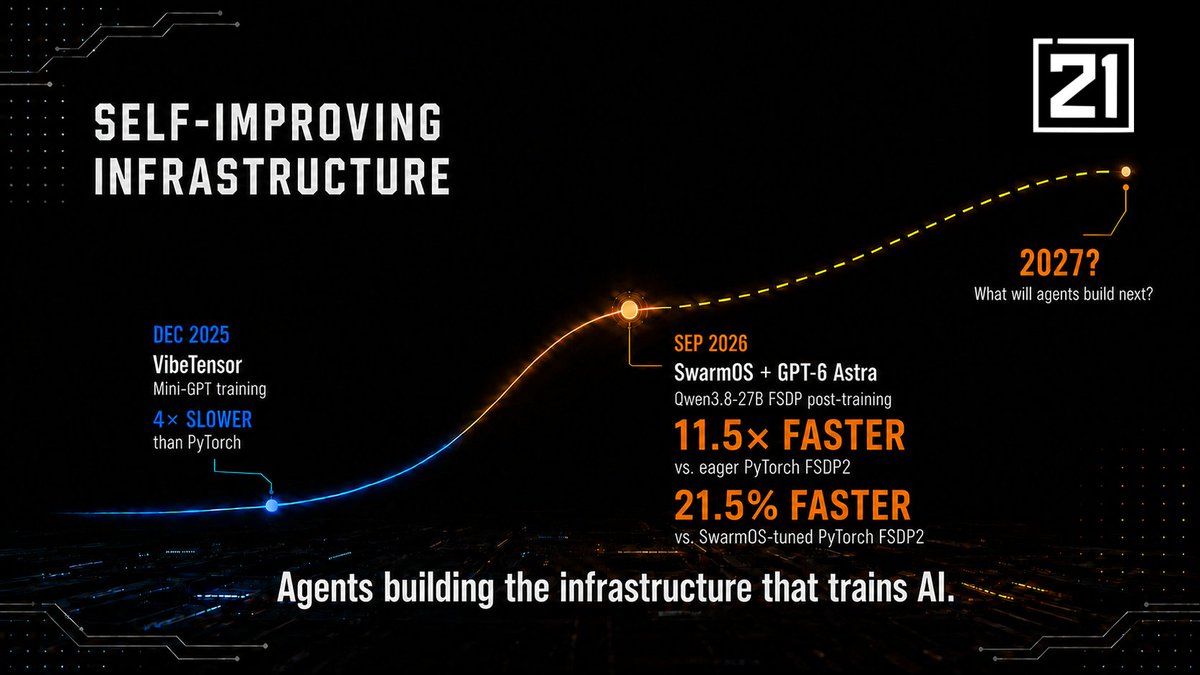
What if self-improving agent swarms could build and own training infrastructure? SwarmOS, our cloud-native platform for running specialized agents, which is backed by GPT-6 Astra, generated a Rust/CUDA fully sharded data-parallel trainer for Qwen3.8-27B.
The results: 11.5× higher throughput than eager PyTorch FSDP2, and 21.5% higher than tuned PyTorch on the same eight NVIDIA B200 GPUs.
We're building this training infrastructure at INT21, where agent swarms develop, validate, and continuously improve specialized systems end-to-end. A trainer that owns one model, one objective, one hardware configuration gets significantly more out of the compute you already own.
Read more in our latest post: https://t.co/1ZpxcsSH7P
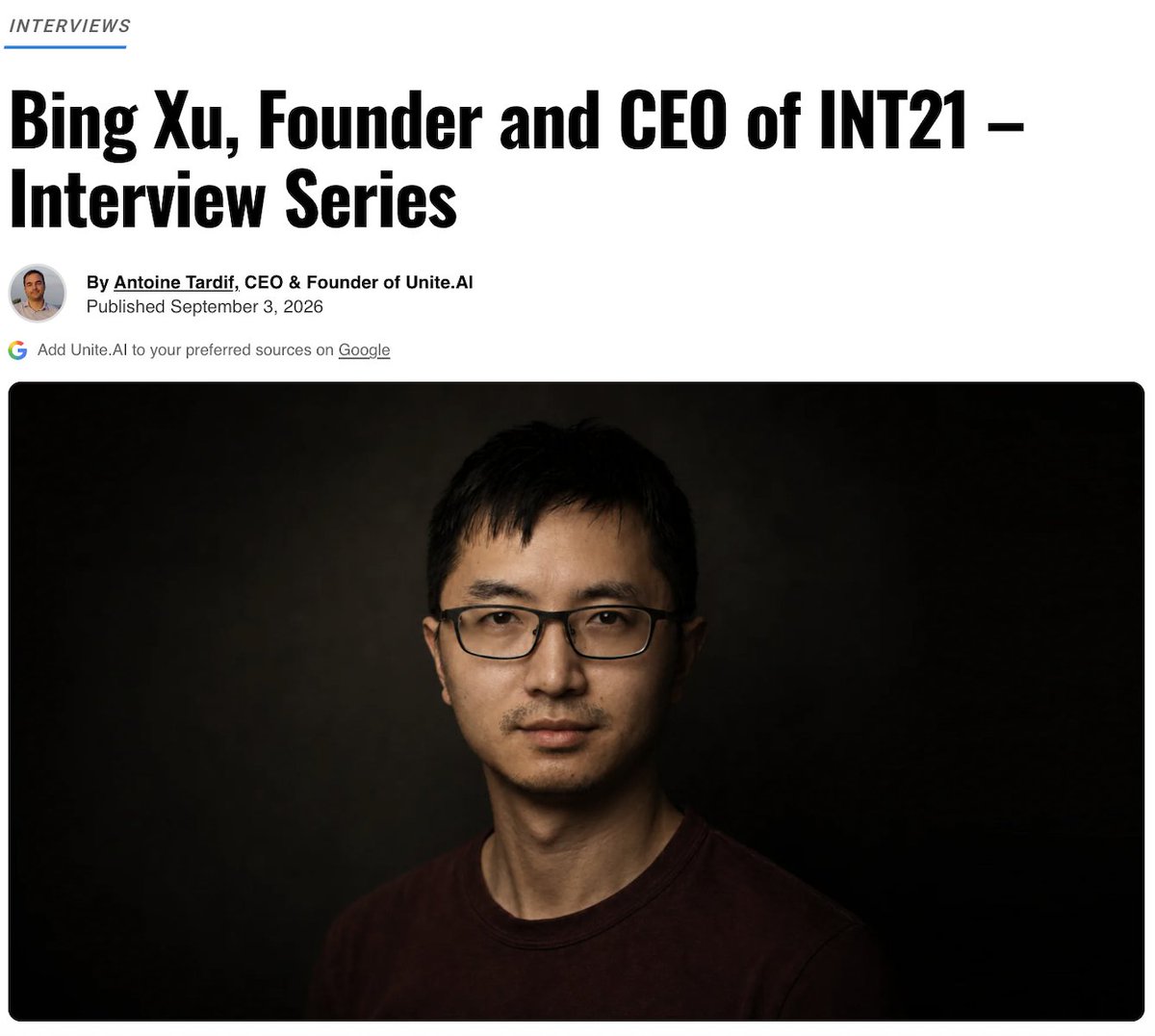
Our founder and CEO @bingxu_ was interviewed by @UniteAi, discussing:
- Our unique approach in building agent swarms that optimize the harness, which determines agent performance on complex tasks
- How our self-improving agent swarms continuously learn and adapt, without requiring specialized engineers to hand-tune every layer
- The recent launch of our Inference Engine Factory, which includes working engineering samples for video, music, and speech
- Why self-improving infrastructure is already a proven and distinct computing category
- Our vision that agent swarms will coordinate autonomously across every layer of the AI stack in the future
Check out the full, in-depth feature story here https://t.co/ghofhO8HdB
It's official: infrastructure unlocks greater capabilities from frontier models. Our SwarmOS pushed GPT-5.6-Sol from a 13.3% baseline to 100% RHAE. On GPT-5.6-Luna, the least expensive frontier model, we improved the RHAE score from 0 to 56%.
What's clear is that model intelligence and agent intelligence are not the same thing, and we're seeing the unit of intelligence shift from the model to the system--an early sign of AGI.
Read more: https://t.co/OV8cuZYZ9E