> ser un estudiante japonés de 19 años
>construir un bot de trading con Claude Code en 2 días
>usar el iPad como segundo monitor
escanear más de 50 mercados
>sincronizar datos de BTC desde Binance
>encontrar errores de precio antes que los humanos
>primera noche: +$6.732
>empezó con $68
>ganancia total $750,000
¿por qué la gente sigue operando manualmente?
CLAUDE AHORA OPERA MI TRADINGVIEW SOLO.
NO TOQUÉ EL RATÓN NI UNA VEZ
Le pedí:
"Encuéntrame todos los futuros de BTC con RSI por debajo de 30 y volumen +200% a la vez"
14 segundos después:
→ 6 contratos encontrados
→ Gráficos cargados automáticamente
→ Soportes dibujados
→ Script de Pine corriendo backtest
→ Zonas de entrada marcadas
Luego: "Reproduce la semana pasada y enséñame dónde habría entrado mi sistema"
Pasó solo a modo replay. Vela por vela, marcando cada entrada y calculando PnL en directo.
9 operaciones. +4.780$ teóricos en el backtest. 83% de acierto (en esa prueba, ojo, backtest no es real).
También le pido indicadores:
"Escríbeme un oscilador de momentum que cruce actividad de ballenas con tendencia de precio"
40 segundos. Script listo, indicador en el gráfico.
La mayoría sigue pasando 50 gráficos a mano.
Esto barre 200+ en un minuto.
Escanea, dibuja, testea, calcula.
No reemplaza tu estrategia.
La ejecuta mucho más rápido.
El tutorial del post de abajo te enseña cómo montar tu propio bot de trading
México tiene una tasa de crecimiento poblacional menor a uno por ciento anual y se registran menos nacimientos en el país, con una tasa de fecundidad de 1.6 hijos por mujer en promedio, expuso ayer la secretaria de Gobernación, Rosa Icela Rodriguez, al encabezar la sesión ordinaria del Consejo Nacional de Población (Conapo).
Apuntó que el país experimenta una profunda transformación en su dinámica y estructura demográfica, por lo que las políticas públicas del gobierno federal evolucionan. A la par, apuntó, hay mayor movilidad humana y profundas diferencias territoriales que demandan respuestas distintas. “Se trata, en suma, de cambios que están modificando la demanda de educación, salud, vivienda, empleo, cuidados, protección social e infraestructura”, señaló durante el acto realizado en el salón Revolución de Bucareli.
Más información en: https://t.co/sS13ZqR7r9
How to Prepare for a 5G Technical Interview
A 5G interview is not only a test of definitions.
Interviewers want to know whether you can explain the architecture, follow signaling flows and troubleshoot real network problems.
Focus on these six areas:
1. MASTER NSA VS SA
Understand the differences between Non-Standalone and Standalone 5G.
Be ready to explain:
• LTE and 5G network dependencies
• EPC versus 5G Core
• Control-plane and user-plane anchoring
• Mobility differences
• Benefits of Standalone 5G
Do not only expand the acronyms. Explain how both architectures work.
2. PRACTISE THE 5G REGISTRATION FLOW
Study the interactions between:
UE → gNodeB → AMF → AUSF → UDM
Understand the purpose of:
• Registration Request
• Authentication
• Security Mode
• Registration Accept
Interviewers may stop the flow at any message and ask what happens next.
3. EXPLAIN PDU-SESSION SETUP
Be ready to explain how a data path is created:
UE → gNodeB → AMF → SMF → UPF → Data Network
Focus on:
• Control-plane signaling
• SMF and UPF selection
• IP-address allocation
• Policy and QoS
• GTP-U user-plane tunnel
4. REVISE AMF, SMF AND UPF
AMF manages access, registration and mobility.
SMF creates and controls PDU sessions.
UPF routes and forwards subscriber traffic.
A common interview question is:
“What is the difference between AMF, SMF and UPF?”
Answer with responsibilities and a simple call flow.
5. PREPARE TROUBLESHOOTING SCENARIOS
Practise structured troubleshooting for:
• Registration failure
• Authentication failure
• PDU session not established
• No internet connectivity
• Handover failure
• Poor throughput
• High latency
Use this approach:
Symptom → Possible causes → Logs and counters → Isolation → Corrective action
6. PRESENT ONE TELECOM PROJECT
Prepare one project you can explain confidently.
Structure it as:
• Objective
• Your role
• Architecture
• Technical challenge
• Solution
• Outcome
• Key learning
Keep your explanation clear, specific and focused on your contribution.
The most effective interview answers combine:
Diagram + Sequence + Technical reasoning + Practical example
Do not memorise hundreds of disconnected questions.
Learn how the network works—and practise explaining it clearly.
Which 5G interview topic should I cover next: registration, PDU sessions, handovers or troubleshooting?
— Nitin Gupta
Telecom AI Made Practical
5G • Telecom Careers • Interview Preparation • 5G Core • AMF • SMF • UPF
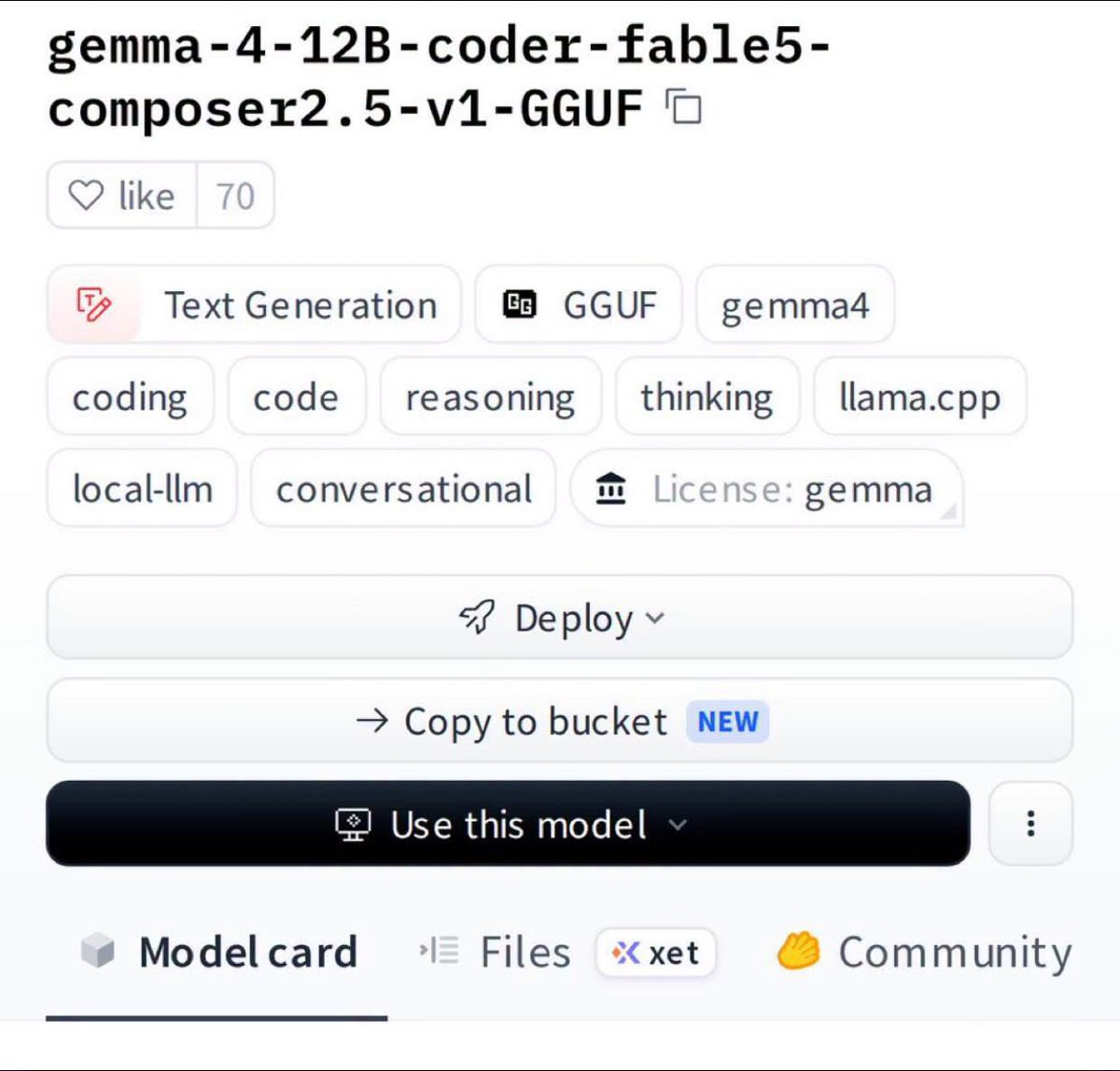
Gemma 4 12B Coder-Fable-5 reasoning dropped and it’s running higher level reasoning completely offline on your laptop.
Google’s latest 12B beast, quantized for llama.cpp.
Code completion, debugging, complex algorithms all local, private, and blazing fast on 12GB+ VRAM.
Russian peasants had a way to multiply any two numbers without knowing the multiplication table.
The method is a thousand years old. It’s the same method every computer chip in the world uses right now.
Let me show you. 🧵
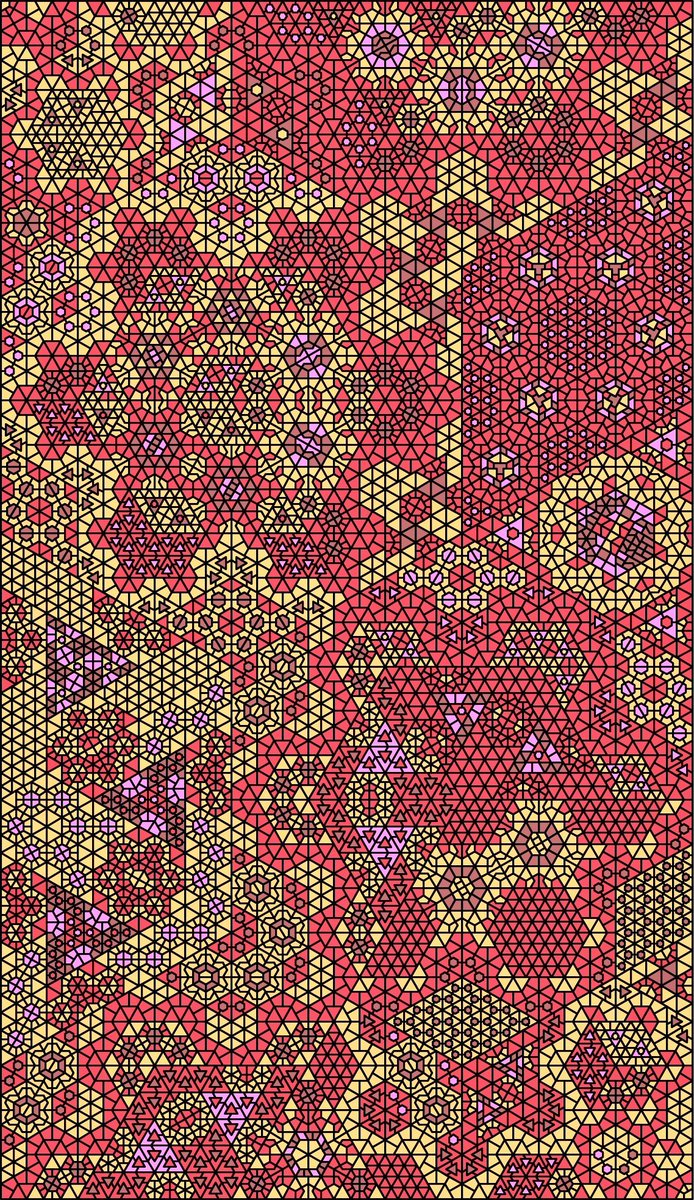
Mathematics, symmetry, weird geometry.
Tiling patterns, complexity, surprise. (Magnify to see the details.)
By John Greene, https://t.co/ptT1kkXO0A, Used with permission.
The circular diagram presents the C major scale, its seven diatonic triads (I–vii°), and the corresponding relative modes in a single, integrated view. At its center lies C, from which the primary triads radiate outward:
CM (I), Dm (ii), Em (iii), FM (IV), GM (V), Am (vi), and Bdim (vii°),
each formed by stacking every other note of the C–D–E–F–G–A–B scale. Encircling these are the seven modes:
Ionian, Dorian, Phrygian, Lydian, Mixolydian, Aeolian, and Locrian
aligned with their respective parent roots and annotated with their characteristic scale degrees and interval patterns.
This unified layout enables musicians to quickly visualize harmonic relationships, making it a practical reference for composition, improvisation, modulation, and transposition across keys.
Complete Interview Tips 🌟
✅ Important skill HR looks for
✅ Interview preparation
✅ Body languages tips
✅ Techniques to answer questions
All in one poster!
Conditional probabilities link events via their intersections in the sample space.
Nodes show regions A ∩ B, Ā ∩ B, A ∩ B̄, Ā ∩ B̄ and events A, B, Ā, B̄ around Ω. Arrows label conditionals such as P(B|A), P(A|B), P(Ā) and P(B). The equality P(A|B) ⋅ P(B) = P(A ∩ B) = P(B|A) ⋅ P(A) holds.
It lets one calculate joint probability using a conditional and the event's probability.
Medical diagnostics uses it to revise the probability of a disease given a positive test by incorporating prevalence and test accuracy.
WHAT'S ACTUALLY ON A CELL TOWER?
That tower you pass every day is doing a lot more than just "giving you signal."
Here's what's happening:
• Sector antennas divide coverage into multiple directions to serve more users.
• Microwave dishes connect sites where fiber isn't available.
• Remote Radio Heads (RRHs) handle RF processing close to the antennas, reducing signal loss.
• Fiber optic cables carry high-speed data between the radios and the baseband equipment.
• Baseband Units (BBUs) process voice and data before it's sent over the air.
• Power systems, batteries, and grounding keep the site running safely even during outages.
• Lightning protection and obstruction lights protect both the equipment and aircraft.
Every phone call, video stream, and message travels through a chain of equipment like this before it reaches the internet.
There's a lot more engineering behind those "signal bars" than most people realize.
@lafresipop En México nos dicen que los venezolanos viven desesperados buscando comida entre montañas de basura, que no hay trabajo, que todas las mujeres son de la calle, los hombres desempleados y delincuentes...
Ahora no entiendo cómo es que hay tiendas de cristalería y gente comprando