@peter_adderton A consumer satellite brand helps distribution, but the MNO still has to own the session. The hard part is one IMS registration and a mobility policy that can fail over to NTN without a second number or a second attach. If that handover is messy, the brand never gets used.
@looknowires The AMR-WB offer doesn't recover the copper. Once the 5ESS has already coded the call as G.711, transcoding into a 16 kHz container still leaves 8 kHz speech. The 21-second setup also shows the cost of tromboning a TDM trunk into a cloud P-CSCF and a Nokia SBC.
@christpatsi Tenorio's four-to-six-year lag is the real constraint, not the auction date. Incumbent clearing, handset filters and coexistence rules all come after the award. A 7 GHz trial can show coverage. It cannot show whether a commercial handset can use the band a year later.
@disruptivedean@Starlink A 160 km/h subscription profile cannot serve a TGV. The SNCF slide shows the drop was a mid-test service-profile change, not a radio cliff, and TCP congestion control alone swung throughput by 6x. For rail, that mobility class has to be locked before the run.
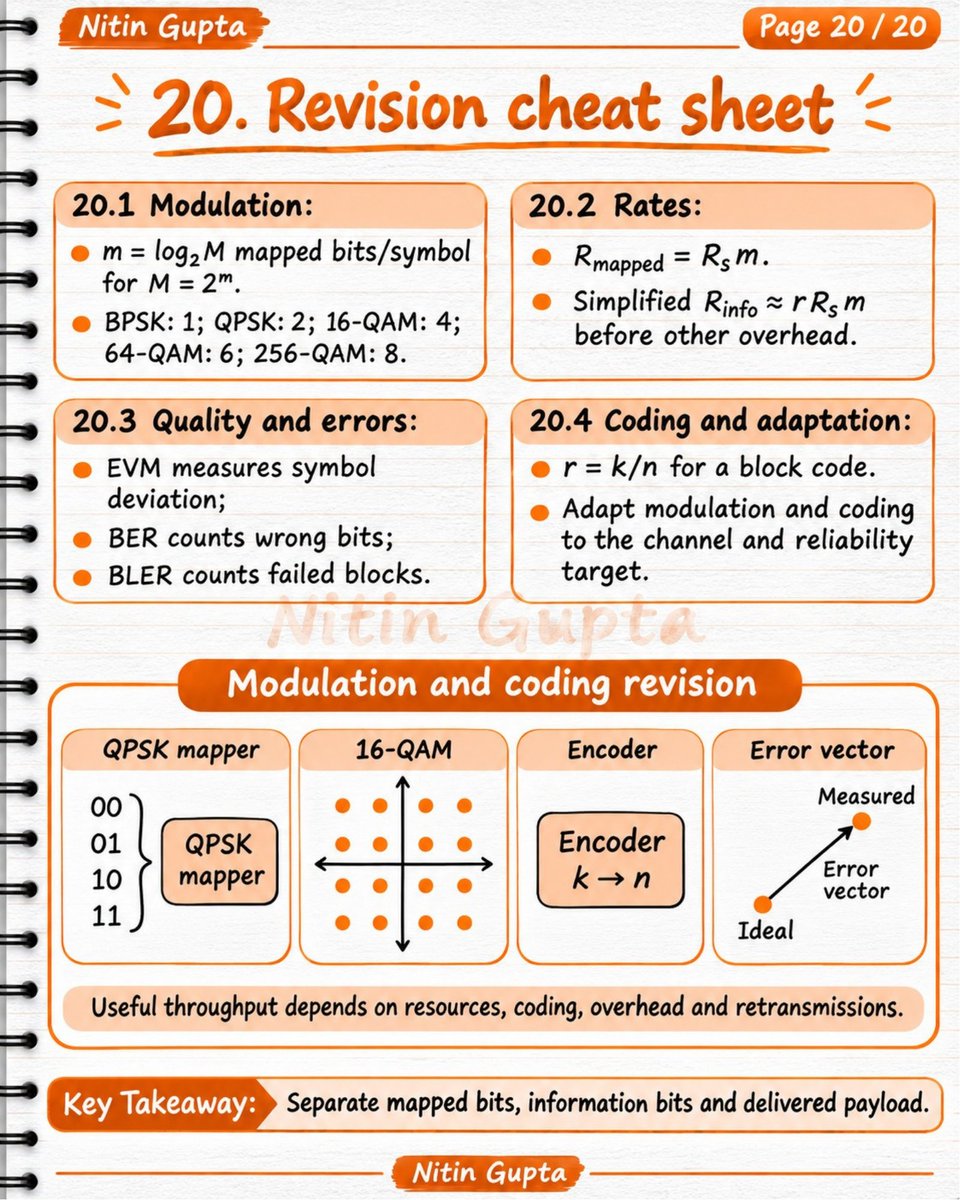
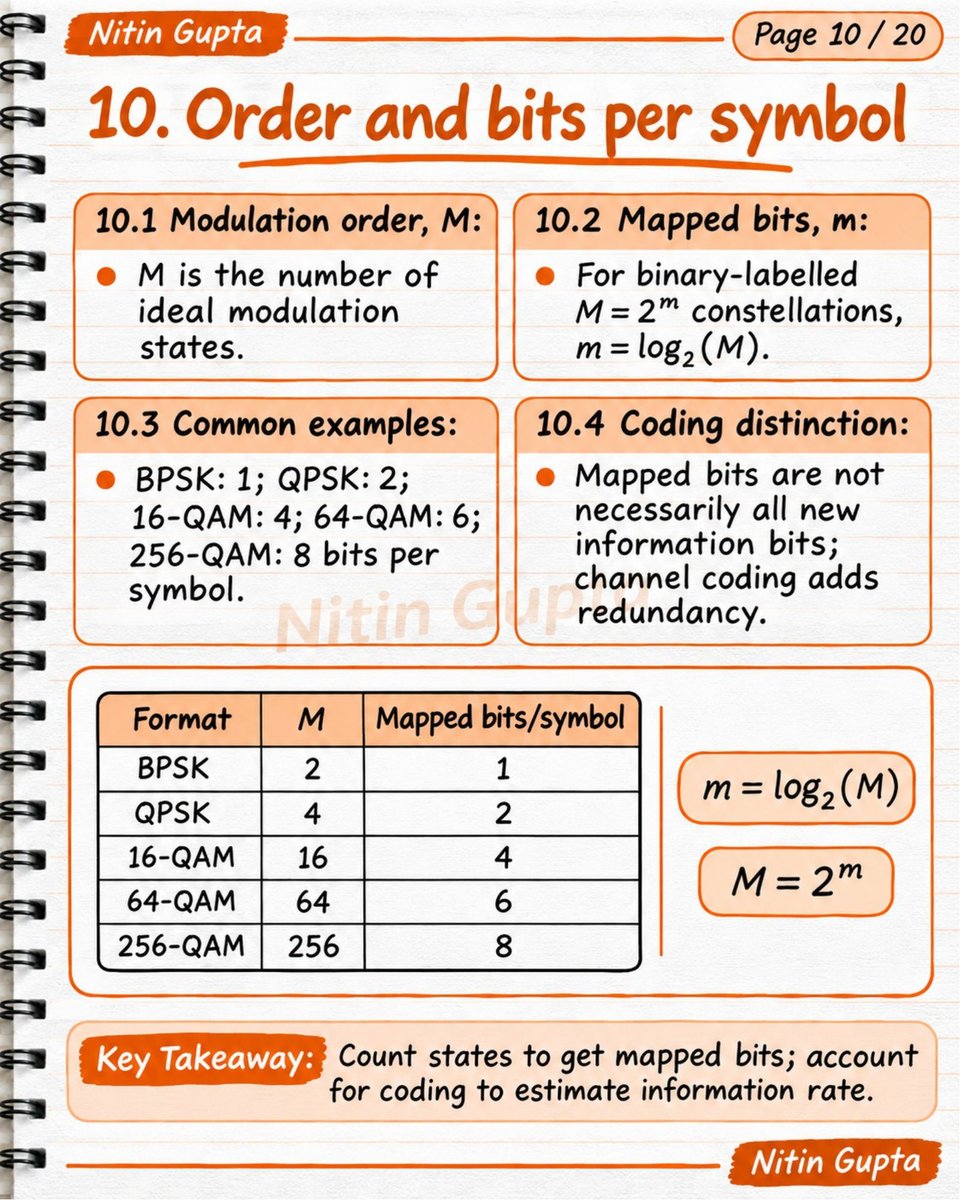
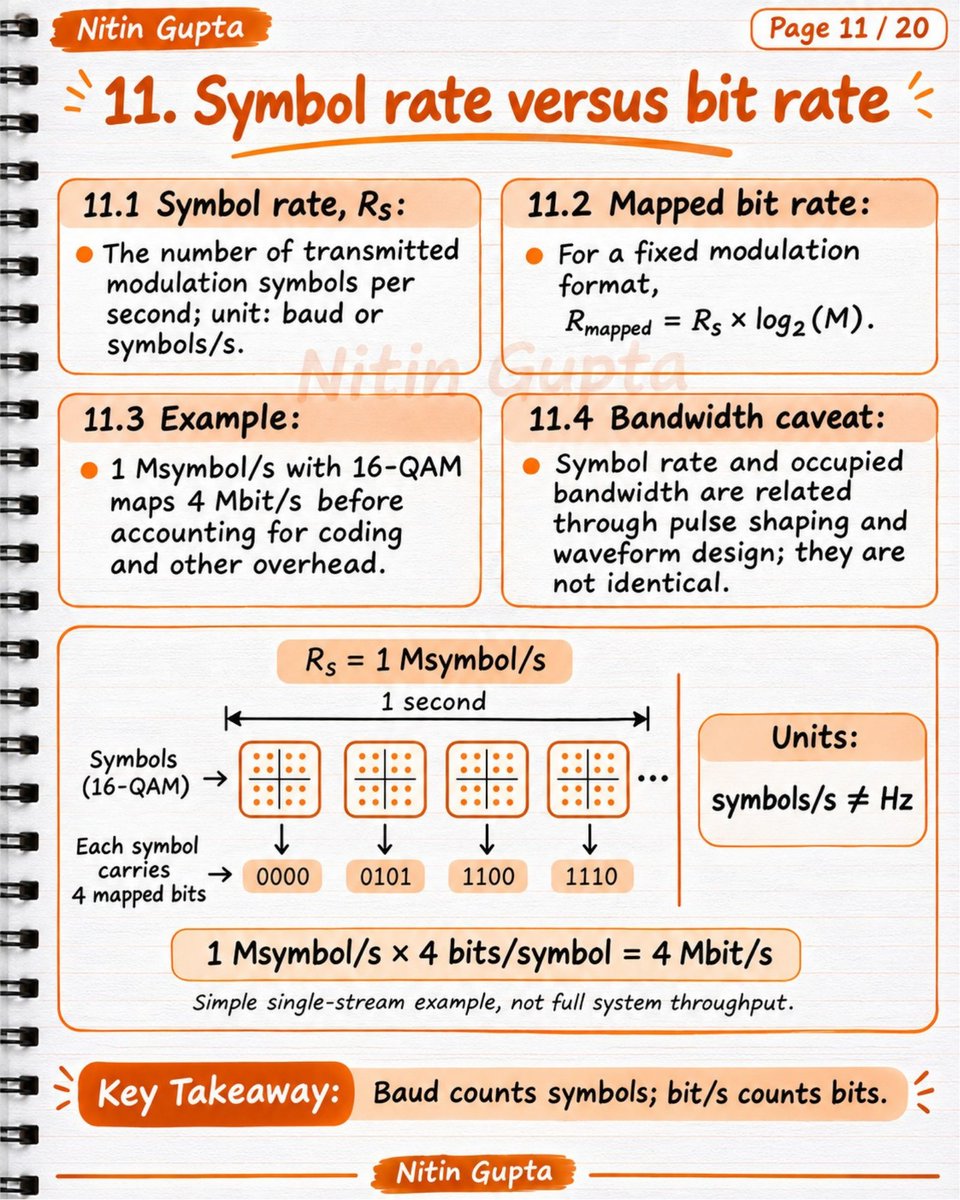
16-QAM carries 4 mapped bits per symbol. How many become useful data?
⠀
That depends on the coding rate—and how much capacity is used by other overhead.
⠀
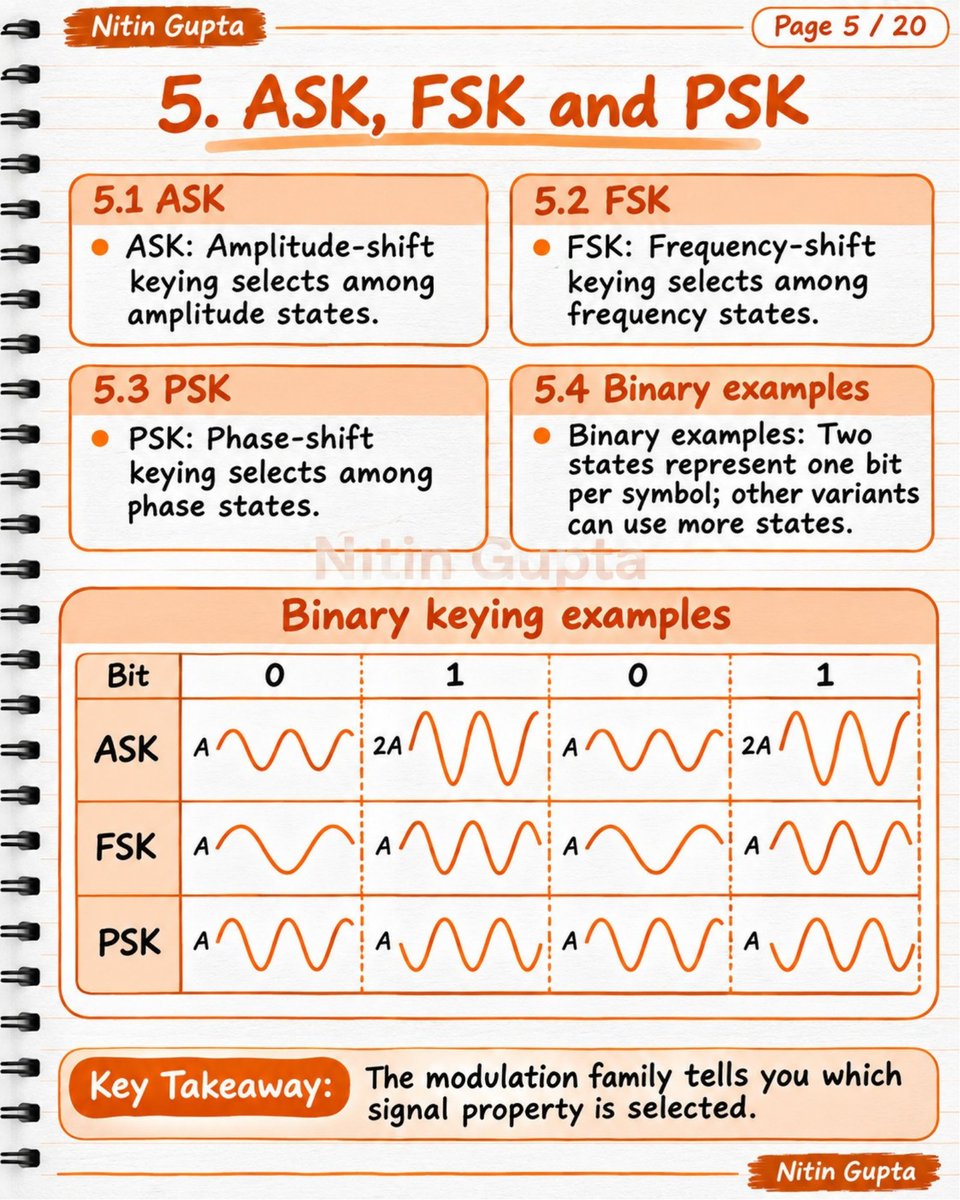
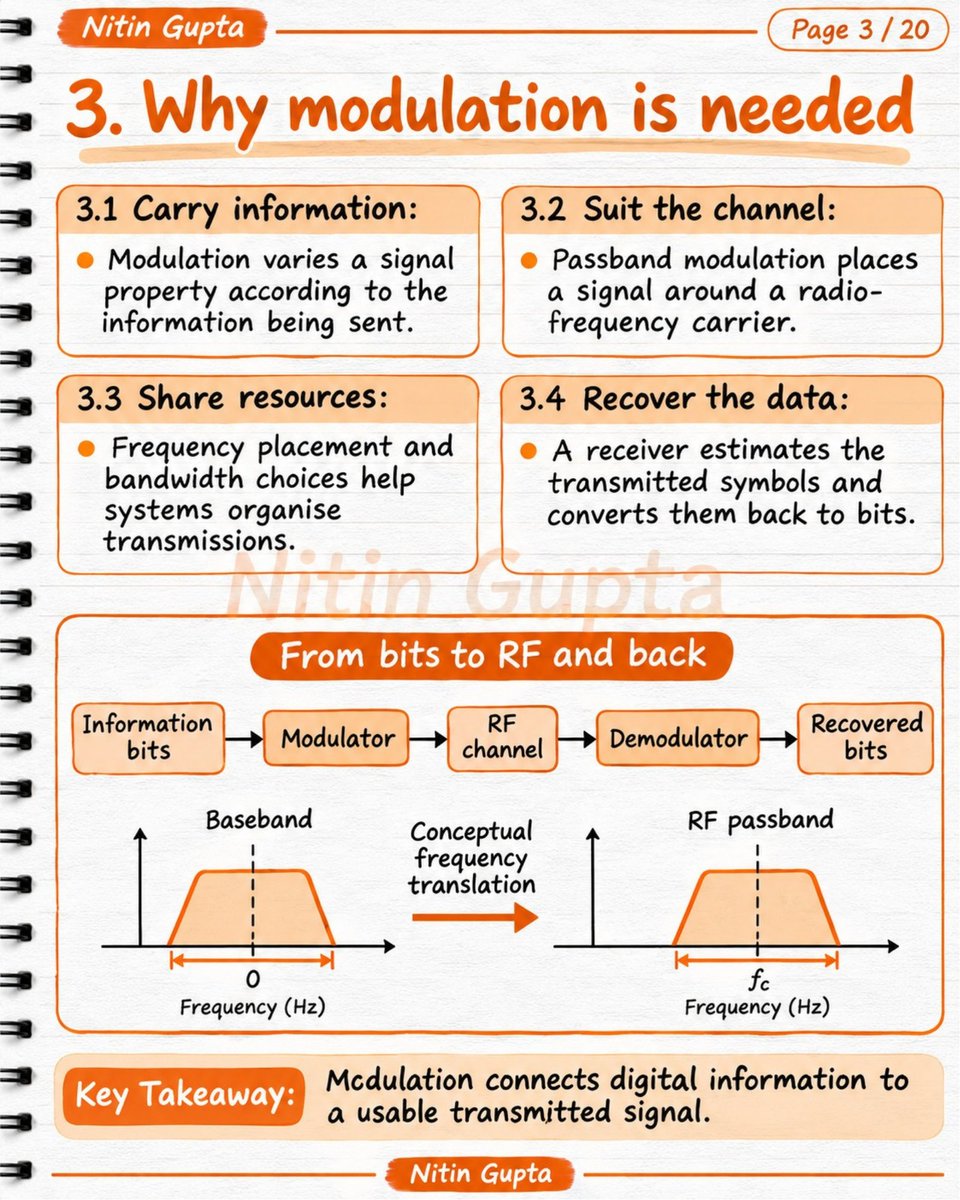
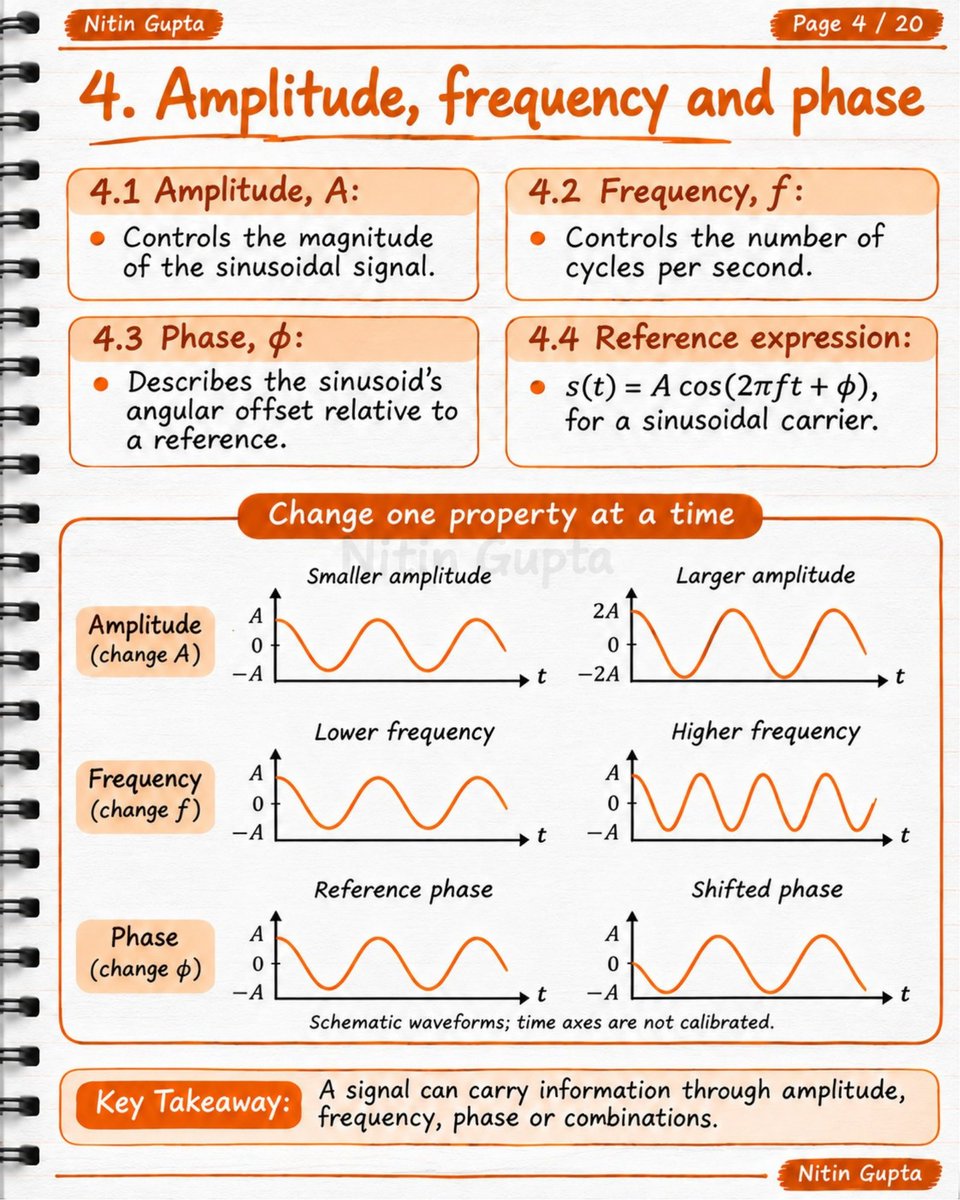
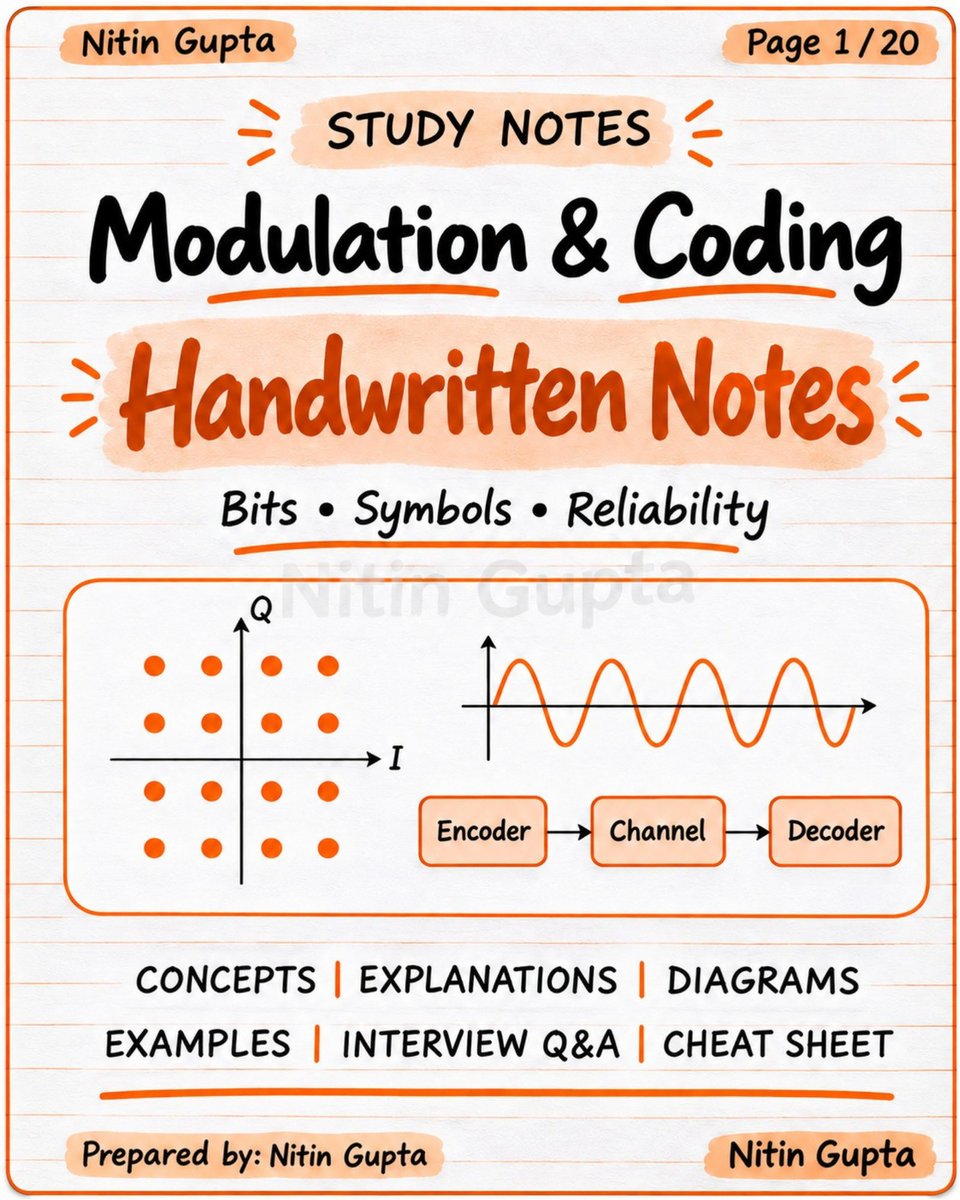
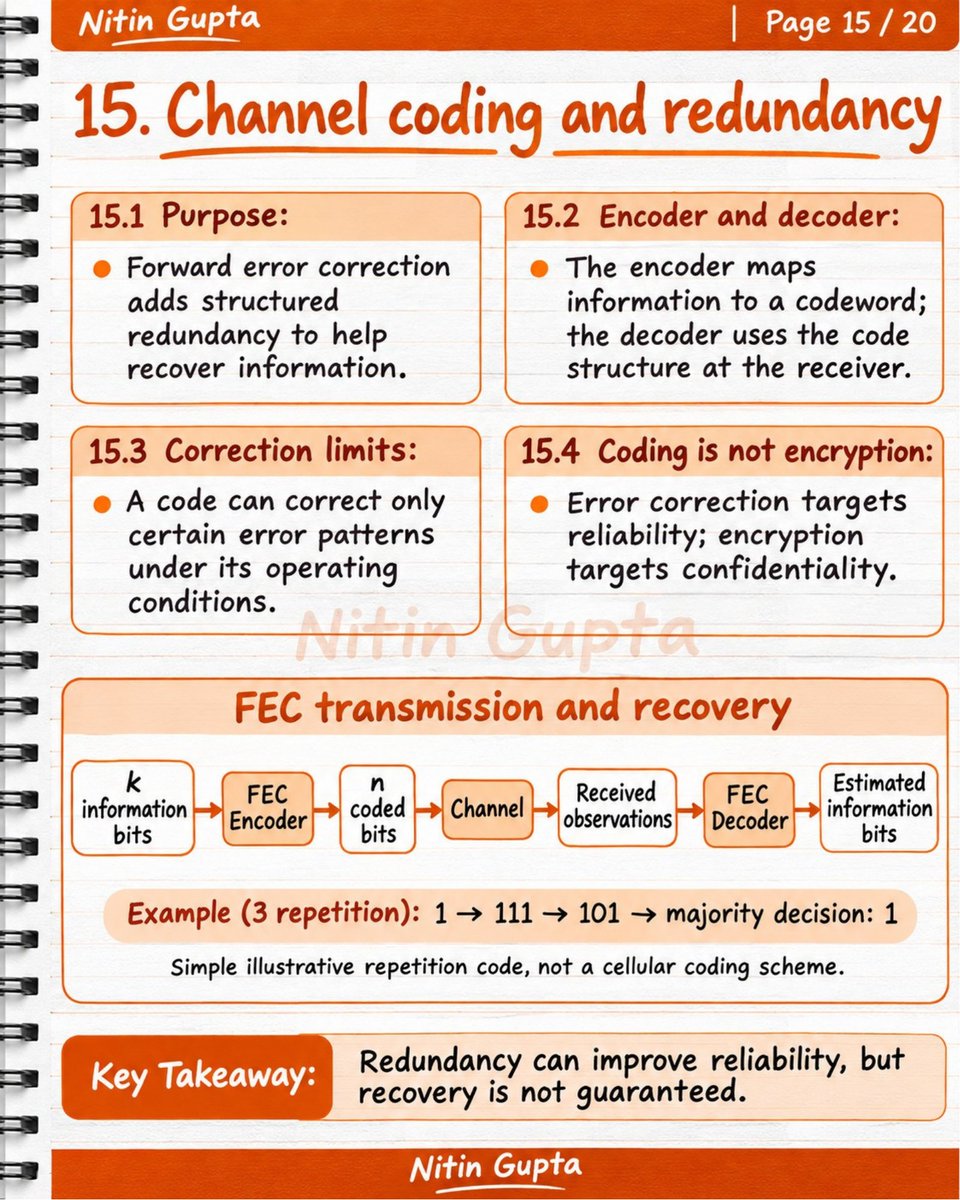
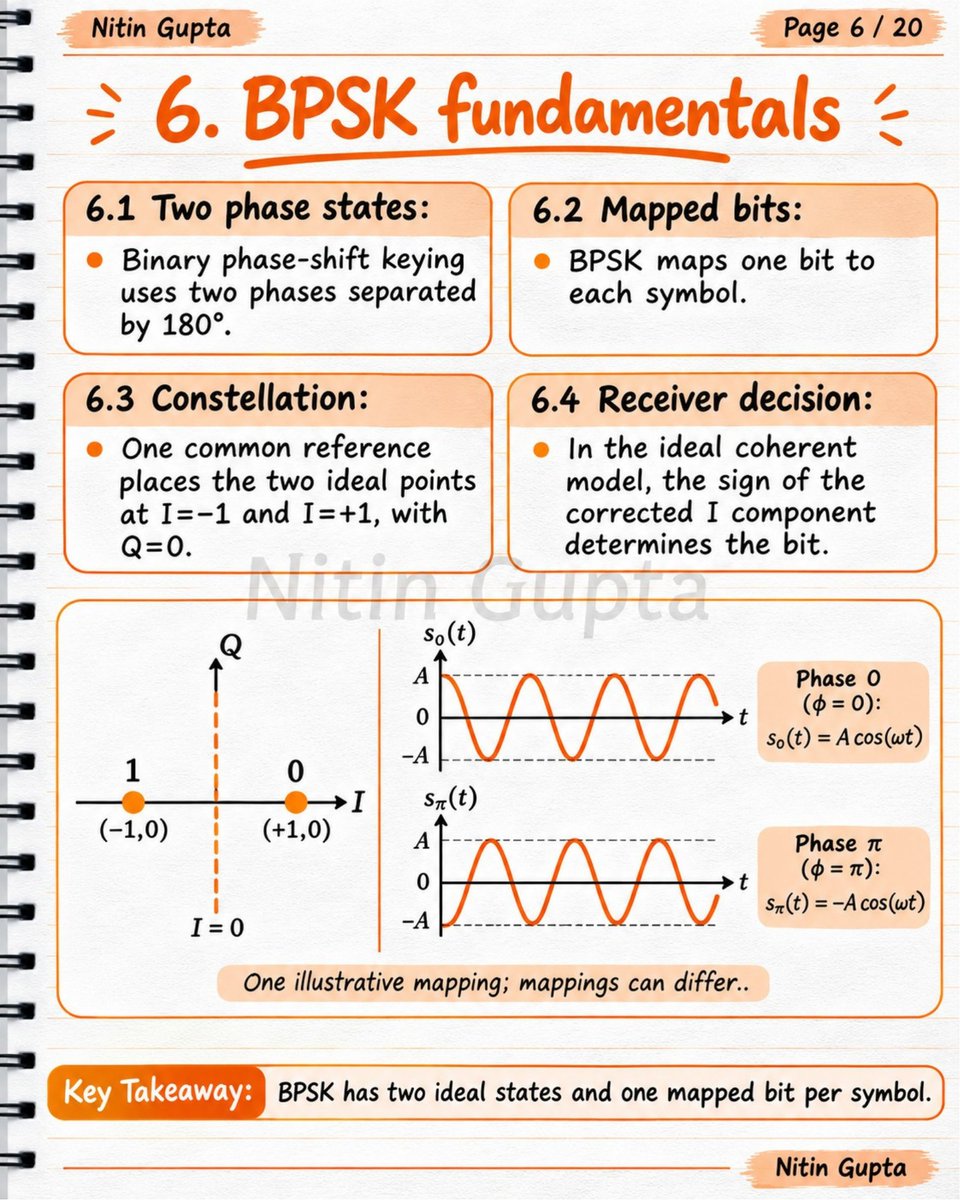
I’ve created a 20-page handwritten guide on “Modulation & Coding” to explain how bits become transmitted signals and how receivers recover them.
⠀
◆ Inside the carousel
⠀
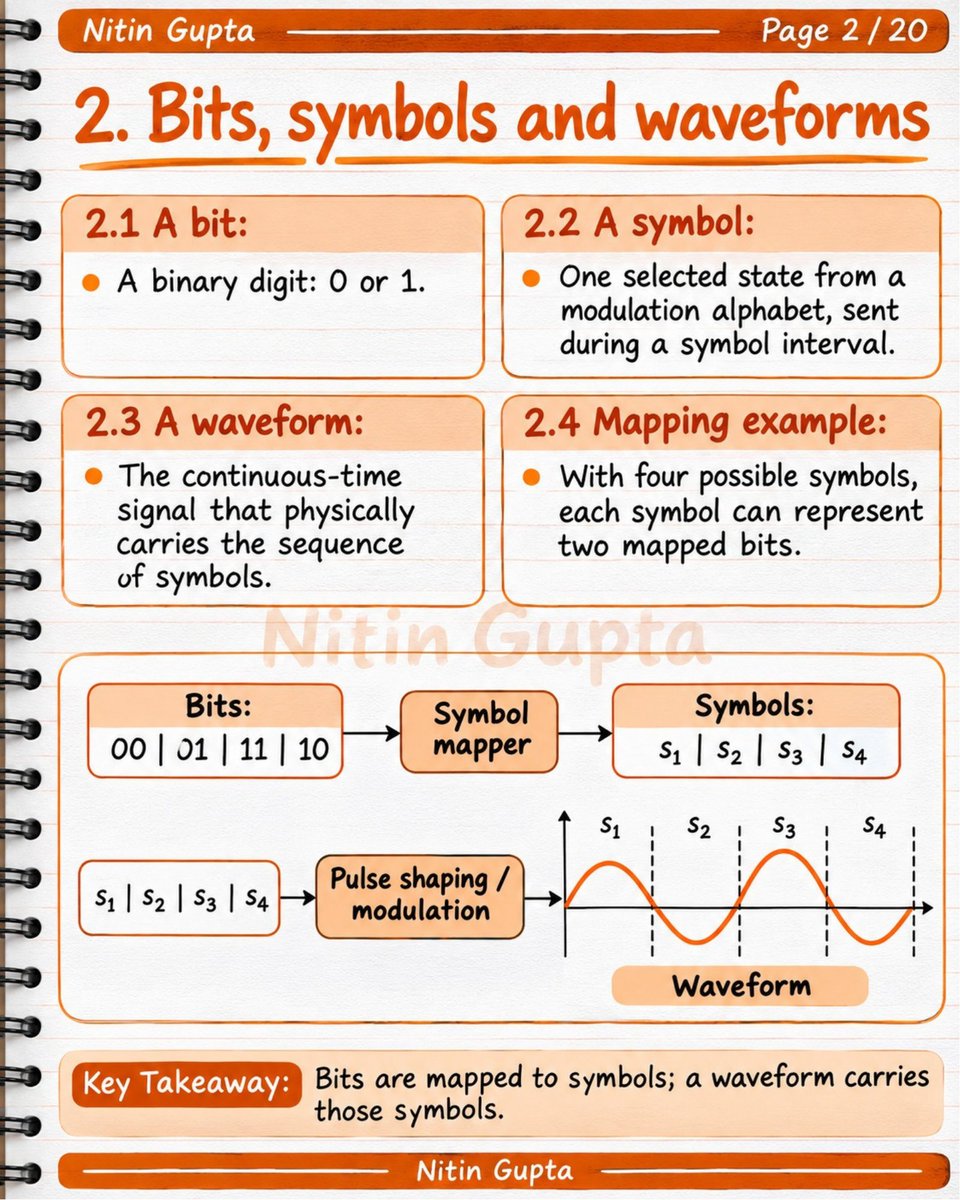
● Bits, symbols and waveforms
● Amplitude, frequency and phase
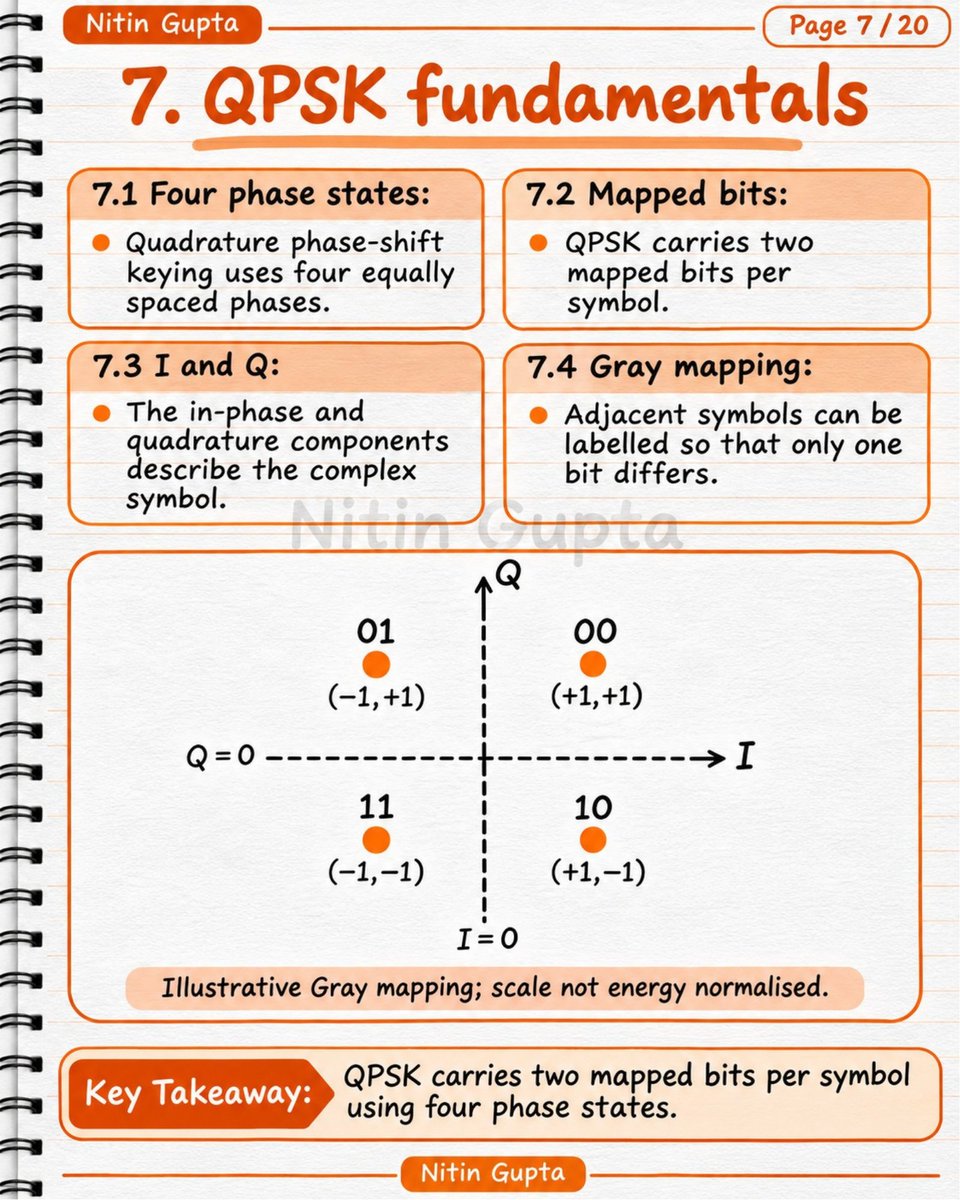
● BPSK, QPSK and quadrature amplitude modulation (QAM)
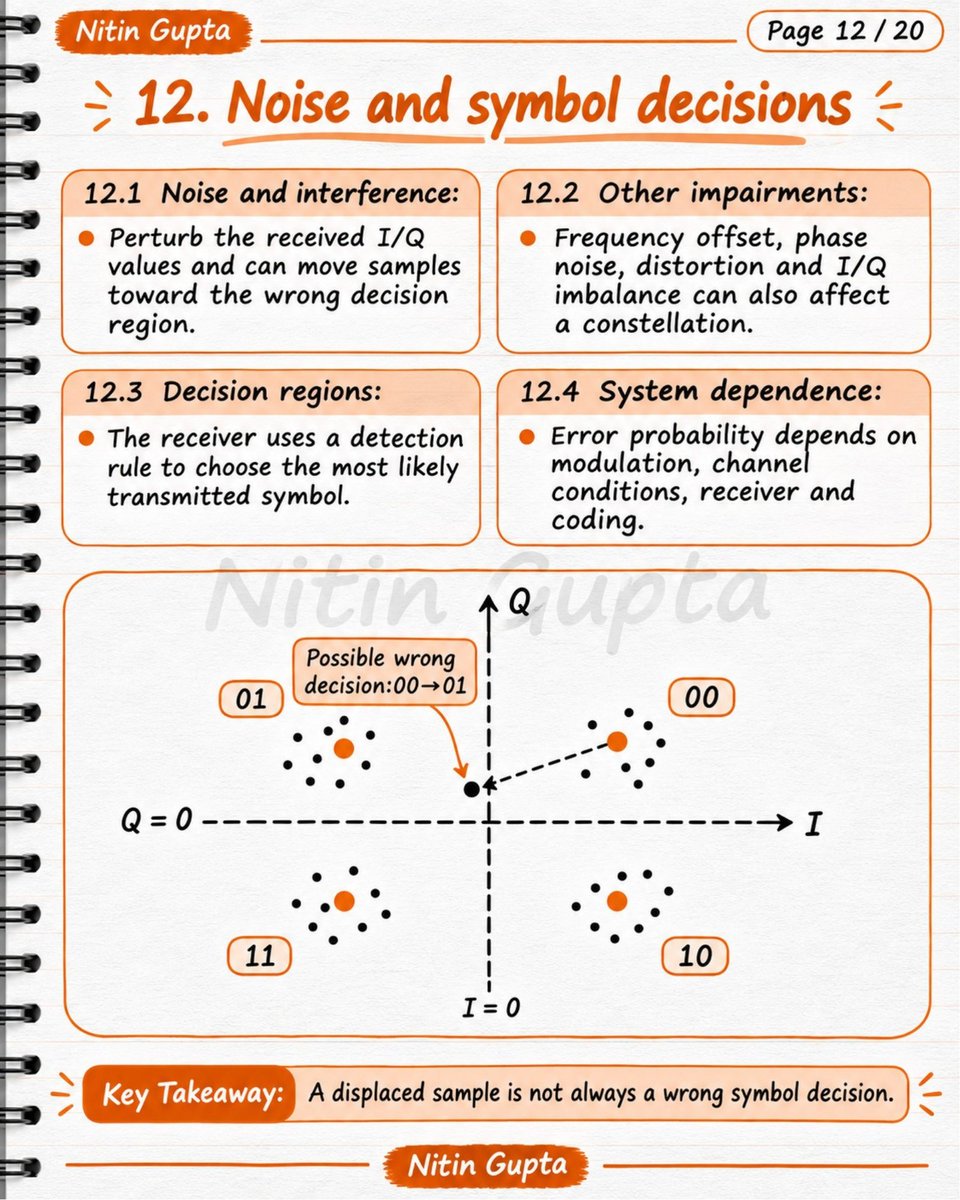
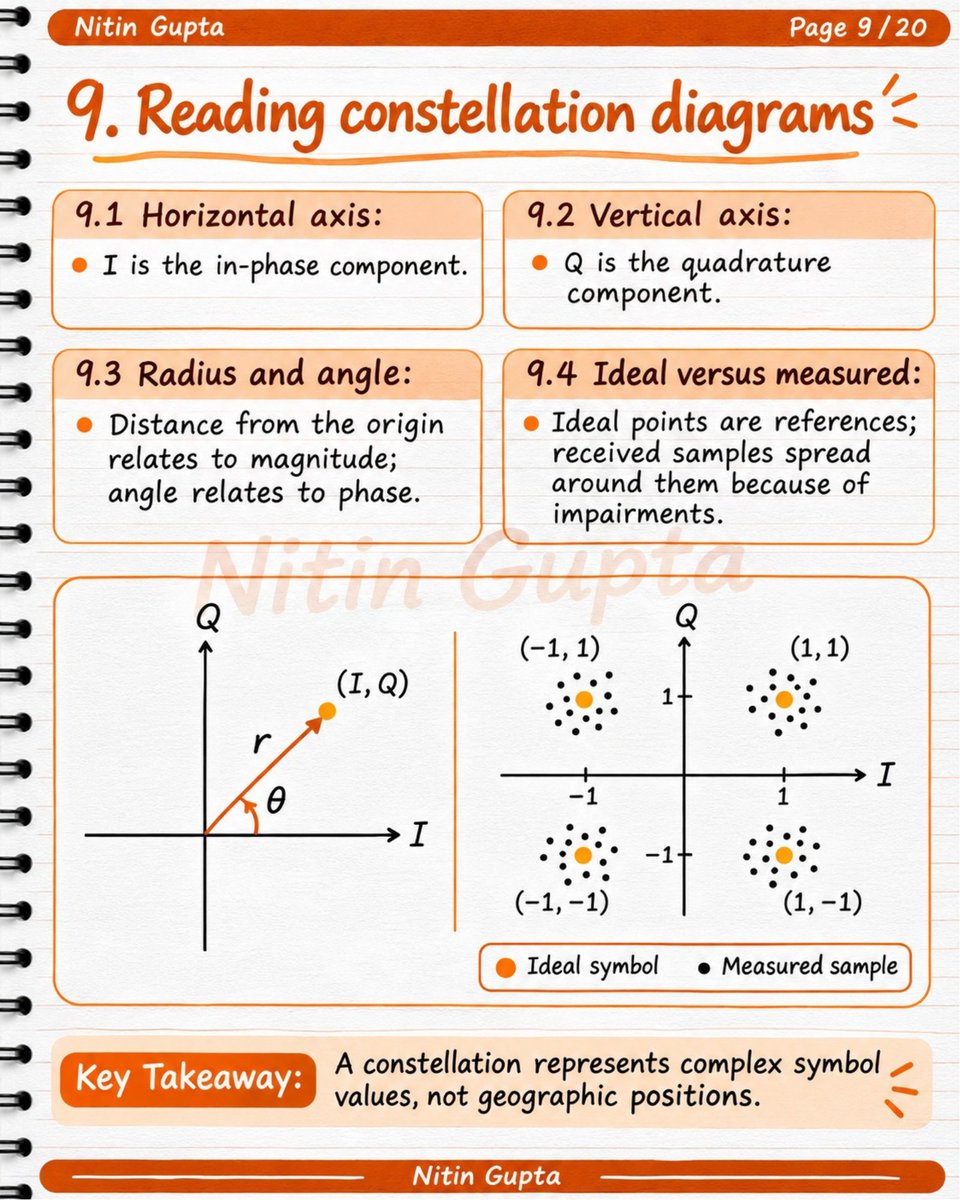
● Constellation diagrams and symbol decisions
● Symbol rate versus bit rate
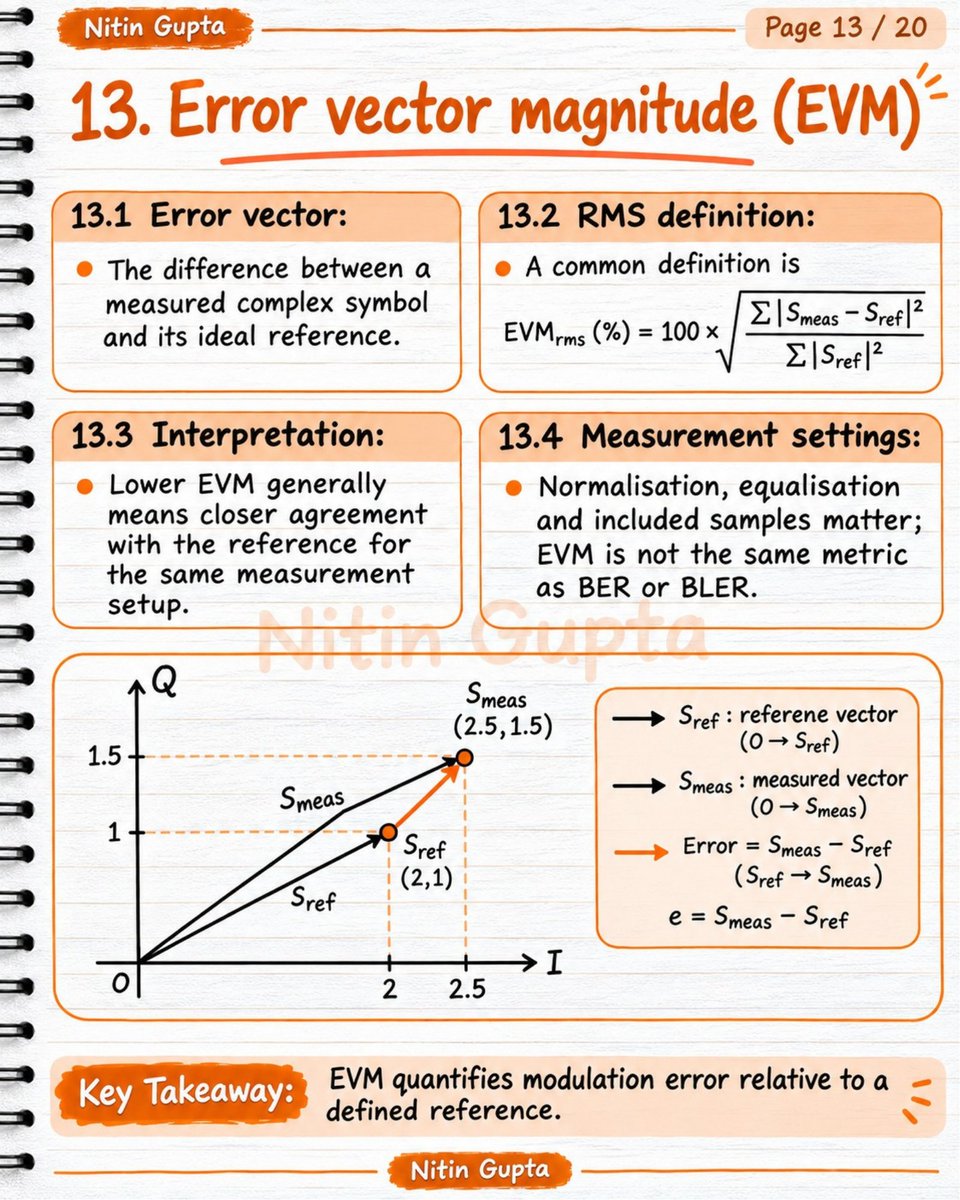
● Error vector magnitude (EVM)
● Bit error rate (BER) versus block error rate (BLER)
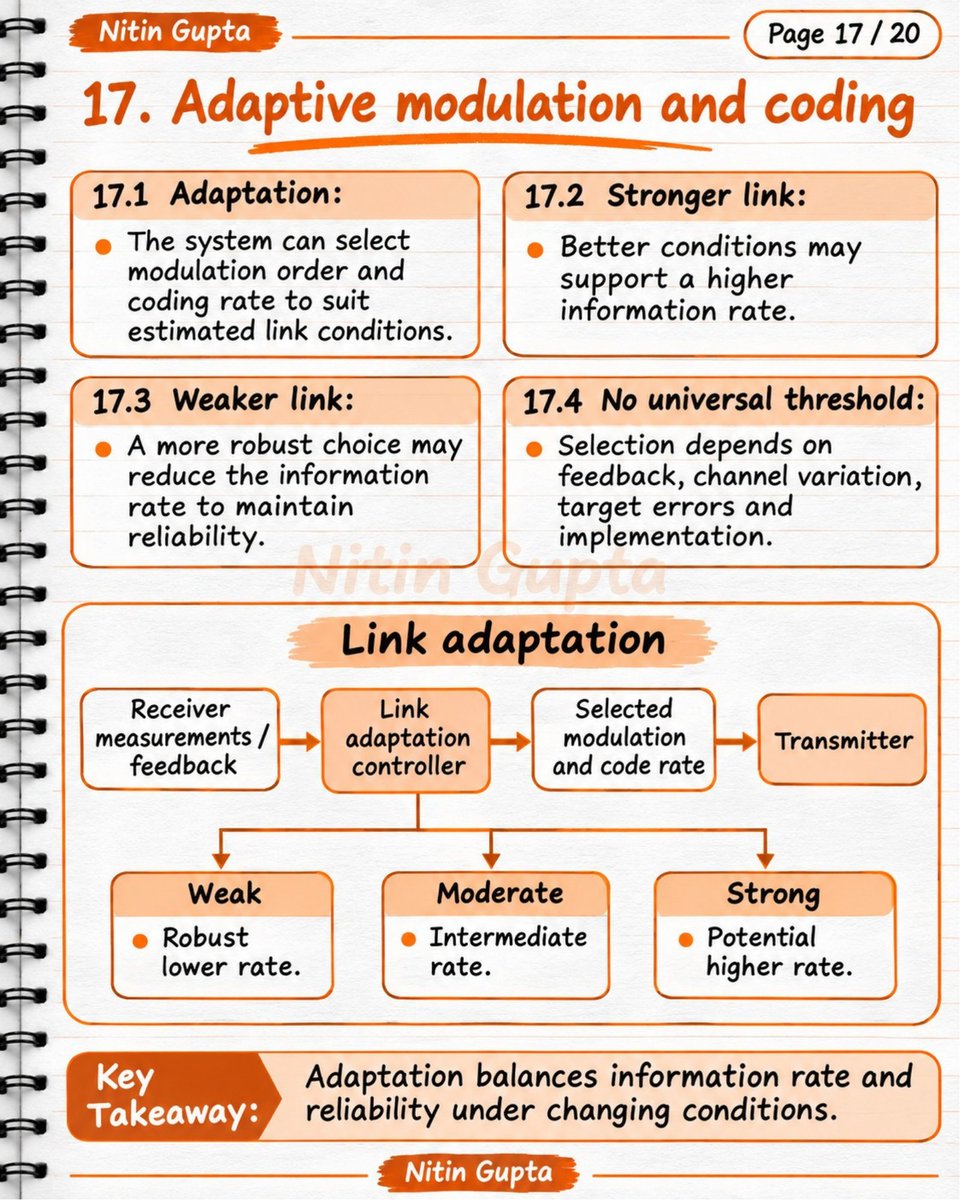
● Channel coding, code rate and link adaptation
● Worked examples, interview Q&A and a revision cheat sheet
⠀
◆ A simple example
⠀
For one hypothetical stream:
⠀
4 million symbols/s × 4 mapped bits/symbol = 16 Mbit/s mapped bit rate.
⠀
With a code rate of 3/4, the simplified information rate is 12 Mbit/s before other overhead.
⠀
Delivered payload throughput also depends on pilots, control, framing, scheduling and retransmissions.
⠀
◆ Three distinctions to remember
⠀
➜ Baud counts symbols per second; bit/s counts bits per second.
➜ EVM measures deviation from ideal symbols; BER and BLER measure error outcomes.
➜ Modulation order and coding rate work together to balance information rate and reliability.
⠀
Swipe through the 20 pages and save the guide for revision or interview preparation.
⠀
Join free 5G/6G Whatsapp Learning Channel : https://t.co/u5wvVpRCPx
Ping on this whatsapp number for Telecom Courses +918130583833
@SneedTech Your screenshot already shows 805 Mbps down under the trees, so the new N77 combo is holding. Because this is still NSA, the test to watch is whether that aggregation survives mobility between the CRAN RUs, and what the uplink does once foliage knocks off the higher layers.
@AGkorthos 20,000 hours at up to 420 kV is serious validation for a seed-stage company. Curious how they hold up in heavy icing or storm-force winds while perched
Up to ¥148 billion: Japan selected @Rakuten_Mobile to build a mid-band LEO network that talks directly to ordinary phones.
⠀
With AST SpaceMobile, that network is meant to start domestic operations by the end of March 2029, under the government's J-LEO programme.
⠀
The architectural choice matters. The base station stays on the ground, so Japanese operators can run the NTN themselves. The satellite links to off-the-shelf smartphones. No special handset.
⠀
It is also meant to support emergency roaming between operators when terrestrial coverage fails.
⠀
Engineers: for a sovereign D2D network, would you keep the gNB on the ground, or fly a regenerative payload?
@Starlink@MobicomOfficial Mongolia is the ultimate textbook use case for Non-Terrestrial Networks (NTN). Massive geography, sparse population, and zero-tower dead zones—turning everyday phones into satellite terminals changes everything
Amazon Leo in space. Bharti at the Indian gateway?
⠀
That is the possibility raised by an Economic Times report on 17 November 2026—not a confirmed partnership.
⠀
ET reports that Bharti Group is in advanced talks with Amazon Leo about an India arrangement that could involve managing local gateway infrastructure and controlling local bandwidth.
⠀
Final terms remain unsettled. According to ET, Bharti Enterprises, Bharti Airtel and Amazon did not respond to its queries.
⠀
◆ WHY THE GATEWAY MATTERS
⠀
A satellite broadband connection includes an extensive network on Earth.
⠀
The GIF follows one illustrative request:
⠀
Laptop → local Wi-Fi router → customer satellite terminal → low Earth orbit satellite → Indian gateway → fibre network → internet application.
⠀
The response travels back through the network to the user.
⠀
● The customer terminal provides the radio connection to the satellite.
● The gateway connects the satellite link with terrestrial networking.
● Fibre carries traffic onward toward internet, cloud or private-network endpoints.
⠀
The laptop’s Wi-Fi connection and the terminal’s satellite connection are separate parts of that journey.
⠀
◆ WHAT IS REPORTED—AND WHAT REMAINS OPEN
⠀
The proposed Bharti role concerns Indian ground infrastructure and local bandwidth. The GIF separates that reported operational relationship from the customer’s data path.
⠀
A commercial agreement, defined operating responsibilities and the required regulatory permissions are separate milestones. Reported talks alone establish none of them.
⠀
My view: local gateway operations, terrestrial connectivity and service delivery deserve as much engineering attention as the space segment when planning an Indian rollout.
⠀
The animation is a conditional technical example. It identifies no confirmed gateway location and makes no claim that this service is already available in India.
⠀
Join free 5G/6G Whatsapp Learning Channel : https://t.co/u5wvVpRCPx
Ping on this whatsapp number for Telecom Courses +918130583833
@6Gflagship@Keysight NTN can back up position when GNSS is jammed, but it is a different kind of fix. The phone has to estimate delay to a moving satellite whose ephemeris may also be degraded. The test is accuracy and integrity with GNSS denied, and whether the NTN link itself holds under jamming.
Dual-SIM phones are the hardest case in India's SIM-binding rule.
⠀
Here's why 👇
⠀
SIM binding means a messaging app must prove the SIM for your number is actually in the phone.
⠀
The cleanest way: network number verification (CAMARA API). The app asks the operator, "Is this number on the connection this request came from?"
⠀
The catch: that check only sees the line carrying mobile data.
⠀
WhatsApp registered on SIM 2. Mobile data on SIM 1.
The network answers for SIM 1. Verification fails, even though the right SIM is sitting in the phone.
⠀
Three ways to fix it:
⠀
1️⃣ Ask the user to switch data to SIM 2 for a moment
Simple, but many users won't. Some can't, if SIM 2 has no data pack.
⠀
2️⃣ Use a GSMA TS.43 entitlement token
Works per SIM, not per data path. But it needs OS and operator support.
⠀
3️⃣ Fall back to SMS
Works everywhere, but it's the weakest option against SIM-swap fraud.
⠀
In India, dual-SIM is normal, not an edge case. So whatever you pick has to handle it by default.
⠀
@TelecomTV@nokia@nvidia Compare GPU AI-RAN with AI already running on the existing RAN at the same cells, not a non-AI baseline. Start with ML channel estimation and link adaptation under mobility, when CSI is stale. Slicing and third-party inference only count if those gains still hold at busy hour.
@TheFastMode SELYCE is a technology programme, not a commercial D2D service. No budget or service date has been published. Messaging can live with satellite delay; emergency voice cannot. The testbed should report call-setup time and mouth-to-ear delay, not just a message path.
@Light_Reading The 10 MHz helps the coverage layer, not mid-band speed. In these counties, about 14% of T-Mobile 5G tests already use 600 MHz as the main leg, and it runs roughly 7x slower than 2.5 GHz. Extra low-band is for indoor and cell-edge capacity.
@rcrwirelessnews For a site that already has geo-redundant edge data centres and campus fibre, putting AI at the radio adds little. The loops that still belong at the DU are those that must finish inside a slot, such as beam weights and link adaptation. Application AI can stay in the campus DC.
@disruptivedean Agreed. At ~1 kbit/s the control plane can outweigh the voice itself. Per-beam capacity ends up set by signalling per call as much as by codec rate.
@MiralineSystems Good question. Operators rarely publish them. The number I'd want is AMF registrations/sec over time after failover, plotted against each barring step. That curve shows whether staged recovery actually worked.
Docomo's 5G SA went down three times in 12 days. 4G users didn't notice.
That contrast is the real engineering lesson.
What happened
NTT Docomo's 5G SA service had nationwide disruptions on 5, 11 and 16 November. Each time, SA subscribers struggled with voice, data and SMS. 4G users, non-SA 5G users, MVNOs and emergency calls were not affected.
That split is architecture, not luck. NSA 5G still anchors its control signalling in the 4G core. SA subscribers live entirely on the 5G core. When the SA control plane chokes, only SA users feel it.
What Docomo has disclosed
For 5 November: core maintenance triggered a memory anomaly in part of the equipment serving SA subscribers. Processing slowed. Devices started retransmitting heavily and traffic swelled. A fault in the peer equipment caused repeated searches for a connection destination, and the central unit stopped. About 14 hours, up to roughly 1.59 million SA users.
11 November (about 9 hours) and 16 November (about 6 hours) were both attributed to congestion of the same equipment. The detailed trigger for those two hasn't been published, so I won't guess.
The pattern engineers should recognise
Slow core → UE timers expire → devices retry → more load → slower core.
That is a retry storm. It's a positive feedback loop, and capacity alone doesn't break a feedback loop. Control does.
The brakes 3GPP already gives you (TS 23.501 clause 5.19)
1. NAS layer
The AMF can reject a request with 5GMM cause #22 (congestion) and a back-off timer, T3346. The device stays quiet until it expires. Randomised values stop everyone returning in the same second.
2. N2 layer
The AMF sends NGAP OVERLOAD START to all gNBs or a chosen proportion. The gNB then admits only high-priority, emergency and mobile-terminated access, or restricts specific slices.
3. Radio layer
The gNB answers with RRC Reject plus a wait time, or applies Unified Access Control barring in system information, so most devices never send the request at all.
4. Inside the core (SBI)
TS 29.500 defines load and overload control information that an NF can return to its consumers. An overloaded NF can tell AMF, SMF and others to throttle, instead of absorbing blind retries.
Each layer pushes the "not now" decision closer to the device, where it is cheapest.
The dangerous moment is recovery
When the core comes back, every barred and backed-off device wants back in. If barring is lifted in one step, or back-off values are not spread, you can trigger the second storm yourself. Release in stages.
Questions I'd ask any SA core team this week
• Is NGAP overload control actually configured and tested between your AMF and every gNB vendor?
• Do your SBI clients honour overload signals, or just retry?
• What is your re-registration rate per second after an AMF instance fails under load, and has anyone measured it in the lab?
• Are maintenance windows gated so two risky changes never overlap?
5G SA is sold as the premium tier: slicing, VoNR, lower latency. It only stays premium if the core knows how to say "not now" gracefully.
Your phone can't do a "make-before-break" handover to a satellite in 5G NR Rel-19.
⠀
That one line in the spec changes how NTN mobility has to be designed.
⠀
What the spec says
TS 38.300 v19.4.0, clause 16.14.3.2.1: DAPS handover (Dual Active Protocol Stack, where the phone stays connected to the source while it joins the target) is not supported for NTN in Rel-19.
⠀
What is supported:
• Conditional handover (CHO): the network prepares one or more target cells in advance and gives the phone the conditions. The phone executes the handover by itself when a condition is met.
• RACH-less handover: the phone skips the random-access step on the target cell, which removes one source of interruption.
⠀
Why this design makes sense (my reading, not the spec's wording)
On a terrestrial cell you can wait for a measurement report, decide, then command the handover. On a LEO satellite, the cell under you keeps moving, and the round trip is much longer than on the ground. A late decision costs more. So the network moves the decision earlier and hands the phone a ready-made plan.
⠀
Without DAPS, there is a break. The goal is not zero interruption. It is a short, predictable one.
⠀
What engineers should take from it
1. Mobility in NTN is planned, not reactive. CHO configuration quality matters more than measurement speed.
2. Interruption time becomes a design budget, not a side effect. Voice and real-time apps have to be engineered around it.
3. Test it like a timeline: when the target was prepared, when the condition fired, how long the phone was off the air.
⠀
Question for NTN and RAN engineers: what interruption would you accept for voice over satellite, and how would you measure it in the field?