This gold rush has turned into a shovel rush. Everyone wants to sell shovels, but too few are actually digging for gold.
The irony is that when everyone starts selling shovels, digging for gold might become the real deal again.
Reliable agents are built in layers: trustworthy data, caller verification, scoped tool permissions, and human handoff when the model gets it wrong.
At VapiCon, the people building those layers and the people running agents on them break it down.
Production vs Demo: How to Keep Agents Reliable
Michael Grinich, Founder & CEO @workos
Sourish Biswas, Sr. Product Manager @HOAi
Vidas Bacevičius, Lead Solutions Engineer @oxylabs_io
Utsav Singhal, Co-Founder & CTO @Interact_AI
Sidhant Kabra, Co-Founder @cekura
Fort Mason, San Francisco
November 11–12, 2026
Agenda and tickets: https://t.co/kA9tkql2SU
Will be speaking at @Vapi_AI's VapiCon this year. I'll be on a panel on How to Keep Agents Reliable, where we'll cover what keeps agents reliable in production and the importance of data in driving reliable agentic experiences. Lot of interesting ideas and learnings to be shared from @interact_ai .
If you’re also at VapiCon, hit me up. Would love to chat! Here's a speaker discount code "SINGHAL20".
See you at the event.
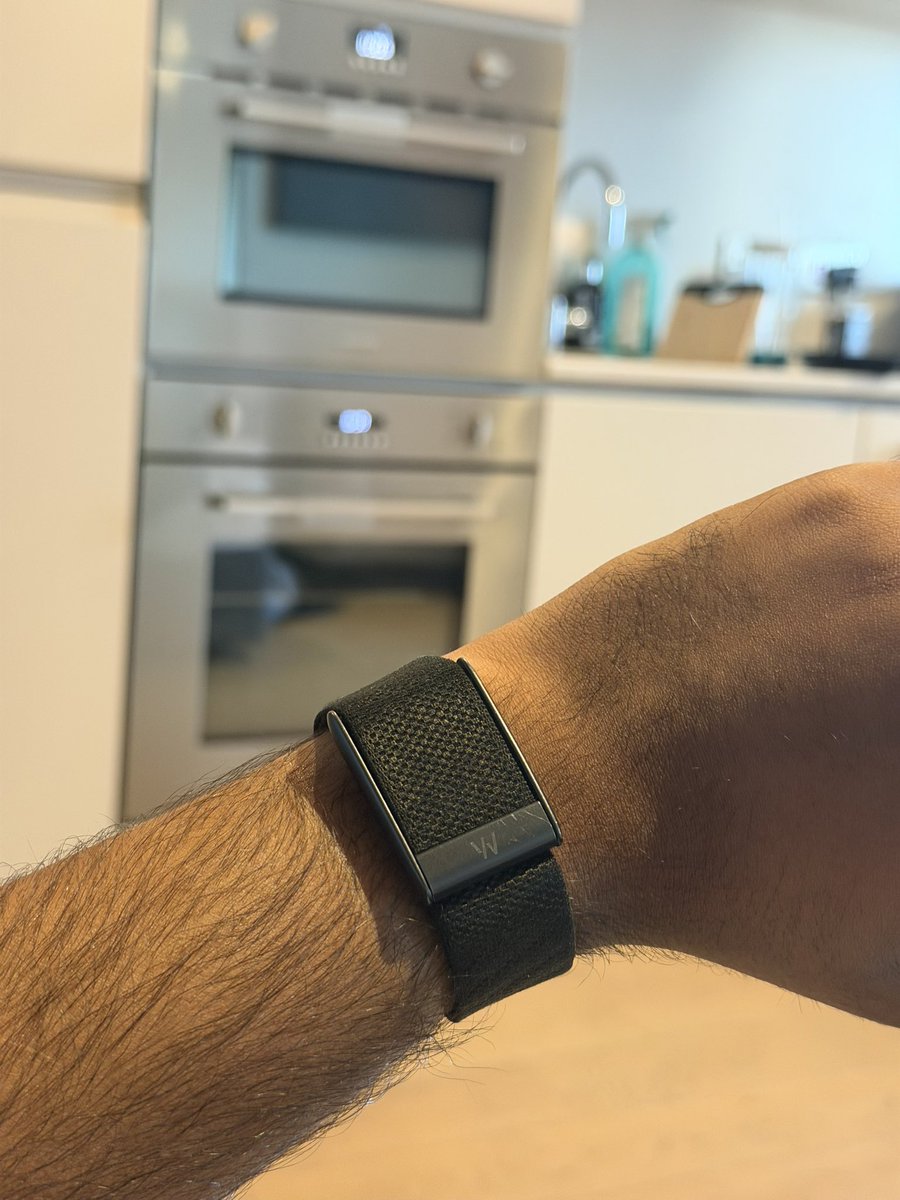
exiting whoop after 18 months.
kept the strap, ditched the subscription. it now runs fully local on zhoop (my fork of noop). no fluff metrics, my data stays on my phone.
ai killed vendor lock-in.
Visitors on Sprinto's website spend an average of 7 minutes conversing with an AI agent.
Pranay Gondane, Head of Demand Gen at Sprinto, shares how Interact AI turned those conversations into conversions.
He walked in a sceptic & ran a two-month A/B test. The results changed how people at Sprinto thinks about their website, and how their sales team starts every call.
Sprinto is a compliance platform, so what it really sells is trust. For years, building that trust took a call with a rep. Now it starts the moment a buyer lands on the homepage.
Pranay tells the rest in his own words.
Props to @harshjndigital for setting this up and Nitin Gupta for producing the video.
I'll be speaking at @aiDotEngineer Shanghai talking about what it takes to build a truly multimodal, agentic system which can talk to millions of customers while personalizing the experience to their individual problems.
At @interact_ai, we’ve built an agent builder that can integrate with your knowledge bases, products, and media to create an expert that can not only talk, but also show and interact with the right information.
Whether it’s powering your website to help visitors understand and navigate your product, helping customers explore complex workflows, or training your internal teams, the goal is the same: build an agent that can understand the context, reason about the problem, and dynamically create the right experience for each person.
This is going to be the step 1 for the dream of Internet of Agents.
Muse is the best Facebook product to ever exist.
Its ability to find things on marketplace is S-tier amazing.
It could also read everything for all of the groups that you are in, so its ability to provide knowledge is incredible.
We put @Meta Muse Voice Transcribe into production 48 hours after launch.
@interact_ai runs a realtime voice agent on LiveKit, where the STT property that governs everything is whether the model knows when to keep listening.
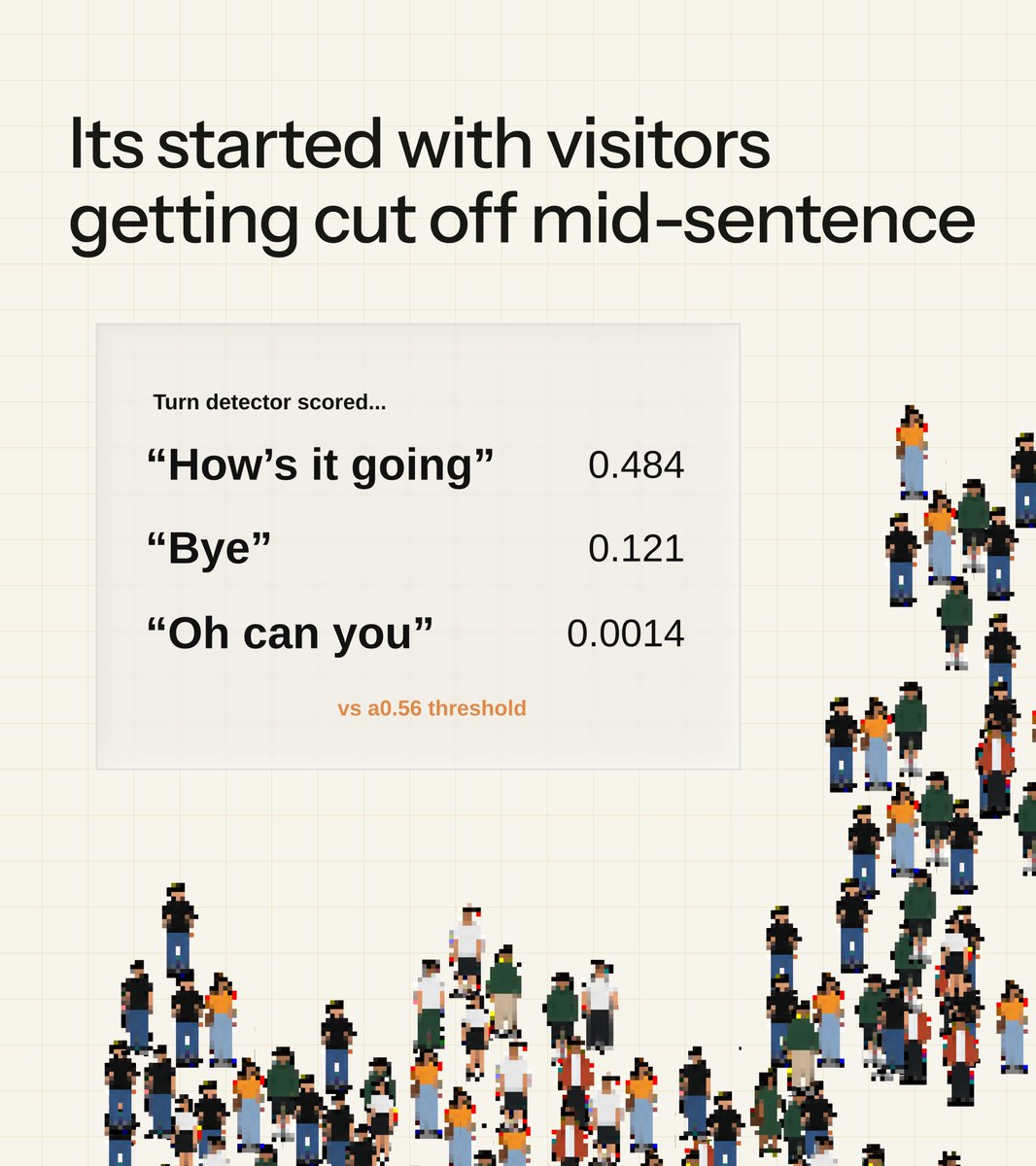
For weeks, visitors had been getting cut off mid-sentence. We traced it to the handoff between our STT and our turn detector. The detector scores every turn for completeness against a 0.56 threshold, and it was doing its job fine.
AssemblyAI finalised mid-utterance, often twice per turn, so complete sentences kept reaching the detector as fragments.
"How's it going?" scored 0.484.
"Bye." scored 0.121.
"Oh. Can you?" scored 0.0014.
Nothing looked finished, so the agent kept committing early and interrupting. Two finals per turn also meant duplicate chat bubbles.
Muse handles streaming ASR and endpointing in the same model. Every 80ms chunk emits either a word or a keep-listening token, and a final arrives only once the turn is over, post-processed and whole.
Artificial Analysis's streaming snapshot has Muse at 3.06% WER against AssemblyAI's 4.02%, first partial at 127ms against 185ms, and $3.00 per 1,000 audio minutes against $7.50.
Those numbers made the decision easy for us, but they measure a metric next to our problem. The architecture of Muse itself fixed the problem.
Going to prod this early meant no LiveKit plugin existed, so we wrote one. (repo in comments)
One trap for whoever integrates next: Muse sends speechEnd before speechComplete, and LiveKit commits the turn on END_OF_SPEECH with whatever text has landed by then. Hold the boundary until the final arrives.
With whole finals guaranteed upstream, we retuned the timing:
commit floor 0.55s → 1.2s
VAD hangover 0.55 → 0.75s
deactivation 0.35 → 0.25.
We fixed "the agent keeps interrupting me" by making the agent wait twice as long. That only works because the endpoint now arrives declared instead of guessed.
@interactaidev@SuyashKarn2@ani1005sai
We’re sharing a solution to the Navier-Stokes Millennium Prize Problem, one of the deepest problems at the frontier of mathematics.
The proof was produced by a group of agents, using an OpenAI next-generation model significantly more capable than GPT-6 Astra.
The problem concerns whether the description of smooth three-dimensional fluid motion modeled by the Navier-Stokes equations can break down. It has remained unresolved for roughly 90 years.
What if movies were not viewed but experienced?
What if you could star in your own movie?
What if you could change the ending?
https://t.co/SJMAPRkf3t
- Choose your genre
- Cast yourself and your friends
- Change the storyline
Create your own adventure. All in 15 minutes.
Introducing Koyal Experiences.
Generate for free now at https://t.co/SJMAPRkf3t
Releasing the model weights and technical report of Kimi K3.
Kimi K3 is our most capable model: a 2.8T MoE model with native visual understanding and a 1M-token context window.
New model architecture: 2.5x the intelligence per unit of compute, not just more params.
Alongside Kimi K3, we're opening up more of the stack behind it — high-performance attention kernels, MoE communication library, and infrastructure for running agent environments at scale.
Model weights: https://t.co/7m7eEg6Y0B
Tech report: https://t.co/yeu6cjpMCT
Tech blog: https://t.co/YTfiMSNM1f
@OlaElectric What is the point. We should then buy EV from Ather only. My new S1X+ was picked up for repair under Care+ plan on 15th and yet no job card is even created yet.
Are we supposed to sit around after buying the vehicle?
At its peak, Sun Microsystems was valued at 205B (394B if inflation adjusted). Sold software in enterprise servers. Got disrupted by Linux, x86, and commodity hardware. Ended up selling to Oracle for 7.4B, losing 96% of its value.
Open source models running on local hardware can have a similar impact given what’s going on.
Keeping up with AI news is becoming a full-time job.
So my friend @ivan_bezdomny built HuggingNews, an AI-curated feed that surfaces the news actually worth reading. Soon, it will even personalize the feed using your Hugging Face profile. Been using it for weeks!
Bookmark it, or ask your agent to send you the top 10 stories every morning or night. Less noise. More signal. More building!
https://t.co/h0xpkq1aHO