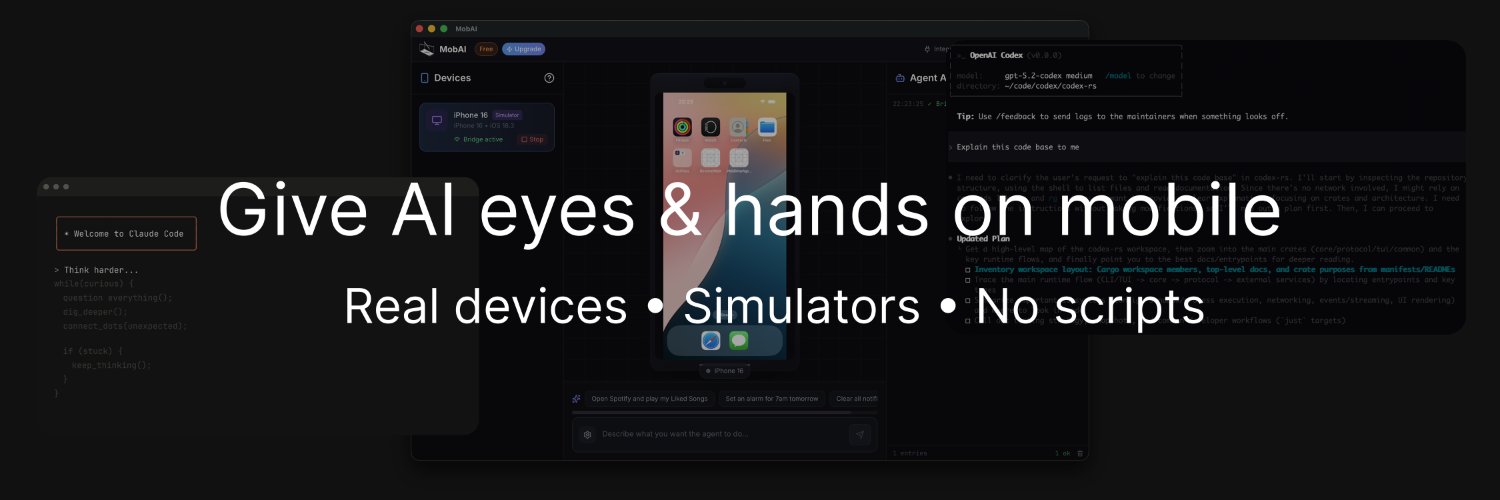
MobAI gives AI agents eyes and hands for mobile apps.
They can control iOS and Android apps on simulators, emulators, and physical devices, then verify the result instead of guessing from code.
Build the app. Let the agent test it. Fix what it finds.
https://t.co/SOnMTYaewn
Create reusable AI skills for almost any App on your phone.
Mobile Harness lets agents learn a workflow inside app, save it as a skill, and run it again later.
Like a small app-specific API, but built from real UI steps.
https://t.co/29OuNP4z70
@adelbucetta@DanKornas Not sure you can find anything faster, at least for iOS.
The video shows the same Maestro YAML test running through MobAI, agent-device, and maestro-cli itself.
Xcode 27:
“Agents can now boot simulators, install and launch apps, synthesize touch events, and capture screenshots to verify UI behavior.”
So who is going to win?
Codex inside Xcode
or
Xcode inside Codex?
Your e2e mobile tests don't have to be slow.
One Maestro test. Same iPhone.
Cold start, run 3 ways.
All latest versions:
mobai-ci → 12.76s
agent-device → 29.63s
maestro-cli → 41.08s
mobai-ci is done before maestro-cli even opens the app.
3.2x faster.
mobai-ci is coming soon.
You can already run tests today with the MobAI desktop app and mobai cli client
https://t.co/rclcXHufOA
npm install -g @mobai-app/cli
@OpenAIDevs Looks cool.
If you need something deeper for testing and automation: Android & iOS, physical devices, lower token usage, batched actions, and support for macOS, Windows and Linux:
https://t.co/rclcXHufOA
I think it’s a nice UX improvement, but I don’t see it as something groundbreaking.
What they shipped is mostly simulator/preview integration into Codex. Nice if you don’t want to open Xcode just to check a SwiftUI preview. But in practice, if I want to see changes, I can already ask Codex to run the app in a simulator or install it on a connected device.
When I talk about deep mobile control, I mostly mean real devices. Especially if you want to control iOS devices from Windows or Linux.
That’s where the real pain starts.
Big AI companies probably won’t go deep into mobile device control.
Not because mobile is unimportant.
Because there’s no clean official path.
Real device control means private APIs, OS quirks, fragile bridges, and signing pain.
That messy layer is what MobAI is built for.
MobAI 2.1.1 is out 🚀
Testing + automation got a solid polish pass:
• Expanded Maestro YAML support
• Run flows from the terminal: mobai test flow.yaml
• New clear action for text fields
• New drag_path for curved gestures
• More agent-friendly DSL
https://t.co/rclcXHufOA
@ardent__dev https://t.co/ZClhmWvhce
Skill that makes demo videos of any app or website for you from a prompt.
And the one for mobile apps - https://t.co/t2QWdgWezW