Resilience patterns don’t just prevent failures — misconfigured, each can cause one.
Timeouts, retries, jitter, budgets, circuit breakers, bulkheads & load shedding all have second-order effects.
🔗 https://t.co/BnLXzlqgBC
#SystemDesign#DistributedSystems#SRE
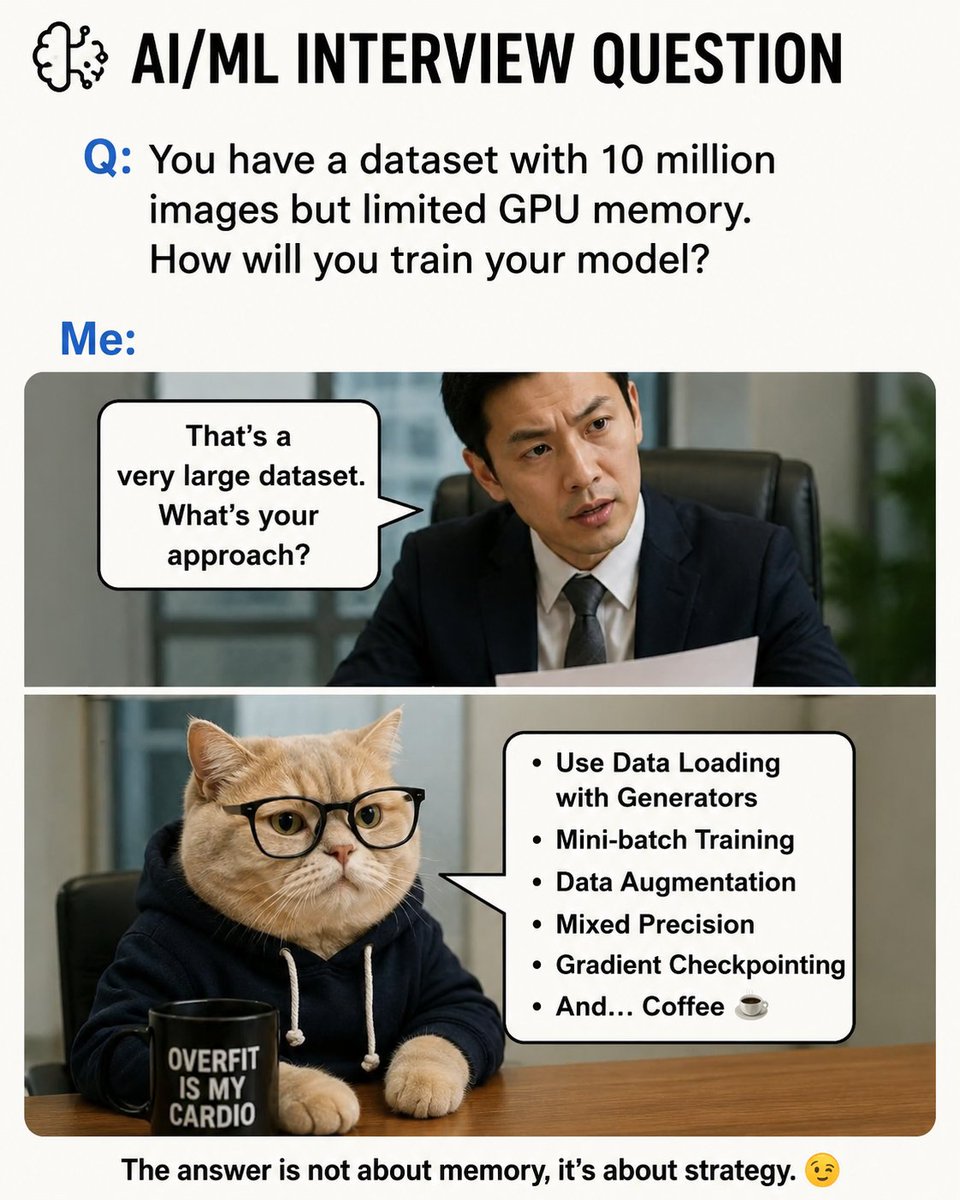
AI/ML interview question:
You have 10M training images but limited GPU memory. How would you train the model efficiently?
If your answer starts with “buy a bigger GPU” 😅 — the interviewer has follow-up questions.
AI/ML https://t.co/ulPtf0psCE
#AI#MachineLearning#AIInterview
Called setCount(count + 1) three times…
Expected: 3
React: “Your render saw count = 0.”
Actual next render: 1 😅
State is a snapshot. When the next value depends on pending state, use an updater:
setCount(value => value + 1)
Practice React https://t.co/oJpKtb84yn
#ReactJS#react
One billion monthly Gemini users and counting. This makes the Gemini app Google's fastest growing product ever, and we couldn’t have done it without this amazing community.
Today we're also opening the weights for Muse Glimmer, a great 30B parameter dense model that can run locally. Soon we'll also release the weights for Muse Spark 1.2, our latest foundation model. Meta is a strong supporter of open source and I'm proud of these releases. Congrats to @alexandr_wang and the MSL team for all your great work on these models.
Interviewer: “How does Python async work?”
Me: “First, what’s the concurrency limit?” 😄
Because senior Python interviews aren’t just about `async`/`await`—they’re about backpressure, deadlines, capacity, and what fails under load.
https://t.co/xOvBpPEuJC
#Python#async