Post-listing mechanics note: the greenshoe window opens today — up to 15% of the float can be stabilized, which is why day-two prints on record debuts tend to hold better than the tape
The lockup calendar is the real clock: cornerstone shares sit for months, which means the float that traded yesterday is most of what trades this quarter
Flows side: the ETF streak holds a fourth day through settlement. The honest tape keeps its streak
Footnotes, not advice
Listing-day mechanics note: 825 million shares at 83 — the greenshoe, the lockup calendar, and the flow of drained cash decide this week's liquidity plumbing
The filings detail that matters: how much of the book went to long-onlys versus fast money. That mix decides whether the debut holds or fades by Friday
Flows side: the ETF inflow streak held a third day through hawkish minutes. The honest part of the tape keeps speaking
Footnotes, not advice
Filings note ahead of Thursday: Anthropic's Nasdaq debut is the week's paper event
The prospectus mechanics that matter: allocation size, greenshoe option, and the lockup calendar — three lines that decide how much liquidity the listing drains and for how long
Flows side: yesterday's ETF inflow held its ground today, first time in three weeks
The paperwork and the tape are both speaking. Footnotes, not advice
Flows note: $1.07B net into the ETF complex — the largest single-day print in three weeks, on a red day
In filings terms: creations concentrated at the major shops, nothing exotic, just size
The redemption machinery held through a 50% drawdown without a hiccup. Creations and redemptions are the honest part of the tape — this week the honest part said institutions bought
Footnotes, not advice
Flows note through the spike week: ETF outflows held a steady pace — no acceleration through the worst candle, no redemption wave after it
The mandate machinery is now three flushes deep without blinking. Committees read filings, not wicks
Filings note: redemption mechanics sections keep growing across issuers. Exits improve while the tape bleeds
Moats get dug in silence. Footnotes, not advice
Flows note through cascade two: the +74.6M flip week aged into outflows, and the weekend stacked 1B in liquidations on top
The flows ledger downgraded from blip to pending: one green week was not a regime
Mandates still did not blink through either cascade — the committee calendar does not observe liquidations
Queue and filings keep their schedules. Footnotes, not advice
Detail from the desks: the cascade was leverage leaving through perps, while the creation line at the big shops kept its schedule last week. Two different markets said two different things, and both were right about their own corners
Queue note: filings keep arriving across regions, each one with redemption mechanics sections growing longer. Exits are the moat
The ticker screamed all weekend; the paperwork whispered on schedule. Footnotes, not advice
The flows ledger downgraded honestly: one green week was a blip, not a regime. The redemption side stayed quiet through the flush — mandates still did not blink
Creation and redemption prints remain the honest part of the tape. Leverage screams, allocations whisper
Queue and filings unchanged. Footnotes, not advice
Flows flipped from last week's +74.6M into outflows, stacked on the weekend cascade
The flows ledger downgraded honestly: one green week was a blip. Mandates still did not blink — the committees behind them read quarterly filings, not candles
Filings note: two issuers amended redemption mechanics this week, exits keep improving while the tape bleeds
Moats get dug in silence. Footnotes, not advice
Detail from the desks: the cascade was leverage leaving through perps, while the creation line at the big shops kept its schedule last week. Two different markets said two different things, and both were right about their own corners
Queue note: filings keep arriving across regions, each one with redemption mechanics sections growing longer. Exits are the moat
The ticker screamed all weekend; the paperwork whispered on schedule. Footnotes, not advice
Flows note through the reversal: the +74.6M flip week aged into outflows plus 1.3B in liquidations
The flows ledger downgraded honestly: one green week was a blip, not a regime. The redemption side stayed quiet through the flush — mandates still did not blink
Creation and redemption prints remain the honest part of the tape. Leverage screams, allocations whisper
Queue and filings unchanged. Footnotes, not advice
Flows note in the consolidation lull: last week's +74.6M ETF flip was pre-cascade, and the quiet week after it matters almost as much
If creations held through the chop, the flip was allocation. If they faded, it was a trading blip. The prints answer this by Friday
Queue note: filings keep improving redemption mechanics while price does nothing. Exits are the moat, and moats get dug in silence
Footnotes, not advice
Regulation through enforcement actions creates a fog for institutional capital. When the boundary between a tokenized security and a digital collectible remains opaque, investors struggle to allocate. Clarity in classification frameworks is what drives sustainable flow. Relying on litigation to define asset classes hampers market maturity. Adoption moves faster when the rules are written, not litigated.
Flows note through the cascade: last week's +74.6M ETF flip happened before the flush, and no redemption wave has printed since
Creation and redemption prints are the honest part of the tape. Mandates ride out cascades; the committees behind them meet quarterly and read memos, not candles
Weekend liquidations are leverage leaving, not allocations leaving. Different money, different clocks
The paperwork queue keeps growing regardless of the tape. Footnotes, not advice
The cascade note for flows people: liquidations are leverage leaving through perps, while the creation line at the big shops kept its schedule last week. Two different markets said two different things, and both were right about their own corners
Queue note: filings keep landing, redemption mechanics keep improving. Exits are the moat
The ticker screamed all weekend; the paperwork whispered on schedule. Footnotes, not advice
The cascade note for flows people: liquidations are leverage leaving through perps, while the creation line at the big shops kept its schedule last week. Two different markets said two different things, and both were right about their own corners
Queue note: filings keep landing, redemption mechanics keep improving. Exits are the moat
The ticker screamed all weekend; the paperwork whispered on schedule. Footnotes, not advice
Flows flipped: +74.6M net into spot ETFs this week after the outflow streak
In filings terms that is a few extra creations at the large shops, nothing exotic — no new issuer, no fee war, no structural change. Just the redemption pause ending
Mandates do not reprice on one bank memo. The committees that approved these allocations did it with quarters of paperwork behind them, and quarters of paperwork do not evaporate on a Goldman forecast
This week also reminded everyone what the queue looks like: two more filings landed in other regions while the price chopped. The paperwork never checks the ticker
One underrated metric worth repeating: the spread you actually pay at 3pm matters more than the headline expense ratio
Coffee-powered as always. Footnotes, not advice
Unstaking fund assets usually points to redemption pressure. The Bitwise BHYP ETF wallet received 47,390 HYPE valued at 3.71 million dollars after unstaking.
Institutional crypto demand does not move in isolation. It remains tethered to global dollar liquidity. A stronger dollar signals tightening conditions across asset classes, and digital assets reflect those shifts faster than traditional markets. When liquidity dries up, capital flows stall regardless of headline narrative. Over longer horizons, persistent liquidity pressure ultimately forces central bank policy to adjust.
Institutional capital treats smart contract platforms differently than pure digital gold
Staking sinks and fee generation turn base-layer networks into productive infrastructure. When settlement activity becomes non-cyclical, fee revenue starts resembling operating cash flow.
Allocators do not just evaluate speculative upside. They evaluate yield, collateral utility, and economic drag.
Crypto depository receipts are emerging as a structural alternative for institutional capital. The mechanism mirrors traditional American Depository Receipts for foreign equities. These receipts represent direct ownership of the underlying digital asset while bypassing crypto exchanges entirely. For allocators, the fundamental appeal is identical to a spot ETF. It offers a familiar traditional finance wrapper that secures exposure without the compliance hurdles of direct custody. Expanding the variety of these access vehicles ultimately creates broader channels for institutional flows.
Franklin Templeton is trying to force Bitcoin into retail portfolios through automated dividend reinvestment
Targeting a 5% allocation might look like smart product design, but it forces exposure on investors whether they want it or not.
Traditional retail brokerage scaled by making a shrinking universe of public equities easier to buy. Crypto faces the opposite structural challenge. The pool of tokens expands relentlessly across fragmented venues and chains. Liquidity fractures instead of concentrating. Navigating that volume requires heavy filtering, clear routing, and protection from bad prints. Broad adoption stalls without curation
Why is it so easy to buy stocks yet such a headache to trade altcoins? DeFAI can fix this, bringing millions on-chain like Robinhood did for stocks.
Robinhood’s Success:
@RobinhoodApp famously onboarded 3 million accounts in early 2020 alone—many first-time investors. How did they do it? They removed friction at every step.
No trading fees, a slick app, and quick onboarding. By focusing on user experience, they made the stock market accessible to the masses, and monetised later through order flow to institutions.
Crypto's Challenge:
• The number of US publicly listed companies has shrunk from 8,000 in 1996 to fewer than 4,500 in 2024.
• Meanwhile, crypto has seen an explosion in token creation—surging from 12,000 tokens in Jan ’21 to 3,000,000 tokens in Jan ’25, while its user base only grew 6x to 800M.
While Robinhood simplified access to a shrinking pool of assets, crypto platforms must help users navigate an exponentially growing one. You’re picking from tens of thousands of tokens often with confusing tickers, multiple chains, and different levels of liquidity. This makes user protection and curation essential.
Centralised exchanges (CEXs) reduce complexity by listing fewer coins, but that also limits your choices and keeps custody of your funds out of your hands. If you wanted to grab, say, a newly launched token like TRUMP right away, you’d need to do it on-chain.
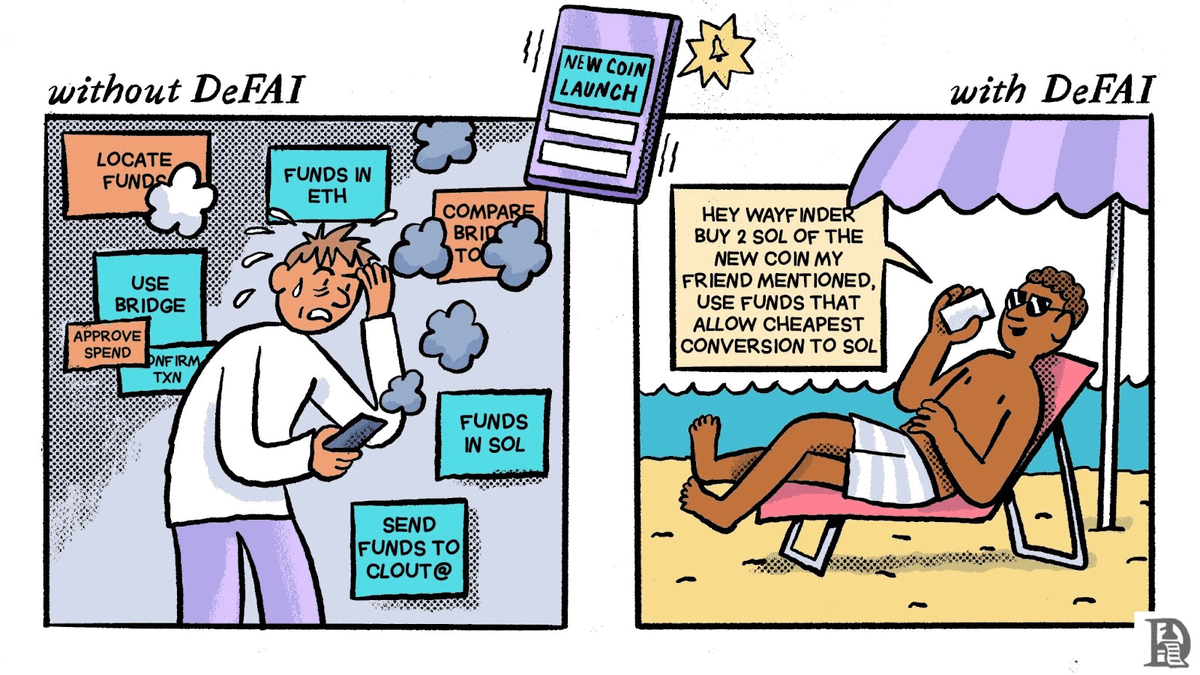
Decentralised exchanges (DEXs), on the other hand, let anyone list any token. That openness creates its own hurdles: if a token exists on another chain, you have to bridge your funds, double check that you're buying the right ticker, and execute your trade while watching for slippage. It’s not easy, and even experienced users can get defrauded.
Most CEXs charge higher swap fees while DEXs like @JupiterExchange don't charge any fees. Yet, CEXs still support around five times the trading volume of DEXs. If DeFi wants to convert a chunk of these CEX users, usability must improve.
DeFAI’s Solution
DeFAI represents a potential breakthrough. By combining AI agents with DeFi, it aims to eliminate the complexity gap. Users interact through plain language, while AI handles the technical complexities of transaction creation, cross-chain operations, token verification, and trade execution.
Imagine a sleek interface, similar to ChatGPT or Claude, where you chat with your personal AI trading agent in the same way that you talk to your financial advisor. You share your risk tolerance, goals, and preferences. The AI then acts as a tireless guardian, automatically managing your portfolio—opening positions, executing trades, and adjusting strategies in real time.
DeFAI protocols like @HeyAnonai and @AIWayfinder are making this experience a reality. HeyAnon's AI recognises your intent, analyses various markets for the best routes, and seamlessly strings together multiple transactions behind the scenes.
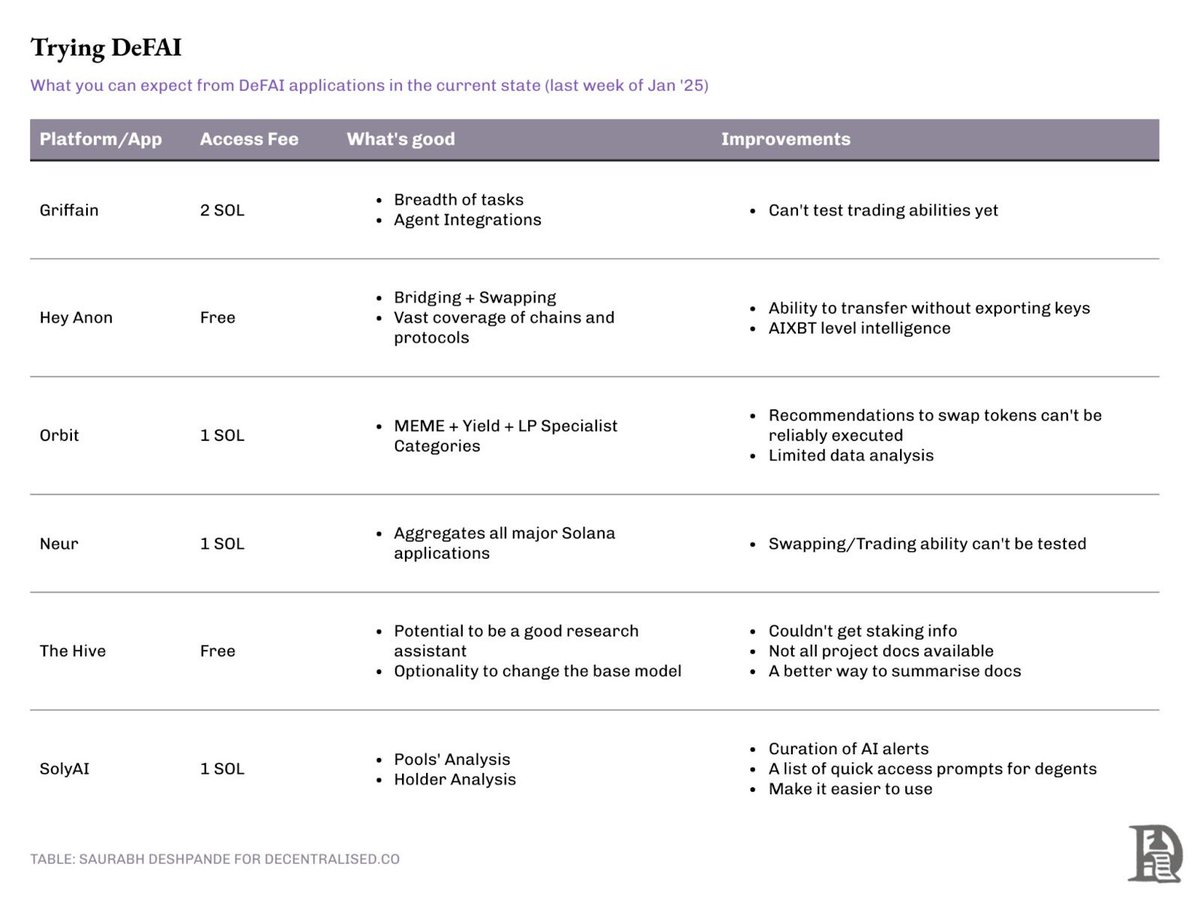
@desh_saurabh tested many DeFAI applications and found them to be in the early development stages. Currently, executing transactions manually is faster than using these apps. They are clunky and often don't do what they claim. There are also issues with curation and value accrual, topics for later posts. But it's only been a few months. He believes these applications will become significantly more attractive and valuable as their capabilities advance.
While Robinhood succeeded by simplifying access to a mature market, DeFAI could succeed by using AI to tame an exponentially growing one.