This month will be absolutely HISTORIC for markets
Big banks claim the Tradfi TOP IS IN as we approach the SpaceX $SPCX IPO
Meanwhile $BTC holds over $60K, is the bear market over?
LIVE NOW with the best trader in the world @brandank_cr
https://t.co/TOLaLlN3VF
The equation is fairly straightforward:
Competent employees x AI tokens = Accelerating business & market share gain
Incompetent employees x AI tokens = slop
Companies are now realizing they have a lot of shitty employees.
They aren’t going to permanently cut spend on tokens. They can’t afford to because of game theory.
So instead they will fire the employees they believe are incompetent to make room for higher token budgets for those that are competent.
Lots of orgs however have a managerial class that doesn’t optimize for share gain and winning in general.
Thats fine. A wave of startups and existing platforms who can effectively leverage AI to expand scope of their business will crush the incompetent at a rate that will leave analysts and managers dizzy.
Change is coming. Fast. And reflexively the faster the change the higher the panic the lower the ROI threshold the more revenue and capital accrues to the labs the faster the models improve. And so on.
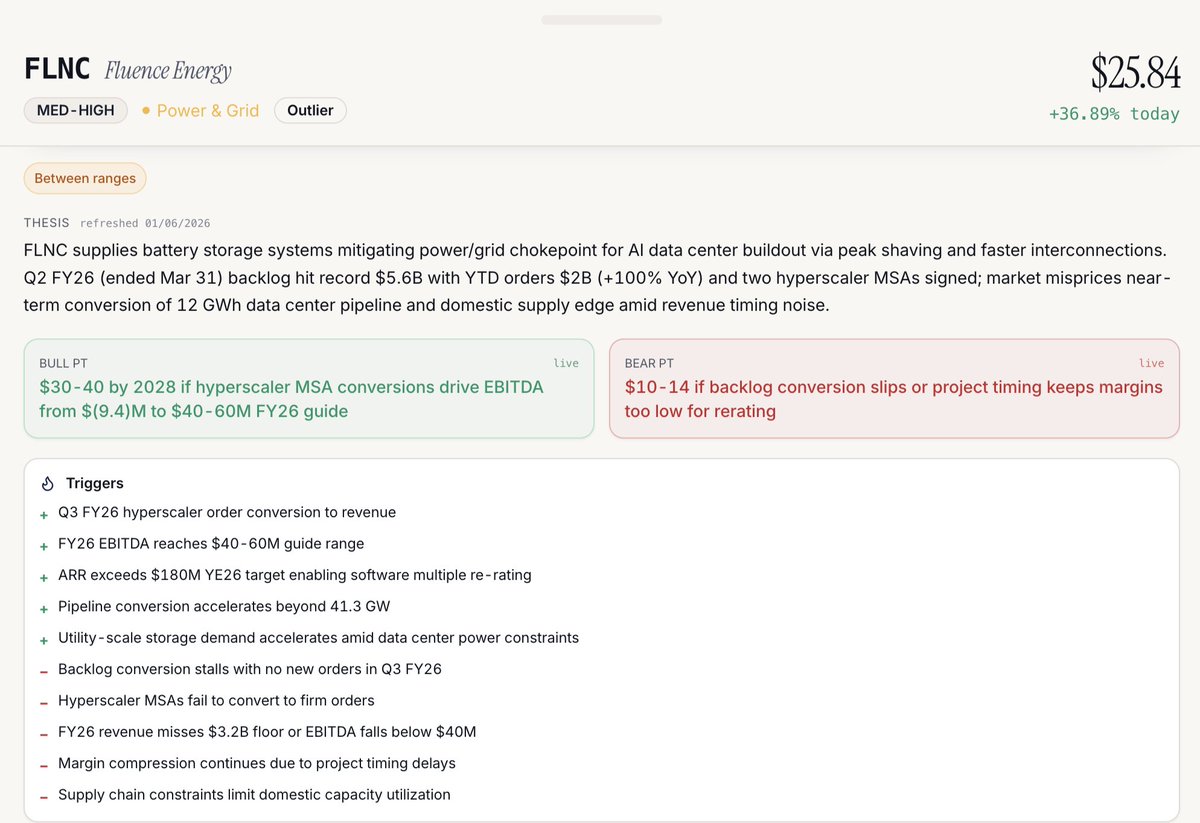
$FLNC leading the bottleneck book on the news today
yesterday’s weekly recap called the rotation into deployment: power & grid cooled short term but the bottleneck thesis stayed live, with FLNC listed right in the stack to watch.
today’s brief caught NVIDIA DSX Flex turning power into an active grid asset, theme accelerating again.
app had the full setup flagged weeks ago as the MED-HIGH power & grid outlier, two hyperscaler MSAs signed Q2, firm orders guided for this quarter ending June 30, EBITDA ramp into the $ 40-60M FY26 guide ahead of Aug 10 earnings.
NVDA + Siemens reference arch just confirmed the whole piece.
thesis playing out line for line.
full FLNC page + every other bottleneck mapped https://t.co/ud4iRaHxdh
Inference got a hundred times cheaper this year. The compute bill went up anyway.
If you understand why those two sentences are both true at the same time, you understand the most important thing happening in AI right now.
I work on inference for a living, at @nebiustf, where we run open-source managed inference at scale. Most of what follows is what I'm seeing from inside the bill.
12 months ago, the cost of 1M tokens of frontier-class reasoning was somewhere on the order of $60.
Today, an equivalent quality of output costs roughly $0.50.
Price /token of o1-level intelligence has dropped about a 128x in a year.
Price of GPT-4-level output has dropped roughly 100x since the original GPT-4 shipped.
By any normal reading of a technology cost curve, this should be deflationary. It should be saving customers money.
The opposite has happened. The total compute bill at every hyperscaler is going up, not down. Anthropic just signed multi-year capacity deals with both XAI and Amazon. Microsoft's Azure capex guide for 2026 starts with an eight. OpenAI is reportedly spending more on compute every quarter than it did in all of 2023. Nvidia paid roughly twenty billion dollars to acquire Groq, an inference-specialist company that did not exist as a serious commercial entity three years ago.
The cost curve and the demand curve crossed, and then the demand curve lapped the cost curve.
Here is what happened underneath.
A reasoning model burns roughly 10x the output tokens of a non-reasoning model on the same task, because it spends most of its tokens thinking out loud before answering. An agentic workflow chains roughly twenty times the requests of a single-shot completion, because it loops, calls tools, plans, retries, and synthesizes. A modern deep-research query (the kind a research analyst can fire off in fifteen seconds and then walk away from for ten minutes) costs more compute than 10 original GPT-4 queries combined. We made every individual token a hundred times cheaper, and then we built a generation of products that consume ten thousand times more tokens.
This is the Jevons paradox playing out at trillion-dollar scale, in compressed time, in front of everyone. Jevons noticed in 1865 that making coal-burning more efficient did not reduce coal consumption. It increased it, because efficiency unlocked uses that were previously uneconomic. Steam engines became more practical at smaller scales. Whole industries that could not afford coal at the old price suddenly could. Britain's coal consumption rose sharply, not despite the efficiency gains, but because of them.
The same thing is happening to AI compute right now and it is happening faster than any analogous historical cycle. Falling token prices did not contract demand. They unlocked agents, deep research, code-writing systems, multi-step reasoning, persistent memory, the entire next layer of AI products. Every product in that next layer consumes orders of magnitude more compute than the chat interfaces it is replacing.
The math at the aggregate level is brutal: 100x cheaper tokens times 10 000 more tokens equals a 100x larger total bill.
The implications stack quickly.
If you are running a hyperscaler, your 2026 capex guide is not a peak. It is a step on a curve. Inference is structurally always-on, twenty-four hours a day, in a way that training never was. Training is bursty. You spin up a cluster, run for weeks or months, and stop. Inference runs continuously, scales with usage, and the usage curve is exponential. Your power bill, your cooling bill, your transceiver count, your storage footprint, all of these were sized for a workload mix that no longer exists.
If you are running an AI software company built on top of someone else's closed API, you have a problem that did not exist a year ago. Your gross margins get worse as your customers get more value out of your product, because the more they use it, the more compute you pay for. The companies that win this are the ones that figured out vertical integration before the math caught them.
If you are watching this from a distance and trying to understand where the next bottlenecks form, the answer is everywhere downstream of "more inference compute, always-on, with massive memory state per session." The KV cache, the running memory state of a long conversation or an agent loop, is the silent monster of the inference era. It does not scale linearly with parameters. It scales linearly with context length and number of agent steps. A long agent session can hold tens of gigabytes of state per user, per session.
Multiply that by every concurrent user of every product, and you understand why $MU, $SNDK, $TOWCF, and the entire memory and packaging layer have re-rated the way they have.
The CPU-to-GPU ratio is evolving. Training is 1:8. Basic chat inference is 1:4. Agentic inference is 1:1, sometimes CPU-heavy. Google has split its TPU line in two, with a dedicated inference chip carrying tripled SRAM for KV cache. $INTC and $AMD just spent two earnings calls explaining that this shift is structural, not cyclical. The hardware map is redrawing in real time and the financial press is mostly still writing about training clusters.
The right framing of where we are right now is not that AI is hitting a wall. The framing a year ago that scaling was hitting a wall was the most expensive bad take of the cycle. The right framing is that AI got dramatically cheaper, dramatically more capable, and dramatically more useful, and the cost of running it at the new equilibrium of demand is much higher than the cost at the old equilibrium of demand, because the new equilibrium is enormous.
A meaningful share of what we actually do at Token Factory, day to day, is help customers stop their bills from running away from them. KV-cache management. Speculative decoding. Quantization. Routing. The kind of vertical integration that, eighteen months ago, every product team was happy to leave abstracted away behind a closed API. The reason this stack matters now is the same reason this whole essay matters: at the new equilibrium of inference demand, the cost of treating compute as a commodity is no longer survivable. The companies that figure out the layer beneath the API are the ones who keep their margins.
Cheaper tokens. More tokens.
Same coal as 1865.
This strait of Hormuz market is basically resolved but you can still make a free 4% on it.
Some people put their money in treasury bonds for this much money anually, you just have to wait 4 days.
There is a false impression from some traders that is market is basically equivalent to the strait of Hormuz reopening but the criteria are actually far stricter than "a consensus of credible reporting".
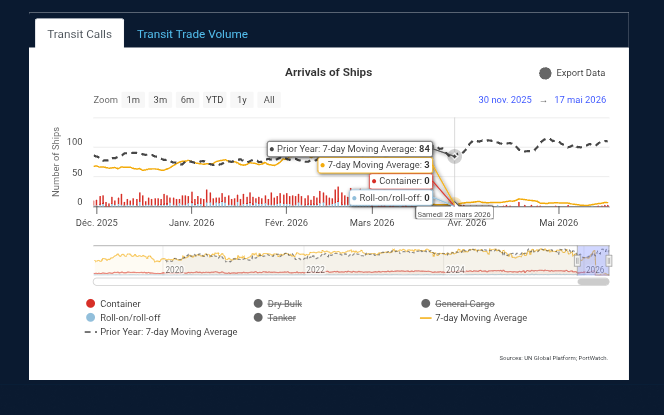
The 7 day moving average of cargo passing through the strait must exceed 60.
It's a pretty high bar considering that the moving average before the war hovered at 80-100. Even if the strait was declared open today, the 7 days window for the last day of may already started on a closed strait so the 6 remaining days would need to average to 70.
By tomorrow it will need to be 80+ for the remaining 4 days etc.
And that previous average from before the war was on a fully open strait, now it's mined and even if Iran "opens" it, it will still be along the narrow lanes thought the minefields and under their supervision.
I don't think a pre war traffic is even achievable under these conditions, much less in the next few days
It's a nice bond
Would love to see Kalshi or Polymarket host a daily live show on their site discussing the most important current markets - basically turning the newsletter into a daily one-hour live show.@mansourtarek_@luanalopeslara@shayne_coplan
NEW | Iran Update: Islamic Revolutionary Guards Corps (IRGC) Commander Brigadier General Ahmad Vahidi and his inner circle have repeatedly blocked attempts by Parliament Speaker Mohammad Bagher Ghalibaf and other “pragmatist” officials to push the regime toward a more flexible negotiating position. Vahidi appears to have prevailed in this internal power struggle and will likely shape the regime’s approach toward negotiations and the war with a maximalist and uncompromising stance. Ghalibaf likely lacks the leverage to alter this trajectory in a meaningful way at this time.
Recent reports that Ghalibaf may resign from being a member of the negotiating team are consistent with ISW-CTP’s assessment that Vahidi has emerged as the winner of the intra-regime rivalry. Sources told Western media that Ghalibaf has grown frustrated with internal divisions and has considered resigning from the negotiating delegation, while some outlets have claimed that Ghalibaf has already resigned from the negotiating team due to disagreements over nuclear concessions.
“Pragmatist” officials may continue to advocate for a more flexible approach, but their efforts are unlikely to meaningfully shape regime decision-making in the near term.
Vahidi’s apparent victory will likely have significant implications for potential future US-Iran negotiations. Vahidi has also shown greater willingness than “pragmatist” officials to accept the risk of renewed conflict with the United States.
Iran and the United States are both sending delegations to meet with Pakistani mediators in Islamabad this weekend, but it remains unclear whether the delegations will engage in a second round of negotiations at the time of this writing. Iranian Foreign Affairs Minister Abbas Araghchi arrived in Islamabad on April 24, and US Special Envoy to the Middle East Steve Witkoff and Jared Kushner will travel to Islamabad on April 25. Sources told Axios that a trilateral meeting between Araghchi, Witkoff, and Kushner could take place following separate bilateral discussions between Witkoff, Kushner, and Pakistani mediators.
Likely Iranian-backed Iraqi militias conducted two fiber-optic drone attacks on Kuwaiti border posts on April 24. Iranian-backed Iraqi militias have not claimed these attacks at the time of this writing. Iranian-backed Iraqi militias have demonstrated their ability to use fiber-optic first-person view (FPV) drones during the war, however.
The US naval blockade appears to be constraining Iran’s oil storage capacity. Tanker Trackers reported on April 23 that Iran has recommissioned the retired very large crude carrier (VLCC) Nasha into service, likely to expand Iran’s floating storage capacity near Kharg Island in the Persian Gulf as Iran’s onshore storage capacity decreases.
Hezbollah claimed that it targeted an Israeli community in northern Israel for the first time since the ceasefire went into effect on April 16. Lebanese Ambassador to the United States Nada Hamadeh said that the Israel-Lebanon ceasefire will remain in effect until May 17, three weeks past its original expiration date on April 26