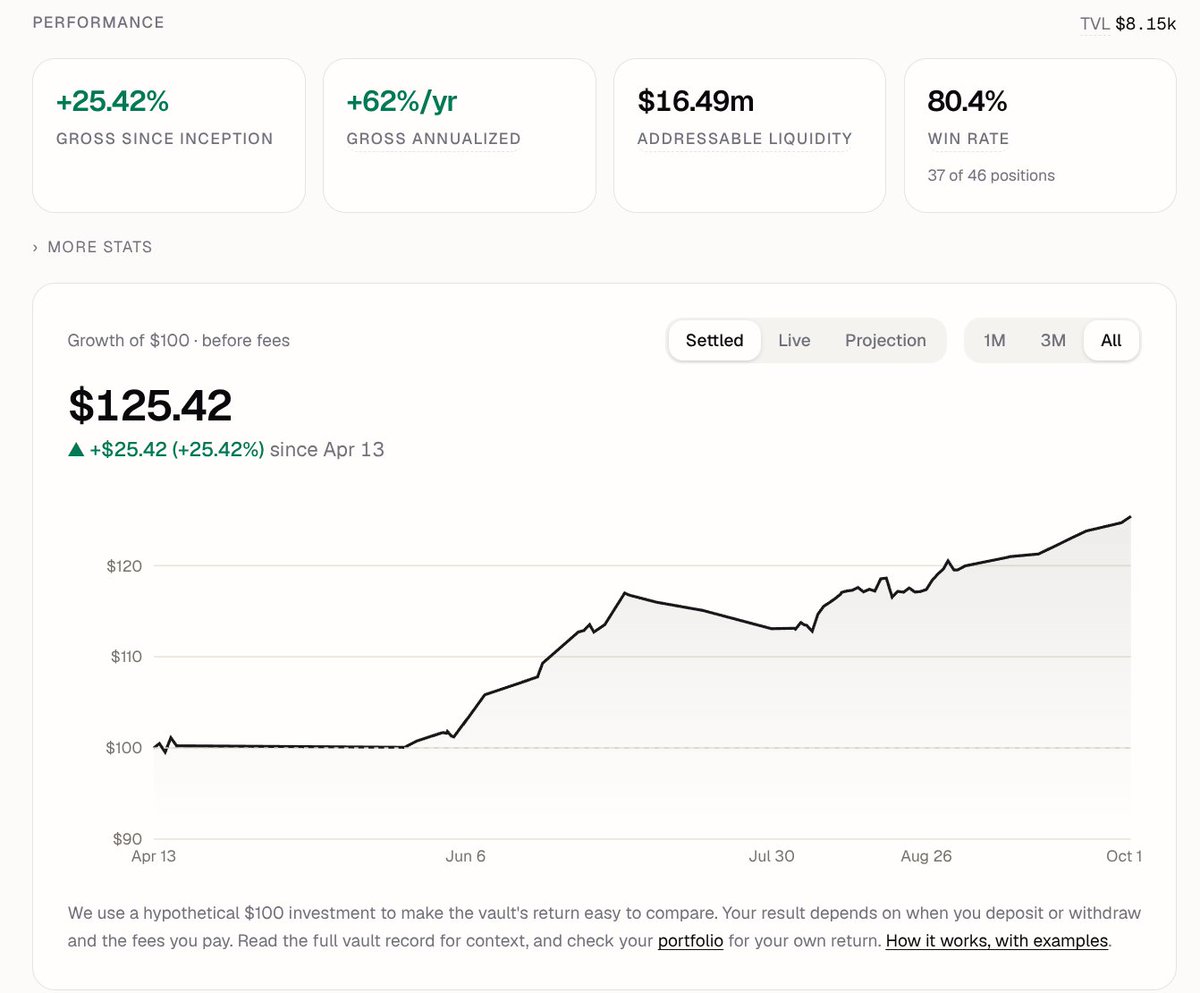
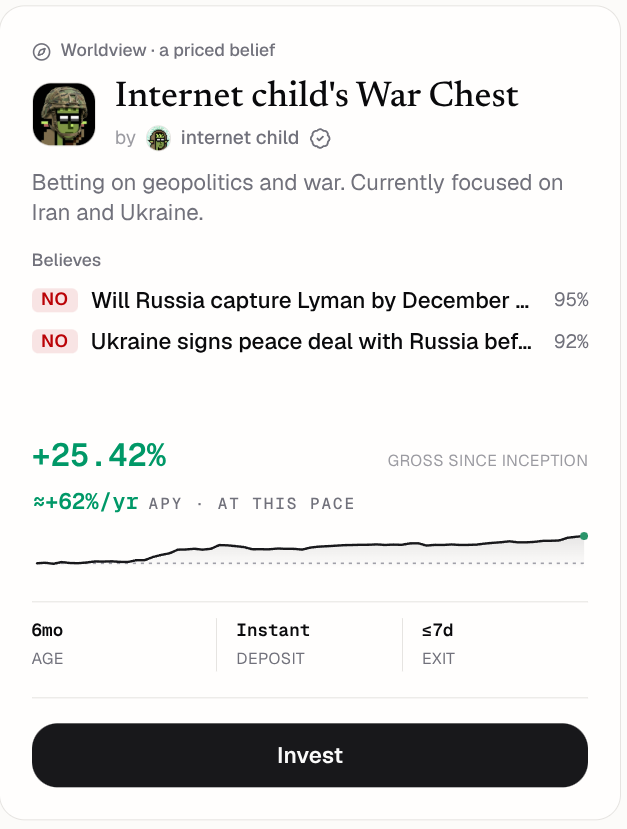
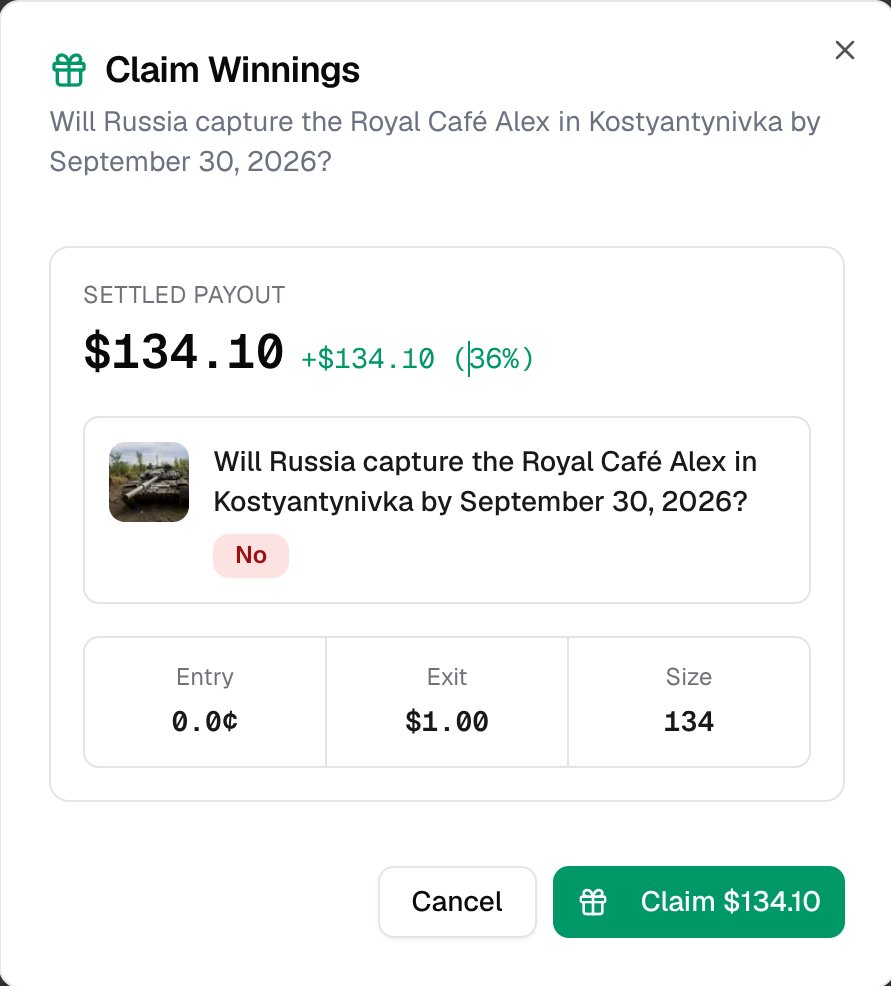
My $WAR vault has reached +25% this month
that's 244% APY for investors !
not bad for passive yield.
the vault statistics actually show only 62% APY because they count from february when the vault was created, but not launched yet.
In reality (1+0.25)^(12/3) = 2.44 so the real number is 244% if i can keep this rate
the chart is pretty smooth lately because i'm trying to stay diversified and never exceeding 10% bankroll per position.
TVL has also grown +3x from $2.6K last month to $8.6k now from all the next deposits but there is still room to grow so don't hesitate to chip in.
I will put the link below for those that want to profit from $WAR 👇
Nate Silver vs. Kalshi’s CEO is the best fight of the midterms.
Tarek says the markets called it. Nate says “give me a break.”
Then a quant pulled 488 races and ran the numbers. Kalshi wins. 👇
tl;dr:
– Tarek: the people called the midterms on Kalshi
– Nate: polls and models led, markets just followed
– 488 US races since 2024: Kalshi had ~12% less forecasting error than the models
– head-to-head with Silver Bulletin on the 2024 presidential race: Kalshi wins, 0.0312 to 0.0348
– Kalshi’s own 2026 study: lowest Brier score of any forecast on Election Day, Silver Bulletin included
– Nate has been a Polymarket advisor since 2024
Lesson learned: markets don’t beat the models. They eat them.
Full details:
–- The fight timline
The night after the election, Tarek posted a victory lap: “the power to decide what America sees changed hands.”
Nate quote-tweeted it. His point: the polls and models gave the direction, and the better models were more confident and got there faster than the markets.
Then he went further on Silver Bulletin, saying markets are “low-key stealing valor from the models.”
–- The scoreboard
Quant Chad pulled 488 US races from 2024 to now and scored Kalshi’s pre-election odds against Silver Bulletin, FiveThirtyEight and JHK.
Average Brier score (lower is better):
Kalshi: 0.0282
Models: 0.0320
That’s roughly 12% less forecasting error for Kalshi.
Against Nate directly, on the 2024 presidential race across 50 states: Kalshi 0.0312, Silver Bulletin 0.0348.
Kalshi’s own 2026 study points the same way. At 9 a.m. on Election Day, Kalshi had the lowest Brier score of every forecast: Kalshi 0.0139, Silver Bulletin Deluxe 0.0141.
Kalshi also says House control passed 99% at 8:10 p.m. ET and Senate control at 9 p.m., hours ahead of the networks.
And Kalshi’s data is public. Nate’s 2026 race forecasts are paywalled, so the 488-race comparison had to use JHK for 2026.
–- Where Nate has a point
The models won 3 of the 5 categories in that data: 2024 Senate, 2024 House and 2026 Senate.
And a NYT analysis found markets did no better than the forecasts for most of the race.
– Worth knowing
Nate is a Polymarket advisor. Kalshi is now offering $1M to researchers to study its election data.
My read:
Both are right, and that’s the point.
The models gave the direction. The markets took the models, the polls, the insiders and the money, and priced all of it at once. That’s why the market comes out ahead across 488 races.
Nate isn’t wrong -- He’s an input.
EP11 * No Silver Bullet
Esports is the one chance Polymarket still has to beat Kalshi.
They just did 4x more volume than Kalshi on the biggest Esports event of the year :
"League of Legend Worlds champion"
Polymarket (US + int) : $14.6M vol.
Kalshi : $3.6M vol.
@polyguana research shows us that Polymarket have consistently better orderbook depth and tighter spreads in the Esports category resulting in ~30% cheaper entries for traders.
On top of having more diverse markets.
Yes Esports is much smaller than Sports at the moment but it has much greater potential.
- Esport betting volume grows 51% faster YoY than sports betting
- 69% of Esports bettors are aged 18-35 vs 21% for sports bettors
Kalshi has won sports betting but if Polymarket can keep their Esports lead they may still own the future.
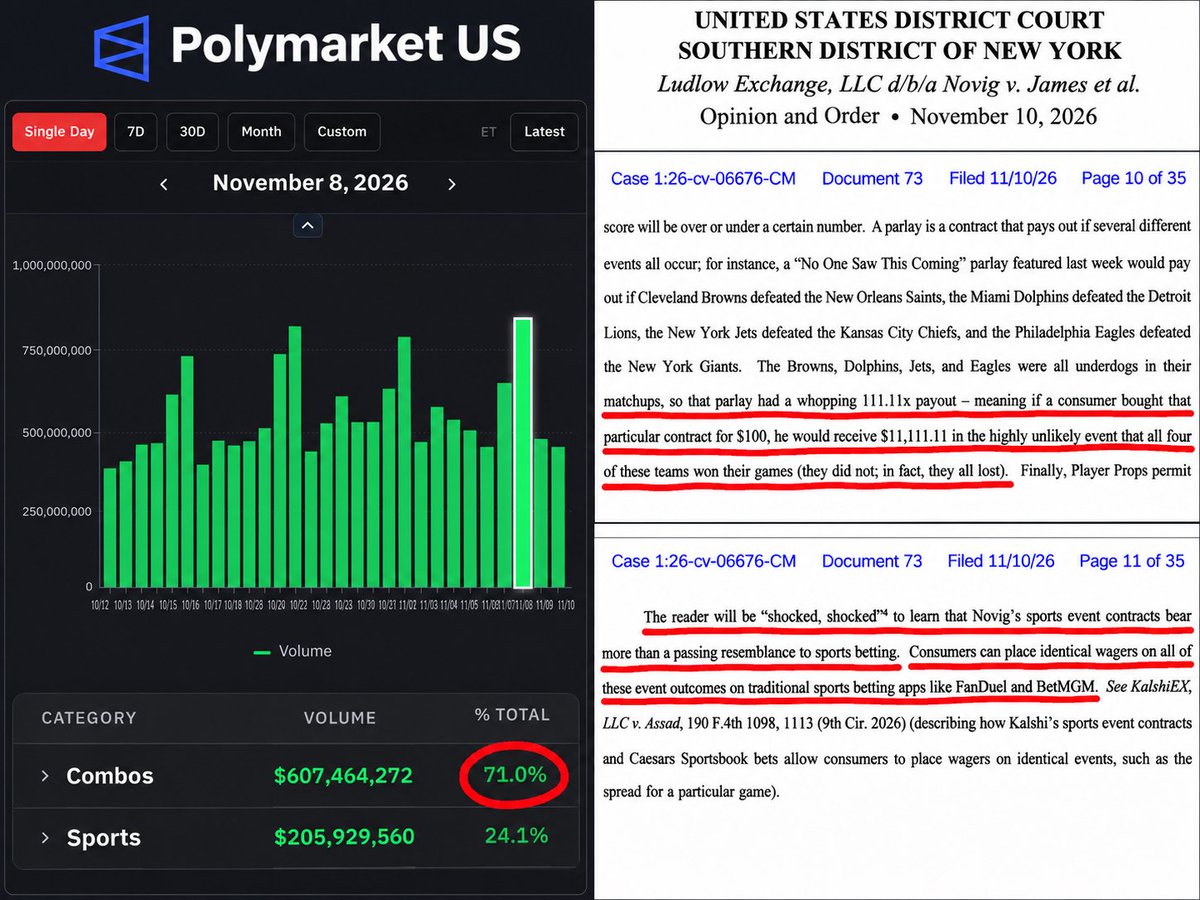
70% of Polymarket US volume now comes from Sport parlays.
Here are the daily volume breakdown this Sunday:
- 71% sports parlays
- 24.1% regular sports
- 4.9% other
This is dangerous for the industry.
Parlays is the #1 arguments that regulator use to classify sports markets as gambling.
Yesterday, a federal judge ruled against prediction markets in the Novig vs New York case citing a "4-leg NFL parlay" to argue that sports contracts are gambling.
As a result sports markets may soon be banned in New York.
The same argument was used against Kalshi.
In August they were banned from Connecticut after a judge argued that "no economic consequence come from BOTH the Giants and Broncos winning on the same weekend".
With standard sports markets you can at least make up some hedging usecases but with parlays it's hard to argue it's not gambling.
That’s the industry’s dilemma.
Parlays drive volume, fees and growth but they also expose weak legal ground that sports markets rest on.
Prediction Markets need to diversify.
Not a fee. It's the full cost of a $100 market buy: the fee plus what you pay above the mid price.
Polymarket charges takers on most markets: https://t.co/w9VlnEvjtu. Sports is 0.05 × p × (1−p) per share, so $1.25 on a $50 trade at 50c (2.5%). Buying at the ask with a 1c gap adds about 1% more. Long shots cost more, favourites less.
Hyperliquid is 110x cheaper than Polymarket on average for a $100 buy.
@polyguana researchers compared the average costs per platform (fee + slippage) for a $100 take :
Hyperliquid -> $0.05
Kalshi -> $4.26
Polymarket -> $5.42
But 99% of Hyperliquid's market don't even have the depth to fill a $10k buy, while all measured Polymarket/Kalshi ones do.
Hyperliquid = tighter spread
Polymarket/Kalshi = more liquidity
WHY THE DIFFERENCE?
1) Hyperliquid deployers typically use a narrower +-2c LP rewards band vs +-6c for polymarket.
2) Tick size on a typical Polymarket/Kalshi market is 1c wich means min slippage is 1%. For Hyperliquid it's 0.001c (100x less min slippage)
Right now @HyperliquidX is optimizing for frequent, small buys at the detriment of big orders.
that makes it ideal for high frequency trading or for retails playing with small bank rolls.