New York tried to force-liquidate every open position on Kalshi nationwide.
The sportsbook lobby paid $1.8M to the politicians behind it. Monday at 11:30 AM the judge said no. Three hours later, Kalshi hired a GC who's 3-0 at the Supreme Court.
Kalshi's institutional volume just jumped from $622.7M in April to $26.3B in October. That same week, NY dragged them back into state court.
The whole ambush came down to one word. New York asked for an order barring Kalshi from operating "within or from New York."
Kalshi is based in New York. Banning operations "from" NY is a 50-state kill switch.
Their lawyer told the judge it "would shut down a federally regulated exchange for every customer, everywhere" and likely force liquidation of all open positions. The AG's office claimed they didn't want that. They still left "from" in the order.
By Friday, Kalshi was boxed in:
Thursday: a federal judge kicks the case back to state court
Friday: another federal judge refuses to let the CFTC block NY
Meanwhile, CFTC Chair Selig is telling Kalshi to stay open ("New York has no business regulating these interstate financial markets")
Monday at 11:30 AM, Justice Melissa Crane killed the injunction. Too early, too broad, federal regulator already involved.
That bought time for Polymarket, Coinbase, Gemini, and Novig too, who are all facing similar cases in NY. Next hearing is January.
That same afternoon, Yaakov Roth announced he's joining Kalshi as General Counsel:
Clerked for Scalia
3-0 at the Supreme Court (two of them 9-0)
Beat the CFTC's election-market ban for Kalshi in 2024 before heading to the DOJ
Now he's in-house, six weeks before January.
This isn't about one app. It's 50 state regimes shaped by sportsbook donors, where one AG can threaten a national market, versus one federal rulebook with unified liquidity, pricing, and protections (18+ rules included).
The lights stayed on Monday. New York comes back for the switch in January, and Kalshi just put a Supreme Court litigator in the room.
Ep20 Lights Out
Win too much at a sportsbook, and they cut your max bet to $3.12. Lose enough, and they make you a VIP.
Massachusetts proved it using the books' own data.
Now even FanDuel built an exchange where winners can play -- and promised to shut it off 👇
tl;dr:
–-> 1905: Supreme Court backs exchanges over "bucket shops"
–-> 2022–2026: NY bets $91.2B on mobile books. Books keep $8.3B – Sep 2025: MA audit proves winners get capped, losers get VIP
-–> Late 2025: DraftKings & FanDuel quit the AGA and launch exchanges
-–> 2026: 81% of gaming execs panic; appeals courts split on Kalshi
Sportsbooks don't hate prediction markets. They hate not being the house.
1. The house picks who plays
Build an NBA model. Stay hot for a month. Suddenly your max bet is $3.12.
They don't ban you. They just make you pointless.
In Sep 2025, Massachusetts audited every book. Bettors who beat the line got limited. Losers got higher limits and VIP perks.
It's a store that stops serving you for being good at shopping. And it prints money: NY wagered $91.2B since 2022, and books kept $8.3B (9¢ on the dollar).
2. How exchanges flip it
On Kalshi, you trade against people, not the house.
You pay 60¢ for YES on the Knicks. Someone pays 40¢ for NO. The winner takes the $1.
Kalshi just takes a small fee (max 1.75¢). They get paid either way, so they have zero reason to cap you for winning.
3. Why the industry is rattled
81% of gaming execs now call sports contracts a "very significant" threat.
Tribal nations are fighting even harder. They guard a $46.2B protected gaming monopoly that funds their governments
4. We've seen this before
--> In 1900s Chicago, "bucket shops" took the other side of grain bets themselves.
--> In 1905, the Supreme Court backed real exchanges instead. Today's bucket shop just comes with an app and a VIP host.
My take:
This isn't gambling vs. finance. It's about who sits across from your bet.
If the house wins in court, you're back at your $3.12 limit.
Whoever takes the other side decides if you're allowed to win.
Ep19 The House
Anthropic starts trading this week.
Somewhere, a guy taps Buy on a free app, sure he finally beat Wall Street. His order gets sold to Wall Street.
On Hyperliquid, a degen longs the ANT perp. Wintermute already paid to jump the queue.
But the north remembers 👇
Here's how "free" works. Your app doesn't send your order to Nasdaq. It sells it to a trading firm for a fraction of a cent per share. The firm fills it itself: you buy, it sells, it keeps the difference. You pay in the price instead of a commission.
Citadel Securities became the biggest buyer of retail orders in America.
In 2020, it paid 34% of all of Robinhood's revenue.
And the new markets?
Wintermute became the biggest buyer of priority on Hyperliquid.
In the past month, a wallet linked to it won about 76% of the top auctions and paid about $824,000 to stand at the front of the line
New exchange, new rules, same result.
Robinhood, per the SEC, "explicitly offered to accept less price improvement for its customers ... in exchange for receiving a higher rate of payment for order flow for itself."
Customers lost $34.1M in worse prices. Robinhood paid $65M and admitted nothing.
Remember who was holding your orders that week.
What we still don't have is a market where anyone can take the other side, and everyone sees the price.
- No paid routing & no paid front of the line.
We need that exchange. And the people who profit from the old one will fight it.
They already are. On Nov 3, a group backed by Cboe and Citadel Securities sued to stop it.
What happened next is Part Two.
Ep16 · The North Remembers · Part One
Casinos and betting companies funded Utah's prosecutor. Now he's charging the founders of Kalshi, a federally licensed market open to everyone.
$82,000 went to his campaign. The founders face 13 felonies each.
One: a $5 undercover bet that won $4.13. 👇
• Utah AG Derek Brown says "Gambling is illegal in Utah." His campaign took $82,000 from casinos and gambling companies. $70,000 of it came after he won.
• Some of it came from DraftKings and PrizePicks, which sell sports bets and picks. An Underdog executive gave another $11,000 personally.
• Kalshi is something new: a federally licensed exchange where people trade directly with each other on real events. No house on the other side.
• On Oct 28, Brown's office charged Kalshi and its founders, Tarek Mansour and Luana Lopes Lara: 13 felonies each, one for every bet an undercover agent placed, plus one for the "pattern."
• One of those bets: $5 on Utah to beat Utah State. It paid $4.13.
• A federal regulator has licensed Kalshi since 2020. The day before the charges, Washington sued Utah to stop its crackdown.
• Both founders must appear in court in person on Dec 4.
DraftKings, PrizePicks, and Underdog sell sports bets and picks where the house sets the odds. Meanwhile, they’ve donated thousands of dollars to an Attorney General who is openly trying to jail two young founders-- innovators who have created hundreds of jobs and built a consumer-friendly platform.
On Kalshi, customers trade with each other and set the prices themselves.
But sure: gambling is illegal in Utah. Gambling money in a Utah campaign is not.
A CFTC-licensed and regulated prediction market is not a back-room bookie. A federal agency licensed it and supervises it. Whether a state can override that license is a real legal question, and federal courts are deciding it -- but trying to put founders in Jail for being compliant with Federal regulations is absolute madness.
Will a federal judge stop it before Dec 4?
My read:
- A prosecutor whose campaign is funded by casinos and betting companies should not be the one charging the founders of a new, open market in the same space. That is a conflict of interest.
- Kalshi's founders did everything the right way. They asked permission, got licensed, hired hundreds of people, and built something people want.
- Utah answered with a fake name, a $4.13 win, and 13 felonies each.
- Build here, and the state may come after you by name. That should worry every founder in America.
Ep17 · 四ドル十三セント · $4.13
In 1905 America was full of fake brokers.
You put $10 on wheat going up. They never sent it to market. They took the other side and won when you lost. A casino dressed as a broker.
The Supreme Court said no. Now 40 states fight the real market. One man stands against them 👇
tl;dr:
– The fake brokers were called bucket shops. You traded against the shop, and it won when you lost
– On a real market, you trade with another person. The exchange only takes a fee
– 1905: the real market took a bucket shop to the Supreme Court and won, 6–3
– Today a sportsbook works like the bucket shop. Kalshi works like the real market
– Mike Selig, the federal referee of these markets, faces 39 states and DC. He is fighting for your right to trade on the real one
Full details:
In 1905, wheat had a price that moved every day, like a stock. People traded on it: buy today, sell later, keep the difference. (what later became futures)
On the real market, the Chicago Board of Trade, every trade had two people. You buy, someone else sells, one of you is right. The exchange takes a fee and has no side.
In a bucket shop, there was only you and the shop. Price up: the shop pays you from its own pocket. Price down: the shop keeps your $10. Every customer's loss was the shop's profit.
– Bucket Shops
The bucket shops had no prices of their own. They copied the Board of Trade's prices onto their chalkboards. The Board told them to stop. One bucket shop, Christie Grain & Stock, kept copying, and the Board sued.
Christie's answer: you are a gambling house too.
On May 8, 1905, the Supreme Court disagreed, 6 to 3. Justice Oliver Wendell Holmes gave the reason. On the real market, real people make real deals with each other. A farmer can sell his harvest in advance and know his price.
Holmes called that "a means of avoiding or mitigating catastrophes."
The Board kept its prices. Without them, the bucket shops died out within ten years.
The case is real: Board of Trade v. Christie Grain & Stock Co., 198 U.S. 236.
– What Congress added
1922: this kind of trading only on exchanges with a federal license.
1936: a broker must keep your money separate from his own.
1974: one federal referee for the whole country, the CFTC. The House voted 375 to 4.
– The same choice today
At a sportsbook, you play against the house. It sets the price, wins when you lose, and limits you when you win too often.
On Prediction Markets, you trade with another person. The exchange sets no price and takes no side. It earns its fee whoever wins, and federal rules give every trader the same access.
No market can promise that you win. This one promises that the house is not your opponent.
– The man in the chair or who is Mike Selig?
Michael Selig, 36, chairs the CFTC. His father was a district attorney. His ancestors fought for the Union. For eleven months, he has been the only commissioner on a commission of five.
39 states and DC told the Supreme Court that their own gambling laws should rule these markets. He has sued twelve states since April. His message to them:
"We will see you in court."
My read:
A real market needs two things.
Someone has to build it. For a century it was the business of grain traders. Companies like Kalshi turned it into a new financial primitive and put it in everyone's hands: any question about the future, traded with another person, on your phone.
And someone has to defend it. Forty states are fighting it. One man sits in the chair Congress built in 1974 and defends it, alone, for every one of us.
Ep15 One Against Forty
Louisiana just banned Kalshi and Polymarket.
The casinos stayed open. The sportsbooks stayed open. The video poker at the truck stop stayed open.
I followed the gambling money behind AG Liz Murrill, who banned them.
It leads to Dublin, London, and Nevada 👇
tl;dr:
– A casino can't legally give a Louisiana politician one dollar. So gambling money takes the side doors
– Video-poker truck stops → AG Liz Murrill: $41,000. Their lobbyist on online gambling: "We will die on this hill"
– The sportsbook lobby → her: $40,500, more than anyone else in the state. Behind it: FanDuel (owned
from Dublin), BetMGM (half-owned from London), bet365 (England), DraftKings, Fanatics
– Its biggest Louisiana cheque, $25,000, landed between the two votes on a law that gave her office new powers
– Caesars (Nevada) → the Republican AGs' club: $260K. The club reportedly spent $1.8M electing her.
She chairs its policy now
– Nov 12: she sues ten prediction markets in the morning. Banned by dinner
She isn't fighting gambling. She's fighting for the house.
Full details:
I went through 2.1 million Louisiana campaign contributions. Every cheque, every date.
– The day
Nov 12, 9 a.m.: the state Gaming Control Board kicks off "Illegal Gambling Awareness Week." -- You can't make this up.
Same morning, Murrill sues Kalshi, Polymarket, Coinbase, Robinhood and six more. By evening, a judge in Tangipahoa Parish signs the order.
These are markets overseen by a federal regulator, the CFTC. Its chairman says their contracts were traded openly in Louisiana for years.
Then one morning it's an emergency.
So what changed?
– The side doors
Door 1, the truck stops.
- Ten video-poker companies, $41,000.
-- Osage Express $12,500.
-- Pelican Gaming $10,000.
-- Redman Gaming $5,000.
Their lobbyist, Alton Ashy, on online gambling:
"This is video poker's Rubicon. We will die on this hill." |
Four of her donors are his clients.
Door 2, the sportsbooks.
Their lobby has paid 83 names in Louisiana. The typical one got $3,000. The governor got $24,000. She got $40,500.
And look who is behind it: FanDuel's parent sits in Dublin, BetMGM is half-owned from London, bet365 is English. None of them vote in Louisiana! This is a literal case of foreign influence.
Door 3, Caesars, out of Nevada.
It can't pay her. So it pays $260K into the Republican Attorneys General Association, which reportedly spent $1.8M on her 2023 race. This year, she's its policy chair.
– The calendar
This is the part that got me.
Nov 15–18, 2023. The last four days of her runoff. Nine gambling donors give her $25,000. Five of the cheques are dated election day. She won by 33 points.
They were buying a seat.
May 9, 2025. Sportsbooks: $12,000.
June 17, 2025. The state fires 40+ cease-and-desist letters at unlicensed online gambling.
April 28, 2026. Sportsbooks: $25,000 to her PAC.
Two weeks earlier, the House passed a bill giving her office new enforcement powers. Two weeks later, the Senate passed it. The governor signed it May 15.
Nov 12, 2026. The ban.
– The table
One more name. Gov. Jeff Landry, her boss for eight years, got $305K from 38 gambling donors.
Sixteen gambling cheques in a single day in 2023. He took the Gaming Control Board's chairman straight out of the AG's gaming division. He signed her new powers.
So it's not just her. It's the whole table.
– Washington
Nov 13: The United States sues Louisiana. CFTC Chairman Selig calls her case "naked lawfare and a cynical political stunt."
She calls him the "obsequious standard bearer" for Kalshi.
My read:
Louisiana doesn't have a gambling problem. It has a guest list.
The truck stops are on it.
Dublin is on it.
London is on it.
Nevada is on it.
-- through the side door.
Kalshi and Polymarket were built in New York.
The sportsbook money behind the Attorney General who banned them leads to Dublin and London.
Since when does foreign-owned gambling money get a say in which American companies Americans are allowed to use?
That one gets its own thread.
Ep14 Whose Ring?
Oucome is cheap but only up to 1k.
Not liquid enough for size.
It also does not have enough soft flow to attract organic makers and sharps. I also don't think it ever will -- the brand isn't retail-attractive.
Still the best one on Hyperliquid (YET), but without a proper distribution venue and brand, they will ultimately fall behind, as soft flow IS EVERYTHING - especially in sports.
We can bash Poly or Kalshi as much as we want, but they still have the deepest books in size AND the best retail flow, so they will attract the makers.
Steelers vs. Bengals
65.7¢ on Polymarket, 66.6¢ on Kalshi, 68.6¢ on Limitless
One game, three prices, and thats before venue fees
Same event, same outcome, up to 2.9¢ between venues
Thats a meaningful difference when choosing an entry
Polyguana pulls liquidity and odds movements from Hyperliquid, Polymarket, Kalshi and Limitless into one view
The question stops being which platform to check and becomes where the best executable price is
Hyperliquid is a separate reason to look closer. Its non-sports markets add a dimension most sports-focused dashboards ignore
Monitoring them alongside prediction markets in one interface means one less place to check
Smart Buy is another feature I'm still studying. It works an order at the best available price, waits for liquidity to replenish and repeats
I'm watching how it performs before deciding whether it has a place in my workflow
I'm considering a broader role for @polyguana in my stack
Less switching between venues, a clearer picture of liquidity and price movements, and potentially better execution
The real question isnt which venue shows the lowest price
Its which one gives you the best entry after fees and available liquidity
ps: This will be a very tough match for the Bengals
You might have missed it, but Polymarket quietly demoted William LeGate.
Head of Growth → Head of Social & Affiliates.
Matthew got fired. Thiel's in Argentina. And Polymarket hired an ex-Uber exec as Chief Growth Officer.
Turns out there's only room for one growth boss.
It was always clear he wouldn't go out with Modabber. He runs the X affiliate machine, and somebody has to keep the badges running. But the second someone can pick up those pieces, he's next.
And even that corner is shrinking. The badge holders are slowly turning on Polymarket too, burned by the token drama and the rising fees.
From doing growth at Kalshi, to Head of Growth at Polymarket, to running the affiliate badges. What a ride, I guess?
My read: he gets discontinued within the next 6 months as part of the IPO streamlining.
Here is how it probably went down:
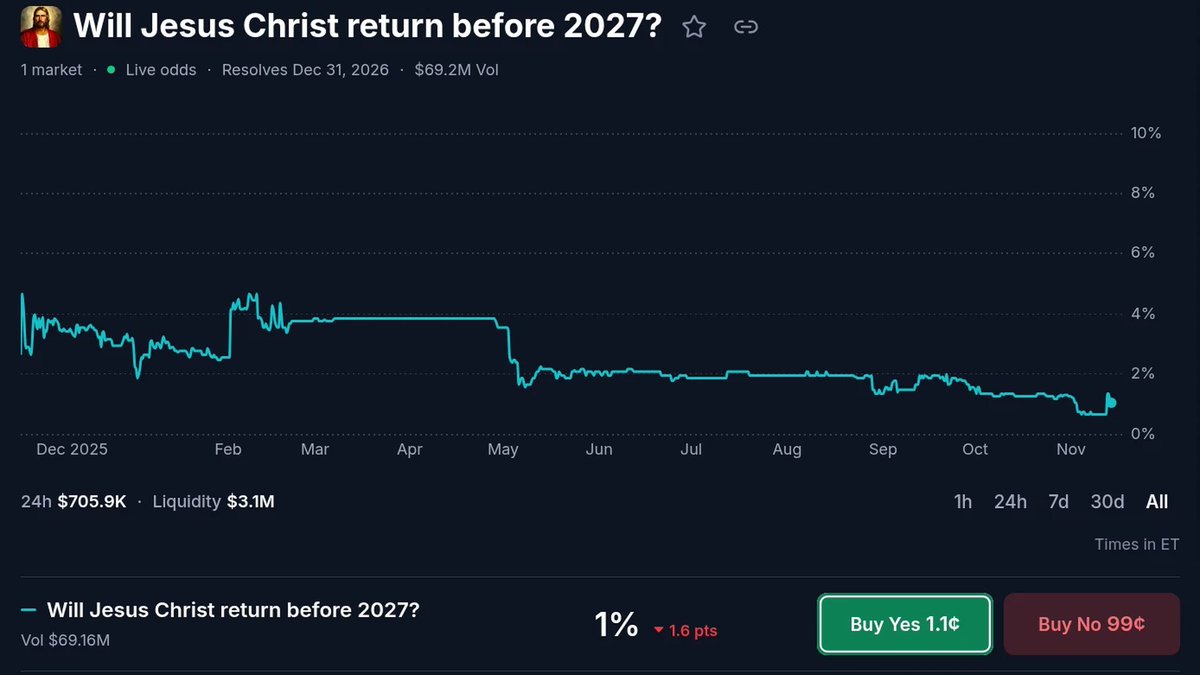
A $69.2 million market is open on whether Jesus Christ will return before 2027, and the odds have spent the whole year sliding.
Yes peaked near 4.7% in February, held around 4% until late April, dropped to about 2% in May, and is now down to 1%. About seven weeks remain until December 31. Some traders still hold Yes at 1.1 cents, a long shot that pays about 90 to 1. Big No buyers sit at 99 cents, locking in a small yield if the date passes.
The last 1% is the market's price for belief. The rest is the price of time.
https://t.co/aywQJ1T01U