For those interested, here are my slides from yesterday's Cowles Lecture at the Econometric Society Meetings @YaleCowles@econometricsoc
https://t.co/HilQnlxMEG
Thanks so much for listening and for the great discussion and comments!
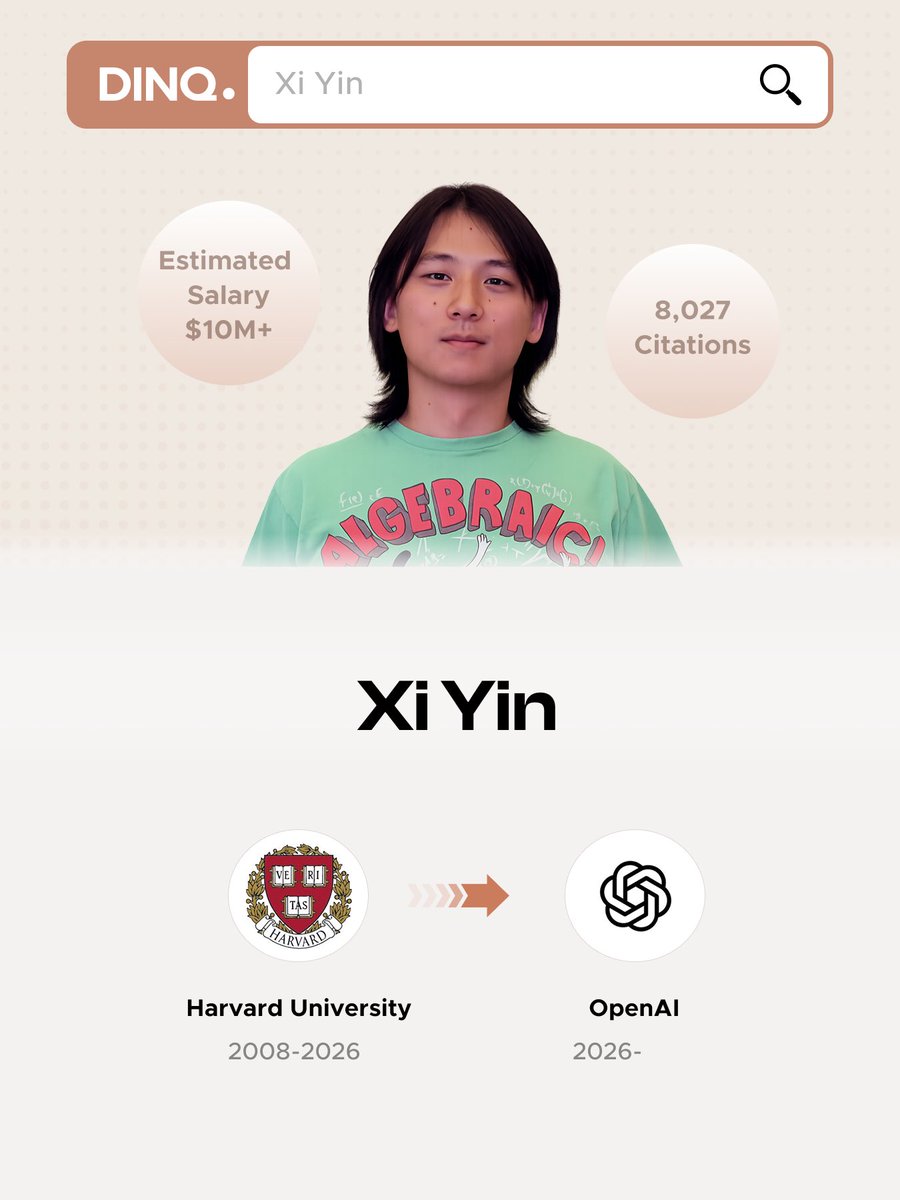
Xi Yin just left Harvard for OpenAI.
String theorist. Youngest full professor in Harvard history.
His words: "AI gives me 100x speedup. Weeks of output would take me 10 years."
Then: "I don't believe there's any human intellectual ability AI cannot replicate."
The man who said that is the one who would know.
#DINQ #AI #OpenAI
How much does a high markup tell you about market power?
When things besides price matter, like time, the markup tells you less than you'd think.
We show that across a range of imperfect competition models, with Tom Phelan and @nickpretnar
AI is greatly increasing "equality of opportunity" between econ faculty at top schools vs lower ranked schools.
There's a few reasons for this:
Reason 1: At top schools, faculty have funding for grad student RAs, and these grad student RAs are more likely to make substantive contributions to research. At lower ranked schools, both RA funding and RAs' abilities to make research contributions are less likely.
Now, everyone has the same agentic coding tools and is starting from similar blank slates in terms of knowing how to make best use of them. However - for many of the tasks that RAs used to do - agentic coding tools are far more effective, even with very little knowledge of the tools.
So, for many applied researchers, if you can afford $100/mo (more on that later) for a Codex or Claude Code subscription, with little agentic coding skill you will have a productivity advantage over the economist with many resources not making use of these tools.
Reason 2: You may argue that the economist at the top school can purchase more CC/Codex subscriptions, or get them for all their RAs, and this will nevertheless give them a big edge over economists with fewer resources.
However, this ignores a significant bottleneck in the use of AI for economics research: how to verify LLM output.
In many domains of software engineering, it's possible to functionally verify an LLMs output. This means you can parallelize software development with agents by having other agents themselves verify its output.
This type of verification is possible only for some economics research tasks, and developing verification mechanisms usually requires skill in agentic coding and software design.
So, we can assume economists - poorly skilled at agentic coding and software design - are doing all their verification themselves.
Then, if you have several RAs left to their own devices and producing copious LLM output, it's still incumbent on you as the high-resource economist to verify all their output.
Ostensibly this could still save you time relative to producing and verifying yourself, but in practice, for two reasons, there are often quickly *negative* returns to more RAs.
Reason 2A: Switching costs. It's a lot easier to verify when you are the prompter. This is both because you're mentally in flow in your particular research task and with the coding agent, and because you understand - through your own prompting - the process by which you arrived at some output.
Reason 2B: Wasted time verifying useless AI output. Last weekend, I spoke to one economist who described this failure pattern. He delegated a task to his RA, who then produced after some time output for him to review.
However, the standard errors felt very fishy, and it was difficult to sort through the output to a root cause. The economist, believing the RA had mindlessly use Claude Code, asked the RA to come back with a written explanation in his own words of what he did.
A few days later, he got the explanation, which itself seemed to clearly be written mindlessly with Claude. In the end, the economist gave up and did the task himself.
Of course, you could argue that this is the result of poor RA selection or training. But verification is even problematic with well-intentioned RAs' output, because in many situations, if a substantive mistake is made at one point in a chain of tasks, it can make the successive tasks' output not useful.
Reason 3. One dimension of inequality between top schools and lower ranked schools is access to the cutting edge of research, and access to resources helping you understand the cutting edge of research.
Pre-LLMs, as an economist or PhD student at a top school, you'd get more access to researchers at top schools, funding to attend educational workshops, etc.
Of course this remains an advantage of being at a top school, but LLMs make this much less of an advantage than in the past. The reason for this is that current-gen LLMs are 95th percentile quality teachers on any topic in their training sample.
For me, this has been extremely empowering. I was never was very good at micro theory, but recently I've become much more interested in learning select topics in micro theory.
Pre-AI, I would have probably never acted on this interest. It's hard to figure out what basics I don't understand when trying to work through some paper I'm interested in. I don't want to waste my friends' time who can answer my basic questions, and it's a bit embarrassing if there's something really fundamental which I've forgotten or never learned.
Now, for any given topic in its training data (i.e. basically everything), I can use AI to create a step by step curriculum, give me homework assignments, and evaluate my homework assignments (sign up to my newsletter to learn more about how I do this: https://t.co/2SBegUvyKo ).
Sure, there are nuances that AI sometimes gets wrong. But for a motivated student, especially when considering availability of the teacher, AI is a better teacher on almost every topic than almost every economist (see, for example "Law Professors Prefer AI Over Peer Answers": https://t.co/3uNzFnecPh)
The price of AI: One way in which you might argue these tools increase inequality is through cost. At a top school, researchers can afford $400+/month to have both Claude Code and Codex, whereas $100/mo might be all someone at lower ranked schools can afford.
A few points here:
- Very few economists are making full productive use of the $400/mo of subsidized compute from a Claude Code and Codex subscription. They'd see little to no fall off dropping one subscription.
- Almost everyone can afford $100/mo. If you think you can't pay $100/mo, this is actually a question of your willingness to humble yourself. You can tutor undergrads (maybe at a university across town), drive Uber, sign up to do part time data labelling at one of the firms looking for PhD economists, or just sell some shit you don't need.
Yeah it sucks, and if you were at a top school you wouldn't need to consider this, but your only option almost certainly isn't to pay $0-20/month for an AI subscription.
Addendum: I do trainings on agentic coding for economists and create software products/internal tools for policy organizations. If this interests you - check out this page - https://t.co/gG48Y9WQhy - or just DM me. I also have a lot of free educational materials here: https://t.co/Y89oQDgScg
Major international soccer tournaments like the World Cup have a significant negative effect on student exam performance.
The odds of reaching the achievement benchmark fall by 12% on average and considerably more for students likely to be interested in soccer.
I believe we now have evidence of FIFA's World Cup ticketing shell game: FIFA is colluding with third-party resale platforms for its own supply management.
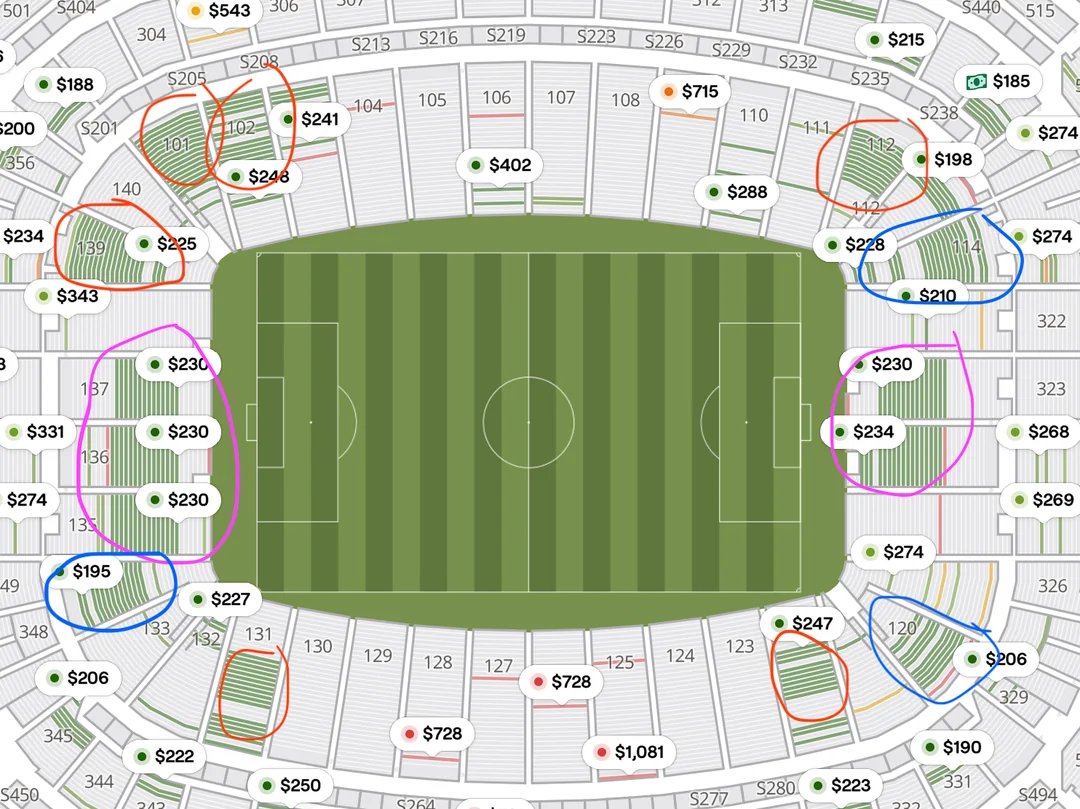
Look at this SeatGeek map (secondary market!) for Saudi Arabia vs Cape Verde. The circled areas are not random single resale tickets, but large, contiguous blocks of seats: entire rows and swaths in sections 101/102, 112/113, 119/120, 134–137, 139, ...
The blue circles appeared weeks ago, then the purple blocks suddenly showed up a day or two ago, and the red blocks seem to have appeared recently too.
That's not what ordinary fan or even commercial scalper resale looks like who resell pairs, fours, and scattered seats. Instead, this looks like inventory being dumped in bulk onto secondary markets, at prices below FIFA's official site.
Why doesn't FIFA just lower prices on its own site Probably because official price cuts could trigger refund demands, chargebacks, or consumer-protection headaches from fans who already bought at much higher prices.
Instead FIFA keeps official prices high, avoids openly admitting the market-clearing price is lower, and moves unsold inventory through third-party resale platforms instead.
Fun thread 😅 @a_auclert Matt Rodolfo and I disagree with some of the points made here. For more, tune in to what promises to be a great session at the @nberpubs Summer Institute! 👇
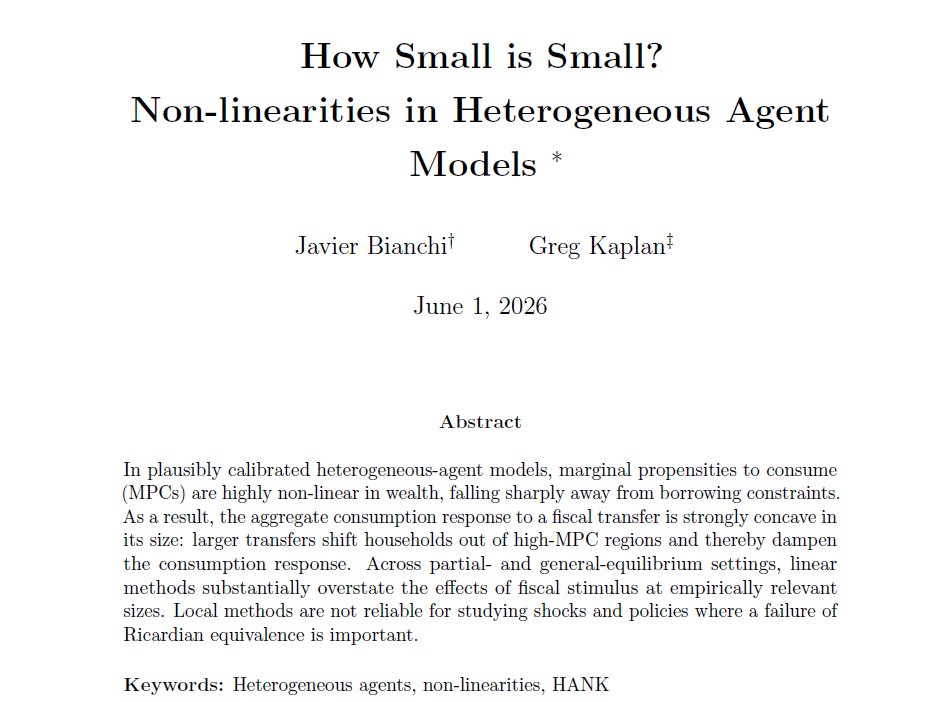
📢 New paper w/ @GregWKaplan 🧵1/10
How small is “small” for local-linear methods to deliver reliable answers in heterogeneous-agent models of fiscal stimulus?
Our answer: very small.
📢 Macro Theory with Measured Expectations (with Roth, Wiederholt, Wohlfahrt)📢
The Lucas critique says policy evaluations based on historical correlations can fail because policy changes alter expectation formation.
We propose a way to address this: measure expectations under alternative policy scenarios.
Below, I quickly describe 4 key results that emerge from this approach. Details in the paper👇
https://t.co/GpBpyKzTQH
If you're interested in adopting our PhD macro textbook https://t.co/OUdVXhDUZn for the coming school year, I just wanted to let you know that slides for all Part I and II chapters are here https://t.co/uRy52xPjs7. I plan to make progress on Part III chapters during the summer.
Excited to FINALLY release toughest+most rewarding paper I've worked on...
….we attack a 150 year old Walras question that's gone unanswered, not for lack of trying (Hicks, Samuelson, Arrow; our chances?😱)...
Q: Is the market equilibrium stable or unstable?¯\_(ツ)_/¯
🧵
I'm not going to be cool about this. This is a huge deal for me. I still can't believe it's real.
I've somehow rolled this Trojan horse of a paper past the gates of the Top 5.
Under its nerdy exterior hides answers to some of the most fundamental question of monetary econ. 1/
I just posted a new textbook chapter on Business Cycles. It covers preliminaries such as the definition of a business cycle, the output gap, the natural rate of unemployment, Okun's Law, and the plucking view:
https://t.co/UF7cccB4RI