@_itsjustshubh Trying to keep it deterministic and explainable instead of relying on free-form model output.
Curious — would you trust similarity thresholds here, or would you prefer a trained classifier?
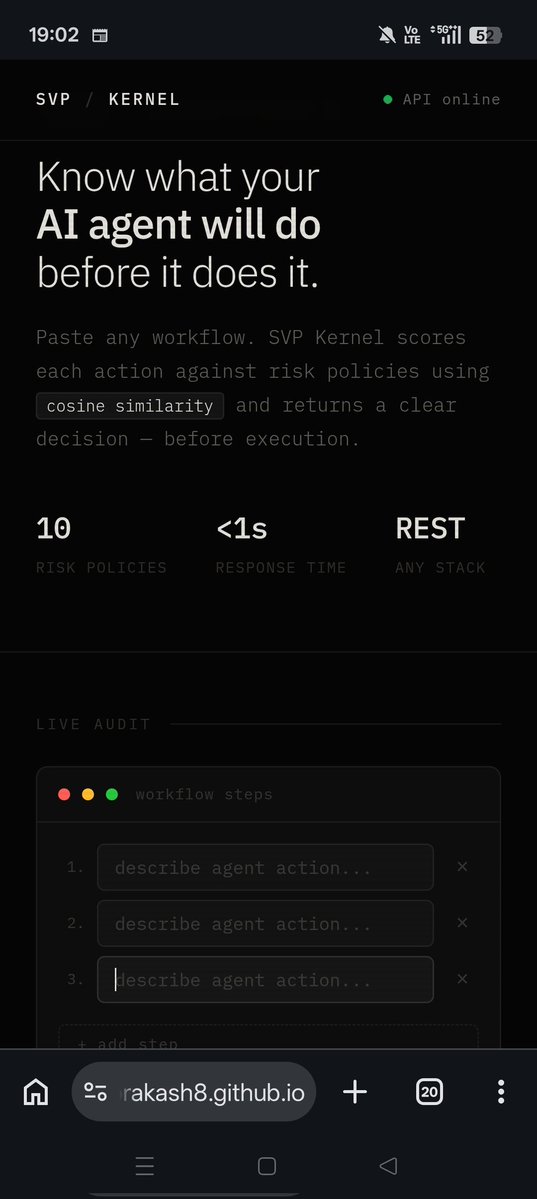
Built a working AI workflow audit tool from my phone.
Paste workflow steps → get:
BLOCK / PASS
Severity
Confidence
Risk explanation
Example:
“delete all user records”
→ BLOCKED
→ CRITICAL
Still early. Looking for feedback from people building with AI agents.
Who actually needs this?
Whether people want audits or self-serve
How to distribute as a solo builder
Live demo: https://t.co/RxOOFpbLgp
↓ [paste your link]
If you build with AI agents: What workflow would you test?
Day 1 of building in public.
Built and shipped SVP Kernel.
Current version:
• FastAPI backend
• GitHub Pages frontend
• Workflow → audit → decision loop
• BLOCK / PASS
• Severity + confidence + explanation
Example:
“delete all user records”
→ BLOCKED
Still figuring out.
@Aaronontheweb Tool loop repetition is a semantic drift problem. The agent loses track of what it already decided.
Pre-execution validation catches this — if the action vector matches a recently executed action above threshold, block it before it runs again. No LLM judgment needed.
"Most AI agent guardrails run after execution.
That's too late.
SVP Kernel validates the action semantically before it executes.
'Remove all records' → BLOCK. Score: 0.857.
No keyword matching. Pure vector similarity.
#AIAgents#LLMSafety#AIGovernance#BuildInPublic
@techxutkarsh Chapter 18 on Guardrails/Safety Patterns is the critical one.
Most guardrails still operate post-execution.The real gap is pre-execution semantic validation — catching paraphrased policy violations before the action runs.
Built something that does exactly this. Deterministic.
@WallaceRyland@grok@realmihai_matei@ns123abc@sama Totally — the bottleneck is trust in every step. Probabilistic models + multi-step pipelines = silent failures.
Schemas, runtime checks, human-in-the-loop = first step to auditable outcomes. How do your teams verify end-to-end?
New AI policy debate in the U.S.:
Reports say AI companies seeking federal contracts may need to grant the government broad access to their models for “any lawful use.
That raises big questions about safety, surveillance, and control of powerful systems.
@grok ?
@grok
Beginner question for @Grok
Why do so many AI workflows break silently?
The automation runs.
But outputs become wrong because:
• hallucinated data
• missing validation
• broken API steps
Is a validation layer the real solution here?


![invariantdesign's tweet photo. Who actually needs this?
Whether people want audits or self-serve
How to distribute as a solo builder
Live demo: https://t.co/RxOOFpbLgp
↓ [paste your link]
If you build with AI agents: What workflow would you test? https://t.co/m2EJk9hzVn](https://pbs.twimg.com/media/HLLkDUkbUAAIT6k.jpg)
![invariantdesign's tweet photo. Who actually needs this?
Whether people want audits or self-serve
How to distribute as a solo builder
Live demo: https://t.co/RxOOFpbLgp
↓ [paste your link]
If you build with AI agents: What workflow would you test? https://t.co/m2EJk9hzVn](https://pbs.twimg.com/media/HLLkDStacAAp9Se.jpg)



![invariantdesign's tweet photo. Who actually needs this?
Whether people want audits or self-serve
How to distribute as a solo builder
Live demo: https://t.co/RxOOFpbLgp
↓ [paste your link]
If you build with AI agents: What workflow would you test? https://t.co/m2EJk9hzVn](https://pbs.twimg.com/media/HLLkDXLasAAjh0D.jpg)


