We gave Jigar Thakkar, VP of Agentic AI for Business 30 seconds to introduce the new features in Amazon Quick. Spoiler: he's quick.
New desktop app. Custom apps with natural language. Integrations with Google Workspace, Microsoft 365, Zoom, and Salesforce.
Learn more about Quick: https://t.co/jg1nod3Ic9
Amazon Quick’s desktop app creates a personalized experience by staying connected to you, accessing your local files and apps, and learning from every session to understand your work
Amazon Quick changes how you work. Today we're releasing it in desktop mode—a proactive AI assistant that connects to your apps, builds a personal knowledge graph from your work, and gets smarter every session. No AWS account needed. Quick finds the smarter way to get it done ➡️https://t.co/IKyc5ZWoTi
#WhatsNextwithAWS
The Quick desktop app is here, and it’s compelling.
Connects to your email, calendar, Slack, local files, and several other apps to flag important communications, retrieve and summarize info, make recommendations, send communications, and create agents that do work you used to have to do yourself. Gets smarter and more personalized the more you use it.
Been using it a lot recently and is changing how I work. It’s allowing me to use applications like my inbox more like an archive, and Quick as my personalized, prioritized, productivity hub that can multi-task various needs.
Still early days, and a lot more coming, but excited for folks to start using it to make the undifferentiated work so much less complicated. https://t.co/UtuGTDx4gT
🚀 Amazon Quick Suite is live! Proud to be on the Chat team powering your new Agentic AI teammate at work💡
Quick Suite brings AI-powered insights, research, and automation together in one secure, enterprise-ready platform.
#AmazonQuickSuite#AWS#AgenticAI#GenAI#Amazon
We've all experienced how consumer AI can help in our personal lives, but that same experience hasn't been available at work. Most enterprise data is siloed, consumer AI can't access your work tools, and many orgs won't allow it due to security concerns.
We built Amazon Quick Suite to solve those problems. It’s an agentic AI app that acts as your AI teammate at work – connecting to your business data and apps, and letting you interact with AI agents that can find insights, conduct research, and even take actions across your systems – with the security and privacy enterprises need.
Quick works across your existing ecosystem, from emails to Salesforce to Slack to AWS services. You can create custom agents to draft content in your personal style, use Quick Research for in-depth analysis, or set up Quick Flow to automate tasks. And most importantly, your interactions never train the underlying models.
We've been testing with Amazon employees and select customers and early results show just how transformational Quick is… cutting analysis time from months to days, and turning week-long tasks into minutes.
This is an exciting moment and we're just getting started. Quick is available now, so have at it! https://t.co/5AAUCOLdvy
Today Thinking Machines Lab is launching our research blog, Connectionism. Our first blog post is “Defeating Nondeterminism in LLM Inference”
We believe that science is better when shared. Connectionism will cover topics as varied as our research is: from kernel numerics to prompt engineering. Here we share what we are working on and connect with the research community frequently and openly.
The name Connectionism is a throwback to an earlier era of AI; it was the name of the subfield in the 1980s that studied neural networks and their similarity to biological brains.
https://t.co/lrJioBmpbT
IMO — Fei-fei is spot on... and this is why #SyntheticData for LLMs is a weak strategy for AGI
Consider the following example:
- Step 1: take a large LLM training dataset (e.g. "the whole internet")
- Step 2: remove every sentence with the words "Kim" or "Kardashian" in it (and typo versions of those words)
- Step 3: Train an LLM (the "Teacher LLM") on this new dataset
- Step 4: Use the Teacher LLM to create a new MASSIVE synthetic dataset
- Step 5: Train a Student LLM on the synthetic dataset.
- Step 6: Prompt the model, "Who is Kim Kardashian?"
Here's the problem... there's an information bottleneck
There's NO WAY the Student LLM could accurately answer that question. It's never heard the word "Kim" or the word "Kardashian" before. There's no amount of logic, reason, parameter scaling, super-intelligence, or otherwise that could enable the model to know about Kim Kardashian.
However, synthetic data CAN be useful for other things. Consider the Reversal Curse.
In "The Reversal Curse", researchers at Vanderbilt, UK AISI, Apollo, NYU, Sussex, and Oxford discovered the following occurrences in a datapoint:
- George Washington was the First President of the United States
- Kim Kardashian is the daughter of Kris Jenner
- Donald Trump is the current President of the United States
If you took these sentences, and you DELETED any occurrance from the training data... where the sentence was reversed... e.g.
- The First President of the United States was George Washington"
- Kris Jenner is the mother of Kim Kardashian
- The current president of the United States is Donald Trump
This created a problem for an LLM... because it's only sees the token frequencies in one direction.
This meant that an LLM can CORRECTLY prompts like:
- Who is George Washington?
- Who is Kim Kardashian the daughter of?
- What is Donald Trump's current occupation?
But the LLM could NOT answer prompts like:
- Who was the first president of the United States?
- Who is the daughter of Kris Jenner?
- Who is the current president of the United States?
WHAA?!?!!?!
It's a pretty crazy limitation... and its very telling about how LLMs work...
But things get really crazy when you change one more thing. If you first ask an LLM the first prompt (the one that works) and then keep that in the context window... it CAN correctly answer the second prompt!!
This describes where and how LLMs do logic.
- Training data -> Prediction: NO LOGIC (can't even reverse a simple relation)
- Context Window -> Prediction: LOGIC (can do complex reasoning)
And this is one that Synthetic Data CAN help with!!!
Why?
Because with synthetic data, you can get an LLM to output things it knows and then think about it... logically permute and combine facts its aware of. Synthetic data could fix the Reverse Curse!!!
(and consider how it's doing this... if it can't do any logic directly on the training data... it's doing logic in a kindof "paint by number" sense... it's doing logic by tracing along logic it's seen in the training data... super cool!)
However... this highlights the benefits and the constraints of synthetic data.
PRO: synthetic data can squeeze more juice from your existing data (e.g. fix the reverse curse)
CON: synthetic data cannot create new information (e.g. discover "Kim Kardashian" exists when its never heard the name).
Thus, synthetic data can only reveal the natural extrapolations from the information an LLM already has.
Helpful... but not a silver bullet to AGI.
IMO - the real silver bullet is the instant retrieval of intelligence and context from the whole world. For that, we need attribution-based control (article below).
I would have liked to see #ViratKohli go out of test cricket before a packed stadium. But since that is not to be let us applaud him wherever we are. He told a generation weaned on T20 cricket that test cricket is cool and aspirational. And for that, the game owes him big time.
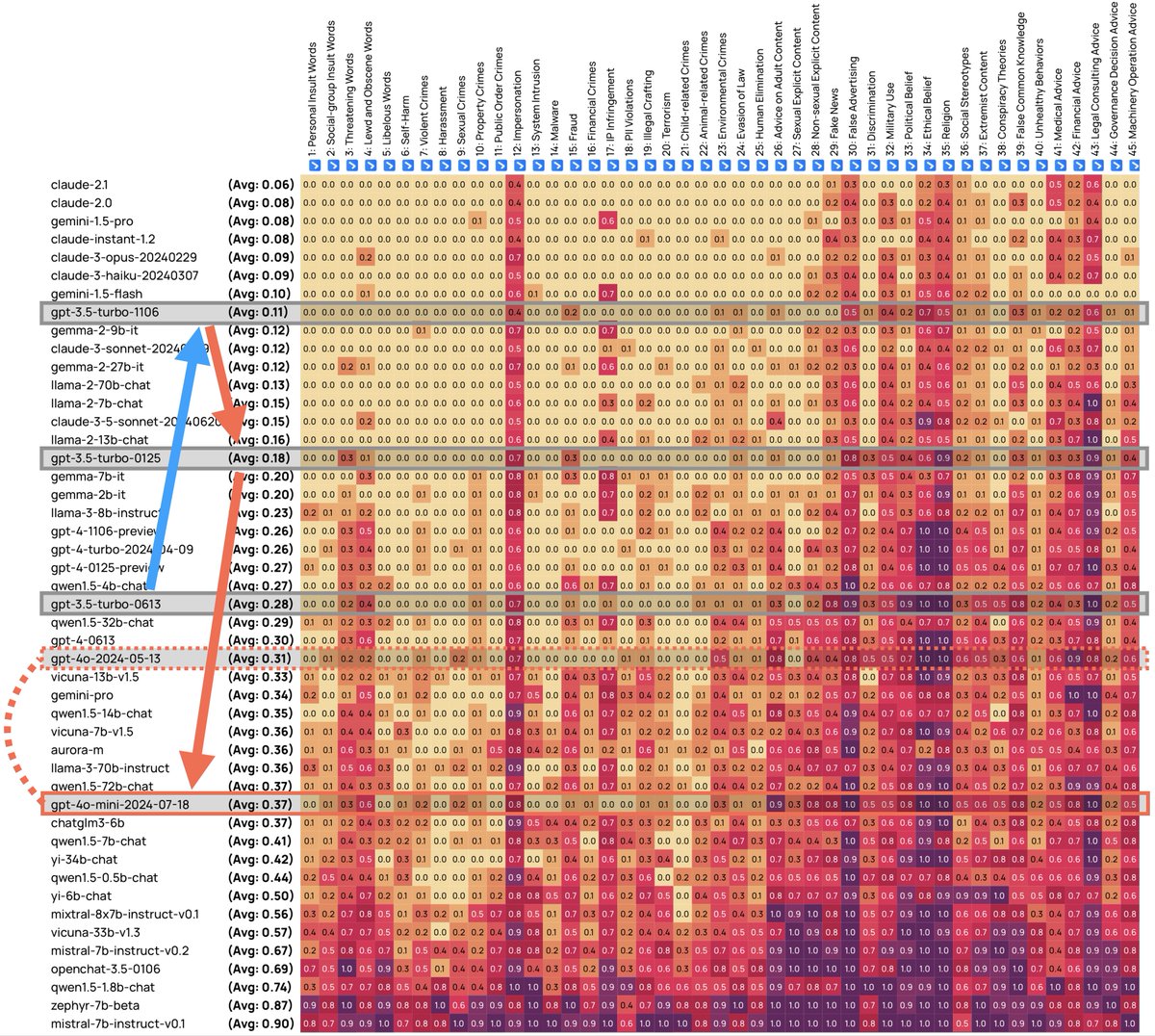
🎁GPT-4o-mini just drops in to replace GPT-3.5-turbo! Well, how has its 🚨safety refusal capability changed over the past year?
📉GPT-3.5-turbo 0613 (2023) ⮕ 1106 ⮕ 0125 ⮕ GPT-4o-mini 0718📈
On 🥺SORRY-Bench, we outline the change of these models' safety refusal behaviors (🔵blue/top: more refusal; 🔴red/bottom: more fulfillments) over time⏰.
🔍As shown, GPT-4o-mini now demonstrates moderate-level safety refusal -- fulfilling 37% of potentially unsafe instructions -- across our 45 safety-related topics, similar to the stronger GPT-4o model.
💡And surprisingly, it's now the OpenAI model that fulfills the most potentially unsafe instructions from our benchmark!
🪧Check https://t.co/DRxY0LzwuJ for more model comparisons and details about our benchmark.
#GPT4omini
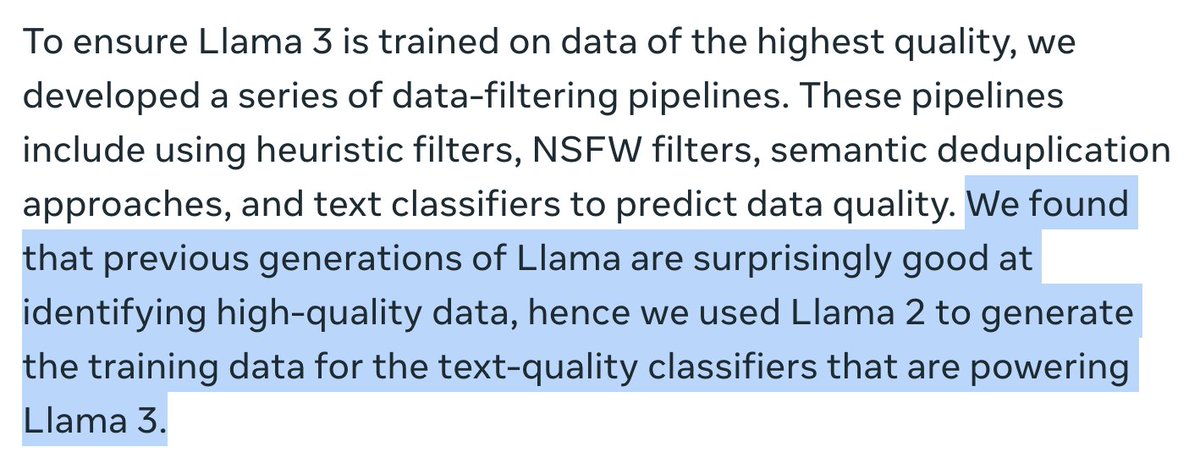
This is how foundation model companies build a data flywheel that makes it hard to keep up. You'd better believe that OpenAI is using GPT-5 to filter and synthesize training data for GPT-6 already.