NEW | Methane emissions from coal mines could be DOUBLE what governments report, according to new Ember analysis.
The lack of direct measurement leaves governments blind to the scale of their emissions and the opportunities to mitigate them.
🧵1/4
Regulating European imports of fossil fuels could impact the lives of millions around the world.
A CATF report finds that oil and gas imports to the EU expose nearly 10 million people to #methane flaring – which is known to release harmful chemicals. https://t.co/320mAPU9vf
Exciting news! The Transporter-7 mission successfully launched. GAPMAP is now in the space and and we've confirmed acquisition of signal! Stay tuned for more updates in the coming days as we prepare to share longer information about this groundbreaking achievement 🚀🛰️
"Where there's smoke there's fire", that is why our @Raymetrics Aerosol Profiler always monitors the sky in our urban #BAQUNIN site in @SapienzaRoma. Do you want more? Visit https://t.co/A2yLrIiiKJ
Learn more from CATF's @ioannis_bin, @jamesturitto, & Zitely Tzompa Sosa on the critical need to improve #methane emission estimates, and the importance of new approaches that quantify real-time emissions at local, regional, and global scales. #CutMethane
https://t.co/5PcaZtH6wz
Our latest article on what methane measurement technologies can currently achieve, what is still missing, and how they can be used to guide methane mitigation efforts around the world.
NEW: CATF’s guide to monitoring and quantifying methane emissions from the oil and gas sector.
Find out why this data is critical to advancing strong methane regulations around the world. #CutMethane
https://t.co/71ttVstxxp
@xavigorronyo Congratulations! But "in areas with large surface heterogeneity and temporal variations, the retrieval can only detect plumes in excess of **500 kg h−1**"? Typo in the abstract?
The @gmethanehub is proud to partner with @carbonmapper providing funding to @RockyMtnInst @cleanaircatf and @c40cities so this information on landfill methane emissions can be used to tackle super-emitting facilities. https://t.co/eZPlNsjmb8
In the lead up to #COP27, CATF experts joined a workshop in Accra, Ghana, with @EPA_Ghana, @IEA, @LimitsCarbon, and @MethaneData to share best practices to #CutMethane emissions from #Ghana's oil and gas industry.
Egypt is showing what it means to take the #GlobalMethanePledge from ambition to action ahead of #COP27, reducing flaring of #methane emissions from its oil and gas sector 26% since 2016. https://t.co/uz4mIynXzp
Very important initial measurement-based estimates of the magnitude of the #NordstreamLeaks. Much smaller than previous engineering estimates.
Now it's time to investigate why such a difference exists.
Reconciliation proves key for all methane mitigation efforts @CH4Observatory
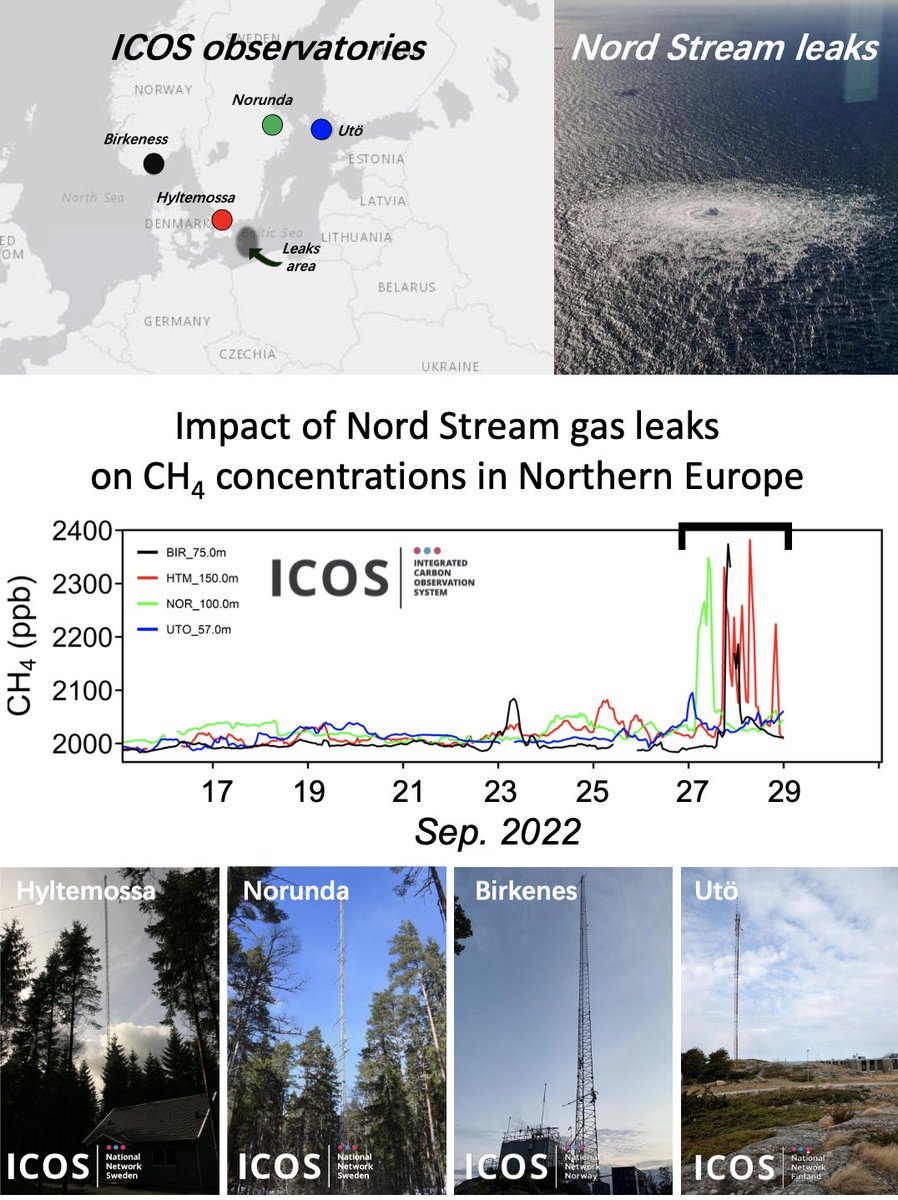
Delighted to share the FIRST ATMOSPHERIC INVERSION estimate of the #Nordstream CH4 emissions using @ICOS_RI stations
👉 70000 tCH4 👈
Three times less than based on the initial content of the three pipelines @mic_ramonet
Preliminary results. Hope more estimates come soon
@ciais_philippe@ICOS_RI@mic_ramonet Congratulations! Very important result!
Did you account for diminishing emission intensity? Is this maybe something that can be estimated through the inversion?
The #Nordstream pipeline continues to leak methane into the atmosphere!
Earlier today at 8:56 AM ET, GHGSat satellite measured a methane emission from the Nord Stream pipeline leak emitting at a rate of 22,920 kg/h 🛰️
👉Read more: https://t.co/tfk3pwqRrM
Aha - a little bonus as the plume is patly gearing eastwards ⤵️
The new CH4 data from Ro’ch Trebudon in Brittany, a new station from the French greenhouse gas monitoring net. It’s in Yellow at the bottom
🚨#BREAKING: An IMEO analysis of satellite images conducted in a partnership between @UNEP and scientists from Universitat Politècnica de València (@UPV) has detected and confirmed for the first time the large methane leak in the rupture of the Nord Stream natural gas pipeline.🧵
@ciais_philippe@icossweden It's just using GFS (0.5 x 0.5), which turned out to work well for qualitative analysis.
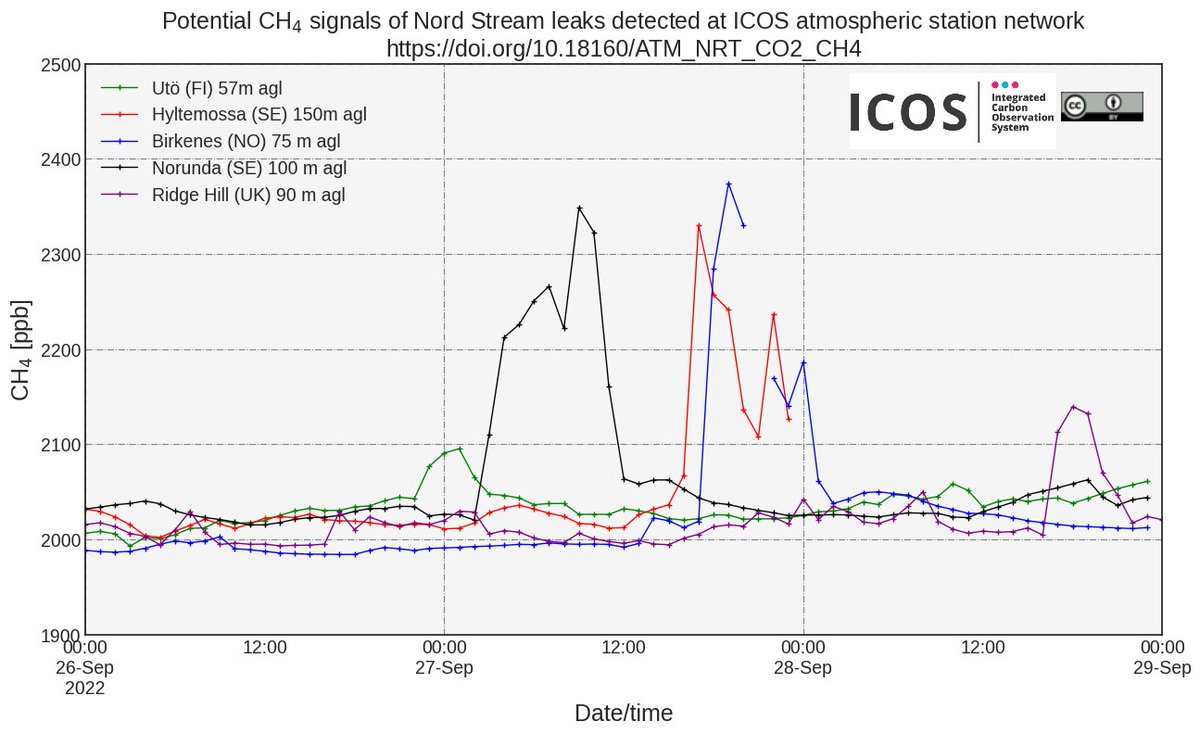
Indeed, the Norunda observed methane emitted around 10:00 UTC on the 26th, just 9 to 10 hours after the initial event.
@drdianafrancis As far as we know, still continuing but at a much lower rate. The simulation examined releases just in the first couple of days of the event, so it's not the full picture.
Simulations of the #NordStream2 methane plume as it travels over northern Europe.
It explains nicely the timing of observations at multiple @ICOS_RI stations, shared by @ciais_philippe
Part of ongoing work by Anna Kampouri / National Observatory of Athens.
🌀🌀 Four new @ICOS_RI atmospheric stations are hit today by the huge #Nordstream CH4 pea, in #Norway northern #Sweden and #Finland …
Stay tuned for emission estimates …
( plot - M. Ramonet LSCE )