A critique of the Oppy-style argument: "naturalism and theism explain the same data equally well, but naturalism has fewer commitments, hence naturalism is preferable." The key premise we target is explanatory parity 🧵
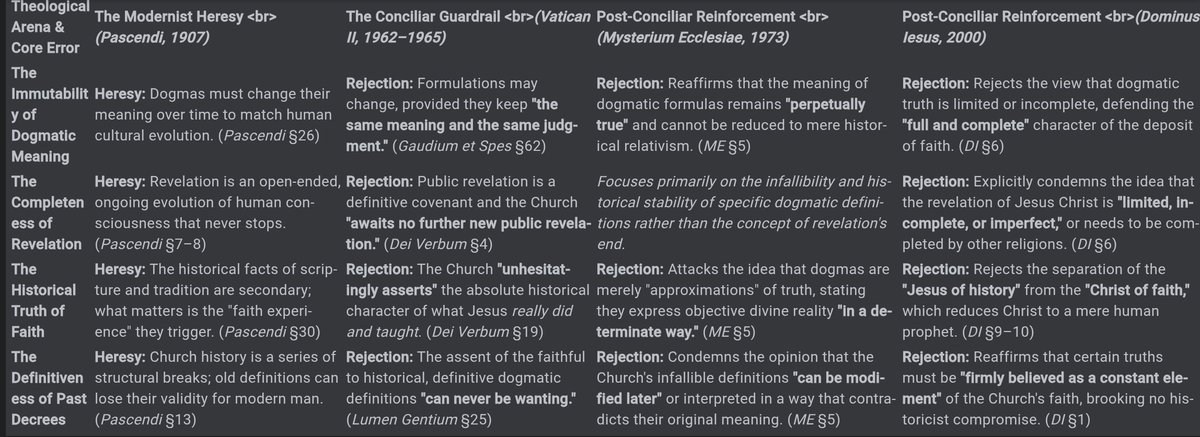
While it is typical of certain traditionalists to say that Vatican II affirmed the heresy of 'Modernism,' a heresy identified and condemned by papal magisterium under Pius X and others, Vatican II and post-conciliar magisterium quite explicitly reject it.
Here's a chart.
@TheLastKekker It's more that a given doctrine has witnesses throughout the history of the Church and, so, credibly enjoys the protection of the indefectability of the Church. This is one of the material signs of the work of the Holy Ghost.
@XboxLiveGOP The Canon protects the TLM and NO tbh. That is not good news for SSPX since they often recommend people to stay home rather than attend an NO (their advice though hinges on the condition of agreeing with their "state of emergency" which makes the recommendation more subtle)
@RomanoSace57080@TaylorRMarshall Deus caput Ecclesiae visibile posuit ut hebetudini nostrae mederetur. Ita, qui a visibili capite aberrat, aut fidei defectione agit, aut superbia.
Falsifiability has well-known problems and is not a solution to the demarcation problem. And astrology is the core case in the philosophy of science to which this problem is applied.
I don’t know why scientific minded people were convinced that Karl Popper was right when he gave falsifiability as the criterion for demarcating science, and then continued frequently to operate with non-falsifiable fundamental parts of their sciences, let alone failed to review the basic literature on falsificationism.
Don’t take my word for it. Pick up and read:
"The Demise of the Demarcation Problem" by Larry Laudan
"Philosophy of Pseudoscience: Reconsidering the Demarcation Problem" (2013), edited by Massimo Pigliucci and Maarten Boudry
"The Pseudoscience Wars" (2012) by Michael D. Gordin
"The Limits of Science: An Analysis from ‘Barriers’ to ‘Confines’" (2016), edited by Wenceslao J. Gonzalez
"Pseudoscience: A Very Short Introduction" (2021) by Michael D. Gordin
"The Modeling of Nature: Philosophy of Science and Philosophy of Nature in Synthesis." by William A. Wallace, O.P.
@Thomistotelian@ClassicalTheis@JudasMaccabeu10 Just the same, their behavior is not "obsequio". I do not think they'd accept from their own priests the same behavior they show to their spiritual father.
@tradcatboy Hermeneutic of continuity is the Catholic and catholic (small and big "c") way of thinking. But, discipline is manifestly lax now and that obscures the continuity (as has happened in previous times though usually to a lesser extent).
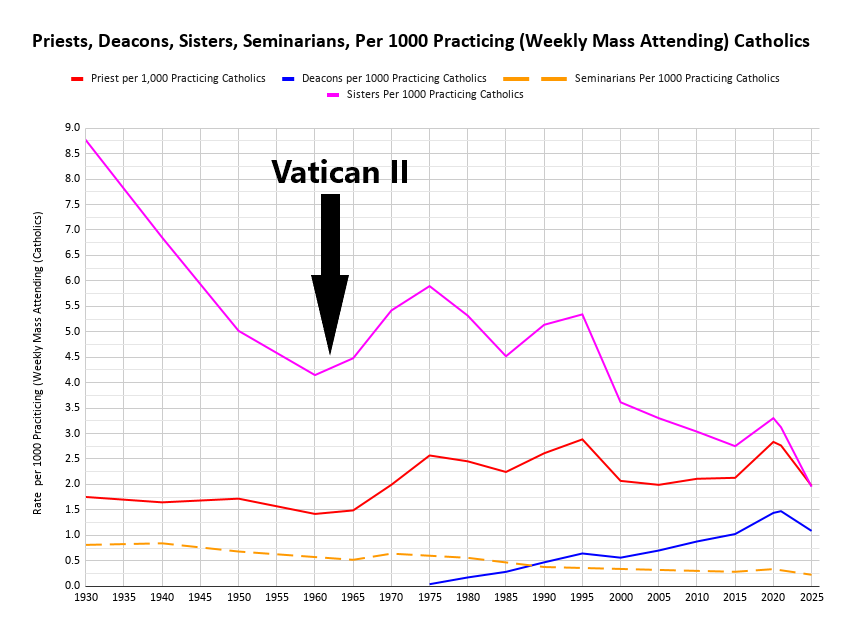
The Church is smaller in reality than it appears on paper, which actually makes the vocations rate, from a certain perspective, not *that* bad or at least not entirely a Vatican II-caused issue
Because so many don't attend Mass regularly, there are very few practicing Catholics left, but those who are left, are still practicing and producing vocations on a per capita basis.
@TLM_Ryan I'd be very curious to hear your thoughts on this.
"The created intellect cannot see the essence of God, unless God by His grace unites Himself to the created intellect, as an object made intelligible to it." - St. Thomas
"But when he speaks formally and authoritatively he speaks as our Lord would have him speak." Anyone rejecting this principle—even if they personally struggle to harmonize a specific magisterial statement with past teachings—thinks in a deeply un-Catholic way.
“Consequently it belongs to the sole authority of the Sovereign Pontiff to publish a new edition of the Symbol, as do all other matters which concern the whole Church, such as to convoke a general council and so forth.” - St. Thomas Aquinas
"You said it and wrote it. (That) I would be a modernist pope. By applying an ecumenical council, I would betray the church. Do you understand that if this were so, I would have to resign and invite you to take my place and lead the church?"
- Pope Saint Paul VI to Archbishop Lefebvre