At long last, here's a new paper on "Amazon's Quiet Overhaul of the Trademark System," forthcoming in @CalifLRev by @markpmckenna & me https://t.co/uaKJK7912K
Exciting news! We just revamped our #Copyright Facts by State webpages to bring you the freshest data! Dive in to discover the latest stats on copyright registrations, job growth, and state creative economies across the U.S. https://t.co/MS79EhjWOR
If you want an understandable explanation for how AI large language models like GPT-4 work, feel free to read my latest article
"ChatGPT, Artificial Intelligence (AI) Large Language Models, and Law"
just published in the Fordham Law Review.
https://t.co/rR15TfAuD4
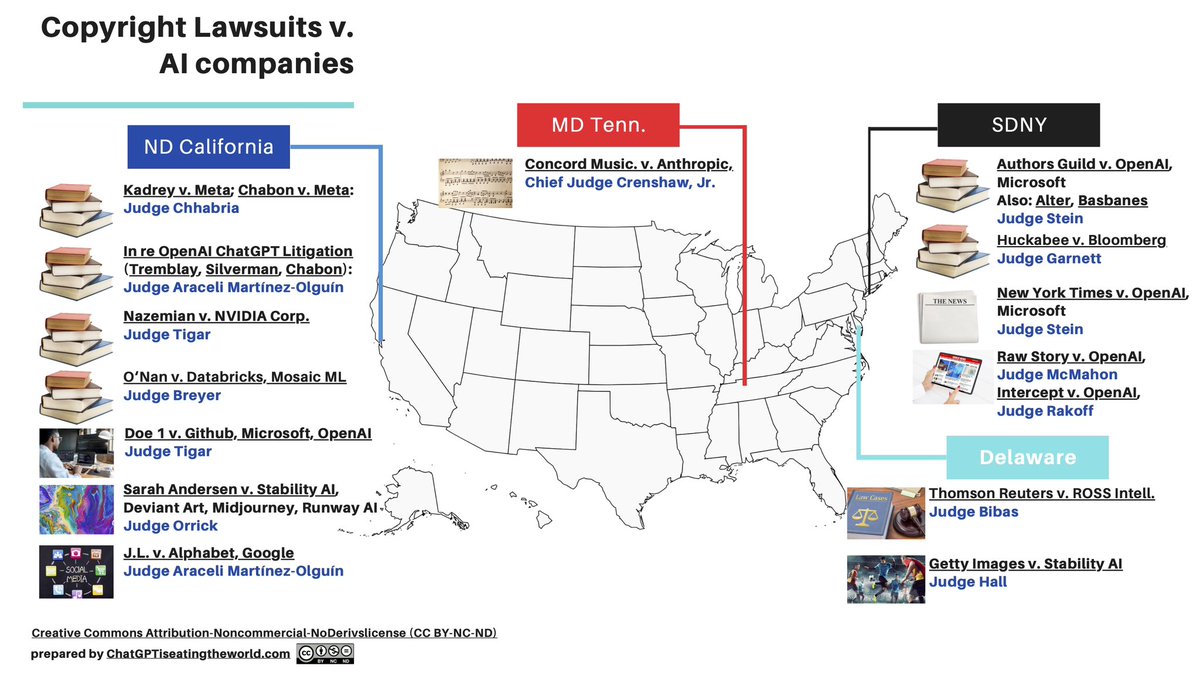
Download the Updated Map of copyright cases v. AI companies. Total count is 22 copyright lawsuits. Map has clickable links to the dockets. 🗺️ How high will the total get? https://t.co/kgZMKixYrT
My latest status report on all 20 AI copyright lawsuits. OpenAI just brought in 7 trial attorneys, all partners from Keker, Van Nest & Peters, who join the team of lawyers from MoFo and Latham & Watkins, in 6 of the lawsuits. 👇🏽
https://t.co/MFEygOTD3e
Given Epic's sizable Chinese ownership stake, could it be next after TikTok, without there even needing to be a change in the law? https://t.co/MTzoLvwxAc
IP as Labor Policy, now forthcoming @nyulawreview (https://t.co/O2ln0znshk): the past few weeks’ pop headlines, first of @taylorswift13 putting her music back up on tiktok before the release of tortured poets dept because she bargained for IP ownership of her music with universal, then of sky ferreira's heart-wrenching performance at coachella after years of (in her own words) "being held hostage by" her record label (to which she signed when she was just a teen), cements the fact that we need to be talking about IP beyond the user/owner, licensor/licensee, infringing/noninfringing, less/more dichotomy that has predominated theory and scholarship in the past few decades.
critics of IP call the system "rentseeking," which, again, focuses on the user/owner, licensor/licensee relationship. but if a real property analogy is apt at all, it is more appropriate to call IP a system of feudalism, in which large swaths of "creators," as the system has so euphemistically called them (and to which the dominant incentives theory assumes is the beneficiary of IP rights), are in fact serfs within the system, owing decades of their labor to vast content dynasties, who are euphemistically called "intermediaries" in IP parlance. (and sure, i'll accept that a few, like swift, are vassals.) and make no mistake--the arrival of AI (digital serfs!) will only deepen the inequalities within the IP system, rather than rid us of it all together. where many have long called for less IP, IP owners have, instead, only gotten more entrenched and larger through a series of M&A deals in the past decade, enabled by IP's rhetoric of bigger-is-better for content creation. my paper calls for more careful attention to how the balance of power is distributed WITHIN the system--and what we can do to ensure a more equitable distribution of IP's promised, but so often illusory, rewards to creators.
@xiyin_tang@nyulawreview@taylorswift13 Government control is a road to serfdom, said Hayek. if you argue private market is also a road to serfdom, where should we go then?
I just finished teaching a short course on copyright and disruptive technologies. I prepared reading materials on copyright and AI for it and thought they might be useful for those who want to learn about or teach the topic.
https://t.co/5zfkXMYkK4
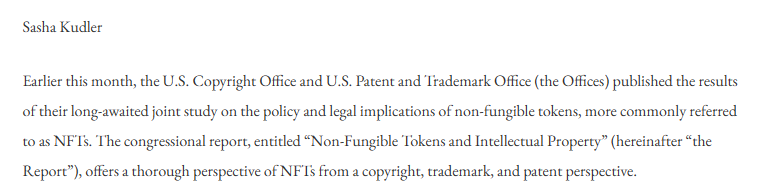
Check out a new JLA Beat post by staffer Sasha Kudler:
"NFTs Under the Legal Lens: Insights from the USCO’s & USPTO’s New Report"
https://t.co/eBLSneJbzE