@JackFarley96@TLandstreet Ignore this fucking loser. This is good marketing. What the hell else do you say? Man my LS port sucks? I didnt even know you had one.
people are not quite realizing yet but this is-by far-the biggest win the crypto industrys ideological believers has ever had i would argue since the birth of bitcoin. this is "Institutional adoption at the Infrastructure layer" that will drive crypto mainstream
watch this space
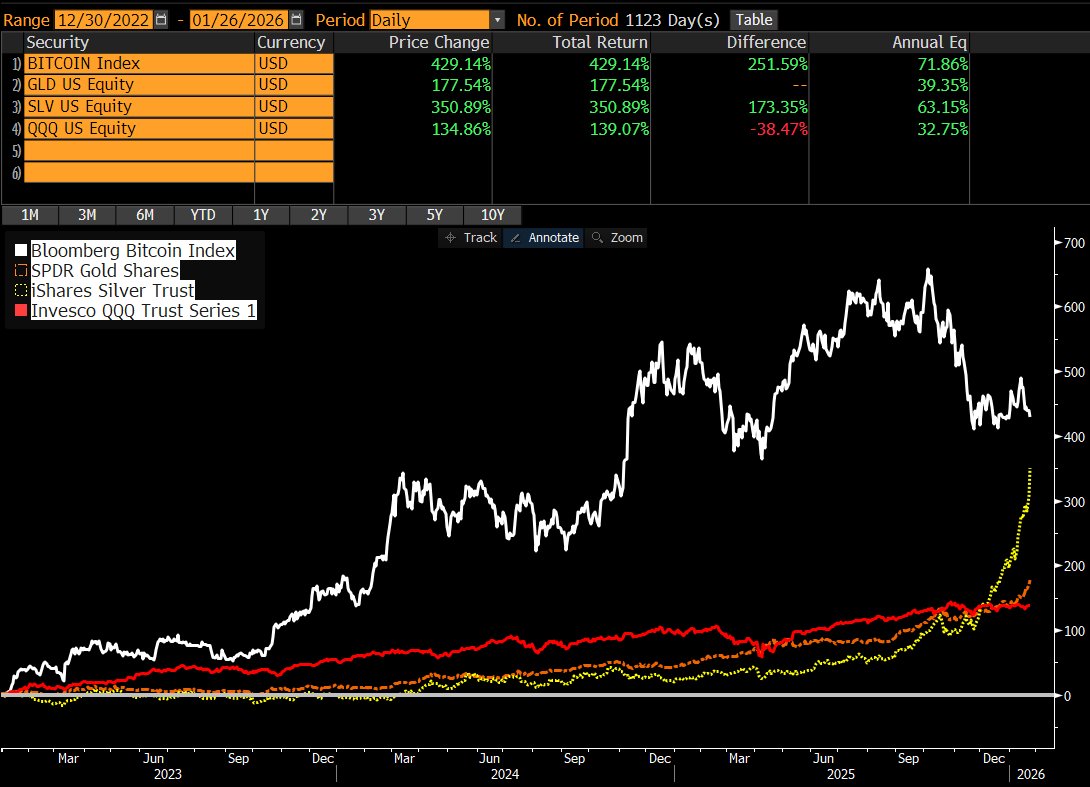
The dread I see from bitcoiners (and the football spiking from the haters) is very short-sighted to me given that since 2022 (right before the BlackRock ETF filing) Bitcoin is up 429%, gold 177%, Silver 350%, QQQ 140%. In other words bitcoin spanked everything so bad in '23 and '24 (which ppl seem to forget) that those other assets still haven't caught up even after having their greatest year ever and btc being in a coma. IMO what happened was the 'institutionalization' narrative got priced in very quickly and ahead of it all actually happening. So it had to take a breather so the actual narrative could catch up to the price. Feel better now? You're welcome.
THE TIMELINE OF THE $MSTR HIT JOB IS COMPLETE: It All Makes Sense Now
JP Morgan and Morgan Stanley are launching leveraged $IBIT products.
The Connection: Who is MSCI? Morgan Stanley Capital International.
The Play: The Index (MSCI) threatens to displace their competitors (MSTR/MTPLF, etc), and the banks (MS & JPM) file products to capture displaced capital into IBIT.
The UPDATED Timeline -
May 14: Jim Chanos announces his "Long $BTC, Short $MSTR" trade; a blatant attempt to sway market sentiment.
July 7: JP Morgan implements a firm-wide margin hike on trading $MSTR (50% to 95%).
Aug 29: JP Morgan releases a fact sheet and preliminary pricing supplement for leveraged products linked to $IBIT. (Image attached)
Sept 12: Metaplanet announces a capital raise. MSCI panics, realizing more companies are adopting the Saylor Playbook at scale.
Oct 10: MSCI announces “...an extension of its ongoing consultation with the investment community…” exactly 16 minutes before President Trump’s tariff announcement (4:50 PM EDT) that triggered the global flash crash.
Oct 14 (4 days later): Morgan Stanley (the creator and former parent company of MSCI) files with the SEC for a "Contingent Income Auto-Callable Security" linked to IBIT. (Links below)
Nov 14: JP Morgan files for its own IBIT structured note.
Nov 20 (THE KILL SHOT): On the exact same day -
JPMorgan releases the "Free Writing Prospectus" to sell its IBIT note.
JPMorgan dredges up the 42-day-old MSCI note to scream "Delisting Risk."
Present Day: We still see reports of frozen $MSTR share transfers out of JPM and failure-to-deliver (FTD) spikes in $MSTR.
They aren't protecting you from risk. They are trying to kill $MSTR to engineer a migration to their products for Bitcoin leverage exposure.
I Bought $250,000 Worth of Cocaine
No, that’s not a typo.
That’s roughly 5 kilograms of ultra-pure, Bolivian flake — the kind of white asset class that’s been outperforming fiat, faith, and fiscal restraint since the 1980s.
Most people would call it criminal.
But let me explain the thesis.
Each gram goes for about $50 today. But over the past 40 years, the street price of premium product has defied gravity, inflation, and international law — up nearly 900% since Reagan, and still climbing every time the Fed hikes rates.
Meanwhile, governments keep inflating currencies and deflating dopamine. The world runs on anxiety and Adderall, but the real energy trade has always been white, scarce, and globally liquid.
So what happens when the next crash hits, the markets freeze, and morale evaporates?
When optimism becomes contraband, those who held the original confidence powder — the “hard assets” of the happiness economy — will see their margins skyrocket. Supply will vanish overnight, replaced by fentanyl-laced impostors and corporate substitutes.
My $250,000 position, therefore, isn’t a “stash.”
It’s an asymmetrical hedge against stagnation, prohibition, and despair.
Worst case? I sit on $250,000 of historically inelastic demand — a tangible, portable reserve currency that never decays and always clears.
Best case? Prices triple, cartels consolidate, or governments legalize and institutionalize the product, turning legacy purity into a collectible, tradable relic of the analog high.
It’s not Bitcoin. It’s not bullion.
It’s not even biotech.
It’s five kilos of compressed confidence —
a hedge against inflation, legislation, and motivation itself.
That’s deep value.
That’s the Cocaine Standard.