Excited to share a stealth CX company @businessbarista and I started last year. We hit $1M ARR in the first 6 months.
Here's what we built and the CX playbook you can steal.
Alex and I met after our startups were acquired in 2023 and wanted to work on something together. We shared the same model: build 0>1, prove PMF, and then install a CEO to scale to $10M+
I spent a decade building offshore teams, and offshore and AI were becoming mainstream. Yet, founders were getting burned by outsourcing and support still ran like a cost center vs a revenue center.
That was the opening.
Founders didn't just want people. They said "Own our CX OS: people + process + technology."
The OS included:
- Onboarding/training for complex, judgement heavy issues
- Support that doubles as activation
- Docs as product (internal KB + help center that stay fresh)
- Daily QA on agents, journeys, workflows
- One owner across QA, L&D, support ops
- Internal/External AI tool maintenance
Combining world class offshore talent plus the OS became our wedge.
@FlowHQ_CX focused on PLG SaaS, AI, and complex workflow companies, where Tier 2 and 3 judgement decided revenue.
And the reality that AI won't build relationships with customers or drive actions (ie setting up a messy account). And it won’t build your CX OS.
We pre-sold the thesis at founder dinners, launched Flow, and started manual (Docs and Sheets).
Customers expanded. We productized the OS. Cleared enterprise security reviews. And began serving regulated companies and the Fortune 500.
They key lesson... Your CX (and every customer facing team) is only as strong as your ops.
Here are 8 learnings to 10x your CX
1. Treat CX like a product: CX in every PRD/roadmap/OKR. Architect the journey pre-sale (SLA, onboarding, handoffs) so nothing breaks post-close.
2. Cadence > intensity: Schedule daily QA (30–45m), weekly AI chat tuning (60m), weekly KB refreshes (90m). If it’s not on a calendar, it won’t happen.
3. Docs are the backbone: A single source of truth that trains agents, powers the AI chat bots, and feeds the help center.
4. Operators > agents: Hire/train for Tier 2/3 judgment and systems thinking. Routing Tier 1 to automation. Humans do judgment and AI does repetition.
5. Optimize what predicts LTV (not vanity): prioritize TTV, first-week activation, and % resolved w/o reopen. Most churn happens early, so fix onboarding and Week 1 first.
6. Tickets become processes: Every recurring ticket becomes a process change. Macros treat symptoms, processes remove causes.
7. Maintenance > model: Train on updated docs, enforce guardrails and version and rollback weekly. Measure success by accuracy and % without reopen, not raw containment.
8. Pipe feedback fast: Tag product, workflow, and issue types and deliver the top insights to the teams best positioned to act.
What's next for Flow?
Keep investing in internal tools that supercharge frontline agents and scale ops. Build the GTM engine (content, partnerships, events, outbound).
And our highest priority is hiring a CEO who loves selling and systems to scale Flow to $10M+. If this is you, apply here: https://t.co/4rond0oqMH
To me, the most fascinating aspect of Deepseek is the fact it stemmed from a hedge fund, a mere few months after China "cracked down" on the levels of compensation in the finance industry.
It's also incidentally an important reason why the U.S. will struggle to compete with China.
Let me explain.
First of all, worth mentioning that this was predictably, as for most Chinese initiatives, presented by Western media as a terrible move (2 examples screenshoted below 👇) - "why would China do this to the poor innocent bankers" 😏. As usual they didn't even try to reflect on why China would do this: as we all know, all Chinese initiatives are always completely mindless and "crackdowns" are just what the Communist party does for fun...
The actual reason this was done, I believe, is that China looked at the West - the U.S. in particular - and saw the overbearing importance of the finance industry at the expense of the real economy. And in particular they saw that the country's most brilliant graduates from the very best Ivy League schools went to work for the increasingly parasitic finance industry instead of working on stuff that actually made society move forward.
Bloomberg lamented below that the "crackdown" would "fuel an industry brain drain" and yes, that was precisely the point: China doesn't want those who can most contribute to society to spend their careers building ever more senseless financial derivative products or new ways to trade crypto. It doesn't mean they don't want a finance industry, it does serve a purpose, just not one that becomes such a drain on society, in particular in terms of capturing the country's best talents. China would rather have them working on stuff like... artificial intelligence.
And lo and behold, fast forward a few months, and you suddenly have hedge fund geniuses who found a new calling in AI. Too good a coincidence not to see a correlation there.
This is something that would arguably be very hard for the U.S. to do, where capital is very much in control: an industry that becomes extremely wealthy, even if largely detrimental to broader societal goals, becomes difficult to reform. We're seeing this with finance, defense, big pharma, etc.
It also illustrates that the U.S. and China are at different stages of their development: excessive financialization is a common pattern among late-stage great powers - from the Dutch Republic to the British Empire (but also Venice or Spain) - and a vicious-circle type factor of their decline. Emerging great powers are often more thoughtful and nimble about managing talent flows to achieve technological and industrial primacy.
Looking at this question is also very interesting in the context of the H-1B visa debate in the U.S. It feels like the debate doesn't address the elephant in the room: why claim a shortage of top talent when the country's best minds are funneled to the finance industry? Much more coherent to first thoughtfully allocate talent at home before seeking to brain drain the rest of the world...
Anyhow, yet another example of a Chinese policy that seems bizarre and incomprehensible to the West at first glance but which over the long run (and even short-run as illustrated by Deepseek) helps China develop another strategic advantage in the tech competition. Simply put: you want your best minds building real value, not extracting it from society.
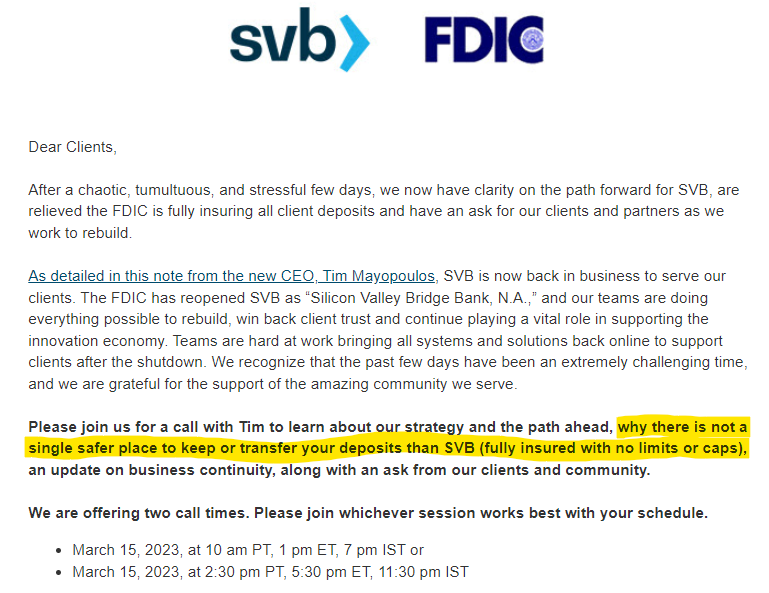
So while Mercury, Brex and others heavily emphasize their raised $2.25M FDIC insurance limits, the newly reopened SVB entity beats them all since it now has an FDIC unlimited backstop...
... So it might actually be the safest bank in the world right now. Move money back? #SVB