iptf [dot] ethereum [dot] org is live with a major update!
A comprehensive, navigable guide to privacy on Ethereum: for institutions deploying private infrastructure, and for the end users protected by it.
Every approach is evaluated under CROPS: Censorship Resistance, Openness, Privacy, and Security.
Institution-to-institution and institution-to-user power dynamics are each modeled, with per-persona summaries for business, technical, and legal functions.
A two-week dispute window lets anyone challenge invalid records via KZG openings.
What lands on-chain: petition outcome and vote tally per eligibility group. No signer identity. No queryable roster. Eligibility uses anonymous group membership proofs, matching the same interface of our resilient identity proof of concept.
Writeup: https://t.co/0HxVCRPIHI
Public petition signer lists expose signers to retaliation. In high-stakes contexts, knowing who signed can be dangerous.
New IPTF writeup: Resilient Civic Participation. Prove a petition reached quorum without ever publishing who signed.
Third and final post in our resilience series.
Two mechanisms carry the design.
Forward-secure ratchet: each signer advances a local key state that cannot regress. Seed material is overwritten after each slot. A compromised device cannot produce prior signatures.
Proofs are batched and published as EIP-4844 blobs.
New writeup: Resilient Disbursement Rails.
Aid organizations' beneficiary databases are an operational security risk. IPTF's PoC shows how to run a disbursement program where no participant, at any step, holds a complete list of recipients.
Each recipient's smartcard holds a private key that never leaves the device. To claim, the card signs a one-time voucher offline. A relay takes the signed voucher, generates a ZK proof, and submits it through a mesh network. The contract pays to a new address per claim.
Result: enrollment, claim, and cash-out are unlinkable by design.
This kind of thing helps a lot with legibility of privacy on chain for enterprises
Kudos to @EntEthAlliance for making it happen!
Happy for IPTF to have played a small part in making this happen
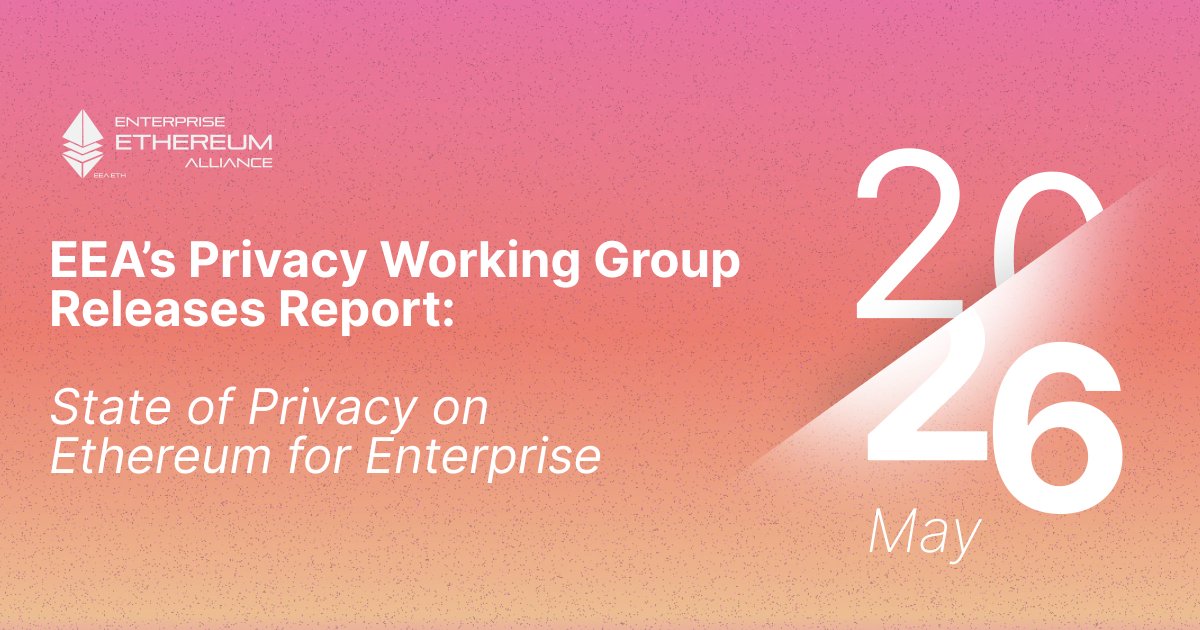
📣 The EEA Privacy Working Group is releasing its first report: "State of Privacy on Ethereum for Enterprise".
7 EEA member organizations and 1 comprehensive map of enterprise privacy on Ethereum.
More on what this means 🧵⬇️
Circuits in Noir/UltraHonk, contracts in Solidity, client in Rust. Selective disclosure supports GDPR data minimization. Onchain events satisfy audit requirements without revealing holder identity.
Full writeup: https://t.co/SwkHOClt2s
Current on-chain identity breaks when the issuer does. Sanctioned, shut down, or turned adversarial; already-verified users lose the ability to prove their credentials.
This is the first post in our three-part resilience series on identity, payments, and coordination. We published a PoC that removes the issuer from the verification path entirely.
Enrollment is one-time.
A threshold MPC network issues a vOPRF tag; an on-chain Merkle root is the trust anchor. The issuer then exits the path entirely.
Three sybil resistance layers:
- vOPRF: one leaf per credential
- 0.1 ETH refundable stake
- Web-of-trust vouching
Also in v0.3.0: 15 new use cases across supply chain, bonds, FX, stocks, and payment corridors. Every pattern carries a CROPS evaluation (Censorship Resistance, Open source, Privacy and Security).
Full release: https://t.co/t7eev92PRn
Browse all patterns: https://t.co/UAdAZep2UJ
IPTF map v0.3.0 shipped.
71 commits. 162 files changed.
New PSI patterns, composable spend and delegation primitives from EIP-8182, a post-quantum threat domain, 15 new institutional use cases, and the CROPS framework across all patterns.
Here's what landed.
IPTF is at ETHCC in Cannes:
@oskarth at main event (Kelly stage) 1315 Wed 1st
@yanis_mezn at main event (Taylor Stage) 1515 Wed 1st and Secret Agents (Bermuda) Wed 1st
@motypes will be presenting at Blockspace Forum Cannes tomorrow Tue 31th
...and a few more event :)





![iptf_updates's tweet photo. iptf [dot] ethereum [dot] org is live with a major update!
A comprehensive, navigable guide to privacy on Ethereum: for institutions deploying private infrastructure, and for the end users protected by it. https://t.co/g2asuyR94d](https://pbs.twimg.com/media/HJ-TNCwXkAAqr6d.png)