Yesterday was my final day at the Ethereum Foundation.
Today, we’re launching @eth_systems .
I started my career at @GoldmanSachs , working inside the financial system. Years later, I found myself at the @ethereumfndn , working with institutions exploring how that system could evolve onchain.
I’ve had hundreds of conversations with banks, asset managers, central banks and regulators around the world about what it would take to build real financial infrastructure on Ethereum.
The ambition is there. But nearly every serious conversation eventually reaches the same question: how can institutions use a public network without exposing their positions, counterparties and sensitive client information?
EthSystems exists to answer that question.
We’re continuing the work we began through the Ethereum Foundation’s Institutional Privacy Task Force as an independent company building confidential systems for institutional Ethereum.
Today we're launching EthSystems.
We build confidential systems for institutional Ethereum.
Institutions want to use Ethereum, but one of the biggest problems is the lack of built-in, modular privacy tools.
We were the Ethereum Foundation's Institutional Privacy Task Force (IPTF) for the past year. We had hundreds of conversations with central banks, regulators, tier-one banks, and asset managers, shipping open source work the whole time.
Wall Street has found crypto as an asset class, but not yet as commercial infrastructure. Institutions want to run real flows on Ethereum: stablecoins, tokenized assets, settlement. These are businesses with billions of dollars on the line, and no bank will operate in full public view. On a public ledger, confidentiality is the hard part: each party to a transaction should see what it has a right to see, and nothing more.
We have a year of proof of work: private bonds, confidential stablecoin transfers, private settlement across chains, the Ethereum Privacy Map, and more. All with protocol specs and security properties, at our website.
We've spent a decade working on privacy in crypto. We know there's no silver bullet. Different use cases need different systems, each designed, specified, and hardened properly, and someone has to do that work. That's why EthSystems exists.
We're an independent, for-profit company, backed by long-term Ethereum-aligned investors. This is a decade-long transition, and we aren't going anywhere.
If you're an institution that wants to build on Ethereum, talk to us. We're hiring: BD in New York, protocol engineers, ops: [email protected]
Fantastic piece by @eth_systems depicting the future of institutional cash.
For context, US money market funds hold nearly $8 trillion, yet they still run on silos: private registers, banking-hour settlement, and constant reconciliation between fund, agent, custodian and bank.
On Ethereum, the ledger becomes the register. Shares settle around the clock, move directly between holders, and work as collateral. Compliance runs inside every transfer. Zero-knowledge proofs keep positions hidden from the public, while the transfer agent sees every share.
No more silos. Instead, continuous visibility is provided, while privacy is preserved.
Fund and asset managers, we hear you.
You want the liquidity and distribution that Ethereum brings, but your institutional clients wont engage at scale unless you bring confidential tokenised funds that can be used confidentially as collateral too!
We constantly strive to showcase how today's privacy tech practically solves these challenges.
Here is a reference implementation by @david__nunez to show what's possible today.
Beyond this, we also have good news if you want to know more about the economics of confidentiality on chain, reach out!
Tokenized money market funds on Ethereum publish their shareholder books: every balance, every subscription and redemption.
Our proof of concept hides positions from the public, while the fund's transfer agent still sees all of them.
How it works, and the links, below 👇🏻
Privacy is a serious design requirement for institutional Ethereum.
On Oct 22-23, @RedoudouM joins:
> Kaushal Vyas (@eth_systems),
> Rob Dawson (@Consensys),
> John Church (@Nethermind)
> Vivek Raman (@Etherealize_io)
..for the Building Ethereum panel at @lfdecentralized's NYC workshop, moderated by Johnna Powell (@DTCC).
We published a writeup on Ethereum's upgrades, past and coming, read through what banks, custodians and other institutions need.
Apart from the move to proof of stake, most institutions we talk to haven't followed the forks closely. Since 2021 the gas limit has doubled, and accounts and rollups can now do things they couldn't before.
The next two forks have different focuses. Glamsterdam, due in December, is mostly about capacity: it prepares clients for a 200M gas limit and makes writing new storage more expensive. Hegotá, planned for 2027, is about control. Frame transactions give accounts more say over how they sign and pay fees, and FOCIL makes it harder for block producers to leave valid transactions out.
We looked at each change through five needs: key control, capacity at a cost firms can plan for, speed to finality, neutral inclusion and confidentiality. Each section opens with a summary for six kinds of firms, from bank treasuries to staking providers, and a replay of mainnet transactions under the new gas rules shows where costs move.
One of those needs the forks leave open. More below.
Stablecoins just crossed 300M holder addresses globally for the first time.
The Ethereum ecosystem is now 37% of all stablecoin holders, up from 29% two years ago, and L2s account for ~3 of every 4 of them. The strategy of scaling adoption through L2s is working. I expect tokenized stocks to follow the same path.
If there is one chart to show EVM dominance, it’s this one: EVM-compatible chains hold ~94% of all stablecoin addresses.
It took 8 years to get to 300M. I think we reach 1B wallets within 18 months, well ahead of trend.
The challenge isn’t just scaling the technology. It’s making it work with the confidentiality, compliance and controls they require.
Great discussion with fellow builders pushing this forward.
Thanks to @ethereumhkhub for having us!
How Institutions Are Unlocking the Full Potential of Ethereum Infrastructure
In this panel moderated by @mcamarda0, leaders across Ethereum infrastructure—including @KimonSh (@LidoFinance), @vnovakovski (@Lighter_xyz), @motypes (@eth_systems), @_julianma (@ethlabs_org ), and @mpfzajac (@Nethermind)—explored how institutional adoption is accelerating performance, privacy, and security upgrades across L1 and L2 layers.
Panelists highlighted advancements such as faster slot times, synchronous L1/L2 composability, node-level compliance frameworks (e.g., Nethermind’s PoC with UBS), and bespoke ZK-privacy primitives for global regulators, positioning Ethereum as the unified, post-quantum settlement layer for global finance.
10/ In Tokyo, @motypes joined the Institutional Privacy session at the Ethereum Institutional Summit (@eis_eth ) during ETHTokyo Week. @wecandaoit framed it around stablecoins, which lines up with this month's map work: private stablecoins is the use case we audited in full. Thanks to Fracton Ventures for the invitation.
https://t.co/Mz8gzBcTVB
Incredible to see how much the team has shipped in September. we’re building the foundations for institutions to use Ethereum without compromising on confidentiality, compliance or interoperability.
Open standards, real implementations, and infrastructure anyone can build on.
Still early. Lots more to come.
Our September community update starts with the specs behind our shielded pools, and it’s now public. How our pools work was defined by the code until now. The specs write it down as a standard anyone can implement or audit against, released under CC0, and our own proof of concept now conforms to them.
Also this month: two new building blocks, two people joining the team, four talks, and more collaborations with @lfdecentralized and @0xMiden.
Kaushal Vyas (@liftlines ), Managing Director at EthSystems, speaks at @Sibos in Miami on Tuesday 29 September, 12:00 ET, at the @lfdecentralized booth.
The session is on the patterns that let institutions build on Ethereum without giving up confidentiality or the controls they run today.
Meeting details below.
From private to public is the journey and the institutions that are the most ahead are deploying on Ethereum.
You can have the affordances, security and control needed to be compliant on public blockchains.
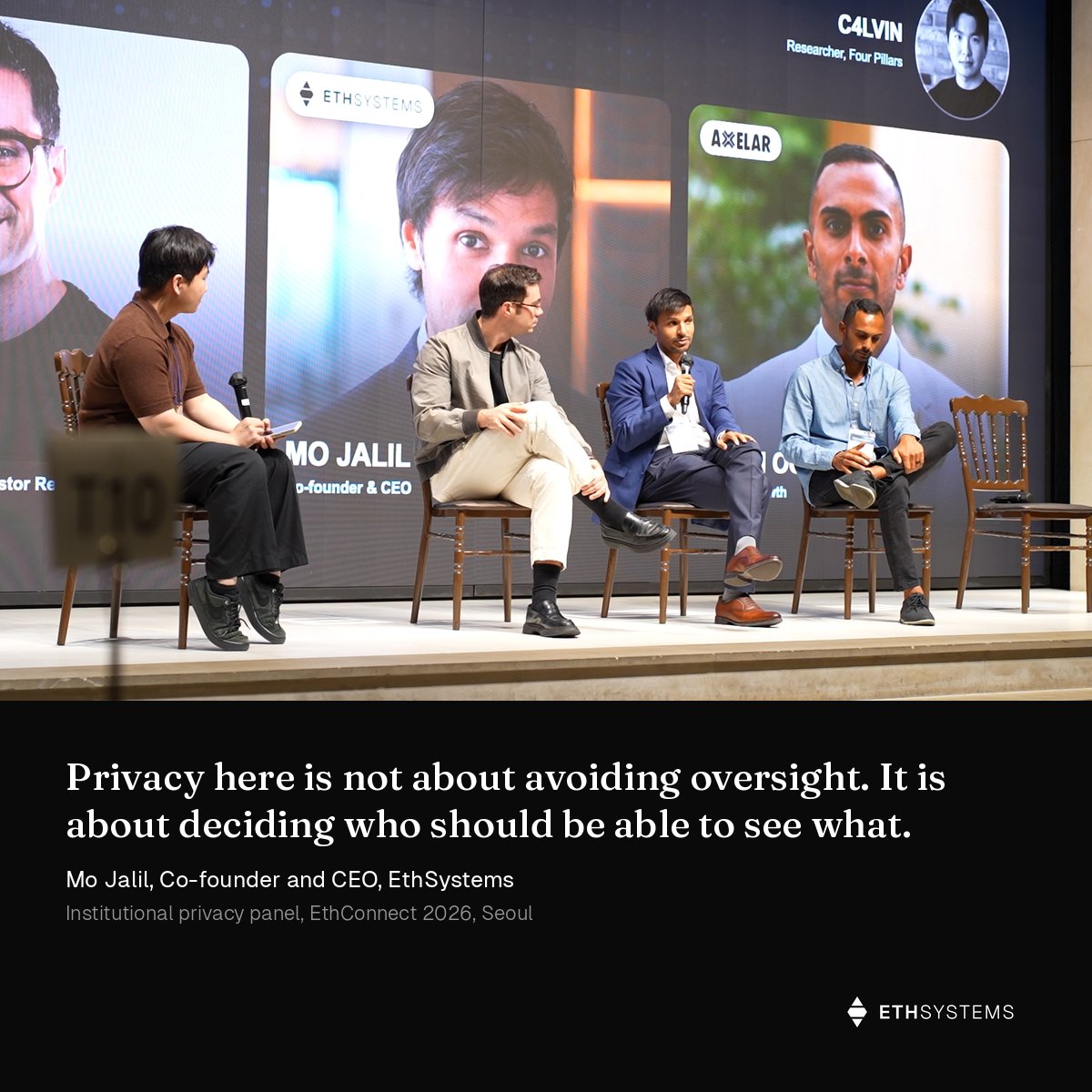
Most banks started on permissioned networks, and that did real work for hedging the risk and building capability. @motypes 's EthConnect 2026 keynote was about what comes after, because the architecture chosen at step one sets the cost of step three, and the wall on the way to a public network is almost always confidentiality.
Confidential is not anonymous. It is control over who sees what, when and how: the counterparty sees the trade, everyone else sees only a proof that it is valid, the operator sees nothing, and the regulator holds a disclosure key.
The same question ran through both panels. Good conversations with @Sharplink , @LidoFinance , @ETHGasOfficial , @Offchain , @zama , @axelar and @FourPillarsFP , and our thanks to @0xundefined_ for hosting.
Coverage in threads 👇🏻
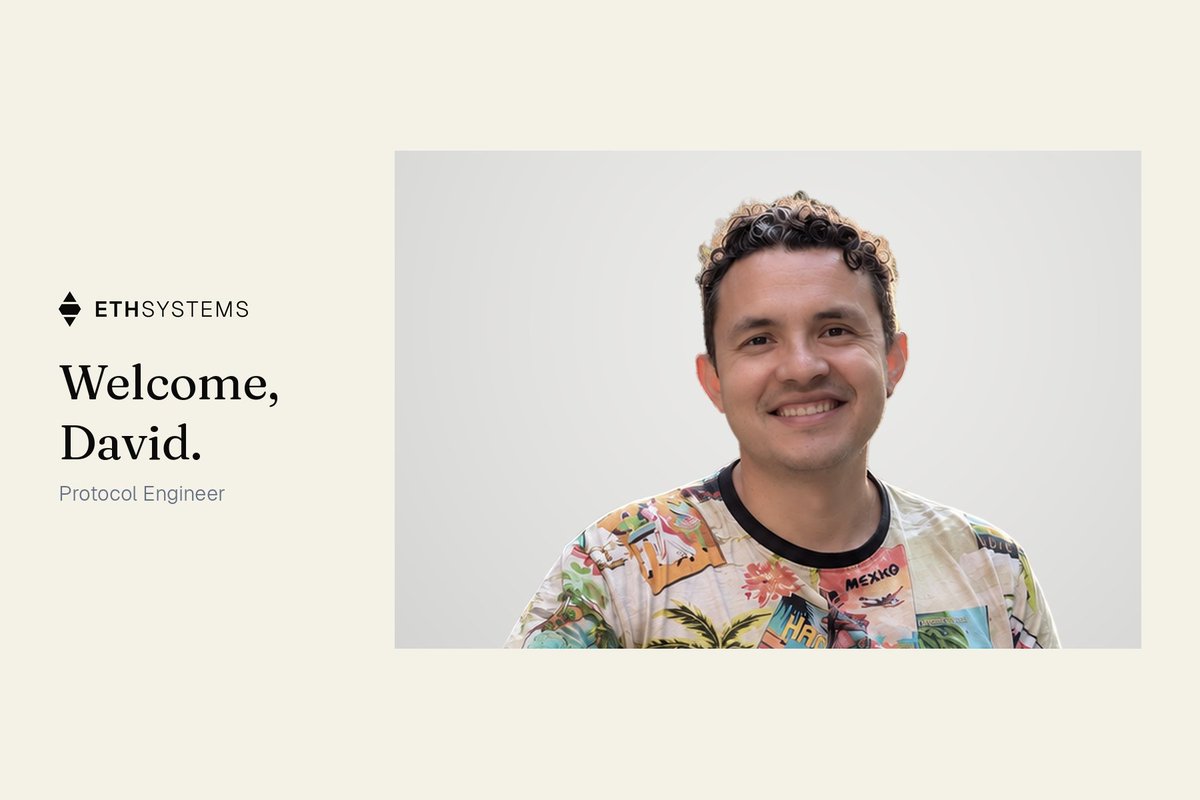
David has spent years working on the cryptography and infrastructure behind Ethereum. I’m excited to have him building with us at EthSystems.
Welcome, David.
We're glad to welcome David (@david__nunez) to EthSystems as Protocol Engineer.
David has spent more than 15 years in cryptography and information security, the last 8 in Ethereum and web3. Most recently he was CTO of NuCypher, leading TACo, an access control layer built on threshold cryptography, and he built the staking and governance smart contracts for Threshold Network.
He holds a PhD in Cryptography from the University of Málaga, and his research has been published at CRYPTO, AsiaCCS and in the Journal of Cryptology.
At EthSystems, David joins as Protocol Engineer. He'll work out which cryptographic building blocks hold up against institutional requirements, how they compose, and what they cost to run, and turn that into reference implementations institutions can test themselves.
Welcome, David.
Let's build confidential systems on Ethereum for institutions.