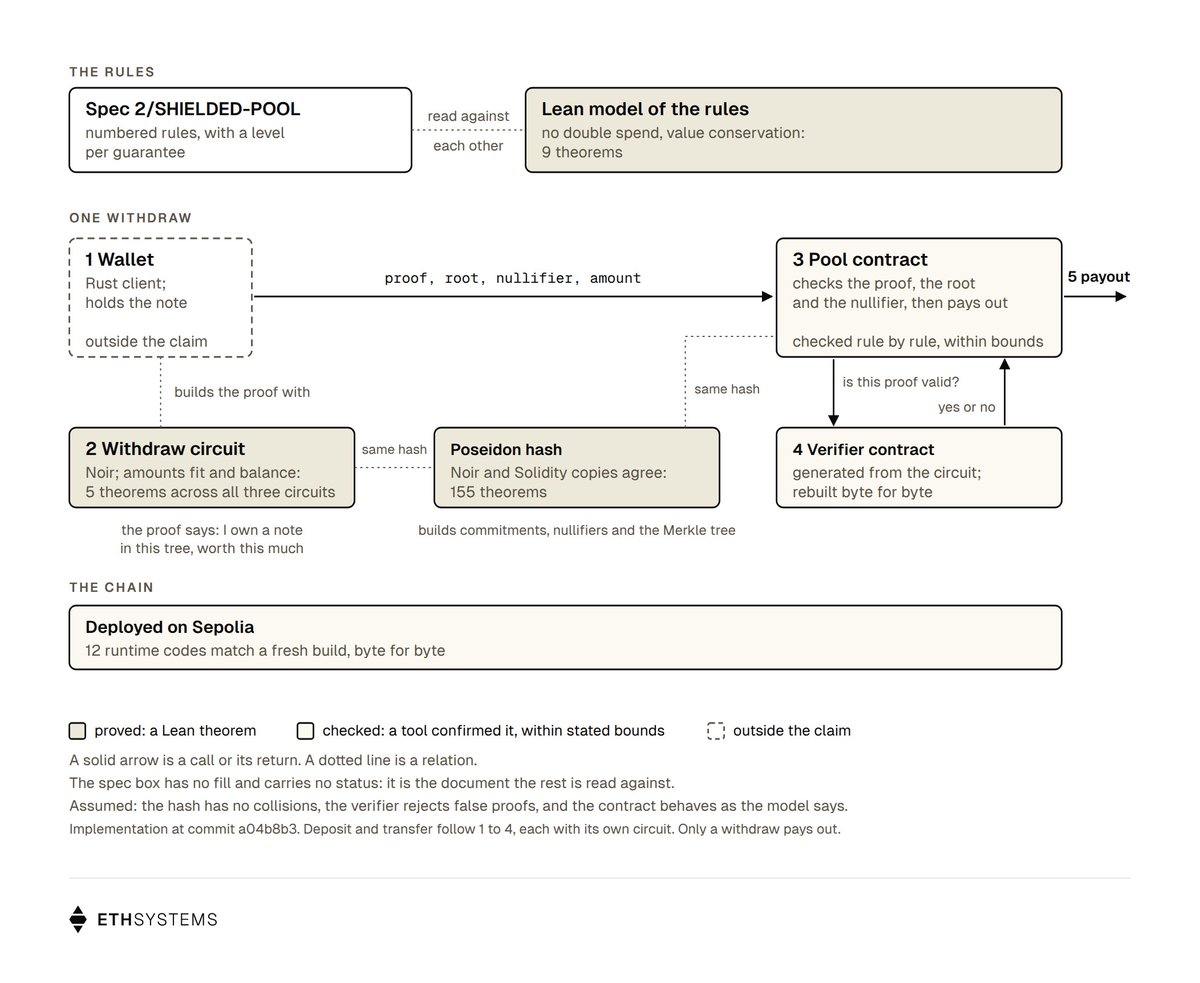
Our October community update starts with formal verification. We took our shielded pool from the written spec down to the bytecode running on Sepolia and checked each layer with its own tool. No double spend and value conservation are now machine-checked theorems in Lean, and the deployed runtime codes match a fresh build byte for byte. We found six issues on the way, three of them in the verification tools themselves.
Also this month: a private money market fund starter kit, a write-up on the next two Ethereum forks, and the team in Seoul, Singapore and New York.
Our Managing Director Kaushal (@liftlines) joins "Staking Economics and the Market for Block Space" panel on 13 November.
As block space markets change where validator revenue comes from, staking yield and its risks shift too. Kaushal brings years of experience in finance and building on Ethereum. Looking forward to the exchange.
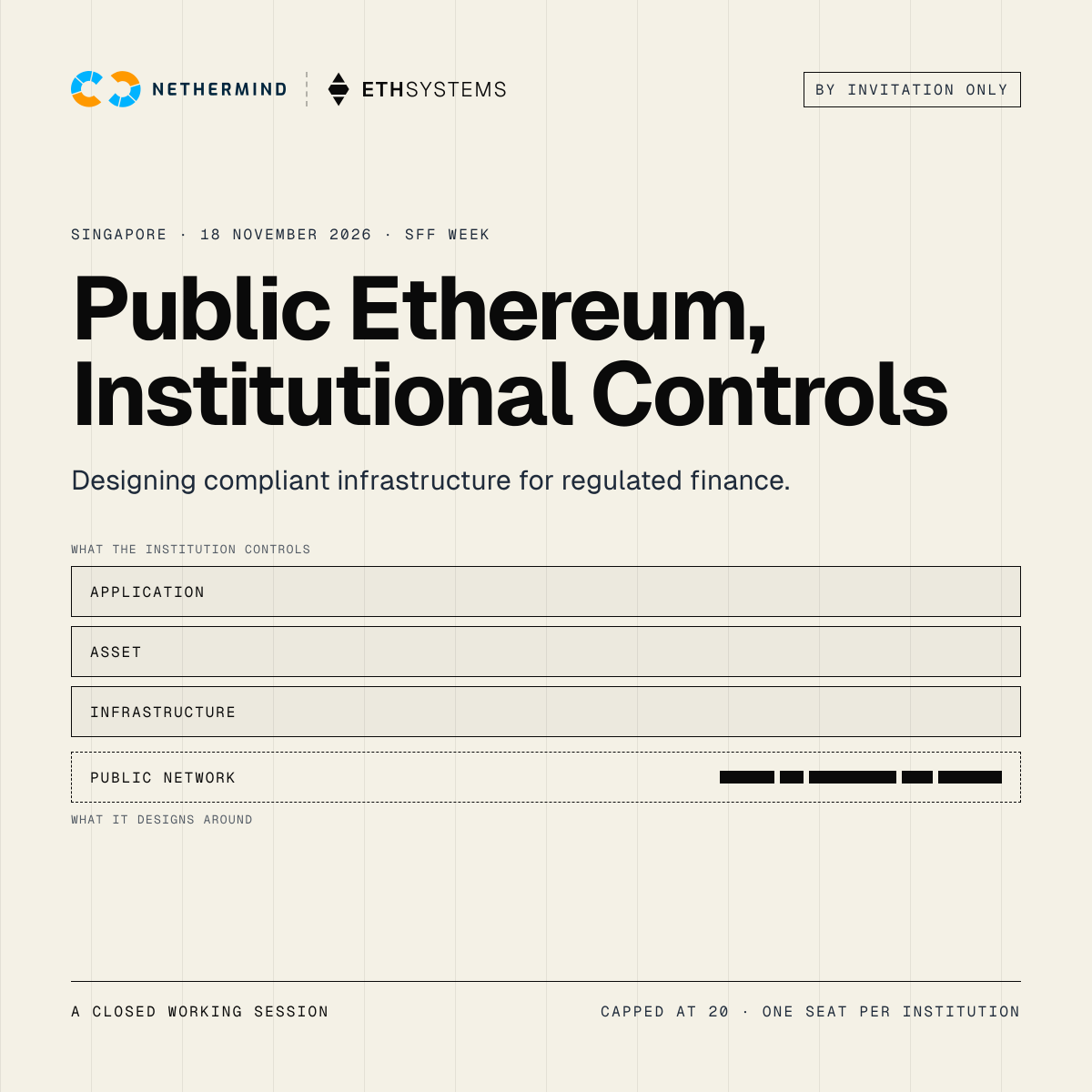
We're co-hosting a closed, invite-only session with @Nethermind in Singapore on 18 Nov, during SFF week.
Looking forward to working through one question with them and a group of banks: how do you design compliant infrastructure for regulated finance on Ethereum?
DMs are open.
Hello everyone at DevCon ✨
Please come catch my talk! 🎤🌸
“The History of Ethereum Grant Funding, Built on Open Data”
Lightning Talk, Rights, Freedoms, and Governance track
November 3, 15:20 to 15:27, Lotus 3
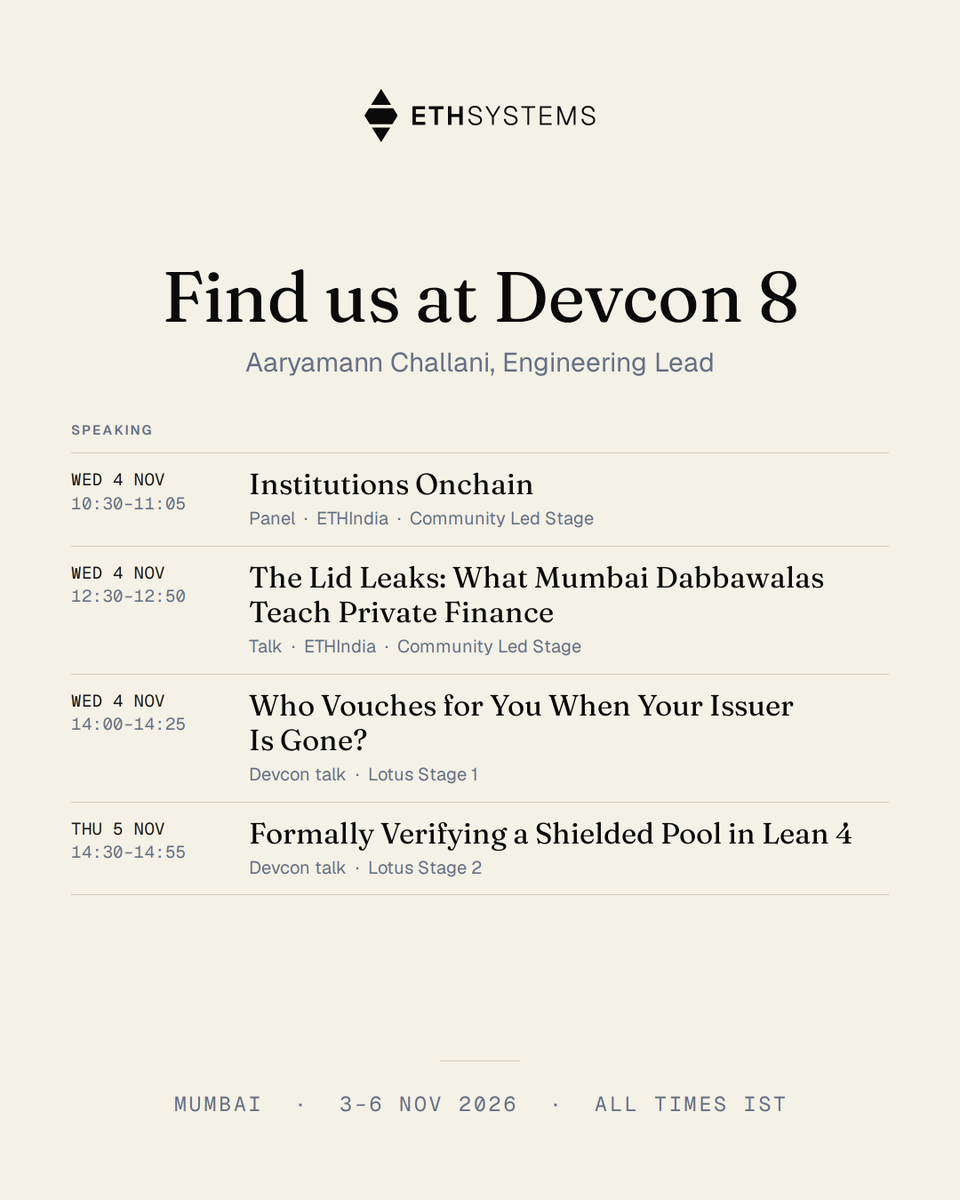
The engineer who spent years working in and around Ethereum, is explaining it with Mumbai’s dabbawalas.
@_rymnc, Director of Engineering at @eth_systems, was part of the Ethereum Foundation’s Institutional Privacy Task Force before the team spun out as EthSystems this year.
He’s taking the stage on The Lid Leaks: what Mumbai’s dabbawalas teach us about private finance. A system the whole city trusts, used to explain what privacy on Ethereum needs to get right.
4 Nov · Mumbai, inside Devcon
Engineering Lead at EthSystems, @_rymnc will be presenting our open source work, as well as speaking about what we've learnt while working with institutions.
Meet us at @EFDevcon and @ETHIndiaco!
A fund on a public chain shows its shareholder book to anyone who finds the contract. On Ethereum, FundBridge's ULTRA has five holders, and its contract minted 25 million units on 4 Sep 2026 and redeemed about the same five days later.
Last week, @eth_systems published a proof of concept for confidential money market fund shares on Ethereum using shielded pool. The pool holds the fund's permissioned token, positions are encrypted notes, and a ZK proof checks each transfer and carries an encrypted copy of every new note for the registrar. The registrar keeps the full register while the public sees daily totals.
Here's how Asian funds keep their register today -
Hong Kong: CSOP and Bosera keep it offchain with the registrar. The SFC says providers "should not use public-permissionless blockchain networks without additional and proper controls".
Singapore: sgBENJI's token is the register.
Japan: The Trust Act puts each holder's name and address in the register, and MUFG keeps its test fund's register onchain on Progmat.
South Korea: From 4 Feb 2027, registers can sit on ledgers the KSD screens, starting with private MMFs for institutions.
Japan's and Korea's rules leave room for Ethereum if a design hides holdings and keeps the registrar's record complete. For small funds, the deployment needs padding, netting or a pool shared across funds to hide anyone.
This week, the Under the Hood series lays out various register models across four markets.
https://t.co/jvX2JePcMk
⛳️ absolute hole-in-one by @oskarth
lots of nuances to formal verification! while it's easy to get a model to spit out thousands of lines of code, it all needs careful review. one would notice that getting proofs is the easy part, but making sure that the generated code abides by what you think the design should be isn't.
you still need someone who understands the business use-case deeply to be able to formally verify systems at this scale.
We pushed formal verification through our shielded pool, from the written spec down to the bytecode running on Sepolia.
Each layer got its own tool: Lean for the model, circuits and hash, Halmos and Kontrol for the contract, Aeneas and Verus for the wallet, and byte-for-byte rebuilds for the verifiers and the deployment.
What we proved, what we found and what we still assume, in the thread below.
major props to @david__nunez, we've had this idea for several months and did a lot of research into existing deployments, their trust models to be able to deliver this piece of work.
Read the writeup!
Tokenized money market funds on Ethereum publish their shareholder books: every balance, every subscription and redemption.
Our proof of concept hides positions from the public, while the fund's transfer agent still sees all of them.
How it works, and the links, below 👇🏻
Kaushal Vyas (@liftlines ), our Managing Director, joins the Building Ethereum panel at @LFDecentralized's Privacy for Financial Services Workshop in New York on Friday 23 October (12:00 to 12:45 pm ET), moderated by Johnna Powell of DTCC.
He will bring our open map of institutional privacy use cases, each with the requirements institutions named, the approaches already ruled out, and starter kits for several of them.
Looking forward to the conversation with fellow panelists, and to building on it together after 🤝🏻
We published a writeup on Ethereum's upgrades, past and coming, read through what banks, custodians and other institutions need.
Apart from the move to proof of stake, most institutions we talk to haven't followed the forks closely. Since 2021 the gas limit has doubled, and accounts and rollups can now do things they couldn't before.
The next two forks have different focuses. Glamsterdam, due in December, is mostly about capacity: it prepares clients for a 200M gas limit and makes writing new storage more expensive. Hegotá, planned for 2027, is about control. Frame transactions give accounts more say over how they sign and pay fees, and FOCIL makes it harder for block producers to leave valid transactions out.
We looked at each change through five needs: key control, capacity at a cost firms can plan for, speed to finality, neutral inclusion and confidentiality. Each section opens with a summary for six kinds of firms, from bank treasuries to staking providers, and a replay of mainnet transactions under the new gas rules shows where costs move.
One of those needs the forks leave open. More below.
Intercompany cash on a public chain publishes the group’s structure, and that includes who funds whom, how much, how often. Competitors can read it even before your annual report.
Our private payments starter kit tests the reverse: hidden on chain, visible to treasury, open to a tax authority on request.
There are still two gaps remain, see threads for more 👇🏻
Our September community update starts with the specs behind our shielded pools, and it’s now public. How our pools work was defined by the code until now. The specs write it down as a standard anyone can implement or audit against, released under CC0, and our own proof of concept now conforms to them.
Also this month: two new building blocks, two people joining the team, four talks, and more collaborations with @lfdecentralized and @0xMiden.
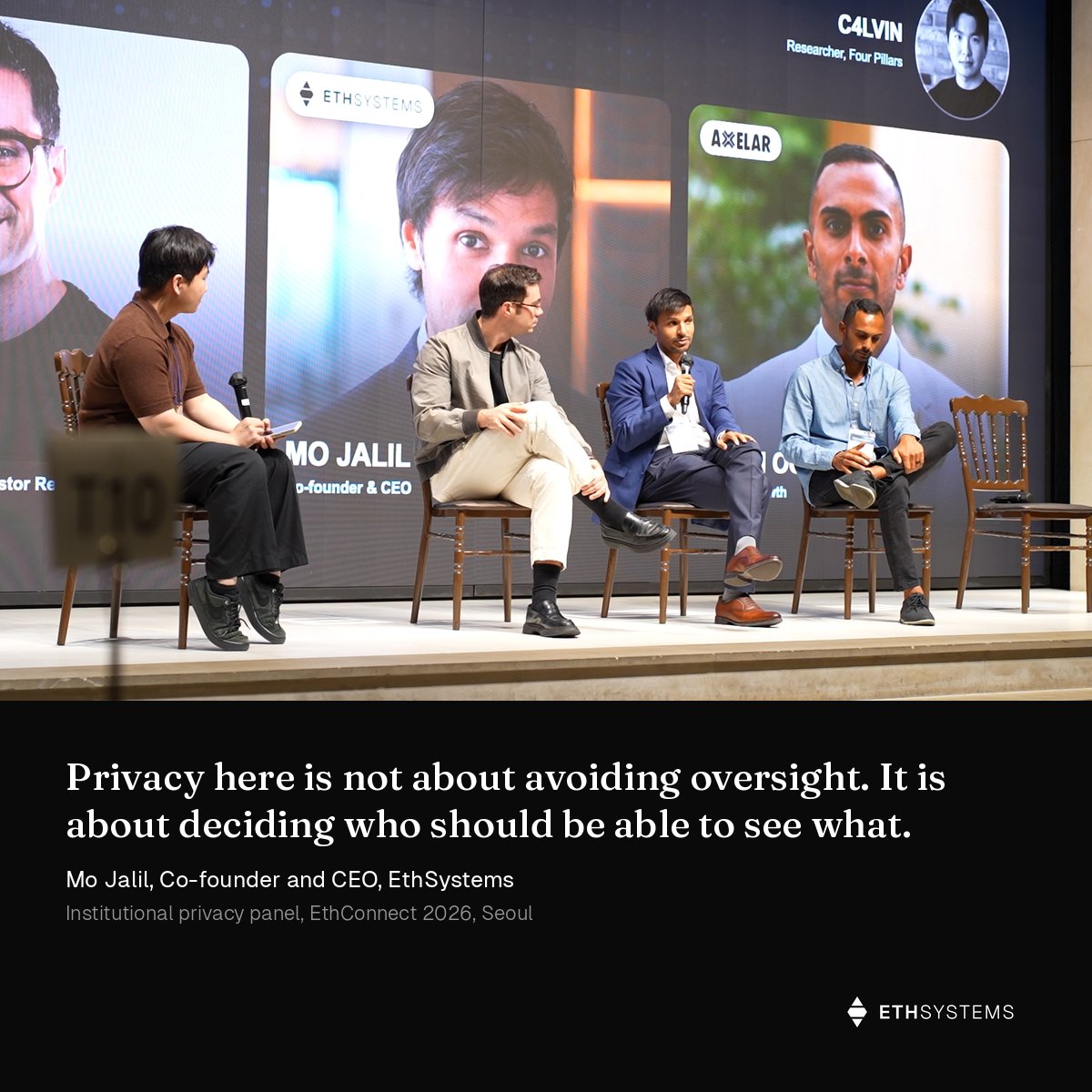
Most banks started on permissioned networks, and that did real work for hedging the risk and building capability. @motypes 's EthConnect 2026 keynote was about what comes after, because the architecture chosen at step one sets the cost of step three, and the wall on the way to a public network is almost always confidentiality.
Confidential is not anonymous. It is control over who sees what, when and how: the counterparty sees the trade, everyone else sees only a proof that it is valid, the operator sees nothing, and the regulator holds a disclosure key.
The same question ran through both panels. Good conversations with @Sharplink , @LidoFinance , @ETHGasOfficial , @Offchain , @zama , @axelar and @FourPillarsFP , and our thanks to @0xundefined_ for hosting.
Coverage in threads 👇🏻
New chapter: I've joined EthSystems to work on privacy infrastructure for institutions building on Ethereum.
It's right in the intersection I've spent most of my career in, so it feels like the right place to be. Looking forward to what we build 🏗️🚀
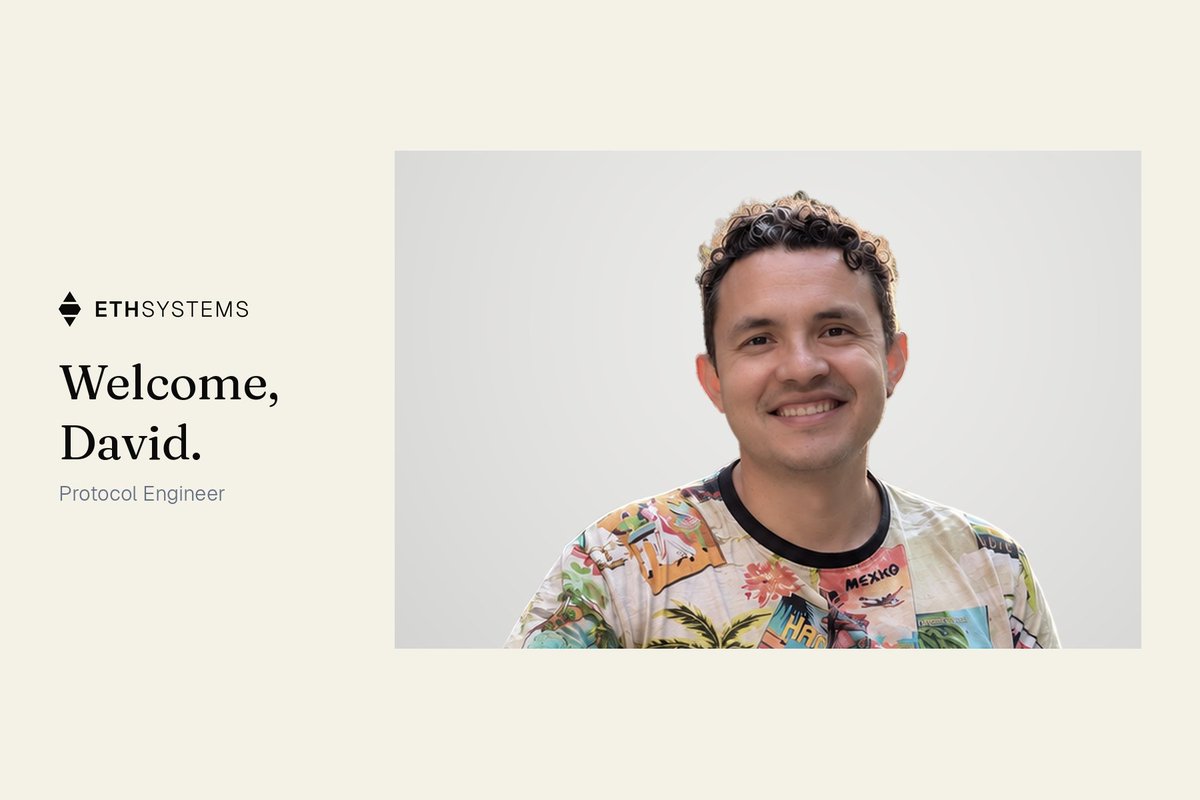
We're glad to welcome David (@david__nunez) to EthSystems as Protocol Engineer.
David has spent more than 15 years in cryptography and information security, the last 8 in Ethereum and web3. Most recently he was CTO of NuCypher, leading TACo, an access control layer built on threshold cryptography, and he built the staking and governance smart contracts for Threshold Network.
He holds a PhD in Cryptography from the University of Málaga, and his research has been published at CRYPTO, AsiaCCS and in the Journal of Cryptology.
At EthSystems, David joins as Protocol Engineer. He'll work out which cryptographic building blocks hold up against institutional requirements, how they compose, and what they cost to run, and turn that into reference implementations institutions can test themselves.
Welcome, David.
Let's build confidential systems on Ethereum for institutions.