Agentic and personalized AI is going to be a major theme.
It feels like consumers’ first real AI agent experience will hit the same way ChatGPT did.
$NET $FSLY $DOCN $AKAM + CPU + stablecoins.
If you ask most people in real life what AI agents or OpenClaw are, chances are you’re getting a blank stare and further questioning. It’s still early outside of the X/tech bubble.
The “ChatGPT moment” for agentic AI probably creates some massive opportunity.
Photonics is the next major bottleneck.
$NVDA has signaled each one ahead of time from:
HBM (with Samsung/Sk Hynix) to CoWoS and now with the $LITE and $COHR investment:
Laser Fab, CPO, and InP.
For the most asymmetrical longs in each bottleneck:
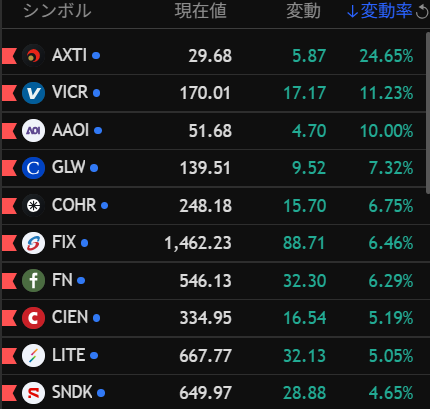
1. InP Substrates: $AXTI, Sumitomo, JX
2. InP Upstream Feedstock + Processing: $AXTI
3. Lasers: $AAOI (internal), $AVGO, $COHR, $LITE
4. CPO: $TSEM, Soitec.
The laser bottleneck was confirmed from the $AAOI earnings call when three different hyperscaler wanted to buy out any optical transceiver they can produce.
The InP substrate bottleneck was confirmed with the backlog from $AXTI. (Image source of players: IndexBox)
And the CPO bottleneck is widely expected to happen later in late 2027-2028.
There's short term volatility from $AVGO comments around "CPO" in specific. But that's different than the laser -> transceiver and InP bottlenecks happening now.
For timeframes:
$AAOI, $LITE, $COHR and the laser transceiver bottleneck is happening real time (and is expected to get worse like memory into 2028).
$AXTI, Sumitomo and the InP substrate bottleneck is happening real time (and is expected to get worse as long as AI uses photonics for the many years to come).
And the larger architectural shift to CPO led by $NVDA will likely happen in 2028.
These feel inevitable for the next paradigm shift in AI.
“This feels like 1999 again.”
No, it doesn’t. And I was there (here).
I joined Cisco in January 2000 as a co-op, then full-time in May 2001. At the time, Cisco was the hottest infra company on the planet, riding the wave of the dot-com boom.
But by the time I started full-time, the crash had already begun. A month in, my manager was laid off. The party was over. Entire industries vanished.
Here’s what actually happened:
1. The users weren’t ready.
Most people were on dial-up. Mobile didn’t exist. E-commerce logistics were immature or non-existent. Everyone had ideas, but the end user wasn’t there.
2. Capital vanished.
The IPO window shut. Venture funding dried up. Startups that depended on future growth couldn’t raise and died fast.
3. Metrics were fake.
Companies like Kozmo, Webvan, https://t.co/G88Rs4MaDI burned cash chasing usage that never converted. Things like CAC/LTV wasn't common enough vernacular.
4. Infra got overbuilt.
Telcos like Global Crossing and WorldCom spent billions on fiber and data centers. The demand never showed up. Cisco’s customers disappeared, not because they lost but because their customers died.
5. Business models were broken.
Most dot-coms were never real businesses. They scaled early and hoped revenue would catch up. It didn’t.
Now look at today.
OpenAI, Meta, Google, xAI, Microsoft are all scrambling to keep up. Jensen put it plainly (h/t @BG2Pod)
“Every hyperscaler has realized they dramatically underbuilt.”
“Every forecast we’ve seen has been too low.”
“We’re not building for speculation. We’re building for active workloads.”
So no. This isn’t 1999.
This isn’t https://t.co/G88Rs4MaDI IPOing on vibes.
We are not in a hype cycle.
We are in a compute bottleneck.