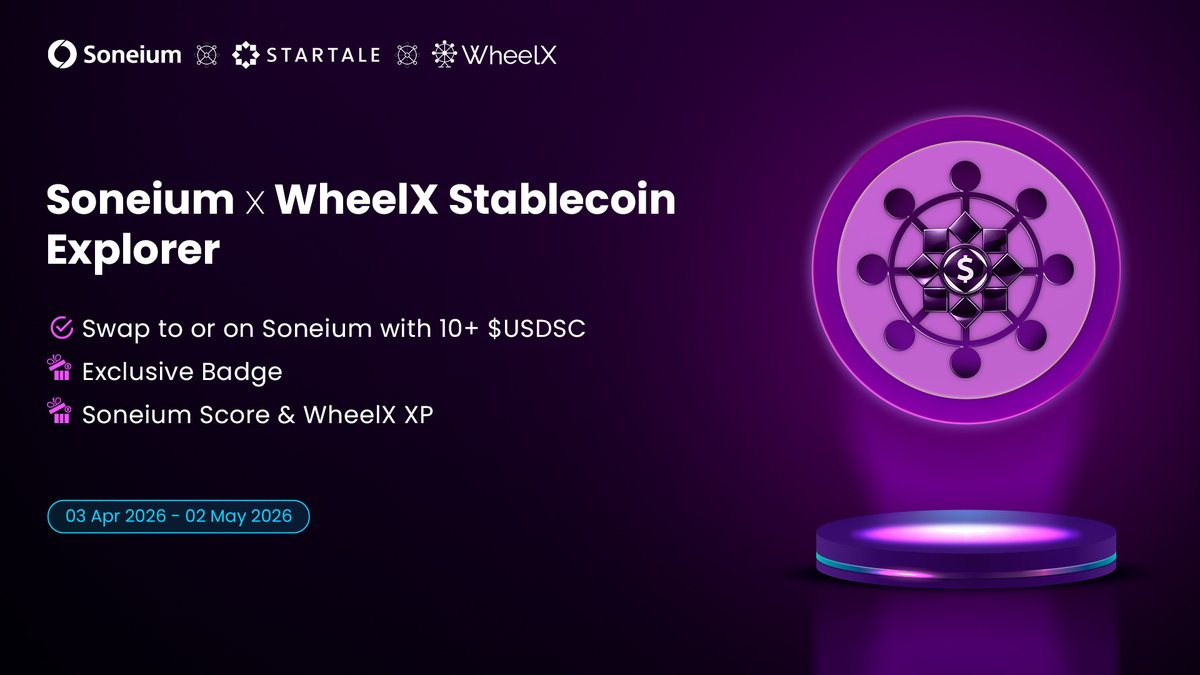
Soneium X WheelX Stablecoin Explorer
Startale USD is the best way to enter the @soneium ecosystem & @StartaleApp. Simply swap to or on Soneium with 10+ $USDSC to unlock Exclusive Badge—and more rewards:
🎁 Soneium Score & WheelX XP
👉https://t.co/cL4jYPd5AL
Guess who just got invited to the @soneium Score S8 Party? 🎉
Startale App is on the VIP list.
Drop 5 GMs and complete the @GalxeQuest campaign for bonus scores!
Join now 👇🏻
Bridges are being replaced by intents. Yield aggregators by settlement layers.
The market is moving toward infrastructure that delivers results.
That's where ORBT sits.
ORBT is a bet on the intent economy.
• UniswapX grows, you earn.
• Across Protocol grows, you earn.
• New intent protocol launches, you earn.
ORBT powers the settlement liquidity for all of them. One deposit captures the entire intent economy, producing yield back to you.
Super Bowl ads are basically a $10M focus group for what brands think America cares about.
This year, we saw AI everywhere, nostalgia up 2x from a decade ago, and everyone trying to make you feel warm and fuzzy.
Marketing is just a vibes play at scale.
ORBT’s intent-based architecture removes the cost of fragmented liquidity in DeFi.
• $1T+ per year now clears through intent-based systems
• $1.2B MEV-related losses in 2025
• Up to 3% of value drained by MEV per trade
With ORBT, inefficiencies turn into a yield engine.
It’s the same question every cycle: What still matters when price stops doing the work?
Right now, the answer is getting pretty clear.
Use cases tied to real activity hold up better than narratives tied to liquidity. Payments that actually move money. Yield that doesn’t depend on leverage. Markets that surface information.
Distribution matters more than clever design. Reliability matters more than novelty. And value capture matters more than ideology.
I’ve watched enough infrastructure mature to know this part is uncomfortable.
It feels slower. Less exciting, more constrained. But this is usually where real systems separate from experiments.
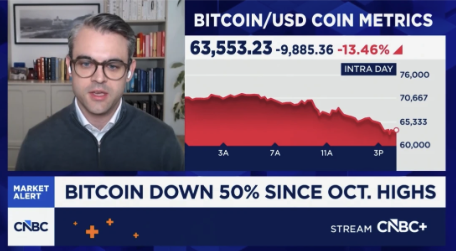
Bitwise CEO said yesterday that Bitcoin under $70K gives institutions "a new crack of the apple."
I've watched institutional adoption long enough to recognize this. It's not about catching a dip, it's about infrastructure building at reasonable entry points.
What institutional allocators actually care about:
1. Entry cost-basis. $100K Bitcoin = $1B for 1% allocation on a $100B fund. At $70K = $700M. That $300M matters for board approvals.
2. Volatility budget. Lower entry = more room to move before triggering rebalancing. Institutions hate rebalancing like burning fees, creating tax events.
3. Infrastructure time. Custody, legal, compliance, reporting = 6-12 months. They're not timing markets, they're completing build-outs they started months ago.
This isn't retail FOMO. This is ops teams getting budget approval for infrastructure they've been building quietly.
The ones deploying capital now aren't bottom fishing, they're building for the next cycle while everyone's distracted.
Crypto dot com just paid $70M for ai dot com and launched AI agents during the Super Bowl.
A cleaner way to look at this is through what the agents actually need to function:
• Autonomous wallet management
• Cross-protocol liquidity access
• Settlement that doesn't require manual approval
• Programmable execution paths
AI agents aren’t experimental projects anymore. They're real products with real infrastructure requirements.
The problem is most crypto infrastructure was built for humans making manual decisions, not agents making autonomous ones.
I think this is where programmable liquidity stops being a narrative and becomes a requirement. When you have thousands of agents executing simultaneously, manual liquidity routing breaks.
This is the kind of application that would do wonders with settlement infrastructure built for machine speed, not human speed.
It’s becoming clearer that interfaces are temporary but coordination layers persist.
Desktop software gave way to mobile apps. Apps gave way to APIs - Stripe, AWS, and Twilio scaled because other systems could reliably plug into them.
Agents push the shift one layer further.
As software is increasingly consumed through personal agents, value moves away from screens and toward services that can be discovered. Routing, permissions, pricing, and uptime start to matter more than layout.
That doesn’t kill products. It changes what compounds inside them.
I see the durable assets as the systems agents can depend on when humans are no longer in the loop.
5 years after GameStop, people still argue about fairness, brokers, or market manipulation.
What actually broke was the underlying system.
Multi-day settlement meant brokers had to front massive collateral while trades sat in limbo. Risk models snapped and trading got shut off when volume spiked.
That wasn’t a bad decision at that moment but just an old system hitting its limits.
Shortening to T+1 helped, but it didn’t fix the core issue: delayed settlement turns volatility into systemic risk.
If equities settled in real time, that day would’ve looked very different.
ORBT is building the next-generation DeFi engine for intent-based architecture.
This engine enables ORBT to coordinate capital across venues, pre-fund execution, and clear results through a unified liquidity pool.
ORBT becomes the clearing house for the intent economy.