CryptoScamDB reporting is down! cc: @mycrypto@cryptoscamdb https://t.co/YmZysB5mtV via @cryptoscamdb Dear CryptoScamDB,
We would like to report a phishing website to you. Your web page says that reporting is unavailable right now, so we report here as you prompt. Please make this report publicly available.
Reported URL: https://t.co/X3Zzg1VFZV.
Threat type: Phishing / brand impersonation / wallet drainer
This website impersonates the legitimate non-custodial crypto wallet IronWallet (official site: https://t.co/J9mc5TCKQO; “IronWallet” is a registered trademark of INWAY AG). It steals users’ wallet private keys / recovery phrases through a fake “Sign in → Forgot phrase → Reset password” flow that asks for a “12-character private key”.
It also runs a pig butchering scam: a fabricated account balance is displayed and victims are pressured via the fake support address [email protected] and Telegram account https://t.co/kJozCWrSBo and Telegram bot https://t.co/M3qH0sD21W, to pay “gas/compliance fees” before a non-existent withdrawal. Multiple victims confirmed (June 2026).
You may check these links to witness the fraudulent activity of https://t.co/9YGiqy3zvl:
https://t.co/XDGSubBwDV
https://t.co/qQehMUHsU3
https://t.co/xvSm3ouzC6
Remember! IronWallet will never ask for your personal details, email, phone number. We are a true non-custodial wallet. If someone is saying they are from IronWallet and contacting you directly - they are definitely a fraudster!
Beware of scammers posing as IronWallet, do NOT use https://t.co/ZHQSIXGiCY or https://t.co/01nTa5k19a also sometimes poses as DS Financial - this website has nothing to do with official IronWallet crypto wallet. We are proactively trying to remove the scam domains. @GoDaddy
IronWallet is one of the best crypto wallets out there! No KYC, No Passport, No phone number or email required!
Check out our new video!
https://t.co/BzMOBbdsYK
https://t.co/tsZ3vD1C7a
WalletConnect Pay launches pilot in Paris next week; IronWallet among first confirmed integrators
WalletConnect — the widely adopted open protocol that connects decentralized applications (dApps) to wallets — has been steadily expanding beyond simple dApp-to-wallet interactions into richer payments flows. Its WalletConnect Pay initiative aims to standardize and simplify web3 payments by enabling wallets, merchants and payment rails to interact through the WalletConnect protocol in a secure, user-friendly manner.
One of the earliest confirmed integrators for WalletConnect Pay is IronWallet, a mobile wallet known for a strong focus on UX and security. IronWallet’s participation marks a significant step toward broader merchant and wallet adoption: by joining the program early, IronWallet helps validate the integration model and demonstrates how consumer-facing wallets can implement the new flows.
Pilot goes live in Paris next week
A timed pilot of WalletConnect Pay is scheduled to go live in Paris next week. The pilot will involve participating merchants, payment processors, and a set of integrated wallets — including IronWallet — to test real-world user journeys, transaction lifecycle handling, merchant settlement, and fallback behaviors. Organizers say the Paris pilot will focus on retail point-of-sale transactions and online checkout experiences to stress-test both in-person QR/payment-link flows and web-based payment flows.
What the pilot will test
– User experience: seamless wallet connection, payment confirmation UI, and friction points during checkout.
– Security and permissions: ensuring that the WalletConnect Pay flow provides clear intent, limits approvals to the necessary transaction scope, and prevents accidental or malicious transfers.
– Interoperability: that multiple wallets and merchant platforms can communicate through the WalletConnect protocol without bespoke integrations.
– Merchant settlement and reconciliation: how off-chain and on-chain settlement options behave in practice, plus reporting and refund workflows.
– Latency and reliability: measuring end-to-end time from checkout initiation to settlement confirmation under real-world network conditions.
Why IronWallet’s involvement matters
As one of the first confirmed integrators, IronWallet brings a user-focused wallet implementation to the pilot. Their participation will help prove that mainstream wallet vendors can add WalletConnect Pay support without sacrificing usability or security. IronWallet also has partnerships in several European markets, which could accelerate merchant onboarding if the pilot demonstrates smooth flows and positive merchant outcomes.
Potential impact
If the Paris pilot succeeds, it could accelerate broader WalletConnect Pay adoption across Europe and beyond by providing a tested blueprint for wallets, payment processors and merchants. A standardized, interoperable payment experience could lower integration barriers for merchants and give users a consistent, secure way to pay with their preferred wallets across different platforms.
What to watch next
– Pilot outcomes and metrics: organizers plan to publish lessons learned and implementation guidance after the trial.
– Additional wallet and merchant sign-ups: more integrations will be important to establish network effects.
– Regulatory and compliance handling: how KYC/AML and consumer protections are managed in integrated payment flows.
– Mainnet or production rollouts: timelines for broader launches if the pilot meets its objectives.
In short, the WalletConnect Pay pilot launching in Paris next week — with IronWallet among the first confirmed integrators — is an important early step toward making wallet-based payments smoother and more widely usable. Observers and participants will be watching the pilot closely for practical insights into user experience, security, interoperability and merchant settlement.
https://t.co/gMra7npbP5
So, What’s an Ethereum Wallet Inside the IronWallet App?
Let’s keep it real — if you’re dipping your toes into crypto, especially Ethereum, you’ve probably heard the term “Ethereum wallet” thrown around. Basically, it’s your personal digital keychain for everything on the Ethereum blockchain. Think of it as your secure little pocket where you can hold ETH, trade tokens, interact with apps, and actually own your stuff without some company babysitting your funds.
Now, in the IronWallet app, the Ethereum wallet is super straightforward and built right in. IronWallet is a non-custodial mobile wallet (available on iOS and Android), which means you hold the keys — nobody else can touch your crypto. No KYC, no handing over your personal info, just you and your seed phrase stored safely on your phone.
When you create or import a wallet in IronWallet, you automatically get full Ethereum support. You can:
– Send and receive ETH
– Hold thousands of ERC-20 tokens (those popular tokens built on Ethereum)
– Swap assets right inside the app with decent rates
– Track your balances and transaction history in a clean, easy-to-read interface
One of the coolest bits? IronWallet makes Ethereum life less annoying with gasless transactions for tokens like USDT or USDC. Normally you need some ETH in your wallet just to pay network fees — but here you can send stablecoins and the fee gets deducted in the same coin. No more “I have tokens but zero ETH to move them” panic.
It also plays nice with decentralized apps. Thanks to built-in WalletConnect support, you can connect to Uniswap, OpenSea, lending platforms, or whatever DeFi thing you’re into. Just scan a QR code from your browser and boom — you’re interacting with dApps while your private keys stay safely on your device.
Security-wise, it feels pretty solid for a mobile wallet. You get biometric login (Face ID or fingerprint), PIN protection, and even an optional NFC card for offline backup of your recovery phrase. It’s like a modern cold wallet vibe without the hassle of hardware.
Bottom line: The Ethereum wallet in IronWallet isn’t some complicated extra feature — it’s one of the main things the app does really well. Whether you’re holding ETH long-term, flipping tokens, or jumping into DeFi, it gives you full control in a simple package.
If you’re tired of clunky interfaces or worrying about who actually controls your crypto, downloading IronWallet and setting up your Ethereum wallet is a pretty chill way to get started. Just remember the golden rule: never share your seed phrase, and you’re good to go.
https://t.co/lJxt7XkZhi
WalletConnect and IronWallet: Secure Gateways to Web3
One of the first things that IronWallet had introduced since the first release of the app was WalletConnect, a universal tool that like a Swiss knife allows users of IronWallet to connect to various platforms and even use the app for every day payments. IronWallet is one of the registed web3 wallets by the WallectConnect and listed on its website: WalletGuide | WalletConnect
WalletConnect is an open-source protocol launched in 2018. It acts as a secure bridge between crypto wallets and thousands of dApps — from DeFi platforms like Uniswap to NFT marketplaces and blockchain games. Instead of risky browser extensions or manual address entry, users simply scan a QR code or use a deep link to connect.
The protocol uses end-to-end encryption and a decentralized network of nodes to relay messages. Private keys never leave the user’s device, ensuring strong privacy and security. It supports dozens of blockchains, including Ethereum, Solana, Polygon, and more. Today, WalletConnect powers connections for over 700 wallets and 80,000+ dApps, handling billions in monthly transaction volume. Recent developments include WalletConnect Pay, which aims to make crypto payments as simple as traditional card transactions in 2026.
IronWallet is a modern, privacy-focused non-custodial wallet available on iOS and Android (with desktop support). It lets users store, send, receive, swap, and track over 10,000 cryptocurrencies and tokens across major networks like Bitcoin, Ethereum, Solana, Tron, and Binance Smart Chain.
As a non-custodial solution, IronWallet never stores your seed phrase or private keys on any server — everything stays on your device. No KYC or personal data is required. Extra security features include biometric protection, PIN codes, and an optional NFC card for offline backup of your recovery phrase. The wallet also offers competitive swap rates and gasless transactions on some networks, making everyday crypto use more affordable.
The real strength appears when the two work together. IronWallet has built-in WalletConnect support, allowing users to connect seamlessly to any compatible dApp. Open a DeFi site or NFT platform in your browser, scan the QR code with IronWallet, approve the session, and start interacting — all while your keys remain safely on your phone. This combination removes technical barriers and lets users enjoy staking, lending, trading, and more without switching apps or compromising security.
Both solutions prioritize user sovereignty: your assets stay under your control, connections are encrypted, and there is no single point of failure. WalletConnect provides the universal standard, while IronWallet delivers a clean, intuitive interface with strong privacy tools.
As Web3 continues to expand, tools like WalletConnect and IronWallet are making decentralized finance more accessible and secure for everyone — from beginners to experienced users. Whether you want to explore DeFi, collect NFTs, or simply hold crypto safely, this pairing offers a reliable and user-friendly path into the onchain world.
https://t.co/LsHiT6LCRA
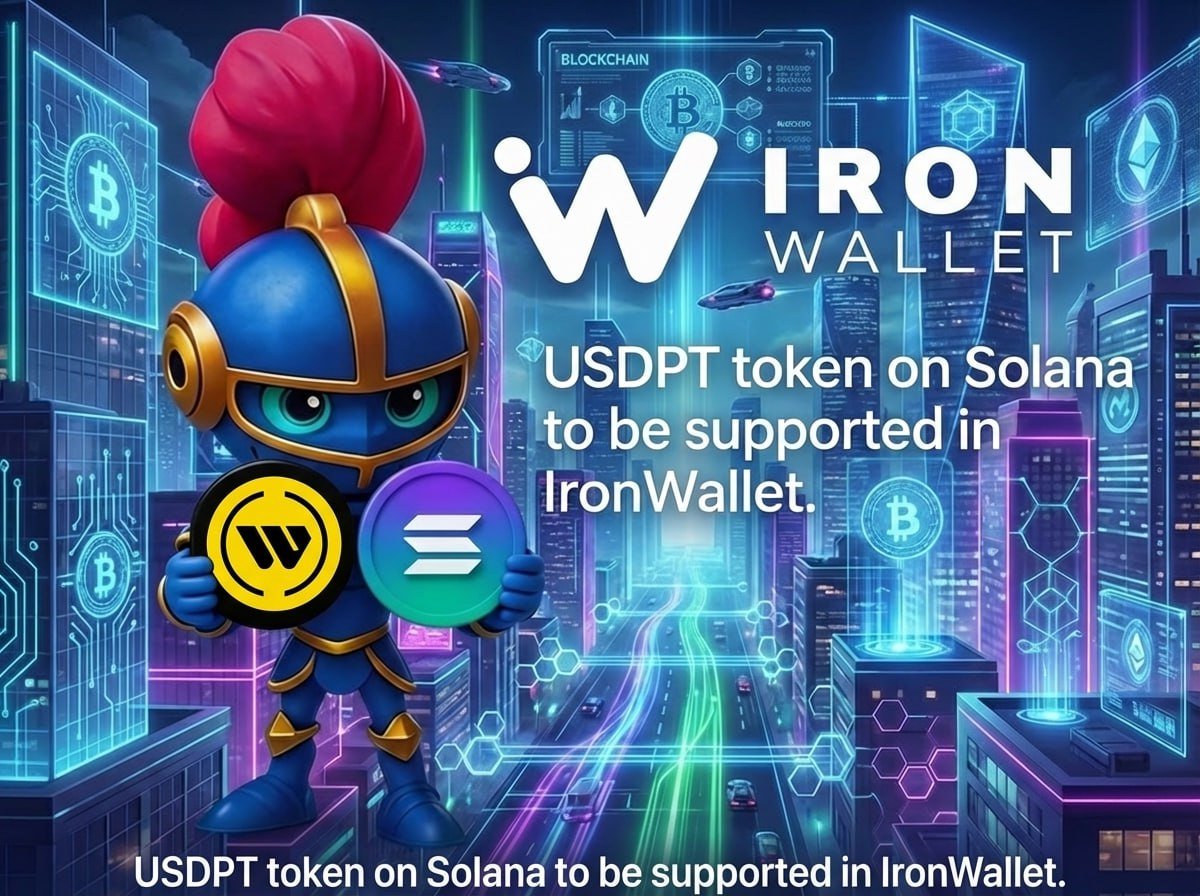
USDPT Token on Solana to Be Supported by IronWallet Soon
The U.S. Dollar Payment Token (USDPT), a new stablecoin developed by Western Union, is set to become available on the Solana blockchain in the near future, with support coming to IronWallet, a popular non-custodial cryptocurrency wallet.
USDPT is a U.S. dollar-backed stablecoin designed to maintain a 1:1 peg with the USD. It was announced by Western Union in late 2025 as part of efforts to integrate blockchain technology into its global payments network. The token is issued by Anchorage Digital Bank, a federally regulated digital asset institution, and built on Solana for its high transaction speed and low fees. Solana’s infrastructure enables fast settlements, making it suitable for cross-border transfers and everyday payments.
Western Union plans for USDPT to facilitate money movement for its customers, agents, and partners, while also supporting internal treasury operations. The stablecoin forms part of a broader Digital Asset Network aimed at connecting traditional finance with digital assets. Access to USDPT is expected through partner exchanges and integrated platforms, with the official launch anticipated in the first half of 2026.
IronWallet, a multi-chain non-custodial wallet trusted by millions of users, supports assets across networks including Bitcoin, Ethereum, Tron, Solana, and others. It offers secure storage, swaps, and management of over 10,000 tokens without requiring KYC verification, emphasizing user control over private keys. The wallet already handles Solana-based assets efficiently.
Support for USDPT in IronWallet will allow users to store, send, and receive the stablecoin directly within the app once it launches on Solana. This addition aligns with IronWallet’s focus on expanding compatibility for emerging tokens on high-performance chains like Solana.
The integration reflects growing adoption of stablecoins in mainstream finance. By combining Western Union’s remittance expertise with Solana’s scalability and IronWallet’s user-friendly interface, the move could enhance accessibility for digital dollar transfers.
Users interested in USDPT should monitor official announcements from Western Union and IronWallet for exact availability dates and any setup requirements. As with any cryptocurrency, participants are advised to conduct their own research and consider security best practices.
https://t.co/FzJEaac4CP
MiCA in Europe: Why Crypto Exchanges Now Share Your Data with Authorities — and How Non-Custodial Wallets Like IronWallet Keep Things Private
Imagine using a crypto exchange in Europe today. Every time you sign up, trade, or send funds, the platform knows who you are — and so do regulators. That’s largely thanks to MiCA (Markets in Crypto-Assets Regulation), the EU’s big crypto rulebook that’s now in full swing as of 2026.
MiCA kicked off in stages: stablecoin rules started in 2024, the main framework hit at the end of 2024, and by mid-2026 (with deadlines like July 1 in many countries), centralized exchanges and similar services had to get licensed as Crypto-Asset Service Providers (CASPs) or stop operating for EU users.
The big change? Stronger rules against money laundering and crime. Exchanges must follow strict KYC (Know Your Customer) checks — asking for your ID, address, and more. They also apply the Travel Rule (from the Transfer of Funds Regulation), meaning:
For every crypto transfer (no minimum amount!), they collect and verify details about the sender and receiver.
They share this info securely with the other platform involved.
They watch transactions closely and flag anything suspicious.
Most importantly, they report details directly to financial authorities like national Financial Intelligence Units (FIUs) if something looks off. Authorities can also request your full transaction history, wallet addresses, and personal data anytime for investigations.
This makes crypto on exchanges much more like traditional banking: traceable and reportable. It’s great for fighting scams and crime, but it means less privacy — your identity links to your on-chain activity.
What about non-custodial wallets? These are different — and they stay out of the spotlight.
With a non-custodial (or self-custody) wallet, you hold the private keys and control your funds completely. The app or software never takes your money, never holds it for you, and never acts as a middleman. You’re sending peer-to-peer straight on the blockchain.
MiCA and related rules clearly say: pure non-custodial wallet providers aren’t CASPs. They don’t offer custody, trading, or transfer services “on behalf of others.” So they skip:
KYC requirements
Travel Rule data collection/sharing
Mandatory reporting to FIUs or other financial authorities
No central company collects or hands over your personal info. Your transactions remain pseudonymous on the blockchain (as always), without forced links to your identity from the wallet side.
IronWallet is a great example of this freedom. It’s a fully non-custodial app — your keys stay on your device, IronWallet never touches your funds or needs your ID. It doesn’t have to comply with MiCA’s licensing or data-sharing rules. You get to use blockchains privately, plus handy features like hidden transactions to block things like dusting attacks.
In short: centralized exchanges trade some privacy for legal access and fiat ramps, sharing data with authorities to stay compliant. Non-custodial options like IronWallet let you keep control and privacy intact — no reports, no forced sharing.
As Europe’s rules tighten in 2026, this choice matters more than ever. If you value keeping your crypto life to yourself, self-custody wallets offer a straightforward, regulation-light way forward. Stay safe, stay sovereign!
https://t.co/UwhGGRfkdY
Dust Attacks Across Blockchains: Bitcoin, Ethereum, Tron — and How IronWallet Helps
Dust attacks (or dusting attacks) involve sending tiny, nearly worthless amounts of cryptocurrency — called dust — to numerous wallet addresses. The aim is rarely theft; instead, attackers seek to compromise privacy by linking addresses, revealing ownership clusters, or setting up follow-on scams like phishing or address poisoning.
Bitcoin (UTXO-based): Classic and Most Effective
Bitcoin’s UTXO model makes dusting powerful. Wallets combine multiple unspent outputs (UTXOs) as inputs when spending larger amounts. If a user spends a dust UTXO alongside real funds, blockchain analysts apply the common-input-ownership heuristic to cluster addresses — exposing that they belong to one person and mapping spending habits. This deanonymizes users for targeted scams, extortion, or linking to real identities via exchanges.
Ethereum (Account-based): Weaker but Still Relevant
Ethereum uses an account-based model — no separate UTXOs, just a running balance per address. Spending subtracts from the total, so there’s no “co-spending” link from dust. Classic dusting provides little new clustering power beyond already-visible transaction graphs.
However, attackers adapt:
Mass-airdropping worthless/scam ERC-20 or ERC-721 tokens (often with phishing metadata or malicious approvals).
Sending “tainted” dust (e.g., from mixers) to pressure users via reputation or regulation.
Combining with address poisoning (near-identical fake addresses).
The real risk emerges when users interact with unknown tokens — approving contracts or clicking links — leading to drains or phishing.
Tron (TRX): A Hybrid Threat, Often Address Poisoning
Tron employs an account-based model (like Ethereum), so pure UTXO-style dusting for clustering is less effective. Yet Tron’s ultra-low fees, high speed, and massive throughput make it a favorite for large-scale micro-transfers. On Tron, “dust attacks” frequently evolve into address poisoning (sometimes still called dusting):
Attackers send tiny TRX (e.g., fractions of a cent, labeled “TRX dust”) or USDT/TRC-20 tokens from addresses crafted to closely mimic ones the victim previously used (e.g., similar first/last characters).
The dust appears innocuous, blending into transaction history.
Later, victims copy-paste the poisoned (spoofed) address from recent history instead of their real contact — sending funds to scammers.
Some include phishing links in memo/notes (a Tron feature).
Reports from 2023–2025 show large campaigns hitting hundreds of thousands of users, with losses in the millions (e.g., USDT drains after poisoned transfers). Classic privacy deanonymization occurs too, but address-poisoning scams dominate on Tron due to usability.
General Protection Tips
Ignore unsolicited tiny incoming amounts; never spend or interact with unknown dust/tokens.
Use coin-control (where available) or avoid auto-consolidation of small inputs.
Check addresses character-by-character before sending (especially on Tron).
IronWallet’s Built-in Defense
IronWallet already implemented this feature back in 2025, where transactions are hidden, including protection against dust attacks. By obscuring or filtering suspicious micro-transfers and privacy-invasive patterns, it prevents these stealthy threats from compromising user anonymity — all while remaining non-custodial and simple. This makes it especially valuable on chains like Bitcoin (strong UTXO risk) and Tron (poisoning-heavy environment). While other wallets like Trust wallet only implementing this now.
As blockchains evolve, dust/poisoning tactics adapt — but awareness plus smart wallet tools like IronWallet’s hiding feature keep users safer. Stay vigilant with unknown inflows; the danger often lies in what happens after receipt.