As a scientist, AI has made me feel the most intellectually alive and excited I have felt since I was a graduate student and postdoc more than 20 years ago. Every day I can start with an idea in the morning, and by lunchtime, I see a testable, rational, well-thought-out hypothesis forming in front of my eyes. And every day, the possibilities seem endless, like mountains beyond mountains. What a time to be alive.
Here's a case in point. I'm collaborating with a professor, an experimentalist, who is trying to solve a thorny problem in his field. There's one particular molecule that he is using in his experiments that seems to result in radically different crystal structures compared to similar molecules. What's happening here? He has come up with a few different hypotheses that could explain the differences but is not a theoretician and needs to tease them apart.
On Thursday, I started an investigation using AI at his bequest. The AI immediately confirmed the hypotheses that he had in mind and added a few of its own.
Then it started its exploration. The investigation was carried out in three different phases, each of increasing difficulty; the first one using classical physics, and the second and third using quantum mechanical techniques of increasing rigor. This tiered strategy is the right one.
By Thursday evening, I had the glimpse of an answer. Most of the hypotheses had been examined and rejected. Two stood out, although the AI identified one as more a mechanism through which the other one operated rather than a root cause. It immediately pivoted to the higher-level, more rigorous calculation.
Every time I interacted with the AI, it was more like a dialogue between a professor and a bright student or scientific collaborator than a mandate issued to a tool. The feeling was very much of a process where the AI and I were solving a problem together. I steered the conversation several times, pushed back, suggested course-corrections, acknowledged my own wrong ideas as well as the AI's and went back and forth. The AI was successful in keeping multiple requests in its memory, stacking them by priority while never losing the conversation thread.
By late Friday morning, there had collected enough data from the more rigorous calculation to corroborate the suspicion that it was really just one hypothesis that was the root cause. It then moved on to the next step, which was to come up with a distinct set of novel molecules that would confirm the hypothesis beyond any reasonable doubt. In addition, it launched an even more rigorous calculation at a higher level of theory.
By the end of Friday, roughly 48 hours later, using this multi-layered approach of increasing rigor, backed up by references, and made useful and actionable by testable experiments, the AI had arrived at a solid, rigorous conclusion.
Now imagine doing this every day, about any topic under the scientific sun, in any scientific field, so that your intellectual labor is multiplied a million-fold.
Mountains beyond mountains. What a time to be alive.
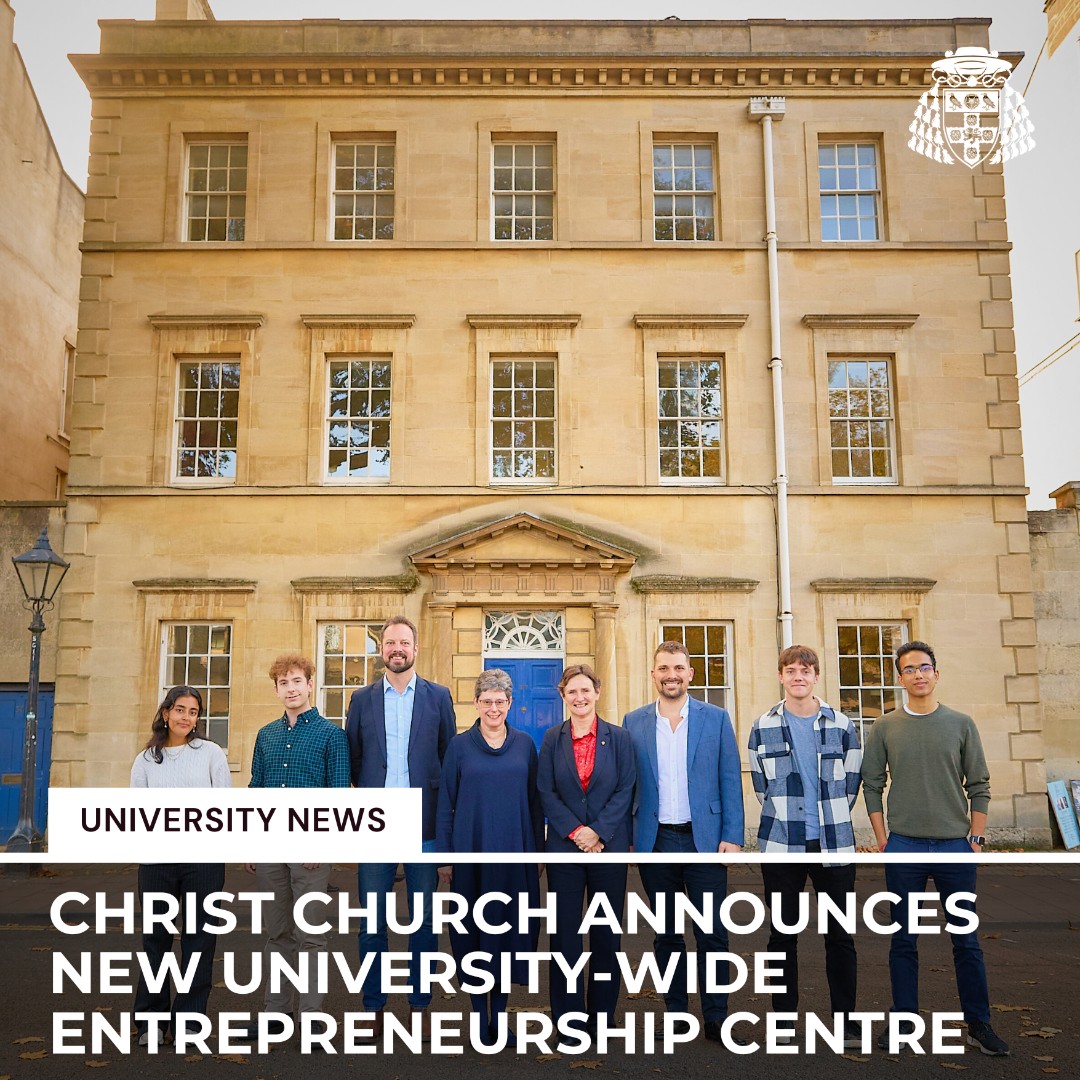
Christ Church is delighted to announce the launch of a new Centre for Entrepreneurship and Innovation. The Centre will educate, inspire and empower undergraduate and postgraduate students from across the University of Oxford.
Learn more ➡️ https://t.co/9owWeUMYag
#MuChChLove
I was particularly glad to see that news has broken – in the Vice-Chancellor's annual oration – of @ChCh_Oxford plans to support student entrepreneurship across academic disciplines with a new centre.
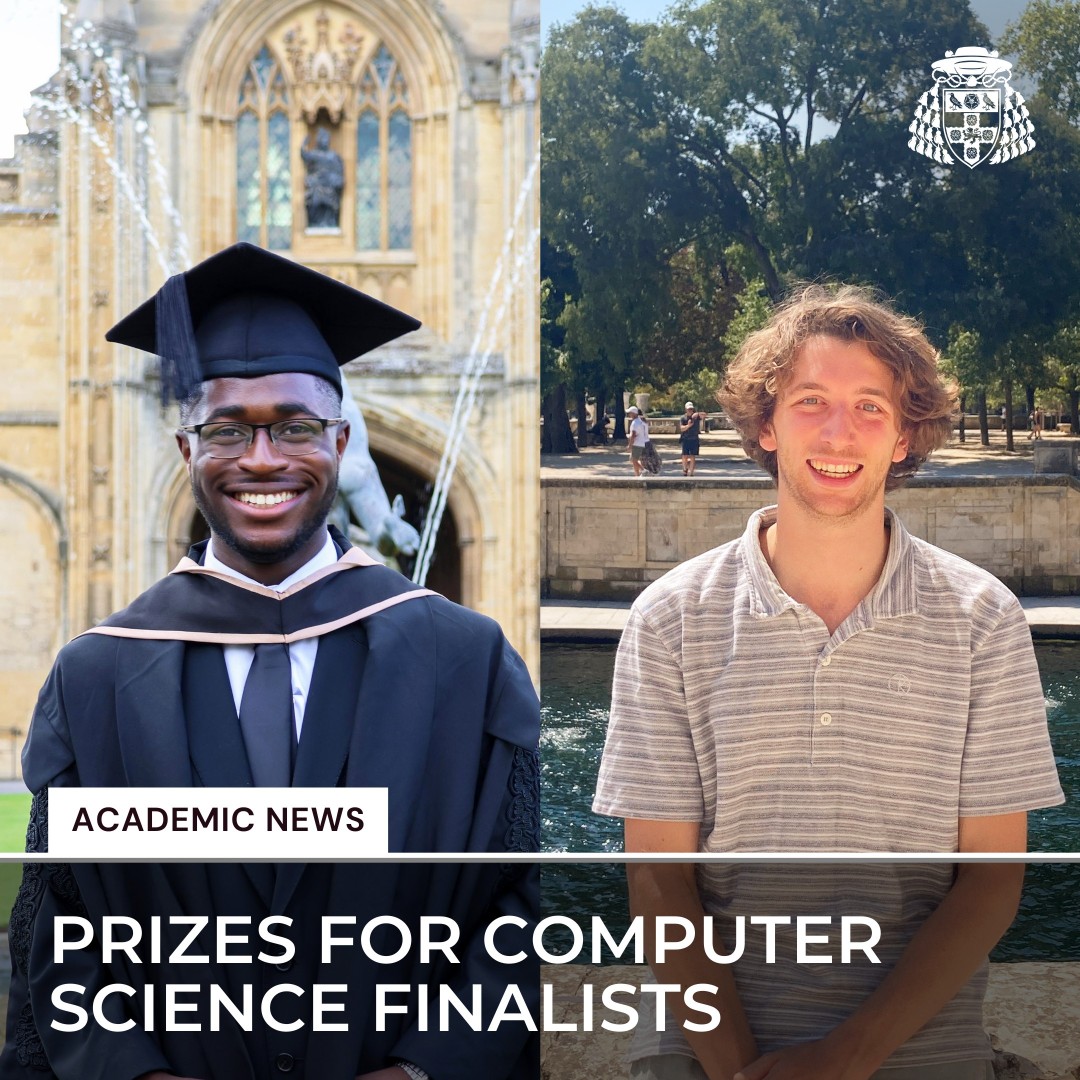
We're delighted that two of our Computer Science finalists have received awards for their impressive performance in their degrees. Well done to Joshua Omolegan and Owen Agnel! #MuChChLove
Learn more 👉 https://t.co/XqXBZ534l5
Incredible! And it was great to supervise Lucas last summer. Over the next few years, we have big plans to get our Computer Science undergraduates @ChCh_Oxford working on the open source libraries that power science and technology worldwide.
We are proud to share that Computer Science & Philosophy student Lucas Colley has been made a maintainer of SciPy (@SciPy_team), a free, open-source software library. This is very exciting news, congratulations Lucas!
Read more here: https://t.co/0wDrgfvwtF
#compscioxford
@amirvaxman_dgp I've been in this situation for a long time, needing to visualize 3D scenes (meshes, volumes, objects, whatever) in Python. There are many newer cool libraries, but to be honest the thing that has always worked for me is VTK. Just plain VTK. If you want a GUI, embed it in PyQT.
Another blog from another stellar intern. 👀
Kristian Minchev shares insights from his work enhancing NumPy support in Numba, from numpy.geomspace to Polynomial classes—navigating challenges and contributing to open source greatness. #Python#OpenSource
https://t.co/dKXA48OHLD
@Peter_shirley To be clear, you have a stack of single-channel float images? Then I think what you want is np.argmax using the axis keyword, where axis is the stack dimension.
@john_pryan To be clear, is that a triple Laplace transform (e.g., x, y, and z are all Laplace-transformed variables)? Would have to know more to say more, but if there is no simple closed form you can sometimes derive infinite sums by applying the residue theorem in the contour integration.
The first thing you notice when you walk into Bill Gates’s private office, just outside Seattle, is a wall-size installation of the periodic table with a sample of each chemical element in its own glass-fronted vitrine
[source: https://t.co/JIGpY65Wkj]
It's been extraordinary to grow Computer Science at Christ Church from scratch with @yaringal. We're rightly proud of our students, are now expanding again, and encourage anyone thinking of studying Computer Science at Oxford to apply!
5 years ago, ChC started offering Computer Science and it's now one of the largest subjects. Our CS students recently met with our Research Student Sir Tim Berners-Lee to discuss the history of the Web and the significance of "//" after "http:" #MuChChLove
@CompSciOxford & @ChCh_Access are excited to open applications for ReadySetCode, a programme for Black women from UK state schools with an interest in Computer Science! Apply if you’re 15-16! @OxOutreach@TargetOxbridge@ThinkingBlack_ @TheGirlsNet
https://t.co/V4RJwLgVkw




![Rainmaker1973's tweet photo. The first thing you notice when you walk into Bill Gates’s private office, just outside Seattle, is a wall-size installation of the periodic table with a sample of each chemical element in its own glass-fronted vitrine
[source: https://t.co/JIGpY65Wkj] https://t.co/cMdlAd2m7q](https://pbs.twimg.com/media/FoCCNRhXEAAkAku.jpg)


