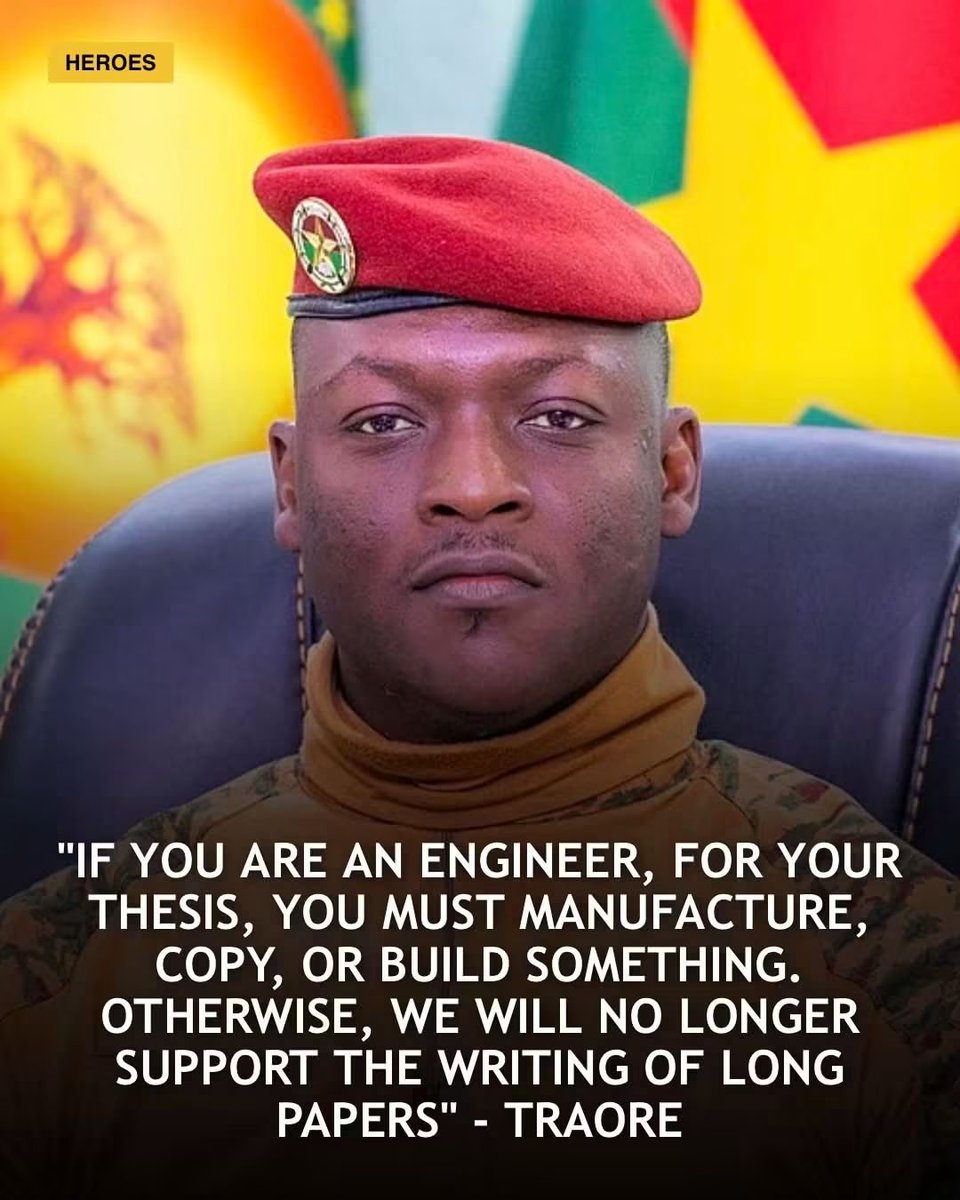
Captain Ibrahim Traoré just told Burkina Faso's engineering students that their thesis must be something they can hold in their hands. Not a bound document. Not a stack of paper. Something built.
"If you are an engineer, for your thesis, you must manufacture, copy, or build something. Otherwise, we will no longer support the writing of long papers" .
He said it in Yaadga, in northern Burkina Faso, speaking directly to young people and technical students. The message was blunt. Degrees should build nations, not grow egos .
And then he gave them the line that should be printed on every African university wall: "Copy everything you can copy except theory" .
That is not an insult to education. It is a demand for relevance. A continent that needs machines, factories, tools, and roads keeps producing paperwork instead, and calls it progress. The thesis gets filed on a shelf where no one reads it again. Nothing is built. Nothing changes on the ground .
Traoré is not telling students to invent everything from scratch. He is telling them to reverse-engineer. To take what already exists, understand it, reproduce it, and then improve it. That is how China built its industrial base. That is how Japan built its car industry. They copied, they built, they improved, and then they surpassed the people they learned from .
His government is putting infrastructure behind the rhetoric. The Technological Academy of Faso at Pabré is designed to train Burkinabè engineers at home rather than sending them abroad and hoping they return. Forty new university lecture complexes are under construction across the country .
The old model produced graduates who could write about engineering. Traoré wants graduates who can do engineering.
The homeland or death. We shall overcome. Share with someone and do you want your country to also move in this direction?
The Tragic Story of Rosemary Koech
Rosemary Koech was earning more than KSh 600,000 per month and had risen to become the Head of Data Protection at KCB Bank—a position many professionals aspire to achieve.
She had built a successful career, earned a good income, and, from the outside, appeared to have the kind of life many people would consider enviable.
Yet behind that success may have been struggles that few people ever saw.
Rosemary Koech Kimwatu was a respected Kenyan lawyer and a champion of data protection whose career spanned nearly two decades. Throughout her professional journey, she held influential roles across Kenya’s technology, fintech, legal, and public policy sectors before eventually becoming the Head of Data Protection at KCB Bank.
She was also a wife and a mother of four. To many people, her marriage appeared ideal. Their photos on social media portrayed a happy family, full of smiles, love, and memorable moments. Looking at them, one could easily assume that everything was going well and that they had built the perfect life together.
However, social media often presents only the highlights of people’s lives, not the challenges they face behind closed doors.
According to reports, Rosemary’s marriage experienced internal conflicts that gradually became difficult to overcome. Over time, the challenges reportedly intensified, eventually leading to separation. Following the separation, Rosemary moved to Ngong, where she had been living alone before her tragic death.
Her story serves as a reminder that the lives we admire from a distance may be far more complicated than they appear.
Many people have since asked how someone who seemed to have achieved so much could reach a point of such despair.
According to reports, Rosemary faced a combination of personal and professional pressures. These reportedly included workplace stress, an overwhelming workload, financial obligations, and difficulties in her personal life. Reports further allege that after she opened up about her mental health struggles, some colleagues responded by isolating her and speaking negatively about her, worsening an already difficult situation.
While the full circumstances surrounding her death may never be completely known, her passing has sparked conversations about mental health, workplace wellbeing, emotional support, and the hidden burdens that many people carry.
Her story is also a powerful reminder that success, wealth, status, and professional achievement do not necessarily protect someone from emotional pain. People who appear strong and accomplished can still be struggling with challenges that others cannot see.
As the nation mourns her loss, many continue to reflect on the importance of checking in on friends, colleagues, and loved ones, even when they seem to be doing well.
May Rosemary Koech rest in peace, and may her family, children, friends, and all who knew her find strength and comfort during this difficult time.
Everyone is neurodivergent now. We're not evolved for a society this large or technology this advanced. The only way to hold on to a semblance of sanity is to accept this.
Only we are coming to save us, and only loons will cling to a single fraying thread for the pyrite salvation;
Boomers, buy a third house.
Zoomers go viral on TikTok for 3 days.
Are you happy yet?
KENYANS, PLEASE HELP US FIND BRIAN MUGAMBI MURETHI.
I have sat for over an hour thinking about Brian Mugambi Murethi and what his family has been going through since Tuesday, 28th July 2026.
Brian is only 29 years old. He is a husband, a father to a beautiful two-year-old daughter, and the proprietor of Meru Sports House, a branding company.
On that fateful day, Brian was in Nairobi to receive his cargo.
He later proceeded along Thika Road and, according to the family, his last known interaction was with Eric Kabi, whom he had dropped at KU, around the China Square KU area.
Since then, Brian has disappeared. His phone is switched off.
His car, KDL 586R, has not been found. His family has been searching, praying, calling and hoping for a miracle.
Behind every missing person is a family slowly breaking.
His mother, Agnes Kiene Murethi, is living through every parent's nightmare.
His father, Japheth Murithi, is desperately waiting for his firstborn son to come home. His wife is waiting. His two-year-old daughter is waiting.
And somewhere, someone knows something.
To whoever may have Brian, please listen to the cry of a mother and the innocence of a two-year-old child.
If this is about money, debt, a business dispute or anything else, there are ways to resolve such matters without destroying a family.
Take the car.
Take the money.
Take whatever property you think you are owed but please, spare Brian.
Let him come home alive.
And to Kenyans: this cannot be another missing-person story that disappears from our timelines after 24 hours.
If you saw KDL 586R along Thika Road or anywhere in Nairobi on or after 28th July, speak up.
If you saw Brian, speak up.
If you know something however small tell the family or the authorities.
Do not wait for someone else to speak.
Let us become Brian's voice while his family searches for him.
Share this widely. Put pressure on the authorities to investigate every lead. Help this family find answers.
Brian must come home. Alive.
#FindBrianMugambi
#BringBrianHome
The Myth of the Glamorous Spy
When most people hear “NIS,” they imagine something out of a Hollywood script - Jack Bauer at CTU, high-stakes operations, and an aura of power. The reality is far less cinematic.
The National Intelligence Service works with whoever is available and desperate enough for money. Barmen, taxi drivers, domestic workers, street cleaners and other low-level service providers have long been among its most common sources of information.
Those who accept the same arrangement place themselves in that exact company. The difference is that the cleaner, the driver or the domestic worker is usually fighting for basic survival in an economy where a significant portion of the population lives on less than a dollar a day.
A toilet cleaner at JKIA at least has the possibility of a pension, medical cover and, in some cases, company housing.
Contrast that with the influencer or blogger who takes the same path. The money arrives in irregular, one-off lump sums that rise and fall with political temperatures.
In exchange, the recipient endures endless phone calls, constant micromanagement and the steady erosion of independence - all for a temporary payday that rarely matches the long-term cost.
Anyone currently considering mortgaging a platform for such an arrangement should understand the terms clearly. The employer will always demand more while offering less. Self-censorship becomes the price of continued access to those payments.
The next few months will be noisy and eventful. Those who have already sold their voice will watch from the sidelines, constrained by the very agreements they signed.
The cleaner still has a job with structure. The person running errands for handouts has only the next political season. The future remains open for those who refuse the trade.
🚨💣 BREAKING: Jordan Henderson to Chelsea, here we go! 🔵🏴
Former Liverpool captain has agreed a two year deal at #CFC and will sign until June 2028 this week.
Henderson left Brentford and Chelsea will now welcome him next.
Exclusive story from Monday, confirmed.
The Chicken Coop Politics of Edwin Sifuna: Manufactured Humility from a Man Who Has Handled Over 100 Million
A photo of Edwin Sifuna’s rural home in Siaka, Bungoma is being circulated to solicit sympathetic sentiment - the image of humility and servant leadership from a man who has served as ODM Secretary General for ten years and Nairobi Senator for four.
From a roughly KSh 1.5 million official monthly income as Senator and Secretary General, four years alone totals 72 million shillings. With that kind of money, he is showing us this chicken shed and expecting applause instead of hard questions about where the money went and why he has not built a proper facility that could serve as a multipurpose recreational centre for the neighbourhood.
He has spent years chasing “ma-yengs” without investing a single meaningful penny in his own community. Someone who seeks the presidency while still in office plans ahead. He builds properly.
Contrast this with the recent Lynn Ngugi story of a woman who, using modest savings, constructed a proper house to honour her late husband.
The visuals alone show that professionals - architects, engineers, interior designers - were engaged. Sifuna’s house looks like it was put up by fundis.
This mediocrity, packaged as noble humility by corrupt, money-hungry bloggers, is exactly what he will export into higher office: running the nation like a chicken farm.
Do not take the bait. A man who has handled over 100 million in salaries, allowances and the inevitable bribes has no business presenting a hurriedly erected chicken coop as evidence of character. It should impress no one.
This is precisely why the warning stands against the Linda Mwananchi bandwagon of scammers led by Edwin Sifuna, James Orengo and Babu Owino.
These are polished conmen who specialise in optical niceties - carefully staged photos, selective interviews, and the buying of media goodwill - to mask the reality that they are career operators thriving on visibility and patronage rather than substance or community investment.
Reject the theatre. Demand better.
The Self-Sabotage of “Activists”: How State-Linked Scripts Destroy Credibility and Political Ambitions
Over time, I’ve always kept wondering why activists or prominently featured individuals eventually get cast into the bin of irrelevance and are either given a wide berth during elections or voted out.
Like when the people of Tetu Constituency rejected Wangari Maathai, or the voters of Kikuyu rejected Paul Muite, I was very baffled.
Two clear examples come to mind: state-sponsored propaganda hoodlums Bob Njagi and Babu Owino.
In 2024, Njagi was “abducted” from a matatu headed to his home in Kitengela and was said to have been holed up in some NIS safe house. He was then released and even featured on the Jeff Koinange Live show, giving a story that touched many Kenyans.
Back then, he even floated the delusional idea that he was planning to vie for the presidency, of which a few Kenyans toyed around with.
But then, come 2025, and it was Njagi again being arrested in Uganda while “campaigning” for controlled opposition quack Bobi Wine. There were no images of him campaigning, just one photo of him donning the hideous red beret.
Kenyans drew the pattern of these repeated scripts and ignored the story.
When it didn’t gain the necessary momentum, he was “released” and came back to Kenya.
Then this year, a day before June 25th commemorations, there was a choreographed news burst that Bob Njagi had been arrested in Kitengela addressing an imaginary crowd. The headline was specific: “Bob Njagi arrested just a day before June 25th protests” - to associate him with organic mass action and propagate the fear that it had been called off.
That immediately destroyed what was left of his credibility. And that’s the thing: the state will provide you with so many overlapping assignments that eventually taint your brand, expose your fraud, and condemn you to social-political isolation as a demagogue working for the regime.
The same applies to Babu Owino, a frontrunner for Nairobi Governor who only needed to do morning exercises and wait. But in his infinite stupidity, he decides to resuscitate a forgotten activist called “Mr Speaker Sir” just before June 25th - a date that seems to give the regime sleepless nights.
So he brings this forgotten quack back into the limelight through scripted blogger interviews, onboards him onto the campaigns of the Linda Mwananchi bandwagon of scammers, and then at some point he’s arrested, and Babu Owino represents him in court using his big hollow words.
It’s insane how beholden these individuals are to the system, which unfortunately comes at great expense to their political ambitions because the smart audience can detect these shifting positions.
And we can only wonder what possesses these individuals into such spectacular acts of self-sabotage, because clearly it cannot be the money. It is just the thrill of undermining and sabotaging the movement and people who are simply pursuing their right to good governance, so as to appear resourceful and endear themselves to civil servants and bureaucrats. What a tragedy.
The pattern is consistent and damning. The state doesn’t just silence genuine voices - it also corrupts and eventually discards its own assets once they have served their purpose or become liabilities.
The repeated “abductions,” dramatic releases, and choreographed associations are not random. They are calculated scripts meant to build temporary credibility and then erode it when convenient.
Njagi and Owino are textbook cases of how the system uses, inflates, and ultimately burns its useful idiots. The public is learning to spot the pattern. The credibility gap widens with every new episode. And the political ambitions of these figures are quietly dying in plain sight.
Kenyans are becoming more discerning.
The days when such theatrical performances could reliably manufacture heroes or martyrs are fading. The audience has seen too many reruns of the same script.
The Day the Goons Raided My Home: A Brutal Reminder of the System’s True Nature
Every day I keep thinking how things could have gone south when the Kiganjo D(minus) DCI killer goons raided my home.
I had just inserted my Safaricom SIM card for one minute to make a payment for a network-specific vendor that was prompting rather than having a PayBill.
Then a female DCI officer posing as a prospective tenant visited the apartment one hour later, seeking to rent a unit as her cover story. In reality, she was staking out the place while the other goons waited in two vehicles within the vicinity.
When they eventually knocked on the door, one of them spoke in Kikuyu to lure me into a false sense of trust. He begged me not to tweet, claiming they were just taking me down to the station to “clarify” a few things.
To me, the only trustworthy civil servant is a dead one. And what they told me not to do is exactly what I did. That’s when all hell broke loose. With the precision of seasoned burglars, they used a vehicle wheel spanner and some cables to break the padlock.
Every time I rethink Albert Ojwang’s arrest - whose stupid friends and retarded father believed the lie by DCI goons that it was a small matter to be quickly resolved and handed him over to die - it chills me.
Some of his fake friends called me way after his death instead of immediately after his arrest. Kenyans, be extremely careful of the friends you surround yourself with.
Bottom line is that DCI and the NIS must be disbanded and reconstituted from scratch. And there is nothing new or foreign about this demand.
The NIS was split from the Kenya Police - then known as the Special Branch run by rogue killer James Kanyotu. The Office of the Director of Public Prosecutions was also split from the police, which was once a British-colonial one-stop shop for terror and death.
But it appears those were just theatrical separations. The software connecting all these institutions remains the same colonial framework of brutality and extrajudicial killings.
The illusion of “independence” was farcical. It served as more of a name change than any meaningful structural or institutional reform.
The corrupt Martha Koome-Ford Foundation judiciary, which has heard and enabled all these cases, must be stripped down to the last man, disbanded, and reconstituted. The legal paperwork that disarms families, neighbors, and property managers - convincing them to hand over their living kin only for them to end up dead - comes from fraudulently procured court orders.
The 2010 Constitution was a farce. It was a Western-funded spectacular waste of time. And anyone who was part of that process; spending countless man-hours in Bomas of Kenya pretending to be serious - should be charged with treason for scamming Kenyans into signing up for a second wave of polished oppression masked as due process.
The system has not changed. It has only refined its methods. The multiple raid on my homes, the murder of Albert Ojwang, and countless other cases prove that the colonial software of repression is still fully operational.
We must dismantle it entirely. No half-measures. No cosmetic reforms. The institutions that terrorize citizens must be torn down and rebuilt from the ground up with genuine accountability at their core.
Kenyans have seen enough. The time for real change is now. The farce must end.
If you are planning to build a house in your rural village,
Do the following:
• Open a bank account. Call it "Project Development Account 2026."
• Write a plan. Use the Triple Constraint Theory in Project Management: BUDGET, TIME and SCOPE.
• Save 50% equivalent of your rent in the account, monthly for 15 months, eg, if your rent is 10,000, then, save 5,000 in that account every month.
• If you can't raise 50% equivalent of your rent to save, then you are living beyond your means. Look for a cheaper house.
• Get an architect and a draughtsman to design a house.
• Do research, consult, read about building and construction online. Travel beyond your comfort.
• Get a Quantity Surveyor to do feasibility and the cost of the project.
• At month 15, draw a budget and begin buying material for construction, eg Sand, Ballast, Stones and timber. Stick to the budget.
• At month 18, start building.
• Get a professional mason licensed by the National Construction Authority. Be present. Supervision by phone calls is disastrous.
• Be hands-on. Learn to do the masonry work alongside the mason. Mix the ballast. Lay the bricks. Be part of the team.
• Create a rapport and good relationship with a hardware. Let this hardware be the only place you will buy construction material.
• Don't live in government houses. Don't buy the so called "affordable houses."
Build your house, to your preference and taste.
Therefore, if you are intending to build, and you start planning today, then you should be building your house in 2026 March.
It is not far.
Start today.
Be patient.
Start.
#BetterTogether
Second Lieutenant Cynthia Awuor Mboya was just 28 years old.
A young Kenya Defence Forces officer based at Gilgil Barracks, she had only recently graduated into the military and had an entire career ahead of her. But on Christmas Day 2025, her life came to a violent end inside the home she shared with her husband John Omondi.
She had travelled to Nyahera Village in Suna East, Migori County, for the festive season. Like many people working away from home, she was spending Christmas with family before returning to duty. No one imagined it would be her last holiday.
According to police, her husband John Omondi returned home from his shop in Migori town shortly after 1:00 a.m. He later told investigators that he found the front door open. After calling her name several times without getting a response, he walked into the bedroom and found Cynthia lying on the floor beside the bed in a pool of blood.
He raised the alarm through the local assistant chief, and the matter was reported at Migori Police Station at around 3:50 a.m.
The scene painted a disturbing picture.
Cynthia had a deep cut across her face, including her nose, and marks on her neck consistent with strangulation, suggesting there had been a violent struggle before she died. Detectives also established that her Samsung phone and a Tecno Camon 12 Pro were missing from the house.
As investigations gathered pace, detectives revisited the home and collected several exhibits, including a pair of black sweatpants, a grey sweater, grey sports shoes and a navy-blue cap believed to belong to her husband John Omondi.
The investigation later led officers to his shop at Cool Plaza in Migori town, where they recovered a blood-stained panga believed to be of interest to the case. It was taken together with the clothing for forensic examination.
Her body was moved to Migori County Referral Hospital Mortuary for a post-mortem.
The circumstances quickly raised more questions than answers.
The husband's account, the recovery of the suspected weapon from his shop and the injuries Cynthia sustained led detectives to arrest him as the main suspect. His mother Mary Akinyi and brother Peter Omondi were also detained to assist with investigations.
Police have never publicly disclosed a motive. While social media was awash with claims that the marriage had been troubled and that jealousy over Cynthia's military career may have played a role, those claims have never been officially confirmed. As with many high-profile cases, rumours spread quickly, but they are not a substitute for evidence.
Cynthia was laid to rest a few days later.
For those who knew her, she was more than another headline.
She was a disciplined young officer, respected by colleagues at Gilgil Barracks and admired for her commitment to service. She had worked hard to earn the rank of Second Lieutenant and was only beginning what many believed would be a distinguished military career.
She came home expecting to celebrate Christmas.
Instead, her family buried her.
There is a painful irony in Cynthia's story. She had been trained to identify danger, respond to threats and protect lives. She wore the uniform of someone entrusted with defending the nation. Yet the danger that claimed her life was not on a battlefield or during an operation—it was inside the place where she should have felt safest.
Some tragedies are difficult to understand.
Cynthia Awuor Mboya's is one of them.
The case is ongoing at Migori Law courts, with all the accused having pleaded not guilty.
Geoffrey Ouma, a 28-year-old boda boda rider working in Rongai, was married to Ann Mbone. Early last year, the couple had a serious quarrel. Ann left for Mombasa and abandoned their four-year-old child with Geoffrey. After some time, she returned home. When Geoffrey asked her where she had been all that time, Ann replied that she was a grown woman and should not be questioned like that. In that moment, Geoffrey slapped her.Ann did not react immediately. She waited until midnight when Geoffrey was asleep, then took a knife and stabbed him multiple times in the neck, stomach, and chest.Despite his serious wounds, Geoffrey managed to get up, ran outside, and screamed for help. Neighbors and his uncle quickly responded. They put him in a vehicle and rushed him to the hospital. On the way, Geoffrey narrated what had happened before he succumbed to excessive bleeding and died.Ann Mbone was in the same car but made no attempt to escape. She was arrested immediately at the scene. In early April 2025, she was charged with manslaughter and remanded at Lang’ata Women’s Prison. The case is still progressing through the Kenyan justice system at its usual slow pace.
He Lost His Job, His Wife Left Him — But His Story Isn't Over
Stanley was a KDF officer with a promising future. In 2013, while unemployed, he gathered the courage to propose to the woman he loved — and was turned down. Three years later, in 2016, he landed a job, she said yes, they married, and together they welcomed a child.
Then life took a brutal turn. After returning from a KDF mission, Stanley began battling serious mental health challenges, which ultimately cost him his career. In his darkest hour, his wife walked out — and took their child with her.
But the story doesn't end there. Through the kindness of good-hearted strangers, Stanley has secured a job in Dubai and is now rebuilding his life from the ground up.
🚨 This police constable by the name of Josphat Ogaro Nyogesoa was stabbed to death on June 26, 2026, by a wanted murder suspect during an arrest attempt in North Sakwa Ward, Awendo Sub-County, Migori County.
The suspect, identified as Dennis Oluoch, was subsequently lynched by an angry mob following the fatal attack on the officer.
This incident is viewed as a result of the June 25th demos.