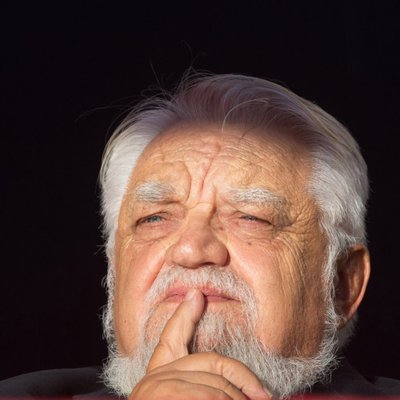
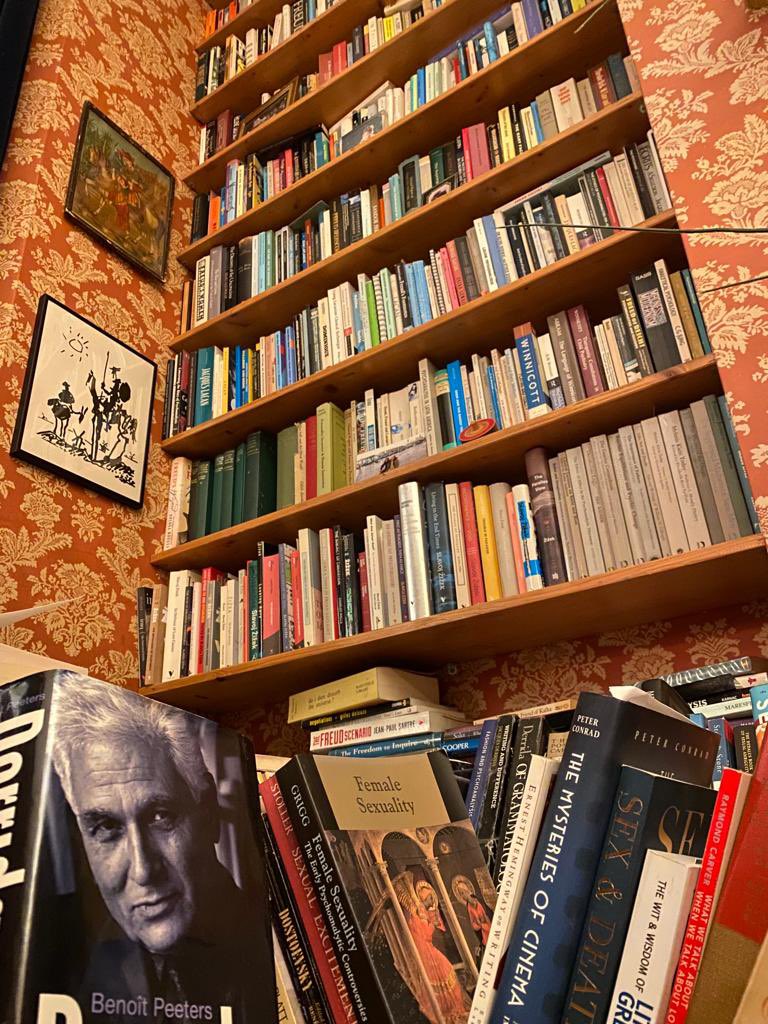
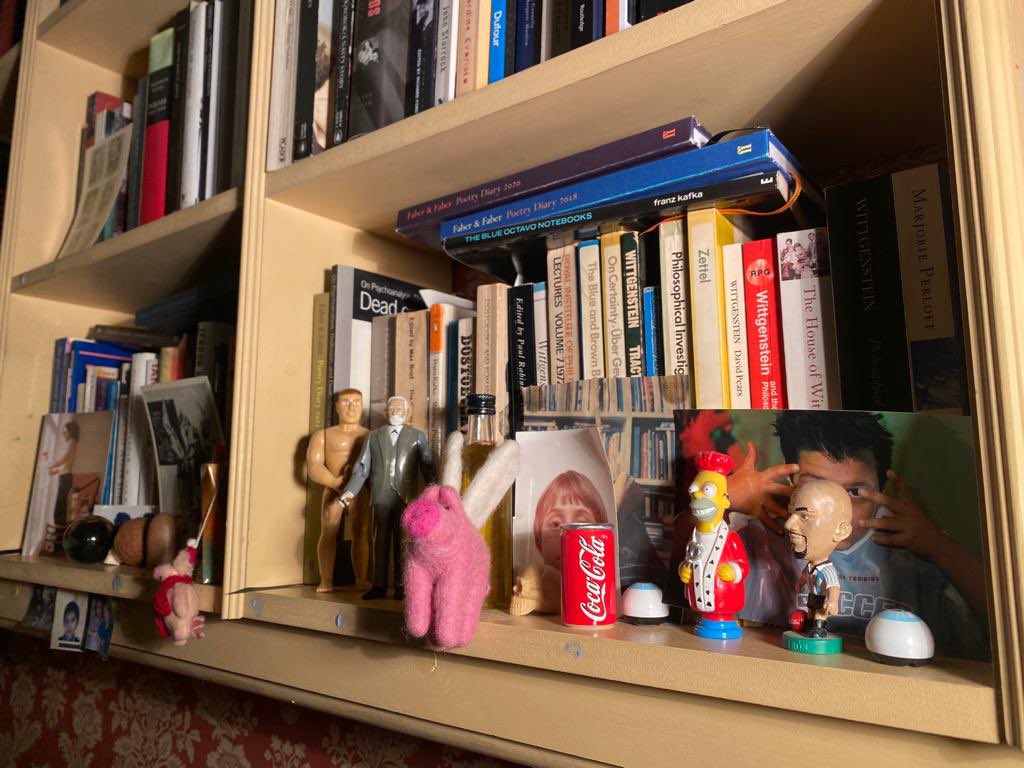
Lo scrittore apre le porte della sua casa londinese a «la Lettura». Il 5 dicembre compirà 70 anni e il 26 saranno due anni dall'incidente che lo ha paralizzato. Lo racconta in un libro («In frantumi», @libribompiani) e nell’intervista di @manzon_federica https://t.co/rXKiqHYGLB
Lo scrittore apre le porte della sua casa londinese a «la Lettura». Il 5 dicembre compirà 70 anni e il 26 saranno due anni dall'incidente che lo ha paralizzato. Lo racconta in un libro («In frantumi», @libribompiani) e nell’intervista di @manzon_federica https://t.co/rXKiqHZeB9
MAGNETS, MAGIC AND MUSLIMS
“At eight o’clock this morning, a man in full Muslim garb came into my house and gave me a bed bath.”
“So?”
“So, it made me anxious, and I am going to tell you why.”
Isabella is away in Rome visiting her parents. Maheen – an adorable, Pakistani friend of mine – has come over to look after me, as she did frequently when I was in hospital. Always generous and vivacious, I enjoy our conversations, particularly when they are combative, as this one was about to become.
She has brought with her some tuna curry and rice, the recipe for which she picked up from her maid in Bahrain.
She is standing over the hob, heating up the food, while intermittently feeding me a particularly robust Bloody Mary through a straw.
I say, “This morning, my live-in carer was joined, as usual, by a carer from the council, who comes twice a day to bathe me and get me in and out of bed. This morning, to my surprise, the council carer, a relatively young man, was South-Asian. He was wearing a black skullcap, an oriental tunic, and had a long, straggly beard.”
“And?” Maheen says.
“Well, the carers are of all nationalities and types: Africans, Caribbeans, Filipinos; people with tattoos, orange dots on their forehead, or whatever. But I have to say, this morning, seeing the man in the Muslim costume, made me wonder.”
“About what?”
“Why he thought he could come to work wearing religious paraphernalia. After all, it could be seen as divisive and intimidating by some people.”
Maheen sits down next to me and puts the straw at my mouth. I could see that she was ready for a good debate. After all, she has been through an arranged marriage, and suffered various traumas because of, what she calls, religious practices. She has no love for patriarchy and its oppressions.
She says, “There aren’t many people who dislike organised religion as much as me. But I don’t see the problem.”
I say, “Like you, I come from a Muslim background. My father was Muslim - ”
“And your family still live in Pakistan.”
“But I do think that someone who is working in healthcare, and who comes into your house, should dress appropriately.”
“Appropriately?” She says, “What does that even mean? You’ve had people here wearing hijabs, do you object to that?”
“I don’t like it, since, for me, it symbolises subjugation, but I would never complain about an individual’s right to wear whatever they choose.”
“What’s the issue then?”
“The costume is not only associated with attacks on the Charlie Hebdo journalists, or the Bataclan, or even 7/7, - ”
“This is getting ridiculous.”
“But it is also personal; Islam’s assault on a fellow writer, an advocate of free speech and a great friend of mine, Salman Rushdie.”
“What makes you think this carer approved of any of this?”
“I didn’t say he did.”
“So what is your problem? None of those terrorists were even wearing ‘religious garb’, as you call it.”
“It made me feel uncomfortable. Intimidated, in fact. Islamism is a hideous, fascist ideology, that is both homophobic and misogynistic. How would you like to live in Tehran?”
“Did you have a conversation with the man?”
“No,” I say, “He did his job, and was efficient and polite. I have no personal beef with him. But I was naked and had just taken a shit in my bed.”
“You know very well that Muslims in the west are subjected to the worst forms of racism,” she says, “Look at Gaza. You can do anything to those people, they are dehumanised. If they were French or American, you couldn’t touch them.”
“I am aware of that. But, if you are working in a bank, hospital or school, or if you are flying a plane, you dress appropriately, you wear the uniform.” Then I say, “Suppose a healthcare professional came to your house, and he was a skinhead, wearing a Ben Sherman shirt, Levis and black boots, how would you react?”
“I would be horrified, obviously.”
“Maybe I felt the same about the Muslim. I mean, under liberalism, identities proliferate. We respect and admire that, it is a function of freedom. But I wonder where the limits are. I know, for instance, that there are people who identify as furries.”
“Furries?”
“People who dress as rabbits or cats. If you were having a heart operation, and the surgeon was dressed as a squirrel - ”
“You are trivialising this.”
“ – or a badger -”
“The man visiting you this morning had faith, he believes in something. Surely that, to you, is incredible, if not moving?”
“That makes it even worse from my point of view.” I say, “I don’t respect faith, all kinds of twats have faith, anyone can sincerely hold some wild belief or bizarre ideology.”
We batted this around for a while longer as Maheen set the table. Then, she placed a kitchen towel around my neck and began to feed me.
“I am in a spiritual mood today.” She says, “You’ll like this, I brought my zen magnet with me.”
“Oh no, not that fucking magnet.”
When Maheen visited me at my rehab facility, Stanmore, she became popular with the staff for her palm readings, which were always optimistic. Nurses would queue at the door for her insights. She even read the palm of my son Carlo, who is typing this, telling him that quite soon, he would become rich. Looking at my palm, she said she saw a strong life line with a break in it, my accident.
Now, Maheen is irritated with me over my cynicism about the magnet, but my carer, Daniele, has come down from her room and is hanging about at the end of my bed, intrigued.
Maheen tells Daniele that she may have ‘past trapped negative emotions’ trapped within her body. She gets Daniele to stand in front of her and sway back and forth in answer to various questions about her relationships.
Maheen then takes out the zen magnet, which resembles a large credit card, and waves it over Daniele, apparently drawing out the trapped negative emotions.
I say, “I think this is exploitative, if not cruel. You cannot waft this so-called magnet around someone’s head and actually believe that this is drawing out anything. To be honest,” I say, “it is fun, but you are truly taking the piss.”
“I like helping people.”
“I love that about you, I envy your kindness.”
“Next time I come, I will bring my tarot cards.”
Maheen puts her coat on, readying to leave. “Before your accident, you lived in a protected circle. You chose your world, and it was well defended. Now, you can’t keep the world away. But it is good for you to run into real people now and again.”
As she kisses me and says goodnight, she adds, “You know, one time, I was in great distress about my husband, and I went to visit my GP. My heart sank when I saw she was wearing a hijab. But after I told her my condition, she embraced me, and said, ‘we will get you out of this, I will do whatever it takes to help you’.”
“I liked the tuna curry. More spice next time.”
-----
If you wish to preorder my forthcoming memoir, Shattered, you can do so by following the links provided here:
https://t.co/KVxdGXJqm0
ADVENTURES IN THE TEACHING TRADE
In my early twenties, when I became writer in-residence at the Royal Court theatre in Sloane Square, it was taken for granted by the directors that I would teach. I was informed, somewhat casually, that I would run a group each week as part of the Court’s youth theatre.
When I turned up, I was startled to find a group of young adults sitting in a circle looking at me expectantly, as if I was someone who knew what they were doing. Never mind that I hadn’t taught before; or that I was more or less the same age as the students. No one had prepared me for this. I was, as they say, thrown in at the deep end.
But I did have some experience with teaching. I’d been taught by both my father and by an editor at the Anthony Blonde publishing house, Jeremy Trafford. But that was one on one teaching: mostly encouragement from my dad and instruction from Jeremy on the creation of character, which in his view drove all interesting writing.
I was always interested in how stories are created out of elements like plot, structure, suspense, conflict and relationships. How does a writer work on himself to produce and shape ideas? Where do they come from? How do you know whether an idea is a good one? How do you bring it to fruition?
For me writing has always been practical. After all, I began this piece by wanting to write something about teaching but when I started I had only the first couple of sentences. Some people like to plan an entire piece in advance but I’ve never worked that way. Experience has taught me that one idea will produce another idea. Shape will come later.
And so, confronted with a group of twelve young and eager faces, many of them, unfortunately, appearing highly intelligent and from cultured families, I knew I couldn’t bullshit.
We would talk about what we expected from the workshop before beginning on the practical part. It was essential to me that at every workshop the students would produce a piece of writing: it might be the creation of a particular character, a description of a place or a conflict. I would send them away for thirty minutes to a quiet area in the building where they would write something new. There was a time limit, it was high pressure.
The young writers would read out their work and the group would articulate their thoughts. This set the paradigm of how I learned to run workshops; having no idea what other writing teachers would do, I created a space where ideas could be developed by the group. The students began to talk to one another, becoming friends and collaborators, going to each other’s houses. I saw that running a workshop meant standing back, keeping out of the way, allowing it to develop its own energy and momentum.
Later, I was invited to run bigger workshops including weekend courses, or even week-long courses for the Arvon Foundation. These involved longer sessions and more reading. It wasn’t uninteresting to find out what the students were thinking at that time; politically, socially, sexually and so on.
Through this experience, I began to learn what constituted originality, and I become aware of what a small proportion of the work I read was of value. You would spend time with writers who couldn’t improve much; there is a limit beyond which they can’t go.
I no longer run workshops or groups, it’s too tiring and it’s not as effective as working with a single student. But on the other hand, the students do learn from one another. Their competitiveness can be a simulant.
Occasionally, it can become clear to the teacher that what the student is actually doing is exploring some particular part of their history in order to think it through. They wonder what went on in their childhood, with their parents, or whatever. This is writing as therapy.
I had a private student who worked with me on a novel for ten years, and she still doesn’t appear to have got anywhere close to finishing it. I wonder now if she was ever really serious about writing the book at all, and why she kept on seeing me. I suspect she enjoyed our conversation, and that the project was therapy by other means.
You cannot exhaust an analysis of your childhood. There is always more to go over, and another way to see things. So, for people who don’t believe they need therapy, writing is a place where they can find out about themselves. After all, writing can be as useful as a dream when it comes to exposing the unconscious. You are there without knowing it.
As a reader I might see things in a student’s work, and therefore in their life, that they were unable to see themselves; I can suggest connections or even truths which may not have occurred to them. These points have to be said at the right moment, when the subject is on the verge of discovering them. You are not the expert of their life.
I teach a young woman now who is talented and her work is strange, evocative and original. I’ve never read anything like it. Many students, even the good ones, tend to follow some kind of formula. They want to write like other people. But this woman is so original it is difficult to know what to say to her. I mostly listen while she tells me what she is doing. I guess my job is to respond in an authentic way. But this is unusual. Most writers need a lot of advice both about their work and the market.
I like working side by side with a student as they cut and rearrange their work to make it more effective. I am their editor and can be a motivator. It’s cheering to see writers improve or to read those who have an original point of view. It reminds me of what I enjoy about reading and others’ creativity.
One of things you might have to do as a teacher is disillusion the student: by this I mean inform them what hard work and commitment – in terms of time and energy – it takes to write a book. It is not a breeze; there will be a lot of frustration to bear, and a lot of rewriting to do, some of which is tedious and exasperating. The chances are that no one will ever read or appreciate your work, so it must be done for its own sake, which is always the best way to do it.
The most frustrating students are the ones who you might call ‘semi-talented.’ They have good ideas and can write a bit, but never reach the standard of publication. I’ve had several students like this, and I wonder what happened to them.
During the time that I’ve been teaching there’s been an eruption of creative writing courses: particularly in universities in the United States but also here in Britain as well as in Europe. It is a neoliberal idea that you can improve or even purchase talent.
On occasion, I have been sent students who are barely proficient in English, let alone able to produce a substantial piece in that language. The colleges are more interested in accruing the wealth of overseas students than in producing quality writing.
If you think of the writers throughout history you have admired, you will find that none of them from, say, Sophocles to J.K. Rowling, actually attended created writing courses. This isn’t to say that these writers haven’t been taught. Presumably they would have read a lot, or shared their work with intelligent friends, editors and other encouragers. But this formalisation of writing has always had something absurd about it.
I still like to teach but I’ve always found it meaningless when I am supposed to give the students a mark or even a degree. It useless to point out to the authorities that giving a student a B+ is neither here nor there. What makes a writer a real writer is that they begin to find an audience for their work; readers who are excited by what they find on the page.
This isn’t to say that it impossible to teach. If anything, creative writing courses do enable writers who are starting out to make contact with readers who know how to talk about texts. A pithy intervention can really help someone.
Someone once said that at least one in five people are writing a novel. I barely know anyone who isn’t. It is still a prestigious form. And so, despite social media – the junk food of communication – literature continues to adapt to the contemporary mood. Where there is digital overload, people are returning to this more relaxed, nutritious analogue mode - reading words on a page.
Reading a great novel like Middlemarch – the minute exploration of class, character and society - is both demanding and time consuming, but in its depth and forensic analysis, it goes further than anything the media can do today.
The return to the novel is not unlike the present rebellion against late-capitalism’s production of trash; junk food, junk pop, cheap clothing and electronics, barren hook-ups. The age of kitsch and synthetic bargains is over; we are experiencing a necessary correction, people want that which is authentic, lasting and real.
If you would like to preorder Shattered, you can do so on Amazon here: https://t.co/i0K7Otn03B
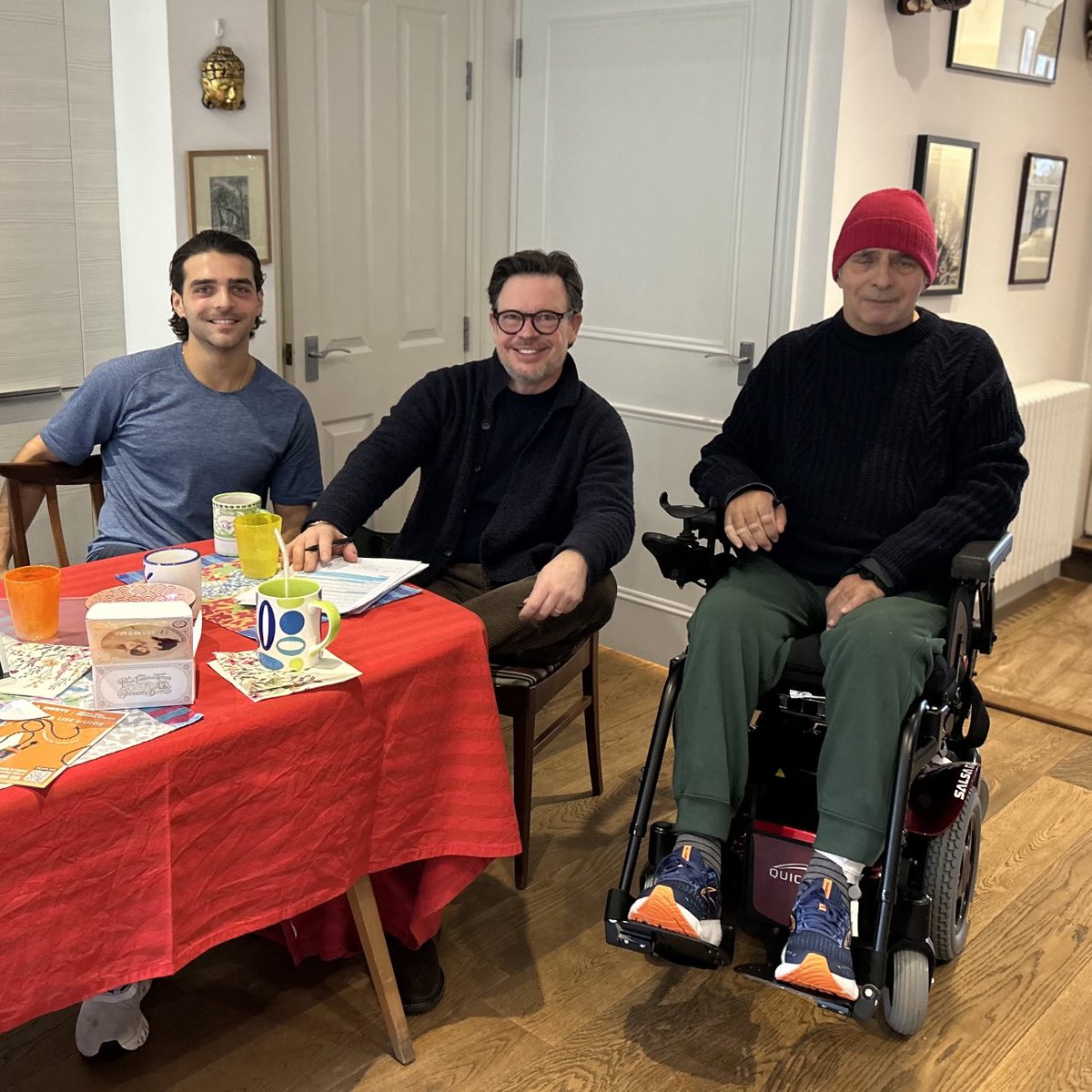
Day One of editing with HANIF KUREISHI and @carlokureishi, with Hanif finally back home after a year in hospitals. The book we are working on is called ‘Shattered’ — a record of that year — to come this October
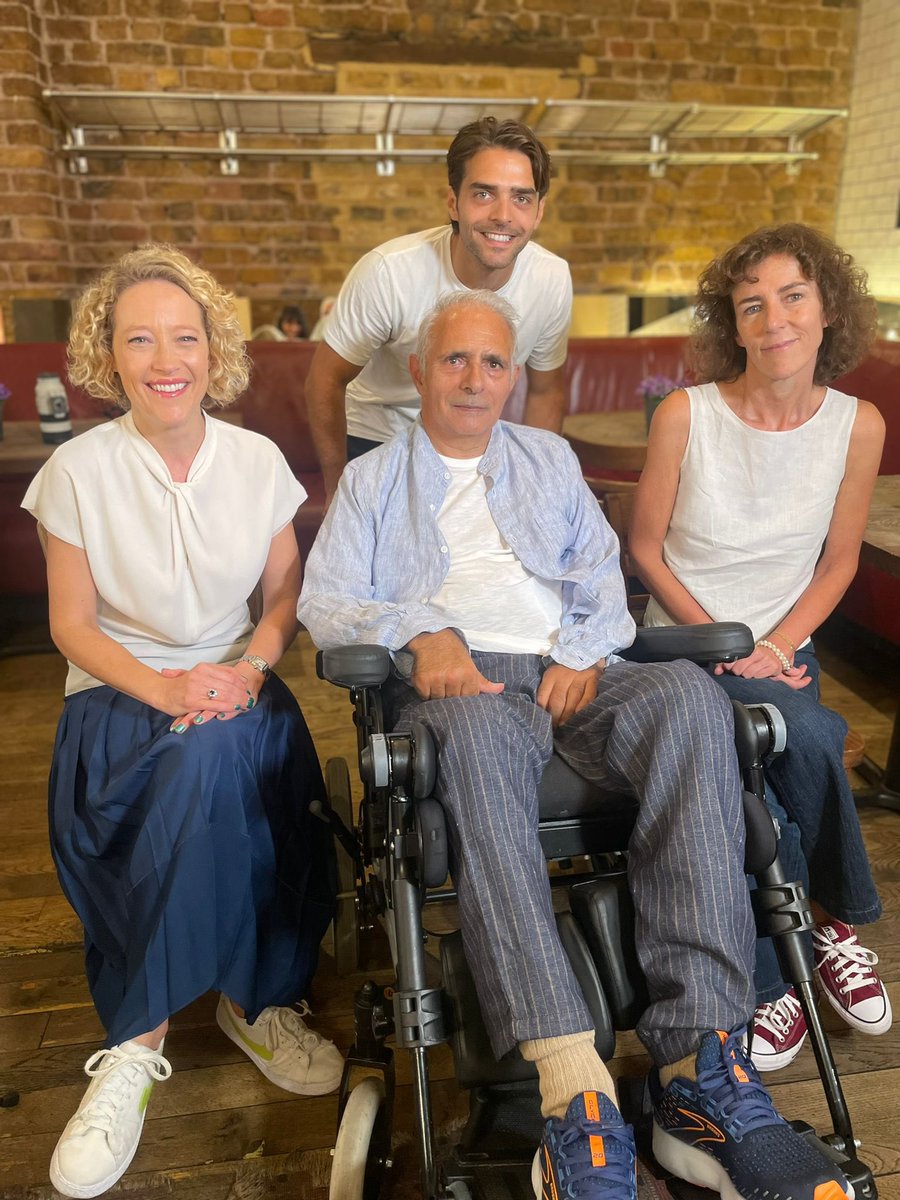
Tonight, in his first TV interview since his devastating accident, author @Hanifkureishi briefly escapes from hospital to tell me on @Channel4News about life, death, writing and dreaming of returning home. Do tune in at 7. It’s tragic, comic and wonderfully human.
LIFE IS NOT BEAUTIFUL
Yesterday, as you might have heard from my son Carlo, was a bit of a catastrophe because we wrote the blog and then we lost the blog. I am sure all of you have had this experience.
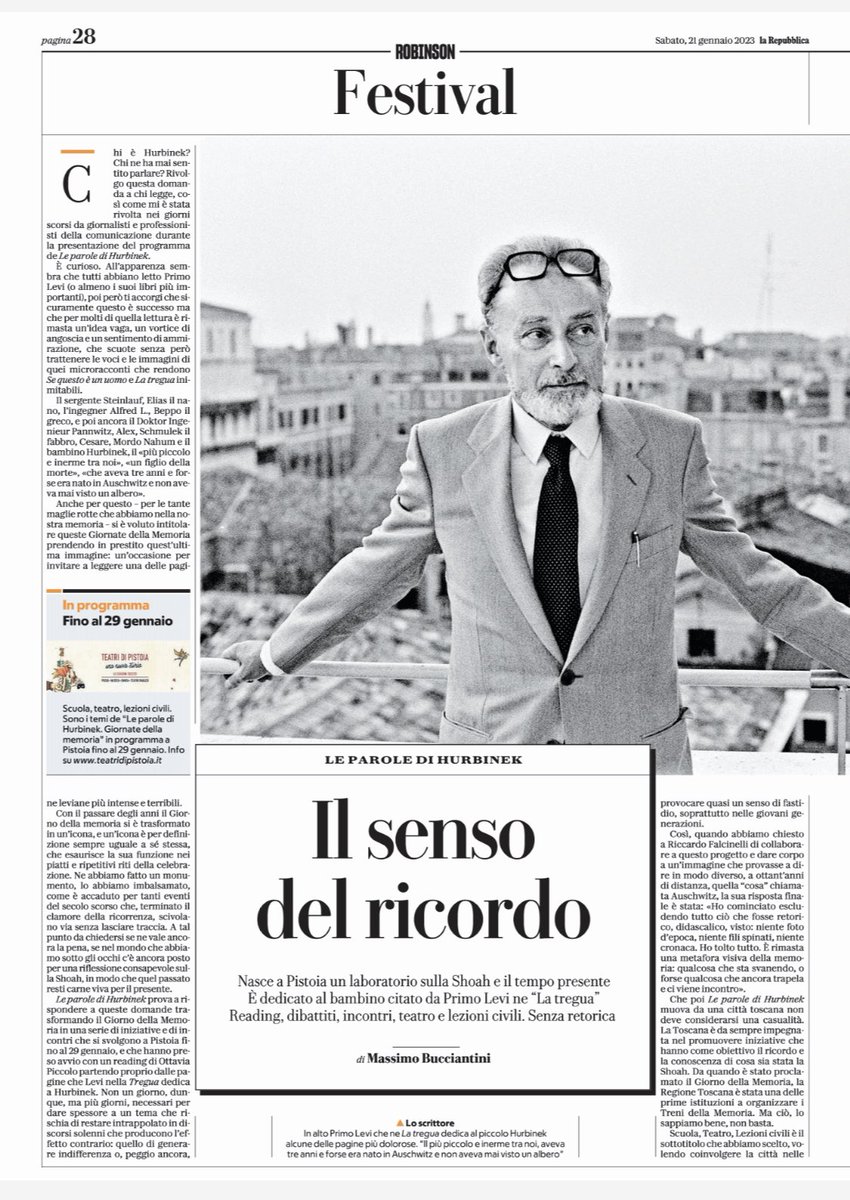
Oggi su la Repubblica Robinson leggete il pezzo di Massimo Bucciantini sul senso del ricordo in occasione di “Le parole di Hurbinek” rassegna sul giorno della memoria che si svolge a Pistoia fino al 29 gennaio. @Robinson_Rep@teatridipistoia