GPT-6 ASTRA TURNED $240 INTO $2,860. THEN IT LOCKED MOST OF THE MONEY AWAY FROM ITS OWN TRADING AGENTS.
four sessions into the experiment, i opened the trading wallet.
$895.
the report said $2,860. i refreshed both screens, convinced something had gone wrong.
then i opened the transfers.
$1,965 had moved into a separate reserve wallet. every transfer had a receipt. the numbers matched to the cent.
the desk had four jobs.
three agents handled discovery, contract checks and execution. the fourth was called CASHIER.
CASHIER watched settled results. after each profitable session, it moved 75% of the net gain into reserve.
the trading agents could see that balance. their permissions gave them no way to pull it back.
that detail suddenly became very interesting to me.
i started calculating what the next position could look like with the whole $2,860 available. opened the settings. hovered over the allocation.
then closed them.
the next session was ugly.
two positions closed red. working capital dropped from $895 to $731.40. i watched the desk reduce its next order and keep scanning.
the reserve still read $1,965.
that was the first time the setup made sense emotionally. a bad session had a smaller pile of money available to damage.
i spent another hour reading the logs. the least exciting agent on the desk had done the thing i was most likely to postpone.
it had actually taken the money off the table.
CASHIER never found a single winning token. it was the first agent i decided to keep.
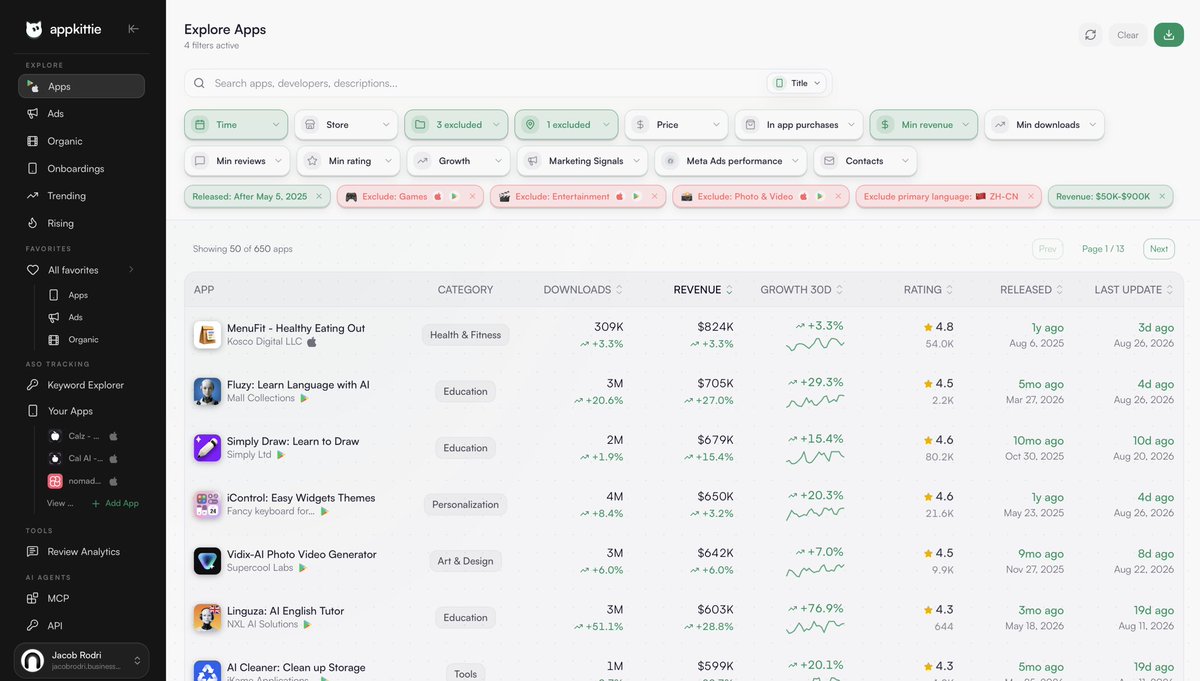
find app ideas that already work:
1. go to https://t.co/NZhuGHxhiV
2. filter apps making over $50,000/mo
3. filter apps launched <1 year ago
4. get inspired by one of them
5. build a better version
find demand, then build
My friend applied to 250 tech jobs in two years. No MIT. No Stanford.
Last month Anthropic offered him $750,000.
I asked him how he broke in from zero.
He sent me the exact video that got him in. Anthropic's 2-hour course on how to become an AI engineer in 2026.
Thariq Shihipar shows you exactly how to build AI agents from scratch.
I watched it last night.
Halfway through, I realized I could break into an AI lab in months, not years.
Bookmark this and read the article below.
• 00:00 - AI agent harness
• 23:44 - building AI agent loops
• 56:39 - AI agent context engineering
• 1:33:34 - AI agent deterministic hooks
• 1:50:31 - Anthropic SWE interview process
ANTHROPIC JUST EXPOSED HOW BADLY MOST PEOPLE ARE PROMPTING CLAUDE.
Their applied AI team dropped a 24 minute workshop.
Free.
From the people who wrote the model.
Not a course creator.
Not someone who figured it out by accident.
THE TEAM THAT BUILT THE THING.
Here is what makes this uncomfortable to watch.
There are 6 elements to a properly structured Claude prompt.
Most people are using 1.
Maybe 2 if they are being generous with themselves.
That gap is the difference between Claude giving you something useful and Claude giving you something you could have Googled.
The people who watch this workshop tonight will prompt differently tomorrow morning.
The people who skip it will keep wondering why their outputs feel slightly off no matter how much they tweak the wording.
24 minutes.
Free.
From the only people on earth who know from the inside exactly how Claude thinks.
I watched it twice.
Then I built a Claude Skill that applies all 6 elements automatically so you never have to think about prompt structure again.
Every prompt you run goes through the framework without you doing anything manually.
Full guide and the skill setup is below.
Bookmark this.
Come back to it this weekend.
This is the thing that compounds.
Follow @cyrilXBT for the exact Claude skills, prompt architecture, and systems I use to get outputs that most people do not believe came from one person.
My little brother failed math twice.
He's 17. Mom took his PlayStation.
I walked into his room. Three monitors. No games.
"What are you doing?"
Filtering wallets.
He found an article about how the top 7% actually win on Polymarket. Not win rate. Payout ratio.
He showed me the screen:
> 7 wallets tracked
> 1 category only
> payout ratio: 4.2x
"That's it?"
Blocked every category except one. No politics. No sports.
I watched for 30 seconds:
+$14.20 captured
+$8.90 captured
+$22.40 captured
"How much did you make?"
Copy his bot here: https://t.co/N2byLbLHH9
$41,300. Three months. From his room.
"How?"
Claude filtered 100K wallets. Found 7 with >70% win rate in one category. He just copies them.
He bought mom a new kitchen last week. She cried.
Dad still thinks he's gaming.
He went back to his room. Three monitors. No games.
He still can't pass algebra.
The bot doesn't care.
Holy shit...
A guy got laid off, built an AI job search system on Claude Code, evaluated 740+ job offers with it, and landed a Head of Applied AI role.
Then he open-sourced the entire thing.
It's called career-ops. One slash command. Full pipeline.
Paste a job URL → get back a structured A-F evaluation, an ATS-optimized PDF tailored to that exact role, salary research, interview prep, and a tracker entry. All in one shot.
No spreadsheets. No copy-pasting. No spray-and-pray.
Here's what's inside:
→ 14 skill modes (evaluate, scan, pdf, batch, apply, deep research, negotiation scripts, LinkedIn outreach)
→ Portal scanner pre-loaded with 45+ companies — Anthropic, OpenAI, ElevenLabs, Mistral, Cohere, Stripe, Retool, Vercel, Decagon, the works
→ 19 search queries across Ashby, Greenhouse, Lever, Wellfound, Workable
→ ATS-optimized PDF generation via Playwright with Space Grotesk + DM Sans
→ Go terminal dashboard built with Bubble Tea to browse your pipeline
→ Batch mode that evaluates 10+ offers in parallel using Claude sub-agents
→ An interview Story Bank that accumulates STAR+Reflection stories across evaluations until you have 5-10 master answers for any behavioral question
→ Auto-fill for application forms
The wildest part isn't the automation. It's the philosophy.
Career-ops is explicitly NOT a spray-and-pray tool. It's a filter. The system literally refuses to recommend applying to anything scoring below 4.0/5. The whole point is to find the few offers worth your time out of hundreds, not to flood recruiters with garbage.
It evaluates fit by reasoning about your CV vs the JD. Not keyword matching.
And because it's all built on Claude Code skills, you can ask Claude to rewrite the system itself. "Change the archetypes to backend roles." "Add these 10 companies." "Translate the modes to English." It reads the same files it uses, so it knows exactly what to edit.
8.2k stars already.
100% Open Source. MIT licensed.
Giving This Free for 24 hours. To get it:
1. Comment the word 'PolyMarket'
2. Like and Retweet this post
3. Follow me @marryevan999 (so i can DM you)
I’m going to show you how *incredibly easy* it is to add some AI-magic to the search bar in your sites & apps in 2025 using @typesense.
Say you’re building a cars site & you have a search bar on top. You have cars. Cars have attributes. You have well structured data like make, model, color, year, hp, mileage, etc. Cool.
Along comes a user & types this into your search bar:
“A black SUV with less than 30K miles in Houston for less than 20K”.
☠️🫣
If you’ve built any kind of search experience you probably know how hard it is to map free-form text like that to specific attributes in your dataset.
Like how do you know that 20K is talking about cost, and black is talking about the overall color and not the color of the seats, and then account for the zillion other ways your users can write the same query?
If you haven’t encountered this, let me tell you that it is HARD to use simple full-text search or even fancy semantic search or hybrid search to pull this off.
Traditionally you’d have to train and build what’s called intent detection ML models to do this well.
Ain’t nobody got time for that! 🤓
Enter @Typesense - an open source, cutting edge, light-weight alternative to Elasticsearch / Algolia.
As of v29.0, it now has a built-in feature that cleverly uses the magic of LLMs, to parse your users’ queries, and convert them automatically into a set of filters and sorts, and then executes that query and returns results.
So in our example “A black SUV with less than 30K miles in Houston for less than 20K” gets converted by Typesense automatically into this search query:
Notice how the free-form user query was correctly mapped to the attributes and values in our cars dataset under the hood.
It’s literally one API call to Typesense, to make this magic work:
The curl request will return results like this:
And you’d display those results in your UI.
That’s it. What used to take teams of ML experts, is now one API call away. No PhD required.
You now have an AI-powered search bar that’s ready for the most brazenly complicated user queries.
How about this one:
No problemo!
That get's translated to: 🪄
```
filter_by: "transmission_type:AUTOMATIC"
```
(Only 4 images per tweet, so only text for that one)
Even though `transmission_type` only has
- `Automatic` and
- `Manual`
across all records, Typesense is able to automatically convert the user’s intent in “I don’t know how to drive shift” to the fact that we should only show them vehicles with automatic transmission.
Easy-peasy.
Here’s a step-by-step guide on how to implement Natural Language Search in your own sites and apps:
https://t.co/KUgjTQ9weB
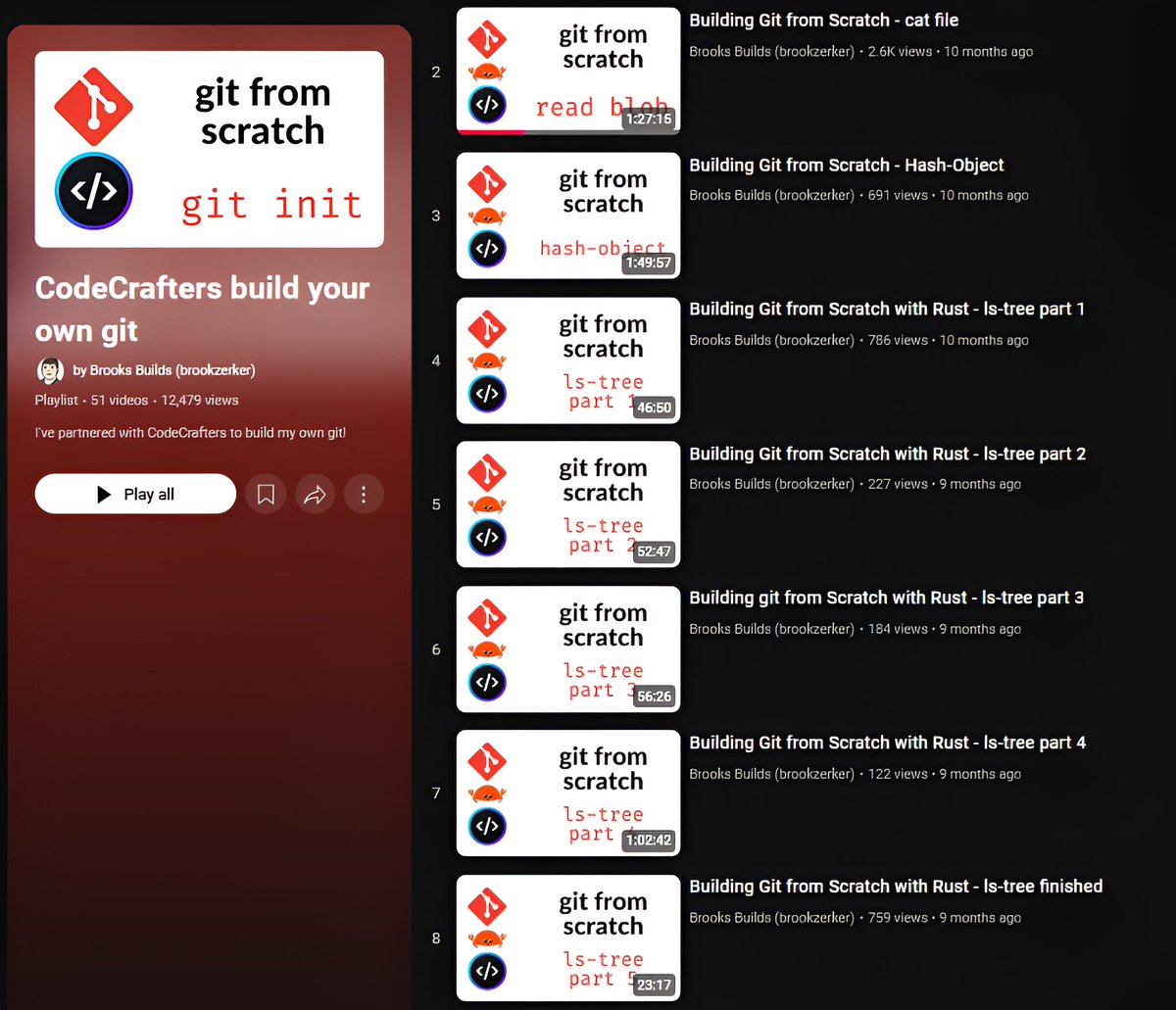
Build Your Own "Git" In C From Scratch
-really great playlist, use this to get most out of this.
-it's great if someone wants to understand how really "Git" works behind the scenes.
-it would give you solid foundation for "Low level system programming".
-don't watch completely, it's quite long, just do what you need.
-learn as you require concepts that you need.
Who do you think is the most insane programmer of our current era?
I think it’s Evan Wallace (cofounder of Figma):
- Basically rebuilt the browser rendering stack to run in the browser for Figma
- Built CRDTs to run Figma’s multiplayer tech for millions of users
- Built a JS bundler 10-100x faster than the status quo (esbuild)
- First person to do crazy graphics stuff on the web (WebGL water)
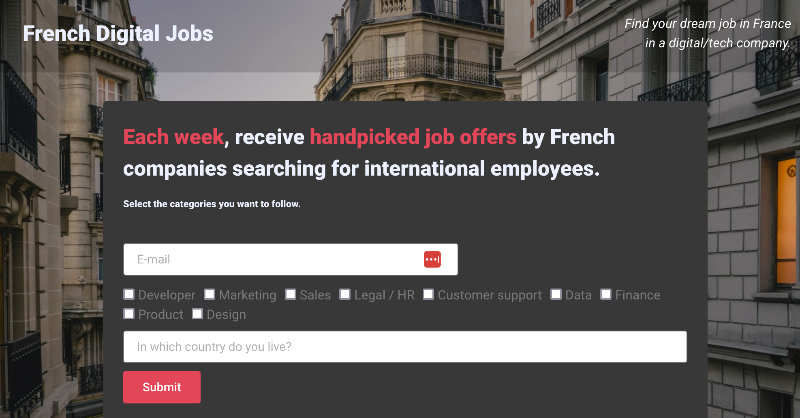
Each week, receive handpicked job offers by French companies searching for international employees.
Companies where :
- French is not required,
- You can apply online from your country.
Jobs in dev, marketing, sales, HR/legal, support, data, finance, product, design
I've seen multiple questions about how to build a Chatbot that:
• Retrieves data from PDFs and
• Has conversational memory
Turns out, it's really simple to do with @langchain.
So, I wrote a quick tutorial with a real-world example for you all.
Code below.