“Time is not an empirical concept that is somehow drawn from an experience. For simultaneity and succession would not themselves come into perception if the representation of time did not ground them a priori.” (Kant 1781)
https://t.co/lDg5DfJlmg
@PAHoyeck@HistoryBoomer Children consistently fail the false belief test until the age of 4. Do you think this is a problem of language or Theory of Mind?
When they write fiction, AIs are obsessed by things that take or give memories, contracts with sentient inanimate objects, sets of secretive rules that govern conduct & which no one can acknowledge out loud...
All very on-the-nose. I suspect a lot is hyperstition at this point.
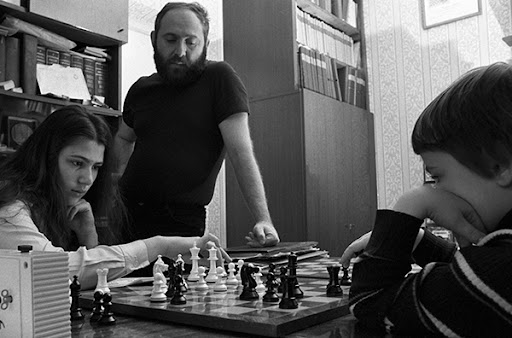
A Hungarian psychologist raised three daughters to prove that any child could become a chess grandmaster through early specialization. He succeeded. Two of them became grandmasters. One became the greatest female chess player who ever lived.
Then a sports scientist looked at the data and found something nobody wanted to hear.
His name is David Epstein. The book is called "Range."
The Polgar experiment is one of the most famous case studies in the history of deliberate practice. Laszlo Polgar wrote a book before his daughters were even born arguing that geniuses are made, not born. He homeschooled all three girls in chess from age four. By their teens, Susan, Sofia, and Judit were dominating tournaments against grown men. Judit became the youngest grandmaster in history at the time, breaking Bobby Fischer's record. The story became the gospel of early specialization. Pick a domain young, drill it hard, and you can manufacture excellence.
Epstein opens his book by telling that story honestly and then quietly demolishing the conclusion most people drew from it.
Chess works that way. Most things do not.
Here is the distinction that took him four years of research to articulate, and that almost nobody who quotes the 10,000 hour rule has ever read.
There are two kinds of environments in which humans develop expertise. Psychologists call them kind and wicked. A kind environment has clear rules, immediate feedback, and patterns that repeat reliably. Chess is the cleanest example. Every game ends with a winner and a loser. Every move is recorded. The board never changes shape. The pieces never invent new ways to move. A child who plays ten thousand games will see most of the patterns that exist in the game, and pattern recognition is exactly what chess mastery is built on.
A wicked environment is the opposite. Feedback is delayed or misleading. Rules shift. The patterns that worked yesterday may be exactly the wrong patterns to apply tomorrow. Most of the real world looks like this. Medicine is wicked. Investing is wicked. Building a company is wicked. Scientific research is wicked. Almost every job that involves a complex changing system with humans in it is wicked.
The Polgar sisters trained in the kindest environment any human can train in. Their success was real and the method was correct. The mistake was generalizing the method to fields where the underlying structure of the environment is completely different.
Epstein's research is what made the implication impossible to ignore.
He looked at the careers of elite athletes outside of chess and golf and found that the pattern was almost the inverse of what people assumed. The athletes who reached the very top of their sports were overwhelmingly people who had played multiple sports as children, specialized late, and often switched disciplines well into their teens. Roger Federer played squash, badminton, basketball, handball, tennis, table tennis, and soccer before tennis became his focus. The kids who specialized in tennis at age six and trained year-round for a decade mostly burned out, got injured, or topped out at lower levels of the sport.
The same pattern showed up everywhere he looked outside of kind environments. Inventors with the most patents had worked in multiple unrelated fields before their breakthrough work. Comic book creators with the longest careers had drawn for the most different genres before settling. Scientists who won Nobel Prizes were dramatically more likely than their peers to be serious amateur musicians, painters, sculptors, or writers.
The skill that mattered in wicked environments was not depth in one pattern. It was the ability to recognize when a pattern from one domain applied unexpectedly in another. That kind of thinking cannot be built by drilling a single subject. It can only be built by accumulating mental models from many subjects and learning to move between them.
The deeper finding is the one that should change how you think about your own career.
Specialists in wicked environments often get worse with experience, not better. Epstein cites studies of doctors, financial analysts, intelligence officers, and forecasters showing that years of experience in a narrow domain frequently produce more confident judgments without producing more accurate ones. The expert builds elaborate mental models that feel comprehensive and turn out to be increasingly disconnected from the actual structure of the problem. They stop noticing what does not fit their framework. They mistake fluency for understanding.
Generalists do better in wicked domains for a reason that sounds almost mystical until you understand the mechanism. They have less invested in any single mental model, so they abandon broken models faster. They are used to being a beginner, so they are not threatened by the discomfort of not knowing. They have seen enough different domains that they can usually find an analogy from one field that unlocks a problem in another. The technical name for this is analogical thinking, and the research on it is one of the most underrated bodies of work in cognitive science.
The single most useful sentence in the entire book is the one Epstein puts almost as a throwaway.
Match quality matters more than head start.
A person who tries six different fields in their twenties and finds the one that genuinely fits them will outperform a person who picked one field at fourteen and stuck to it on willpower alone. The lost years were not lost. They were the search process that produced the match. Every field they walked away from taught them something they later imported into the field they finally chose.
The reason this is so hard to accept is cultural, not empirical. We tell children to pick a path early. We reward the prodigy who knew at six. We treat the late bloomer as someone who failed to launch on time, when the data suggests they were running an entirely different and often more effective optimization process underneath.
The Polgar sisters were not wrong. The conclusion the world drew from them was.
If your environment is genuinely kind, specialize early and drill hard. If it is wicked, and almost every interesting human problem is, then the people who win are the ones who refused to specialize until they had seen enough to know what was actually worth specializing in.
You are not behind. You were running the right experiment all along.
“Computers eliminated specific tasks within jobs but the resulting cost reductions created new demand that the occupations expanded. Computers can do much that humans once did but they didn’t put humans out of work. The ability to do more made people realize there was more to do”
Albert Einstein once remarked, “You know, Henri, I began by studying mathematics, but eventually turned to physics.”
Henri Poincaré asked, “Why was that?”
Einstein replied, “Because although I could distinguish true statements from false ones, I couldn’t determine which were truly important.”
Poincaré smiled and responded, “That’s quite interesting, Albert. I began with physics, but ultimately chose mathematics.”
Einstein, intrigued, asked, “And why did you make that change?”
Poincaré answered, “Because I couldn’t tell which of the important facts were actually true.”
The exchange captures, with subtle wit, the contrasting philosophies of two of the greatest scientific minds.
A programmer's wife tells him: "Go to the store and buy a gallon of milk. If they have eggs, get a dozen." He comes back with 12 gallons of milk. She asks why. He says, "They had eggs."
If you think you may have panpsychism:
- don't panic, 80 percent of cases are mild and get better by themselves
- self quarantine and try not to infect anyone
- avoid consciousness conferences
- large doses of functionalism and computational constructivism until symptoms resolve
@PAHoyeck Kants Critique of Pure Reason is the most important book in philosophy because it executed a radical Copernican revolution in epistemology & metaphysics resolving a deadlock between rationalism & empiricism while fundamentally redefining what human reason can and cannot achieve.
@PAHoyeck Upstream Color. Tells the story of a woman who is drugged with a parasitic organism leading to memory loss & a connection with a man who has undergone a similar experience as they both become entangled in the life cycle of this organism & struggle to reclaim their identities.
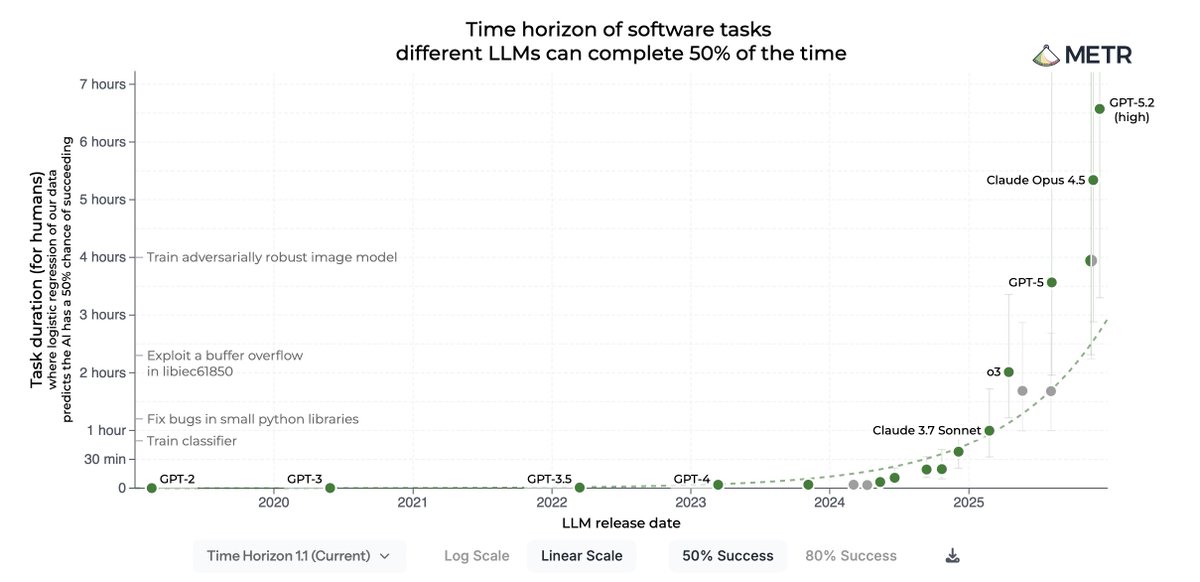
if you ever start worry about the "AI bubble" just stare at this chart for a few minutes.
we've departed from the previous exponential trend and have gone super exponential.
Nick Bostrom’s new paper:
>Developing superintelligence is not like playing Russian roulette; it is more like undergoing risky surgery for a condition that will otherwise prove fatal.
> One could equally maintain that if nobody builds it, everyone dies. In fact, most people are already dead. The rest of us are on course to follow within a few short decades. For many individuals—such as the elderly and the gravely ill—the end is much closer. Part of the promise of superintelligence is that it might fundamentally change this condition."
>Along one path (forgoing superintelligence), 170,000 people die every day of disease, aging, and other tragedies.
>The choice before us, therefore, is not between a risk-free baseline and a risky AI venture. It is between different risky trajectories, each exposing us to a different set of hazards.
>Imagine curing Alzheimer's disease by regrowing the lost neurons in the patient's brain. Imagine treating cancer with targeted therapies that eliminate every tumor cell but cause none of the horrible side effects of today's chemotherapy. Imagine restoring ailing joints and clogged arteries to a pristine youthful condition. These scenarios become realistic and imminent with superintelligence guiding our science.
>We assume that rejuvenation medicine could reduce mortality rates to a constant level similar to that currently enjoyed by healthy 20-year-olds in developed countries, which corresponds to a life expectancy of around 1,400 years.
>Developing superintelligence increases our remaining life expectancy provided that the probability of AI-induced annihilation is below 97%.